
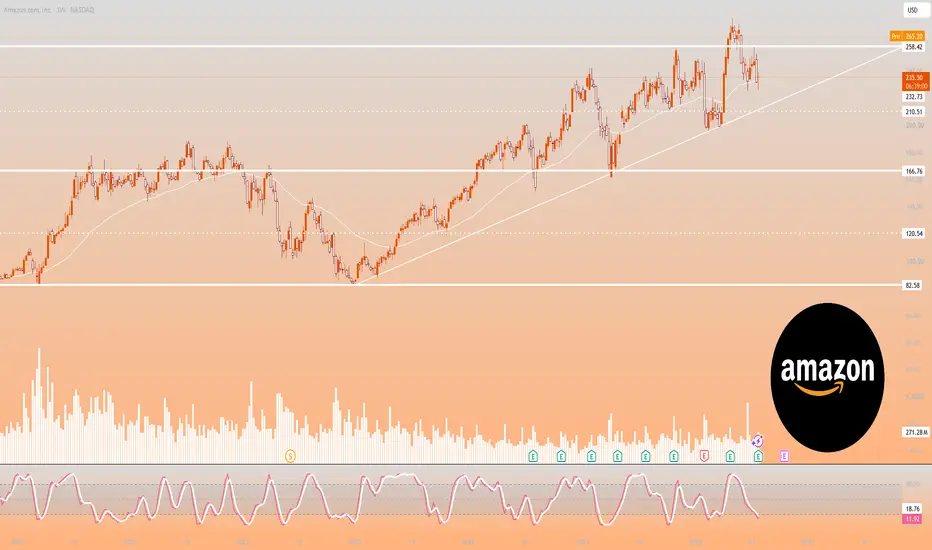
Amazon Is Spending $220 Billion This Year. CEO Andy Jassy Says It Still Isn't Enough!
Amazon now expects to spend $220 billion in capital expenditures this year, up from its previous plan of $200 billion. Even that won't be enough to keep up with demand
CEO Andy Jassy summed it up during the earnings call
"Even at that amount, we will still not have enough capacity to meet all the demand we have in 2026 .. I believe this dynamic will also be true in 2027"
AWS has now posted five straight quarters of accelerating growth, its backlog has climbed to $496 billion, and margins continued to improve even as Amazon ramps up one of the biggest infrastructure investments in its history
For years, Amazon has been building the foundation for AI.. Now the focus is shifting from building the technology to proving the business case. Customer demand is growing faster than Amazon can add capacity, and management believes today's spending will pay off over the long run
Here's what stood out this quarter
Amazon Q2 FY26 Results
Strong growth across the business
-Revenue increased 20% year over year to $200.6 billion, beating expectations by about $4.2 billion
-Gross margin held steady at 52%, while operating margin improved to 14% from 12% a year ago
AWS was the biggest contributor, with operating margin reaching 39%, up six percentage points from last year. North America and International retail margins were largely unchanged
Net income received a major boost from a $53.4 billion non operating gain, mostly tied to the higher valuation of Anthropic after its latest funding round
💸Cash flow tells a different story
Operating cash flow over the last twelve months climbed 33% to $161.4 billion, showing the business continues to generate enormous amounts of cash
Free cash flow, however, turned negative at $7.6 billion because capital spending jumped 64% over the past year to $169 billion. Amazon is investing faster than it is currently generating cash
The balance sheet remains healthy, with $123 billion in cash and marketable securities compared with $129 billion in long term debt
🔮For Q3, Amazon expects: Revenue growth between 9% and 12% and Operating income of roughly $24.5 billion at the midpoint, representing about 40% year over year growth
The biggest takeaways
AWS keeps getting stronger
AWS revenue grew 37% year over year to $42.2 billion, its fastest growth in more than four years..Even after adjusting for a one time accounting benefit related to energy contracts, AWS margins still expanded significantly
Amazon also revealed that both its AI business and its custom chip business have now reached annual revenue run rates above $25 billion, with both growing at triple digit rates
Growing this quickly while also expanding margins is one of the most impressive parts of the quarter
📈AI investment keeps climbing
Amazon's AI buildout is becoming even more expensive
The company raised its planned capital spending for the year from $200 billion to $220 billion, mainly because memory costs have increased..For now, those investments are pushing free cash flow into negative territory. Amazon is betting that today's spending creates capacity that customers will use for many years.
🛒Retail remains healthy
North American revenue grew 16%, International revenue rose 15%, and worldwide paid units increased 17%
Margins stayed steady despite higher transportation and fuel costs, helped by continued improvements in fulfillment efficiency
📢Advertising continues to grow
Advertising revenue climbed 26% to $19.8 billion, putting the business on pace for nearly $80 billion annually..Sponsored Products remains the largest driver, while Prime Video and live sports continue creating new advertising opportunities.
Guidance looks softer than reality
At first glance, Amazon's Q3 revenue guidance appears slower than recent growth
However, moving Prime Day into Q2 reduced reported growth by nearly four percentage points, and currency movements created another headwind
Operating income is still expected to grow around 40%, suggesting profitability continues improving even if reported revenue growth slows
Why Amazon Is Comfortable Spending So Much on AI
Jassy also explained how Amazon thinks about these massive investments
Not every dollar is equally risky
Servers and networking equipment are usually purchased only a few months before deployment, once customer demand is already visible. Those investments generally pay for themselves in less than three years, while many AI contracts last five years or longer
Data centers require much more patience. They often take around two years to build but can remain productive for more than thirty years while supporting several generations of hardware
Amazon says much of its planned capacity through 2027 is already reserved, with meaningful customer commitments extending into 2028..That means today's spending is backed by long term demand rather than speculation
⚙️Moving beyond infrastructure
AWS is also expanding higher up the AI stack
Customers spent more on Bedrock during Q2 than in all previous quarters combined.
Amazon introduced new features for Bedrock AgentCore, expanded the capabilities of Amazon Quick, saw usage of its coding assistant Kiro triple from the previous quarter, and launched Continuum to help companies automatically identify and fix software vulnerabilities
The strategy is straightforward
Trainium and Graviton reduce computing costs, Bedrock provides access to AI models and agents, and products like Quick, Kiro, and Continuum bring AWS closer to end users.
Key comments from Andy Jassy
On AI profitability:
"We see the margins and returns in AI tracking what we saw with Core at the same point of evolution, actually a little ahead."
Amazon believes AI can become just as profitable as traditional cloud services, and possibly even faster than AWS did during its early years.
On the future of AI demand:
"Most enterprise production workloads aren't using inference today. That is going to change very significantly over time."
Jassy expects the biggest opportunity won't come from AI startups or research labs. Instead, it will come from existing enterprise software gradually adding AI capabilities.
On Amazon's own AI model:
"They'll all be in Bedrock, one of them will be ours."
Amazon doesn't believe it needs to build the single best model. Instead, it wants Bedrock to give customers access to multiple leading models while also offering its own
What Investors Should Watch
AWS market share
Global cloud infrastructure spending rose 43% year over year during Q2
AWS kept its leading 28% market share, ahead of Microsoft Azure at 20% and Google Cloud at 15%
Although Microsoft and Google continue growing faster, AWS has maintained its leadership while operating from a much larger revenue base
Trainium outside AWS
Amazon is considering selling Trainium chips directly to companies running their own data centers.
That could create an entirely new business beyond AWS, though it also means giving up some of the competitive advantage those chips currently provide inside Amazon's cloud platform.
Grocery keeps expanding
Amazon now offers same day grocery delivery in 2,300 U.S. cities
Monthly active grocery customers have increased 50% since the beginning of the year, and grocery orders typically contain three times as many items as other purchases.
That helps increase shopping frequency, larger baskets, delivery efficiency, and advertising opportunities.
The AI spending race
Big Tech companies generated roughly $660 billion in trailing twelve month operating cash flow during Q2 2026
That cash allowed them to begin the AI buildout without relying heavily on outside financing.
Now the investment cycle has become so large that free cash flow has turned negative at Amazon and Google and is close to zero at Meta. Debt is becoming a larger part of the funding mix
Amazon argues this is simply the cost of building infrastructure years before demand fully arrives. If AI demand continues growing as expected, today's spending should generate returns for decades. If demand slows or pricing weakens, those same investments could become much harder to justify.

Related publications
Disclaimer
The information and publications are not meant to be, and do not constitute, financial, investment, trading, or other types of advice or recommendations supplied or endorsed by TradingView. Read more in the Terms of Use.
Related publications
Disclaimer
The information and publications are not meant to be, and do not constitute, financial, investment, trading, or other types of advice or recommendations supplied or endorsed by TradingView. Read more in the Terms of Use.