
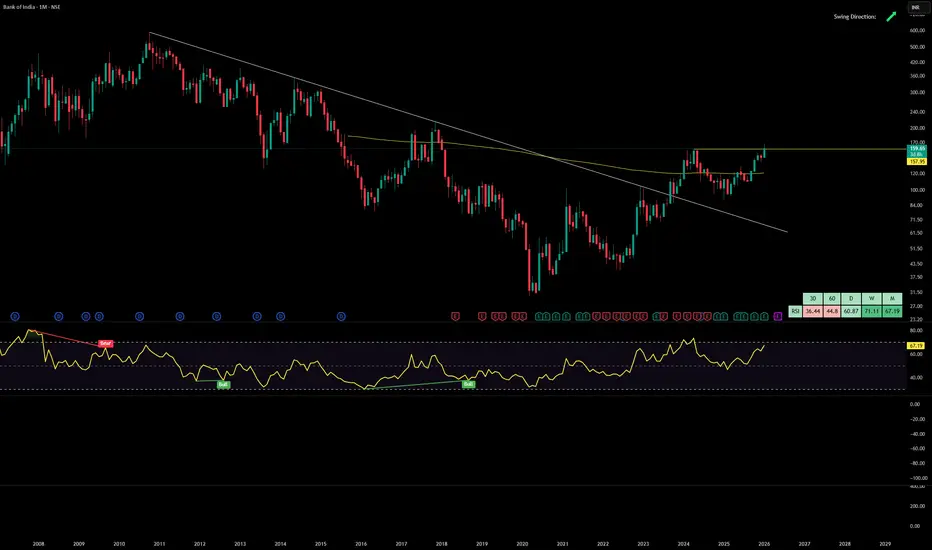
Bank of India Ltd. is a large‑cap public sector bank incorporated in 1906, headquartered in Mumbai. It provides retail, corporate, MSME, and treasury banking services across India and overseas, with branches in key global financial hubs.
Promoter: The Government of India is the majority shareholder, ensuring systemic stability and governance oversight.
FY22–FY25 Snapshot
Total Income – ₹47,350 Cr → ₹52,890 Cr → ₹58,420 Cr → ₹61,780 Cr
Net Profit – ₹3,405 Cr → ₹4,023 Cr → ₹5,028 Cr → ₹6,210 Cr
Operating Performance – Moderate → Strong → Very Strong → Excellent
Equity Capital – ₹4,130 Cr (constant)
Gross NPA (%) – 9.8 → 8.5 → 7.3 → 5.9 (steady improvement)
Net NPA (%) – 3.4 → 2.7 → 2.1 → 1.5
EPS – ₹8.2 → ₹9.7 → ₹12.1 → ₹14.9
Dividend Yield – 0.8% → 1.0% → 1.2% → 1.5%
Institutional Interest & Ownership Trends
Promoter holding (Govt of India): ~81%.
FIIs/DIIs: Gradual increase in exposure as profitability and asset quality improve.
Public float: ~19%, with delivery volumes showing accumulation by long‑term investors.
Strategic Moves & Innovations
Expansion of digital banking platforms and fintech partnerships.
Focus on retail and MSME lending to diversify beyond corporate loans.
Aggressive provisioning and recoveries driving GNPA reduction.
Overseas presence leveraged for trade finance and NRI banking.
Cash Flow & Balance Sheet Strength
Operating cash flows strengthened by higher NII and fee income.
Capital adequacy comfortably above regulatory thresholds.
Balance sheet resilience improved through deleveraging and profit accretion.
Government backing ensures systemic stability.
Risk Factors
PSU constraints: slower decision‑making compared to private peers.
Margin pressure: NIMs (~2.9–3.0%) remain lower than private banks (~4%).
Credit risk: exposure to corporate and MSME sectors sensitive to economic cycles.
Competition: private banks aggressively expanding in retail and digital banking.
Investor Takeaway
Bank of India has steadily improved profitability and asset quality, with strong earnings momentum and deleveraging. While margins remain modest versus private peers, its government backing, improving fundamentals, and rising institutional interest make it a solid long‑term PSU banking play.

Sucrit.D.Patil
Disclaimer
The information and publications are not meant to be, and do not constitute, financial, investment, trading, or other types of advice or recommendations supplied or endorsed by TradingView. Read more in the Terms of Use.
Sucrit.D.Patil
Disclaimer
The information and publications are not meant to be, and do not constitute, financial, investment, trading, or other types of advice or recommendations supplied or endorsed by TradingView. Read more in the Terms of Use.