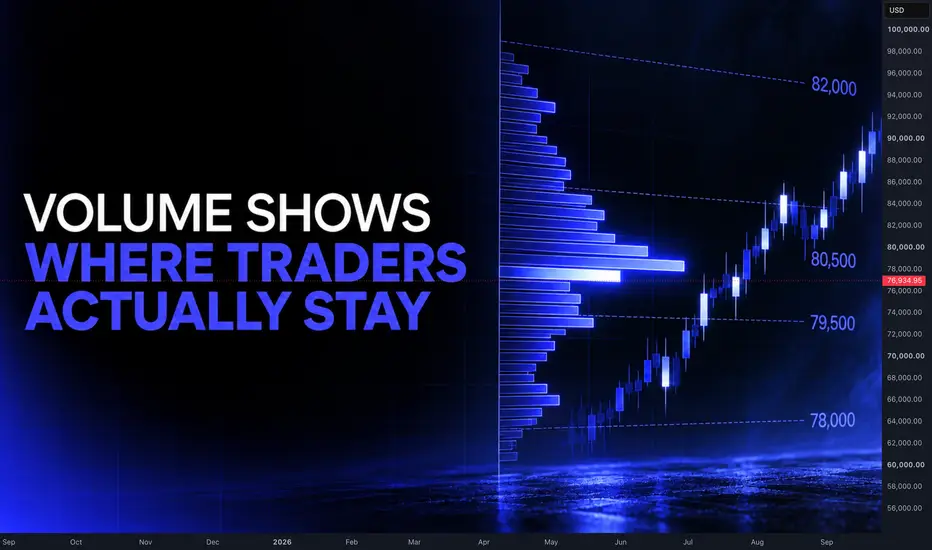
Most traders read volume vertically. They see a large volume bar and know that significant activity occurred during that candle, but that still leaves an important question unanswered: where did that trading actually take place?
Volume at price gives a different view of market structure because it separates areas where participants repeatedly accepted price from areas the market moved through quickly.
Imagine BTC trades between $78,000 and $82,000 for several days, but most of the volume occurs between $79,500 and $80,500. Price occasionally reaches the edges of the range, yet relatively little business is completed there.
That tells you the entire $4,000 range should not necessarily be treated equally.
The area around $80,000 has become an accepted region. Buyers and sellers repeatedly found enough opposing interest to transact there, positions accumulated, and the market spent considerable time around that price. IfBTC leaves the range and later returns, this area can become important because many previous participants have a reference point there.
Low-volume areas tell a different story.
SupposeBTC breaks above $80,500 and moves rapidly toward $82,000 while relatively little volume trades between the two prices. The market has travelled through that area, but it has not necessarily established much acceptance there.
If price later re-enters that low-volume region, there may be less historical participation to slow the move. Instead of expecting every previous candle or minor level to create support or resistance, traders can watch whether price moves quickly through the area again until reaching a region where substantial trading previously occurred.

This creates a useful distinction.
High-volume areas are locations where the market previously found balance. When price returns, watch whether it begins rotating and spending time there again. If it does, the market may be rebuilding acceptance around that price.
Low-volume areas are locations where the market previously found less agreement. When price enters them, watch whether it again moves efficiently toward the next area of heavier participation. If price instead begins spending time and building volume inside the area, something has changed: a previously rejected price region is now gaining acceptance.
This is also why volume at price should not be used as an automatic support-and-resistance tool. A high-volume area does not guarantee a reversal, and a low-volume area does not guarantee fast movement.
The useful information comes from comparing historical participation with current behavior.
Price tells you where the market has travelled. Volume at price helps show where participants previously wanted to stay — and whether they still want to stay there when price returns.
Volume at price gives a different view of market structure because it separates areas where participants repeatedly accepted price from areas the market moved through quickly.
Imagine
BTC trades between $78,000 and $82,000 for several days, but most of the volume occurs between $79,500 and $80,500. Price occasionally reaches the edges of the range, yet relatively little business is completed there.That tells you the entire $4,000 range should not necessarily be treated equally.
The area around $80,000 has become an accepted region. Buyers and sellers repeatedly found enough opposing interest to transact there, positions accumulated, and the market spent considerable time around that price. If
BTC leaves the range and later returns, this area can become important because many previous participants have a reference point there.Low-volume areas tell a different story.
Suppose
BTC breaks above $80,500 and moves rapidly toward $82,000 while relatively little volume trades between the two prices. The market has travelled through that area, but it has not necessarily established much acceptance there.If price later re-enters that low-volume region, there may be less historical participation to slow the move. Instead of expecting every previous candle or minor level to create support or resistance, traders can watch whether price moves quickly through the area again until reaching a region where substantial trading previously occurred.
This creates a useful distinction.
High-volume areas are locations where the market previously found balance. When price returns, watch whether it begins rotating and spending time there again. If it does, the market may be rebuilding acceptance around that price.
Low-volume areas are locations where the market previously found less agreement. When price enters them, watch whether it again moves efficiently toward the next area of heavier participation. If price instead begins spending time and building volume inside the area, something has changed: a previously rejected price region is now gaining acceptance.
This is also why volume at price should not be used as an automatic support-and-resistance tool. A high-volume area does not guarantee a reversal, and a low-volume area does not guarantee fast movement.
The useful information comes from comparing historical participation with current behavior.
Price tells you where the market has travelled. Volume at price helps show where participants previously wanted to stay — and whether they still want to stay there when price returns.

Related publications
Disclaimer
The information and publications are not meant to be, and do not constitute, financial, investment, trading, or other types of advice or recommendations supplied or endorsed by TradingView. Read more in the Terms of Use.
Related publications
Disclaimer
The information and publications are not meant to be, and do not constitute, financial, investment, trading, or other types of advice or recommendations supplied or endorsed by TradingView. Read more in the Terms of Use.