
More exclusive indicators from EXCAVO
Subscribe to EXCAVO PRO: Indicators + My Positions for $49.00/month to get exclusive indicators by this author. You pay right on TradingView and can use them on your charts straight away.
Explore EXCAVO PRO: Indicators + My Positions That is roughly how my morning started on October 30.
I have been in this market for a long time. I remember Binance appearing, growing and launching new products. In June 2019, CZ wrote about the exchange’s first margin liquidation. It was a Bitcoin short. Binance launched its BTC/USDT perpetual futures that September. Contemporary report · Binance Futures history
Today, the scale is different.
Binance reported approximately $6.3 billion in assets stolen after its hot wallets were compromised on October 29. The consequences spread well beyond those wallets. Binance’s October 30 update
At approximately 16:37 UTC on October 30, CoinGlass showed around $1.65 billion in liquidations across tracked venues over the preceding 24 hours. About $835 million was on Binance and $815 million on other venues. The dashboard reported 251,920 liquidated traders, with longs representing approximately 87% of liquidation volume.
These are historical snapshot figures, not today’s totals. They describe forcibly closed positions, and the trader count is the aggregator’s measure rather than an independently verified number of unique people. The liquidation volume cannot be treated as exchange revenue. CoinGlass
What interests me most is the timing.
I have seen this kind of fear before.
In my experience, important market lows often develop while the news makes buying feel almost impossible.
A hack. A bankruptcy. Another liquidation cascade. Add war headlines, recession fears and expectations of another crisis, and the reasons to stay away keep multiplying.
People who wanted lower prices suddenly find those prices frightening.
That is why this episode does not surprise me. For a panic-driven shakeout, the timing looks almost perfect.
There is a version of this story in which the shock is deliberately amplified. A genuine incident can become much larger through positioning, leverage, social media and participants pushing their own interpretation. Some amplification may be intentional; some happens automatically as traders react and positions are liquidated.
I cannot establish that the event was engineered. I can observe how the market responds to it.
Fear alone does not confirm a bottom. The panic can intensify, and another wave of selling remains possible. But these are precisely the conditions in which I start paying closer attention to accumulation, exhausted selling and the recovery of important levels.
I do not know whether the exact low is already behind us. My working scenario is that this correction and liquidity sweep are part of the process that prepares the next advance.
What happens after the panic
Remember March 2020.
The COVID crash hit on March 12–13. On April 2, Binance announced its acquisition of CoinMarketCap, one of the most important information platforms in crypto. Roughly three weeks separated the crash and the announcement· Acquisition announcement
Those dates do not prove that the crash caused the deal or that Binance acquired the business at a discount.
But I remember the moment: the market was struggling through a crisis while Binance was expanding.
I would not be surprised if this episode is followed by acquisitions of companies, equity stakes and infrastructure by participants that retain enough capital. Binance could be among the buyers again. That is a hypothesis, not a report of confirmed deals.
After a major shock, I watch who preserves liquidity, who needs financing, where customers move and who ultimately owns the assets.
The consequences can continue long after the initial headlines disappear.
Why I remain skeptical
I remain skeptical of how complete the first public explanations are.
The repeated appearance of North Korean hackers in crypto headlines sometimes reminds me of the way bin Laden appeared in the news in the 2000s: a familiar name quickly becomes an explanation for a complicated event. That comparison concerns media framing.
TRM attributes this attack to TraderTraitor with high confidence. Its assessment deserves examination. Naming a group still leaves important questions about the exchange’s own infrastructure and safeguards.
TRM describes EIP-7702 authorisations on Ethereum alongside ordinary signed transactions on other chains, pointing to a compromise of Binance’s hot-wallet signing infrastructure. I want to understand the full sequence, why the controls failed and what changed afterward.
TRM’s preliminary investigation
The relationships between investigators and the exchange are also public. Elliptic says Binance had used its services since 2019, and Binance Custody announced a TRM integration in 2022. Those relationships deserve transparency. They do not, by themselves, establish that either company’s findings are false. Elliptic · TRM integration
Aave, frozen funds and SAFU
Aave shows how the consequences reached another part of the industry.
The attacker deposited approximately 60 million USDT and borrowed 19,762 WETH, worth about $44.6 million at the time. LlamaRisk’s report, updated at 01:00 UTC on October 30, said the collateral exceeded the debt.
The claim that Aave lost “44 million ETH” is incorrect.
Aave nevertheless froze new deposits and borrowing across its V3 and V4 markets. Repayments, withdrawals and liquidations remained enabled, although withdrawals depended on available liquidity. Binance’s compromise disrupted another protocol even though Aave’s contracts had not been exploited. LlamaRisk’s report
Binance said approximately $3 billion had been frozen on-chain and promised to cover stolen funds using SAFU and company funds. At that reporting point, freezing assets was a step toward recovery, not evidence that the money had already returned. Trading losses from falling prices and liquidations were a separate matter. Binance’s update
The SAFU Bitcoin story also needs its dates kept straight. The reported $1 billion reserve conversion was completed on February 12, 2026, leaving the fund with 15,000 BTC at that point. That does not substantiate the claim that SAFU bought $500 million of Bitcoin during this October panic. February report
Binance’s ability to absorb the shock could leave it in a stronger competitive position afterward. That possibility does not mean the incident cost it nothing.
While the market panicked, others were trading
The on-chain breakdown adds another layer.
The attacker hurried to exchange assets that issuers could freeze. Large swaps moved individual pool prices away from the broader market, creating opportunities for traders able to buy on one venue and sell on another.

UNI: exchange prices and DEX pool prices diverged. Orange shows the minute-weighted DEX price; dotted red shows the pool minimum after a trade. Chart: HOW TO ONCHAIN.
Bitquery estimates that traders and bots retained approximately $59.9 million after counted gas and execution-priority costs. Ethereum block builders and validators together received around $29.5 million. The method does not fully capture costs of acquiring inventory elsewhere.
Its analysis found a peak ETH premium of 38% in a Uniswap pool against its market benchmark, and up to 18% for TRX in a SunSwap pool. These were local price distortions. Bitquery’s analysis and methodology

TRX: the white line shows DEX prices; coloured lines show centralised exchanges. Chart: HOW TO ONCHAIN.
Some traders were receiving margin calls. Some were selling in fear. Some had limit orders waiting. Others were competing for arbitrage trades and paying for faster execution.
All of this happened simultaneously.
A visible spread is not automatically an available profit. Execution, costs, access to venues and completing both sides of the trade still matter.
HYPE provides another perspective. The source chart shows an initial decline followed by a stronger recovery than several other assets in the displayed window.

Purple: HYPE. Blue: BTC. Orange: ETH. Green: BNB. Yellow: PEPE. Dotted line: median of 187 coins. All three charts are reproduced from HOW TO ONCHAIN; their underlying series have not been independently reconstructed. Original article and charts
Hyperliquid’s documentation says its Assistance Fund automatically converts trading fees into HYPE. Those purchases alone do not establish advance knowledge of the attack. Hyperliquid documentation
The potential beneficiaries extend across traders, validators and competing platforms. Earning money during an event does not prove involvement in causing it. It shows where the opportunities and the ability to act were.
My trading scenario remains bullish
I remember Terra. I remember FTX. Each crisis had its own causes.
After each one, it was useful to watch how market share, customers and ownership changed. That is what I intend to do here.
I have no evidence that Binance staged its own hack. My skepticism concerns how much of the full picture the early explanations reveal. My hypothesis is that this crisis could accelerate concentration in the industry while helping create the conditions for another market advance.
I could be wrong about that sequence.
For trading, I do not need to wait until an investigation answers every question.
On October 30, my previously placed limit orders filled.
Those levels were selected before the news appeared. I am now watching how price behaves after those fills.
Repeated bad news that stops producing sustained new lows would interest me. So would a liquidity sweep followed by a recovery of the lost range. Continued weakness and failed recoveries would require a different response.
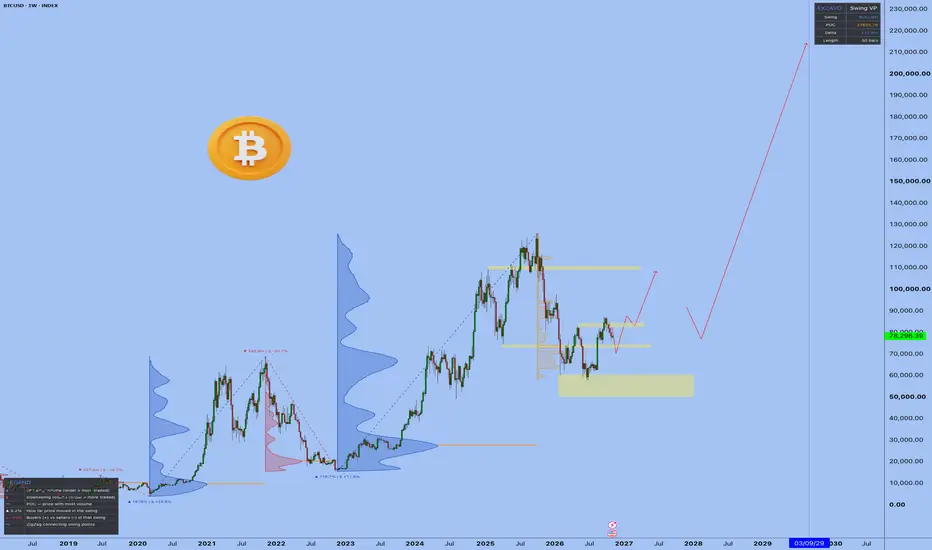
My base case remains that Bitcoin resumes its advance after the correction and liquidity sweep are complete. Another leg down remains possible.
That view predates the hack. I outlined it in The Bear Market Is Ending. A sustained break of the cycle-low structure followed by failure to reclaim it would make me reconsider.
The fear is part of the setup I am watching. Price still has to confirm it.
We have to remain flexible. Read the market, have a plan and withstand the moments when following that plan becomes uncomfortable.
This is a difficult profession. It is also an exceptionally interesting one.
I use a broad set of indicators alongside price action to assess market structure, volume and liquidity. They help me organise decisions, while position sizing and clear invalidation levels keep the risk defined. I also share my entry levels and the reasoning behind them.
Stay tuned for updates. I will continue sharing the levels I am watching, the entries I take and any changes to the scenario.
My limit orders have filled. Next, we will see whose plans to buy entire companies get filled.
Best Regards, EXCAVO
I have been in this market for a long time. I remember Binance appearing, growing and launching new products. In June 2019, CZ wrote about the exchange’s first margin liquidation. It was a Bitcoin short. Binance launched its BTC/USDT perpetual futures that September. Contemporary report · Binance Futures history
Today, the scale is different.
Binance reported approximately $6.3 billion in assets stolen after its hot wallets were compromised on October 29. The consequences spread well beyond those wallets. Binance’s October 30 update
At approximately 16:37 UTC on October 30, CoinGlass showed around $1.65 billion in liquidations across tracked venues over the preceding 24 hours. About $835 million was on Binance and $815 million on other venues. The dashboard reported 251,920 liquidated traders, with longs representing approximately 87% of liquidation volume.
These are historical snapshot figures, not today’s totals. They describe forcibly closed positions, and the trader count is the aggregator’s measure rather than an independently verified number of unique people. The liquidation volume cannot be treated as exchange revenue. CoinGlass
What interests me most is the timing.
I have seen this kind of fear before.
In my experience, important market lows often develop while the news makes buying feel almost impossible.
A hack. A bankruptcy. Another liquidation cascade. Add war headlines, recession fears and expectations of another crisis, and the reasons to stay away keep multiplying.
People who wanted lower prices suddenly find those prices frightening.
That is why this episode does not surprise me. For a panic-driven shakeout, the timing looks almost perfect.
There is a version of this story in which the shock is deliberately amplified. A genuine incident can become much larger through positioning, leverage, social media and participants pushing their own interpretation. Some amplification may be intentional; some happens automatically as traders react and positions are liquidated.
I cannot establish that the event was engineered. I can observe how the market responds to it.
Fear alone does not confirm a bottom. The panic can intensify, and another wave of selling remains possible. But these are precisely the conditions in which I start paying closer attention to accumulation, exhausted selling and the recovery of important levels.
I do not know whether the exact low is already behind us. My working scenario is that this correction and liquidity sweep are part of the process that prepares the next advance.
What happens after the panic
Remember March 2020.
The COVID crash hit on March 12–13. On April 2, Binance announced its acquisition of CoinMarketCap, one of the most important information platforms in crypto. Roughly three weeks separated the crash and the announcement· Acquisition announcement
Those dates do not prove that the crash caused the deal or that Binance acquired the business at a discount.
But I remember the moment: the market was struggling through a crisis while Binance was expanding.
I would not be surprised if this episode is followed by acquisitions of companies, equity stakes and infrastructure by participants that retain enough capital. Binance could be among the buyers again. That is a hypothesis, not a report of confirmed deals.
After a major shock, I watch who preserves liquidity, who needs financing, where customers move and who ultimately owns the assets.
The consequences can continue long after the initial headlines disappear.
Why I remain skeptical
I remain skeptical of how complete the first public explanations are.
The repeated appearance of North Korean hackers in crypto headlines sometimes reminds me of the way bin Laden appeared in the news in the 2000s: a familiar name quickly becomes an explanation for a complicated event. That comparison concerns media framing.
TRM attributes this attack to TraderTraitor with high confidence. Its assessment deserves examination. Naming a group still leaves important questions about the exchange’s own infrastructure and safeguards.
TRM describes EIP-7702 authorisations on Ethereum alongside ordinary signed transactions on other chains, pointing to a compromise of Binance’s hot-wallet signing infrastructure. I want to understand the full sequence, why the controls failed and what changed afterward.
TRM’s preliminary investigation
The relationships between investigators and the exchange are also public. Elliptic says Binance had used its services since 2019, and Binance Custody announced a TRM integration in 2022. Those relationships deserve transparency. They do not, by themselves, establish that either company’s findings are false. Elliptic · TRM integration
Aave, frozen funds and SAFU
Aave shows how the consequences reached another part of the industry.
The attacker deposited approximately 60 million USDT and borrowed 19,762 WETH, worth about $44.6 million at the time. LlamaRisk’s report, updated at 01:00 UTC on October 30, said the collateral exceeded the debt.
The claim that Aave lost “44 million ETH” is incorrect.
Aave nevertheless froze new deposits and borrowing across its V3 and V4 markets. Repayments, withdrawals and liquidations remained enabled, although withdrawals depended on available liquidity. Binance’s compromise disrupted another protocol even though Aave’s contracts had not been exploited. LlamaRisk’s report
Binance said approximately $3 billion had been frozen on-chain and promised to cover stolen funds using SAFU and company funds. At that reporting point, freezing assets was a step toward recovery, not evidence that the money had already returned. Trading losses from falling prices and liquidations were a separate matter. Binance’s update
The SAFU Bitcoin story also needs its dates kept straight. The reported $1 billion reserve conversion was completed on February 12, 2026, leaving the fund with 15,000 BTC at that point. That does not substantiate the claim that SAFU bought $500 million of Bitcoin during this October panic. February report
Binance’s ability to absorb the shock could leave it in a stronger competitive position afterward. That possibility does not mean the incident cost it nothing.
While the market panicked, others were trading
The on-chain breakdown adds another layer.
The attacker hurried to exchange assets that issuers could freeze. Large swaps moved individual pool prices away from the broader market, creating opportunities for traders able to buy on one venue and sell on another.
UNI: exchange prices and DEX pool prices diverged. Orange shows the minute-weighted DEX price; dotted red shows the pool minimum after a trade. Chart: HOW TO ONCHAIN.
Bitquery estimates that traders and bots retained approximately $59.9 million after counted gas and execution-priority costs. Ethereum block builders and validators together received around $29.5 million. The method does not fully capture costs of acquiring inventory elsewhere.
Its analysis found a peak ETH premium of 38% in a Uniswap pool against its market benchmark, and up to 18% for TRX in a SunSwap pool. These were local price distortions. Bitquery’s analysis and methodology
TRX: the white line shows DEX prices; coloured lines show centralised exchanges. Chart: HOW TO ONCHAIN.
Some traders were receiving margin calls. Some were selling in fear. Some had limit orders waiting. Others were competing for arbitrage trades and paying for faster execution.
All of this happened simultaneously.
A visible spread is not automatically an available profit. Execution, costs, access to venues and completing both sides of the trade still matter.
HYPE provides another perspective. The source chart shows an initial decline followed by a stronger recovery than several other assets in the displayed window.
Purple: HYPE. Blue: BTC. Orange: ETH. Green: BNB. Yellow: PEPE. Dotted line: median of 187 coins. All three charts are reproduced from HOW TO ONCHAIN; their underlying series have not been independently reconstructed. Original article and charts
Hyperliquid’s documentation says its Assistance Fund automatically converts trading fees into HYPE. Those purchases alone do not establish advance knowledge of the attack. Hyperliquid documentation
The potential beneficiaries extend across traders, validators and competing platforms. Earning money during an event does not prove involvement in causing it. It shows where the opportunities and the ability to act were.
My trading scenario remains bullish
I remember Terra. I remember FTX. Each crisis had its own causes.
After each one, it was useful to watch how market share, customers and ownership changed. That is what I intend to do here.
I have no evidence that Binance staged its own hack. My skepticism concerns how much of the full picture the early explanations reveal. My hypothesis is that this crisis could accelerate concentration in the industry while helping create the conditions for another market advance.
I could be wrong about that sequence.
For trading, I do not need to wait until an investigation answers every question.
On October 30, my previously placed limit orders filled.
Those levels were selected before the news appeared. I am now watching how price behaves after those fills.
Repeated bad news that stops producing sustained new lows would interest me. So would a liquidity sweep followed by a recovery of the lost range. Continued weakness and failed recoveries would require a different response.
My base case remains that Bitcoin resumes its advance after the correction and liquidity sweep are complete. Another leg down remains possible.
That view predates the hack. I outlined it in The Bear Market Is Ending. A sustained break of the cycle-low structure followed by failure to reclaim it would make me reconsider.
The fear is part of the setup I am watching. Price still has to confirm it.
We have to remain flexible. Read the market, have a plan and withstand the moments when following that plan becomes uncomfortable.
This is a difficult profession. It is also an exceptionally interesting one.
I use a broad set of indicators alongside price action to assess market structure, volume and liquidity. They help me organise decisions, while position sizing and clear invalidation levels keep the risk defined. I also share my entry levels and the reasoning behind them.
Stay tuned for updates. I will continue sharing the levels I am watching, the entries I take and any changes to the scenario.
My limit orders have filled. Next, we will see whose plans to buy entire companies get filled.
Best Regards, EXCAVO

EXCAVO PRO: 13 indicators + my market research and position updates.
Subscribe on TradingView:
tradingview.com/scripts/marketplace/EXCAVO/
My Telegram:
t.me/ceoexcavo
Trading Tournament pnl.world/auth?ref=90144806
Subscribe on TradingView:
tradingview.com/scripts/marketplace/EXCAVO/
My Telegram:
t.me/ceoexcavo
Trading Tournament pnl.world/auth?ref=90144806
Disclaimer
The information and publications are not meant to be, and do not constitute, financial, investment, trading, or other types of advice or recommendations supplied or endorsed by TradingView. Read more in the Terms of Use.