
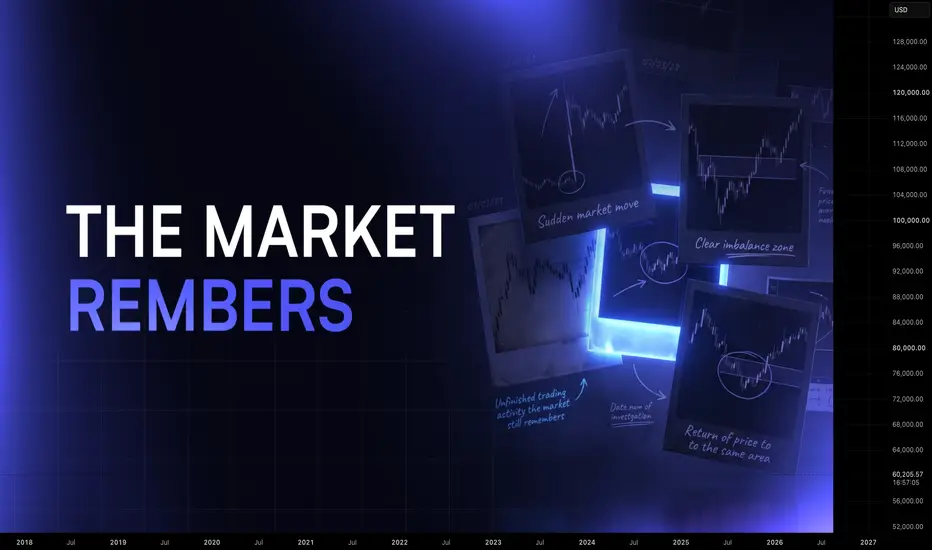
One of the reasons certain areas on a chart continue attracting attention long after they were created is that markets have a tendency to revisit places where trading was incomplete.
Most traders focus on where price is currently trading. The market, however, often responds to where important transactions previously occurred.
When price moves slowly, buyers and sellers have time to interact. Orders are absorbed, positions are established, and value is gradually agreed upon. These areas tend to create relatively stable structure because participation was balanced.
The opposite happens during aggressive movement.
Sometimes price accelerates so quickly that it leaves entire sections of the chart behind. The move appears strong and decisive, but the speed itself creates a problem. Large groups of participants never had the opportunity to transact efficiently. Some were unable to enter, others were unable to exit, and many were forced to react rather than act intentionally.
Months later, those areas can still matter.
When price eventually returns, activity often increases because unfinished business remains. Traders who missed the original move become interested again. Participants trapped during the initial expansion finally have a chance to exit. Larger players who could not complete their orders during the first move may continue executing them.

This is why certain zones continue producing reactions long after the market has left them behind.
The reaction itself is not magical. It is simply a consequence of participants remembering where they previously wanted to do business.
Understanding this changes how charts are viewed. Instead of treating old price action as irrelevant history, traders begin recognizing that markets carry memory. Areas where significant imbalance occurred frequently remain important because they represent unfinished interaction between buyers and sellers.
The market is always searching for efficiency. When it finds an area where efficiency was previously absent, it often becomes interested in revisiting it.
The longer you study charts, the more obvious this becomes. Price may travel far away from a zone, but that does not necessarily mean the market has forgotten about it.
Sometimes the most important level on the chart is one that has not been touched for weeks.
Most traders focus on where price is currently trading. The market, however, often responds to where important transactions previously occurred.
When price moves slowly, buyers and sellers have time to interact. Orders are absorbed, positions are established, and value is gradually agreed upon. These areas tend to create relatively stable structure because participation was balanced.
The opposite happens during aggressive movement.
Sometimes price accelerates so quickly that it leaves entire sections of the chart behind. The move appears strong and decisive, but the speed itself creates a problem. Large groups of participants never had the opportunity to transact efficiently. Some were unable to enter, others were unable to exit, and many were forced to react rather than act intentionally.
Months later, those areas can still matter.
When price eventually returns, activity often increases because unfinished business remains. Traders who missed the original move become interested again. Participants trapped during the initial expansion finally have a chance to exit. Larger players who could not complete their orders during the first move may continue executing them.
This is why certain zones continue producing reactions long after the market has left them behind.
The reaction itself is not magical. It is simply a consequence of participants remembering where they previously wanted to do business.
Understanding this changes how charts are viewed. Instead of treating old price action as irrelevant history, traders begin recognizing that markets carry memory. Areas where significant imbalance occurred frequently remain important because they represent unfinished interaction between buyers and sellers.
The market is always searching for efficiency. When it finds an area where efficiency was previously absent, it often becomes interested in revisiting it.
The longer you study charts, the more obvious this becomes. Price may travel far away from a zone, but that does not necessarily mean the market has forgotten about it.
Sometimes the most important level on the chart is one that has not been touched for weeks.

🌎 Website
hyrotrader.com/?coupon=hyrosocials
🟣 Discord Community
discord.gg/Pz6N3S4Kmc
🔵 Telegram
t.me/hyrotrading
🔴 YouTube Streams
youtube.com/@HyroTrader/streams
hyrotrader.com/?coupon=hyrosocials
🟣 Discord Community
discord.gg/Pz6N3S4Kmc
🔵 Telegram
t.me/hyrotrading
🔴 YouTube Streams
youtube.com/@HyroTrader/streams
Related publications
Disclaimer
The information and publications are not meant to be, and do not constitute, financial, investment, trading, or other types of advice or recommendations supplied or endorsed by TradingView. Read more in the Terms of Use.