
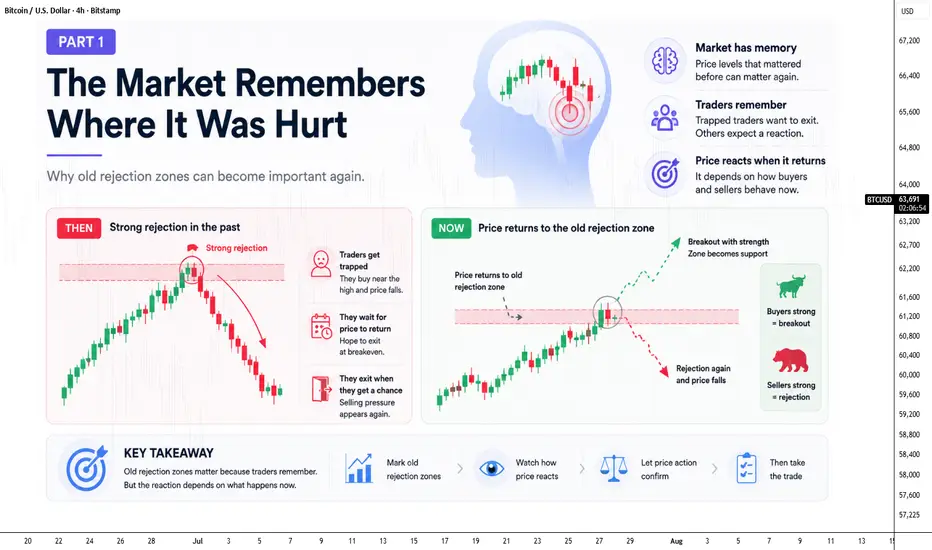
Markets have a memory. Not in the way people do, of course, but price often reacts around the same areas where it reacted strongly in the past.
This is why an old rejection zone can become important again.
Imagine a stock moving from ₹400 to ₹500. Buyers are excited and keep pushing the price higher. But when the stock reaches around ₹500, sellers suddenly become aggressive. The price struggles to move above that area and eventually falls back to ₹450.
That ₹500 area has now become important.
Months later, the stock starts moving higher again and comes back toward ₹500. At first glance, you might think, “That happened a long time ago. Why should this level matter now?”
The answer is simple: the traders who were involved in the earlier move may still remember what happened there.
Some traders may have bought around ₹500 and then watched the stock fall. They were trapped in a losing position. If the stock eventually comes back to ₹500, they may see it as a chance to get out without a loss.
They may simply think, “I have been waiting for this level. I am selling now.”
Now imagine many traders thinking the same thing.
That can create selling pressure when price reaches the old zone again.
But it is not only trapped traders who matter. New traders looking at the chart can also see the previous rejection. They know that sellers were strong around that area before. Because of this, some of them may expect another rejection and start selling when price gets close.
This is one reason old rejection zones can remain relevant for a long time.
However, there is an important difference between saying a level is important and saying price will definitely reverse there.
An old rejection zone is not a guaranteed sell signal.
It is simply an area where traders should start paying closer attention.
What matters most is how price behaves when it returns.
Suppose price approaches the old zone slowly. The candles become smaller, the stock struggles to move higher, and sellers begin appearing again. That tells us the old zone may still have influence.
Now imagine the opposite.
Price reaches the same zone with strong momentum. Buyers continue pushing higher, the stock breaks above the previous rejection area, and price stays above it.
That tells us something has changed.
The sellers who controlled that area in the past may no longer be strong enough to stop the buyers.
This is why you should never trade an old rejection zone blindly.
The old level gives you a place to watch. The current price action gives you the information you need.
Another important point is that these zones are usually areas, not exact numbers.
If a stock was rejected between ₹495 and ₹505, you should not assume that ₹500 is a special number. Markets do not always respect exact prices.
Price may move slightly above ₹500 before sellers appear. It may also turn around at ₹497 or ₹503.
What matters is the overall behaviour around the area.
You also need to look at the bigger picture.
An old rejection zone during a strong uptrend may eventually break because buyers keep getting stronger.
The same zone during a weak or falling market may lead to a much stronger rejection.
The level is the same, but the market around it has changed.
This is why old rejection zones should be treated as context, not certainty.
They tell us where the market struggled before.
They show us where buyers and sellers had a strong fight.
They can reveal where traders may still be trapped or waiting for an opportunity to exit.
And when price comes back to that area, all of those factors can come into play again.
The most important lesson is simple.
Do not assume the old reaction will repeat. Watch what price does when it reaches the old zone.
The past gives you the level to watch.
The present tells you whether that level still matters.
By BrightRally_Research

Related publications
Disclaimer
The information and publications are not meant to be, and do not constitute, financial, investment, trading, or other types of advice or recommendations supplied or endorsed by TradingView. Read more in the Terms of Use.
Related publications
Disclaimer
The information and publications are not meant to be, and do not constitute, financial, investment, trading, or other types of advice or recommendations supplied or endorsed by TradingView. Read more in the Terms of Use.