
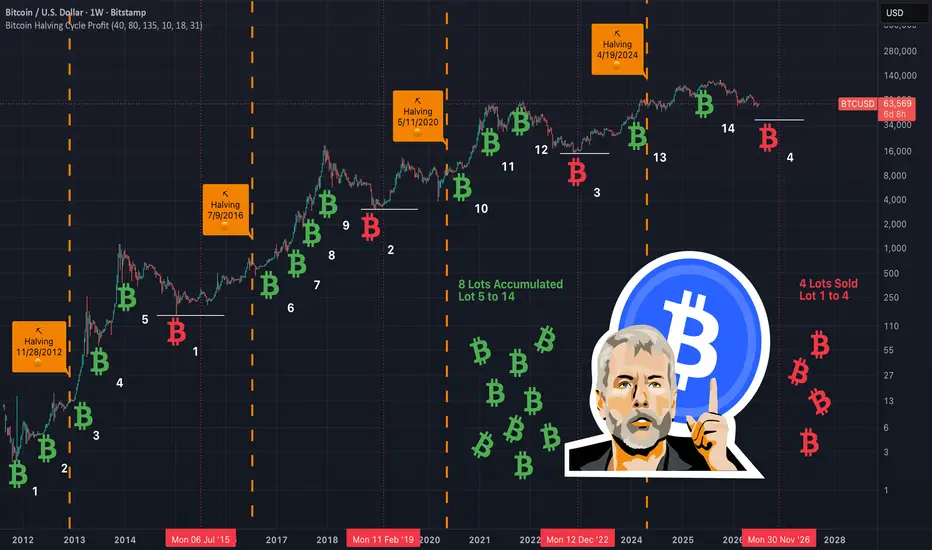
Strategy’s recent sale of 3,588 BTC for roughly $216 million sparked a predictable debate: if Michael Saylor’s company believes in Bitcoin, why sell any Bitcoin at all?
The simple bearish interpretation is: “They are losing faith.”
My thesis is different.
The correct way to understand Strategy is not as a company holding one giant anonymous pile of Bitcoin. It is a company holding hundreds of thousands of Bitcoin acquired across different periods, at different prices, through different financing conditions. Each purchase has its own economic identity.
That changes everything.
Strategy reportedly reduced its holdings to about 843,775 BTC after the sale, while the proceeds were used to fund preferred stock dividends and support its dollar liquidity position. The company’s aggregate average Bitcoin purchase price was reported around $75,476 per BTC, while the recent sales occurred around the $59,000–$61,000 zone.
On the surface, that looks contradictory: selling Bitcoin below the company’s average cost while still claiming to be a long-term accumulator.
But the average cost is not the whole story.
Bitcoin Is Fungible. Bitcoin Lots Are Not.
One Bitcoin equals one Bitcoin on the network.
But on a corporate balance sheet, one Bitcoin bought at $10,000 is not economically identical to one Bitcoin bought at $100,000.
Each Bitcoin lot has:
This is the key point.
A company may hold 843,775 BTC in total, but internally that position is made of many separate purchase lots.
Strategy’s public purchase history shows this clearly. Early lots were acquired around $10,419, $11,652 and $21,925 per BTC in 2020, while later lots were acquired at much higher levels, including purchases above $95,000 and $100,000 per BTC during 2024–2025.
That means a BTC sale at $60,000 can be interpreted in completely different ways depending on which economic lot is being monetized.
Example 1: The Average-Cost Illusion
Imagine a company buys Bitcoin in two waves:
| Lot | BTC Bought | Purchase Price | Cost |
| ----- | ---------: | --------------: | ----: |
| Lot A | 10,000 BTC | $10,000 | $100M |
| Lot B | 10,000 BTC | $100,000 | $1B |
| Total | 20,000 BTC | $55,000 average | $1.1B |
Now suppose the company sells 2,000 BTC at $60,000.
A headline may say:
“The company sold Bitcoin only slightly above its $55,000 average cost.”
But that misses the real question: which Bitcoin was sold?
If the company sells from Lot A, the economics are:
| Sale Price | Lot Cost | Profit Per BTC | BTC Sold | Realized Profit |
| ----------: | ---------: | -------------: | ---------: | --------------: |
| $60,000 | $10,000 | $50,000 | 2,000 | $100M |
That is a profitable liquidity event.
If the company sells from Lot B, the economics are:
| Sale Price | Lot Cost | Loss Per BTC | BTC Sold | Realized Loss |
| ----------: | ---------: | ------------: | ---------: | -------------: |
| $60,000 | $100,000 | -$40,000 | 2,000 | -$80M |
Same BTC sale. Same market price. Completely different economic meaning.
This is why treating the entire Bitcoin balance as one average-cost blob is too simplistic.
Example 2: Selling Can Be Accumulation-Friendly
The biggest misunderstanding is assuming that selling Bitcoin automatically means reducing the long-term Bitcoin strategy.
It does not have to.
A company can sell a small portion of profitable Bitcoin lots to generate cash, fund obligations, stabilize the capital structure, and preserve the larger hoard.
For example:
| Starting BTC. | BTC Sold | BTC Remaining | % of Holdings Sold |
| --------------: | ----------: | --------------: | -------------------: |
| 843,775 BTC | 3,588 BTC | 840,187 BTC | 0.43% |
Selling 0.43% of holdings does not necessarily mean abandoning the asset.
It may mean converting a small slice of accumulated Bitcoin into dollars to pay expenses that cannot be paid in Bitcoin.
Preferred dividends, interest costs, payroll, taxes, and corporate obligations are dollar liabilities. If the company wants to keep operating without permanently relying on equity issuance, it needs a dollar engine.
This is where my thesis begins:
> Strategy’s long-term goal may still be Bitcoin accumulation, but its operating model now requires a cash-generation mechanism. Selective Bitcoin monetization can become that mechanism.
The Real Model: Bitcoin Treasury + Cash Engine
The old interpretation of Strategy was simple:
1. Raise capital.
2. Buy Bitcoin.
3. Hold forever.
4. Repeat.
But once the company issues preferred stock, debt, and other financing instruments, the model becomes more complex.
Now Strategy has two linked objectives:
1. Keep growing or preserving long-term BTC exposure.
2. Generate enough dollars to service the capital structure.
That is not the same as “no longer believing in Bitcoin.”
It is closer to a Bitcoin-backed treasury company creating an internal cash-flow machine.
The recent sale was reportedly tied to preferred stock dividends and dollar reserves. Strategy had also announced a framework involving a USD reserve, preferred dividends, interest obligations, possible Bitcoin monetization, and buybacks.
That matters.
If Bitcoin is the reserve asset, and preferred dividends are the cost of capital, then selling a small portion of BTC can be understood as paying the carrying cost of the structure.
But There Is a Real Risk
This thesis is not blind bullishness.
There is a legitimate risk.
If Strategy is forced to sell Bitcoin because its capital structure becomes too expensive, then the model weakens. If Bitcoin falls for too long, and the company must repeatedly sell more BTC to fund dividends, interest, or buybacks, then the treasury can become self-consuming.
That is the bearish case.
The bullish case is different:
* Bitcoin adoption continues;
* Bitcoin price rises over time;
* old low-cost BTC lots remain deeply profitable;
* small sales fund dollar obligations;
* the company protects most of its BTC stack;
* future capital raises or operating improvements allow renewed accumulation.
In that case, selective selling is not a contradiction.
It is treasury management.
The Key Metric Is Not “Did They Sell?”
The market is asking the wrong question.
The question should not be:
> “Did Strategy sell Bitcoin?”
The better questions are:
1. Which economic lots were sold?
2. Were those lots sold at a profit?
3. What percentage of total holdings was sold?
4. Were proceeds used defensively or productively?
5. Did the sale improve the company’s ability to keep holding the remaining BTC?
6. Did BTC per share improve or deteriorate?
7. Is the company still a net accumulator over time?
A company can sell Bitcoin and still be structurally bullish Bitcoin.
A company can also buy Bitcoin and still be structurally fragile if it overuses leverage, expensive preferred equity, or poorly timed capital raises.
The signal is not the sale alone.
The signal is whether the sale strengthens or weakens the long-term Bitcoin-per-share engine.
The 4-Year Cycle and the Accumulation Vision
The 4-year cycle strengthens the logic of lot-based treasury management.
If Bitcoin adoption grows over time and supply issuance keeps falling, then older cycle purchases can become extremely valuable in later cycles.
This is the key.
A treasury company that survives multiple Bitcoin cycles has more strategic optionality than one that is forced to sell during every downturn.
Cash generated during stronger periods can help the company survive weaker periods.
And survival is what allows accumulation to continue.
Final Thought
Strategy’s Bitcoin position should not be viewed as one single pile with one single average price.
It should be viewed as a layered treasury made of unique Bitcoin lots.
Some lots are strategic reserves.
Some lots are deeply profitable legacy positions.
Some lots are expensive recent acquisitions.
Some lots may become liquidity tools.
Once you see it this way, selling Bitcoin is not automatically a rejection of Bitcoin. It can be part of a model where the company accumulates Bitcoin over the long term while selectively monetizing profitable identifiers to fund operations, dividends, reserves, and survival.
Disclaimer
This article represents my personal thesis and interpretation of Strategy’s Bitcoin treasury strategy. It is not financial advice, investment advice, or a recommendation to buy, sell, or hold Bitcoin, Strategy stock, or any related security. The examples used are simplified for educational purposes and may not reflect Strategy’s exact accounting, tax treatment, financing structure, or lot-selection methodology. Readers should do their own research and consider the risks, including Bitcoin volatility, leverage, financing costs, dilution, and forced-selling risk.
The simple bearish interpretation is: “They are losing faith.”
My thesis is different.
The correct way to understand Strategy is not as a company holding one giant anonymous pile of Bitcoin. It is a company holding hundreds of thousands of Bitcoin acquired across different periods, at different prices, through different financing conditions. Each purchase has its own economic identity.
That changes everything.
Strategy reportedly reduced its holdings to about 843,775 BTC after the sale, while the proceeds were used to fund preferred stock dividends and support its dollar liquidity position. The company’s aggregate average Bitcoin purchase price was reported around $75,476 per BTC, while the recent sales occurred around the $59,000–$61,000 zone.
On the surface, that looks contradictory: selling Bitcoin below the company’s average cost while still claiming to be a long-term accumulator.
But the average cost is not the whole story.
Bitcoin Is Fungible. Bitcoin Lots Are Not.
One Bitcoin equals one Bitcoin on the network.
But on a corporate balance sheet, one Bitcoin bought at $10,000 is not economically identical to one Bitcoin bought at $100,000.
Each Bitcoin lot has:
- an acquisition date;
- an acquisition price;
- an unrealized profit or loss;
- a financing source;
- a tax/accounting basis;
- a role inside the capital structure.
This is the key point.
A company may hold 843,775 BTC in total, but internally that position is made of many separate purchase lots.
Strategy’s public purchase history shows this clearly. Early lots were acquired around $10,419, $11,652 and $21,925 per BTC in 2020, while later lots were acquired at much higher levels, including purchases above $95,000 and $100,000 per BTC during 2024–2025.
That means a BTC sale at $60,000 can be interpreted in completely different ways depending on which economic lot is being monetized.
Example 1: The Average-Cost Illusion
Imagine a company buys Bitcoin in two waves:
| Lot | BTC Bought | Purchase Price | Cost |
| ----- | ---------: | --------------: | ----: |
| Lot A | 10,000 BTC | $10,000 | $100M |
| Lot B | 10,000 BTC | $100,000 | $1B |
| Total | 20,000 BTC | $55,000 average | $1.1B |
Now suppose the company sells 2,000 BTC at $60,000.
A headline may say:
“The company sold Bitcoin only slightly above its $55,000 average cost.”
But that misses the real question: which Bitcoin was sold?
If the company sells from Lot A, the economics are:
| Sale Price | Lot Cost | Profit Per BTC | BTC Sold | Realized Profit |
| ----------: | ---------: | -------------: | ---------: | --------------: |
| $60,000 | $10,000 | $50,000 | 2,000 | $100M |
That is a profitable liquidity event.
If the company sells from Lot B, the economics are:
| Sale Price | Lot Cost | Loss Per BTC | BTC Sold | Realized Loss |
| ----------: | ---------: | ------------: | ---------: | -------------: |
| $60,000 | $100,000 | -$40,000 | 2,000 | -$80M |
Same BTC sale. Same market price. Completely different economic meaning.
This is why treating the entire Bitcoin balance as one average-cost blob is too simplistic.
Example 2: Selling Can Be Accumulation-Friendly
The biggest misunderstanding is assuming that selling Bitcoin automatically means reducing the long-term Bitcoin strategy.
It does not have to.
A company can sell a small portion of profitable Bitcoin lots to generate cash, fund obligations, stabilize the capital structure, and preserve the larger hoard.
For example:
| Starting BTC. | BTC Sold | BTC Remaining | % of Holdings Sold |
| --------------: | ----------: | --------------: | -------------------: |
| 843,775 BTC | 3,588 BTC | 840,187 BTC | 0.43% |
Selling 0.43% of holdings does not necessarily mean abandoning the asset.
It may mean converting a small slice of accumulated Bitcoin into dollars to pay expenses that cannot be paid in Bitcoin.
Preferred dividends, interest costs, payroll, taxes, and corporate obligations are dollar liabilities. If the company wants to keep operating without permanently relying on equity issuance, it needs a dollar engine.
This is where my thesis begins:
> Strategy’s long-term goal may still be Bitcoin accumulation, but its operating model now requires a cash-generation mechanism. Selective Bitcoin monetization can become that mechanism.
The Real Model: Bitcoin Treasury + Cash Engine
The old interpretation of Strategy was simple:
1. Raise capital.
2. Buy Bitcoin.
3. Hold forever.
4. Repeat.
But once the company issues preferred stock, debt, and other financing instruments, the model becomes more complex.
Now Strategy has two linked objectives:
1. Keep growing or preserving long-term BTC exposure.
2. Generate enough dollars to service the capital structure.
That is not the same as “no longer believing in Bitcoin.”
It is closer to a Bitcoin-backed treasury company creating an internal cash-flow machine.
The recent sale was reportedly tied to preferred stock dividends and dollar reserves. Strategy had also announced a framework involving a USD reserve, preferred dividends, interest obligations, possible Bitcoin monetization, and buybacks.
That matters.
If Bitcoin is the reserve asset, and preferred dividends are the cost of capital, then selling a small portion of BTC can be understood as paying the carrying cost of the structure.
But There Is a Real Risk
This thesis is not blind bullishness.
There is a legitimate risk.
If Strategy is forced to sell Bitcoin because its capital structure becomes too expensive, then the model weakens. If Bitcoin falls for too long, and the company must repeatedly sell more BTC to fund dividends, interest, or buybacks, then the treasury can become self-consuming.
That is the bearish case.
The bullish case is different:
* Bitcoin adoption continues;
* Bitcoin price rises over time;
* old low-cost BTC lots remain deeply profitable;
* small sales fund dollar obligations;
* the company protects most of its BTC stack;
* future capital raises or operating improvements allow renewed accumulation.
In that case, selective selling is not a contradiction.
It is treasury management.
The Key Metric Is Not “Did They Sell?”
The market is asking the wrong question.
The question should not be:
> “Did Strategy sell Bitcoin?”
The better questions are:
1. Which economic lots were sold?
2. Were those lots sold at a profit?
3. What percentage of total holdings was sold?
4. Were proceeds used defensively or productively?
5. Did the sale improve the company’s ability to keep holding the remaining BTC?
6. Did BTC per share improve or deteriorate?
7. Is the company still a net accumulator over time?
A company can sell Bitcoin and still be structurally bullish Bitcoin.
A company can also buy Bitcoin and still be structurally fragile if it overuses leverage, expensive preferred equity, or poorly timed capital raises.
The signal is not the sale alone.
The signal is whether the sale strengthens or weakens the long-term Bitcoin-per-share engine.
The 4-Year Cycle and the Accumulation Vision
The 4-year cycle strengthens the logic of lot-based treasury management.
If Bitcoin adoption grows over time and supply issuance keeps falling, then older cycle purchases can become extremely valuable in later cycles.
This is the key.
A treasury company that survives multiple Bitcoin cycles has more strategic optionality than one that is forced to sell during every downturn.
Cash generated during stronger periods can help the company survive weaker periods.
And survival is what allows accumulation to continue.
Final Thought
Strategy’s Bitcoin position should not be viewed as one single pile with one single average price.
It should be viewed as a layered treasury made of unique Bitcoin lots.
Some lots are strategic reserves.
Some lots are deeply profitable legacy positions.
Some lots are expensive recent acquisitions.
Some lots may become liquidity tools.
Once you see it this way, selling Bitcoin is not automatically a rejection of Bitcoin. It can be part of a model where the company accumulates Bitcoin over the long term while selectively monetizing profitable identifiers to fund operations, dividends, reserves, and survival.
Disclaimer
This article represents my personal thesis and interpretation of Strategy’s Bitcoin treasury strategy. It is not financial advice, investment advice, or a recommendation to buy, sell, or hold Bitcoin, Strategy stock, or any related security. The examples used are simplified for educational purposes and may not reflect Strategy’s exact accounting, tax treatment, financing structure, or lot-selection methodology. Readers should do their own research and consider the risks, including Bitcoin volatility, leverage, financing costs, dilution, and forced-selling risk.
Note
📈 Market Position & Valuation• Total holdings: ~846,000 BTC
• Average cost basis: ~$75,416 per coin
• Current unrealized profit: ~$8 billion at $85K Bitcoin
Strategy Inc. (MSTR) recently swung from a $10 billion unrealized loss to roughly $8 billion in unrealized gains as Bitcoin rallied above $85,000. Under Executive Chairman Michael Saylor, the company pursues an aggressive corporate treasury strategy centered on acquiring and holding Bitcoin long-term, currently controlling over 846,000 BTC acquired at an average price of $75,416 per coin (Source : Yahoo! Finance)

Related publications
Disclaimer
The information and publications are not meant to be, and do not constitute, financial, investment, trading, or other types of advice or recommendations supplied or endorsed by TradingView. Read more in the Terms of Use.
Related publications
Disclaimer
The information and publications are not meant to be, and do not constitute, financial, investment, trading, or other types of advice or recommendations supplied or endorsed by TradingView. Read more in the Terms of Use.