
First, four rules.
1. The market is always right.
2. Every price is already set.
3. Every view is a quantum view — stay flexible, keep every state open.
4. All evolution comes through repetition.
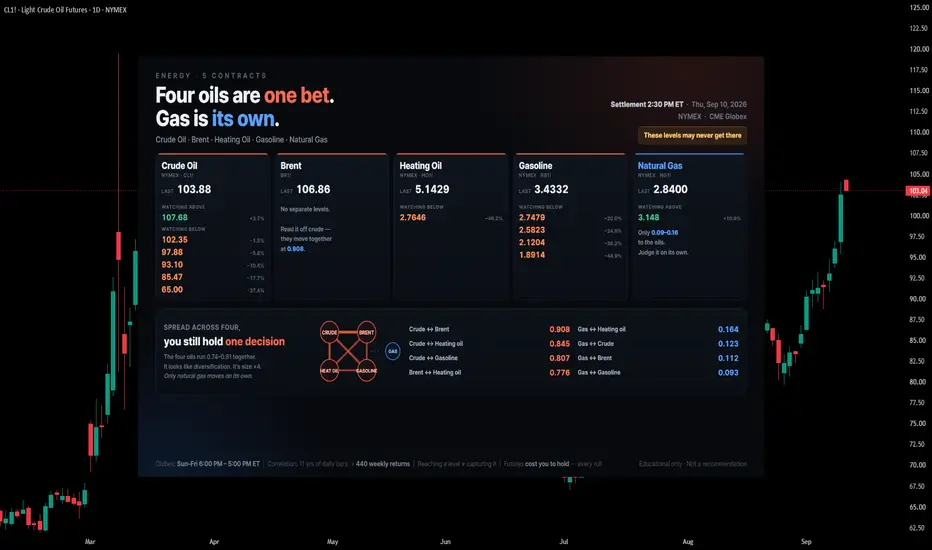
Five energy contracts in one place: crude oil, Brent, heating oil, gasoline and natural gas.
Prices are as of the **September 10, 2026 settlement**. All times below are Eastern.
Two things before the numbers.
**These are levels I'm watching. They are not instructions to buy or sell.**
And this is a **medium- to long-term** view. Not days. Months, and possibly longer.
Rule three, applied honestly: **the levels I've written down may never get there.** The probability is open in both directions.
===================================
CRUDE OIL · CL1!
===================================
```
Last 103.88
Watching above
107.68 +3.7%
Watching below
102.35 −1.5%
97.88 −5.8%
93.10 −10.4%
85.47 −17.7%
65.00 −37.4%
```

===================================
BRENT · BR1!
===================================
```
Last 106.86
```
I'm not setting separate levels for Brent. Read it off crude oil. The reason is in section ① below.

===================================
HEATING OIL · HO1!
===================================
```
Last 5.1429
Watching below
2.7646 −46.2%
```

===================================
GASOLINE · RB1!
===================================
```
Last 3.4332
Watching below
2.7479 −20.0%
2.5823 −24.8%
2.1204 −38.2%
1.8914 −44.9%
```

===================================
NATURAL GAS · NG1!
===================================
```
Last 2.8400
Watching above
3.148 +10.9%
```
The only one of the five I'm watching to the upside.

===================================
① Five contracts is not five decisions
===================================
This is the part I think will help most.
I pulled eleven years of daily bars for all five, converted them to weekly returns, and counted how closely they moved together. April 2015 through September 2026 — 440 weeks.
```
Crude ↔ Brent +0.908
Crude ↔ Heating oil +0.845
Crude ↔ Gasoline +0.807
Brent ↔ Heating oil +0.776
Gasoline ↔ Heating +0.736
```
The closer to 1, the more they are the same thing. **The four oils sit between 0.74 and 0.91. They are effectively one market.**
So if you spread across crude, Brent, heating oil and gasoline, you hold four tickers and **one decision**. It looks like diversification. It isn't. When it's wrong, all four are wrong together — you haven't reduced the risk, you've multiplied the size by four.
Watching together and holding together are opposites. **Watching together confirms. Holding together concentrates.**
===================================
② You cannot read natural gas off crude
===================================
Same method, run on natural gas.
```
Gas ↔ Heating oil +0.164
Gas ↔ Crude +0.123
Gas ↔ Brent +0.112
Gas ↔ Gasoline +0.093
```
**Around 0.1 against every one of the four oils.** They share the word "energy" and not much else.
"Oil is up, so gas should follow" feels natural. Eleven years of data says otherwise. However long you stare at a crude chart, it tells you about a tenth of what you'd need to know about gas.
Gas has to be judged on gas.
===================================
③ Reaching a level and capturing it are different things
===================================
Given enough time, most levels get touched. Markets keep moving.
The problem is **sequence**. On the way up you may hit the downside first, or the other way round. Get the direction right and the order wrong, and you're not there when it arrives.
So "it will probably get there" and "I can capture it" are two different statements. Choosing the level matters less than **building a position that can survive the path to it.**
===================================
④ Holding for months means rolling the contract
===================================
All five are futures. If you're thinking in months, this section matters more than the levels.
**Futures expire.** You cannot simply hold them the way you hold a stock. To stay in a position past expiry you have to roll. In practice, two ways:
```
① Enter the next month alongside
Open the deferred month while closing the front month.
② Close before the front month expires, then re-enter
Exit ahead of expiry, then open the next month.
```
Done this way, you can run a position for months, close to the way you'd hold a stock.
It isn't free. **The contract months trade at different prices.** Every roll can go in your favour or against you. Stack enough rolls and the difference shows up clearly in the result.
That's why a chart can be flat while the account is down. **The price on the chart and the result in the account are not the same number.**
The same applies to averaging down. It works on the spot market. On futures, a cost is inserted at every roll — the longer you do it, the worse it gets.
===================================
⑤ Have three to five scenarios before you enter
===================================
This is the most practical thing here.
**If it goes the way you saw it, you run your plan. If it goes the other way, you need a different plan.** Working out that other plan *after* the market turns is too late — what comes out then isn't judgment, it's reaction.
So write them down beforehand. Three at minimum, five if you can.
```
Plan A It goes as expected → run the original plan
Plan B It stalls and goes sideways → decide in advance: wait, or step aside
Plan C It goes against you, shallow → cut size, look again
Plan D It goes against you, deep → the view is wrong. Close it. Don't hold on
Plan E Something unforeseen hits → reduce first, sit out until it settles
```
Do you really need all five? **Yes.** Markets don't only arrive as A or D. Most of the time they arrive as B and C — and B and C are where unprepared traders take the worst damage, because sitting through a market that goes neither up nor down is exactly when people start forcing trades.
**What matters isn't prediction, it's flexibility.** Not holding one view and waiting for the market to agree with it, but having a response ready wherever it goes.
That's what rule three means. Keeping every state open requires having an answer prepared for each one.
===================================
⑥ When it goes against the view, not forcing it comes first
===================================
The market can move against the levels above. On a medium- to long-term view, that stretch can last a while.
What matters then is not being right — it's **still being there**. If the view looks wrong, don't push harder. Cut the size, or step aside. The market stays open and the opportunities keep coming. **You only need to avoid the one loss that ends it.**
===================================
⑦ The setup I consider most favourable
===================================
Everything above is about protection. This part is about compounding.
The shape I consider most favourable looks like this.
```
Precondition The full-size position is up 50–100%+ on margin
↓
Then You are trading from a position of psychological advantage
↓
Operation Use mini and micro contracts to adjust both ways
Add with mini/micro if the trend extends
```
**The order is the whole point.** The profit has to come first.
Once you're up 50–100% on margin, the decisions themselves change. A move against you no longer threatens the account, so you can read the market as it is. **Judgment made while under pressure and judgment made without it are not the same quality of judgment.** The same chart produces a different conclusion.
Only after that cushion exists do you bring in the **smaller contracts**. The same products list side by side in different sizes.
```
Crude oil Full CL1! · Mini QM1! · Micro MCL1!
Natural gas Full NG1! · Mini QG1! · Micro MNG1!
```
The mini is roughly half the full contract; the micro about a tenth. Because the size is small, you can adjust in either direction, and being wrong doesn't take a large bite out of what you've already banked.
If the trend extends, you add in small increments. Scaling a full-size position in one step and scaling with small contracts are **completely different risk shapes**. Same direction, but one settles in a single move while the other leaves room to adjust repeatedly.
**Now the reverse case, stated plainly.**
Used while you're losing, this method does the exact opposite. Adding small contracts into a losing position is averaging down — and on futures, section ④ applies on top of it: a cost at every roll.
**Mini and micro are tools for reducing size, not tools for pressing harder.** Flip that one sentence and the same method runs precisely backwards.
Put simply: **bank it first, then compound it.** Reverse the order and none of it holds.
===================================
⑧ There is no floor underneath
===================================
The downside levels above are lines I drew. They are not places the market has agreed to stop.
On April 20, 2020, WTI crude futures settled at **minus $37.63**. That was a day when zero turned out not to be the floor.
I'm not saying these go to zero. I'm saying **the assumption that zero is the limit has never actually been verified.**
===================================
Count it yourself
===================================
The correlation figures above need no special tools. Pull daily bars, convert to weekly returns, line up two contracts and count. Any market will do.
Counting it yourself changes three things.
One, you stop taking someone else's target on faith. "Where did that number come from" becomes the first question.
Two, you start recognising people who show one side only. If someone gives you the upside and no downside figure, that isn't a calculation.
Three, you start recognising a list of tickers being sold as diversification. Measure the correlation and you'll see immediately whether it's four positions or one.
That alone removes a lot of opportunities to be taken in.
===================================
Closing
===================================
To say it once more: this is a **medium- to long-term view**. The levels above are **not a settled future**. They may never get there, and the market may go the other way. Every probability is open.
What to do with any of it is yours to decide. It isn't mine to decide, and it shouldn't be. Count it yourself, and judge for yourself.
Educational record only. Not a recommendation to buy or sell.
1. The market is always right.
2. Every price is already set.
3. Every view is a quantum view — stay flexible, keep every state open.
4. All evolution comes through repetition.
Five energy contracts in one place: crude oil, Brent, heating oil, gasoline and natural gas.
Prices are as of the **September 10, 2026 settlement**. All times below are Eastern.
Two things before the numbers.
**These are levels I'm watching. They are not instructions to buy or sell.**
And this is a **medium- to long-term** view. Not days. Months, and possibly longer.
Rule three, applied honestly: **the levels I've written down may never get there.** The probability is open in both directions.
===================================
CRUDE OIL · CL1!
===================================
```
Last 103.88
Watching above
107.68 +3.7%
Watching below
102.35 −1.5%
97.88 −5.8%
93.10 −10.4%
85.47 −17.7%
65.00 −37.4%
```
===================================
BRENT · BR1!
===================================
```
Last 106.86
```
I'm not setting separate levels for Brent. Read it off crude oil. The reason is in section ① below.
===================================
HEATING OIL · HO1!
===================================
```
Last 5.1429
Watching below
2.7646 −46.2%
```
===================================
GASOLINE · RB1!
===================================
```
Last 3.4332
Watching below
2.7479 −20.0%
2.5823 −24.8%
2.1204 −38.2%
1.8914 −44.9%
```
===================================
NATURAL GAS · NG1!
===================================
```
Last 2.8400
Watching above
3.148 +10.9%
```
The only one of the five I'm watching to the upside.
===================================
① Five contracts is not five decisions
===================================
This is the part I think will help most.
I pulled eleven years of daily bars for all five, converted them to weekly returns, and counted how closely they moved together. April 2015 through September 2026 — 440 weeks.
```
Crude ↔ Brent +0.908
Crude ↔ Heating oil +0.845
Crude ↔ Gasoline +0.807
Brent ↔ Heating oil +0.776
Gasoline ↔ Heating +0.736
```
The closer to 1, the more they are the same thing. **The four oils sit between 0.74 and 0.91. They are effectively one market.**
So if you spread across crude, Brent, heating oil and gasoline, you hold four tickers and **one decision**. It looks like diversification. It isn't. When it's wrong, all four are wrong together — you haven't reduced the risk, you've multiplied the size by four.
Watching together and holding together are opposites. **Watching together confirms. Holding together concentrates.**
===================================
② You cannot read natural gas off crude
===================================
Same method, run on natural gas.
```
Gas ↔ Heating oil +0.164
Gas ↔ Crude +0.123
Gas ↔ Brent +0.112
Gas ↔ Gasoline +0.093
```
**Around 0.1 against every one of the four oils.** They share the word "energy" and not much else.
"Oil is up, so gas should follow" feels natural. Eleven years of data says otherwise. However long you stare at a crude chart, it tells you about a tenth of what you'd need to know about gas.
Gas has to be judged on gas.
===================================
③ Reaching a level and capturing it are different things
===================================
Given enough time, most levels get touched. Markets keep moving.
The problem is **sequence**. On the way up you may hit the downside first, or the other way round. Get the direction right and the order wrong, and you're not there when it arrives.
So "it will probably get there" and "I can capture it" are two different statements. Choosing the level matters less than **building a position that can survive the path to it.**
===================================
④ Holding for months means rolling the contract
===================================
All five are futures. If you're thinking in months, this section matters more than the levels.
**Futures expire.** You cannot simply hold them the way you hold a stock. To stay in a position past expiry you have to roll. In practice, two ways:
```
① Enter the next month alongside
Open the deferred month while closing the front month.
② Close before the front month expires, then re-enter
Exit ahead of expiry, then open the next month.
```
Done this way, you can run a position for months, close to the way you'd hold a stock.
It isn't free. **The contract months trade at different prices.** Every roll can go in your favour or against you. Stack enough rolls and the difference shows up clearly in the result.
That's why a chart can be flat while the account is down. **The price on the chart and the result in the account are not the same number.**
The same applies to averaging down. It works on the spot market. On futures, a cost is inserted at every roll — the longer you do it, the worse it gets.
===================================
⑤ Have three to five scenarios before you enter
===================================
This is the most practical thing here.
**If it goes the way you saw it, you run your plan. If it goes the other way, you need a different plan.** Working out that other plan *after* the market turns is too late — what comes out then isn't judgment, it's reaction.
So write them down beforehand. Three at minimum, five if you can.
```
Plan A It goes as expected → run the original plan
Plan B It stalls and goes sideways → decide in advance: wait, or step aside
Plan C It goes against you, shallow → cut size, look again
Plan D It goes against you, deep → the view is wrong. Close it. Don't hold on
Plan E Something unforeseen hits → reduce first, sit out until it settles
```
Do you really need all five? **Yes.** Markets don't only arrive as A or D. Most of the time they arrive as B and C — and B and C are where unprepared traders take the worst damage, because sitting through a market that goes neither up nor down is exactly when people start forcing trades.
**What matters isn't prediction, it's flexibility.** Not holding one view and waiting for the market to agree with it, but having a response ready wherever it goes.
That's what rule three means. Keeping every state open requires having an answer prepared for each one.
===================================
⑥ When it goes against the view, not forcing it comes first
===================================
The market can move against the levels above. On a medium- to long-term view, that stretch can last a while.
What matters then is not being right — it's **still being there**. If the view looks wrong, don't push harder. Cut the size, or step aside. The market stays open and the opportunities keep coming. **You only need to avoid the one loss that ends it.**
===================================
⑦ The setup I consider most favourable
===================================
Everything above is about protection. This part is about compounding.
The shape I consider most favourable looks like this.
```
Precondition The full-size position is up 50–100%+ on margin
↓
Then You are trading from a position of psychological advantage
↓
Operation Use mini and micro contracts to adjust both ways
Add with mini/micro if the trend extends
```
**The order is the whole point.** The profit has to come first.
Once you're up 50–100% on margin, the decisions themselves change. A move against you no longer threatens the account, so you can read the market as it is. **Judgment made while under pressure and judgment made without it are not the same quality of judgment.** The same chart produces a different conclusion.
Only after that cushion exists do you bring in the **smaller contracts**. The same products list side by side in different sizes.
```
Crude oil Full CL1! · Mini QM1! · Micro MCL1!
Natural gas Full NG1! · Mini QG1! · Micro MNG1!
```
The mini is roughly half the full contract; the micro about a tenth. Because the size is small, you can adjust in either direction, and being wrong doesn't take a large bite out of what you've already banked.
If the trend extends, you add in small increments. Scaling a full-size position in one step and scaling with small contracts are **completely different risk shapes**. Same direction, but one settles in a single move while the other leaves room to adjust repeatedly.
**Now the reverse case, stated plainly.**
Used while you're losing, this method does the exact opposite. Adding small contracts into a losing position is averaging down — and on futures, section ④ applies on top of it: a cost at every roll.
**Mini and micro are tools for reducing size, not tools for pressing harder.** Flip that one sentence and the same method runs precisely backwards.
Put simply: **bank it first, then compound it.** Reverse the order and none of it holds.
===================================
⑧ There is no floor underneath
===================================
The downside levels above are lines I drew. They are not places the market has agreed to stop.
On April 20, 2020, WTI crude futures settled at **minus $37.63**. That was a day when zero turned out not to be the floor.
I'm not saying these go to zero. I'm saying **the assumption that zero is the limit has never actually been verified.**
===================================
Count it yourself
===================================
The correlation figures above need no special tools. Pull daily bars, convert to weekly returns, line up two contracts and count. Any market will do.
Counting it yourself changes three things.
One, you stop taking someone else's target on faith. "Where did that number come from" becomes the first question.
Two, you start recognising people who show one side only. If someone gives you the upside and no downside figure, that isn't a calculation.
Three, you start recognising a list of tickers being sold as diversification. Measure the correlation and you'll see immediately whether it's four positions or one.
That alone removes a lot of opportunities to be taken in.
===================================
Closing
===================================
To say it once more: this is a **medium- to long-term view**. The levels above are **not a settled future**. They may never get there, and the market may go the other way. Every probability is open.
What to do with any of it is yours to decide. It isn't mine to decide, and it shouldn't be. Count it yourself, and judge for yourself.
Educational record only. Not a recommendation to buy or sell.

Four questions, free, no sign-up:
tv-leap-guide.pages.dev - how much can I buy?
burm-en.pages.dev - what moves together?
mystic-invest-en.pages.dev - when does wealth turn?
youtube.com/@HappyLittleTrades - how do I read it? 90 lessons, ten languages
tv-leap-guide.pages.dev - how much can I buy?
burm-en.pages.dev - what moves together?
mystic-invest-en.pages.dev - when does wealth turn?
youtube.com/@HappyLittleTrades - how do I read it? 90 lessons, ten languages
Disclaimer
The information and publications are not meant to be, and do not constitute, financial, investment, trading, or other types of advice or recommendations supplied or endorsed by TradingView. Read more in the Terms of Use.