
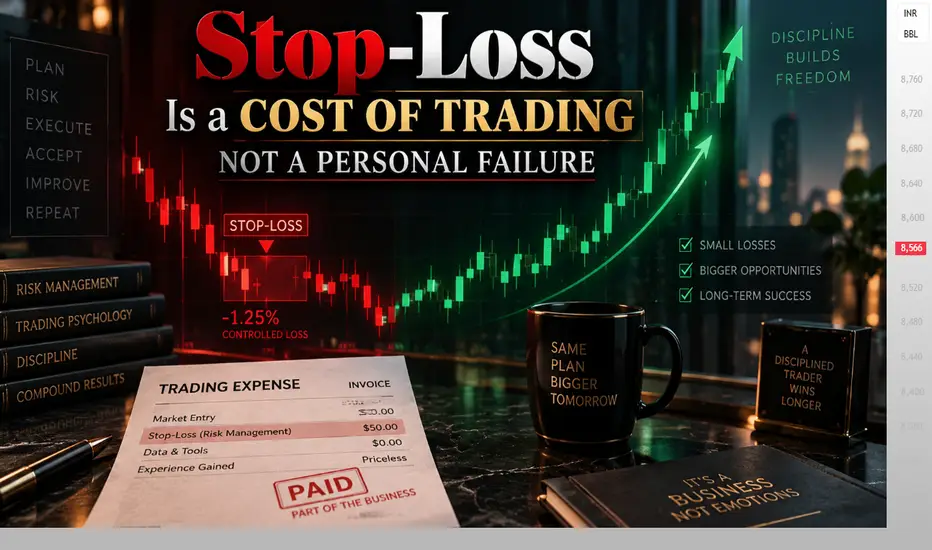
📊 Stop-Loss Is a Cost of Trading — Not a Personal Failure
A stop-loss can feel personal. You enter a trade. Price moves against you. The stop gets hit. And immediately the mind starts saying:
“I was wrong.”
“My analysis failed.”
“I need to recover this.”
But a valid stop-loss means something much simpler:
**This particular trade idea did not work, and the risk plan protected your capital.**
---------------------------------
📊 A Stop-Loss Has a Job
Before entering, every trade should answer:
“Where does this setup become invalid?”
For a bullish trade, that may be:
• Support failure
• Breakout level failure
• Higher-low structure breaking
• VWAP loss with bearish confirmation
The stop should represent invalidation.
Not fear. Not a random number.
---------------------------------
📊 Losing Trade ≠ Bad Trade
Suppose you had:
✅ Valid setup
✅ Proper confirmation
✅ Correct position size
✅ Logical stop
✅ Good R:R
…and the stop still gets hit.
That can simply be: Good Process + Losing Outcome
Trading is probabilistic. A good setup is never guaranteed to win.
---------------------------------
📊 Planned Loss vs Uncontrolled Loss
A planned loss:
• Risk defined before entry
• Stop respected
• Quantity correct
• Result = −1R
An uncontrolled loss:
• Stop moved
• Position averaged
• Quantity increased
• Hope replaces invalidation
The first is part of trading. The second is a process problem.
---------------------------------
📊 Think Like a Business
Every business has expenses. Trading has them too:
• Brokerage
• Slippage
• Losing trades
• Stop-losses
The goal is not to eliminate every cost. The goal is to keep costs controlled while your overall edge remains profitable.
---------------------------------
📊 One Stop Is Only One Trade
Imagine:
+2R
−1R
+1.5R
−1R
+3R
Net result:
**+4.5R**
The two stop-losses were normal costs inside a profitable sequence. One −1R trade does not define the system. The larger sample does.
---------------------------------
📊 Position Size Comes After the Stop
Use this sequence:
1️⃣ Find technical invalidation
2️⃣ Measure stop distance
3️⃣ Define maximum account risk
4️⃣ Calculate position size
Do not choose a large quantity first and then force the stop closer just to fit the trade.
Risk first.
Quantity second.
---------------------------------
📊 The Stop Protects More Than Capital
A disciplined stop protects:
• Financial capital
• Mental capital
• Opportunity capital
• Strategy discipline
Small controlled losses keep you available for the next valid opportunity.
---------------------------------
📊 Do Not Try to Recover Immediately ⚠️
After a stop-loss:
Accept → Record → Reset → Wait
The next trade does not owe you the previous loss. It must qualify on its own. Revenge trading turns a normal business expense into unnecessary damage.
---------------------------------
📊 Simple Formula
Valid Setup + Defined Risk + Stop Hit
= Normal Cost of Trading
But:
Moving Stop + Oversizing + Hope + Revenge
= Uncontrolled Loss
---------------------------------
📊 Finally, the important point to note is:
A stop-loss is not a verdict on you.
It simply says:
“This trade has reached the point where I no longer want to risk more capital.”
The professional goal is not:
“Never take a loss.”
It is:
**Keep losses planned, affordable and disciplined.**
Plan the risk.
Respect the stop.
Review the trade.
Move to the next valid setup.
---------------------------------
Educational Purpose Only.

⭐For Live Trading Courses And Trading Community 📈
Contact ⬇️
📱wa.me/919322295961
📱telegram.me/investyourasset1
⭐Advanced courses
⭐Fully Automated Algo Trading
⭐Daily F&O Trade tips
📱 telegram.me/investyourasset1
Contact ⬇️
📱wa.me/919322295961
📱telegram.me/investyourasset1
⭐Advanced courses
⭐Fully Automated Algo Trading
⭐Daily F&O Trade tips
📱 telegram.me/investyourasset1
Related publications
Disclaimer
The information and publications are not meant to be, and do not constitute, financial, investment, trading, or other types of advice or recommendations supplied or endorsed by TradingView. Read more in the Terms of Use.