
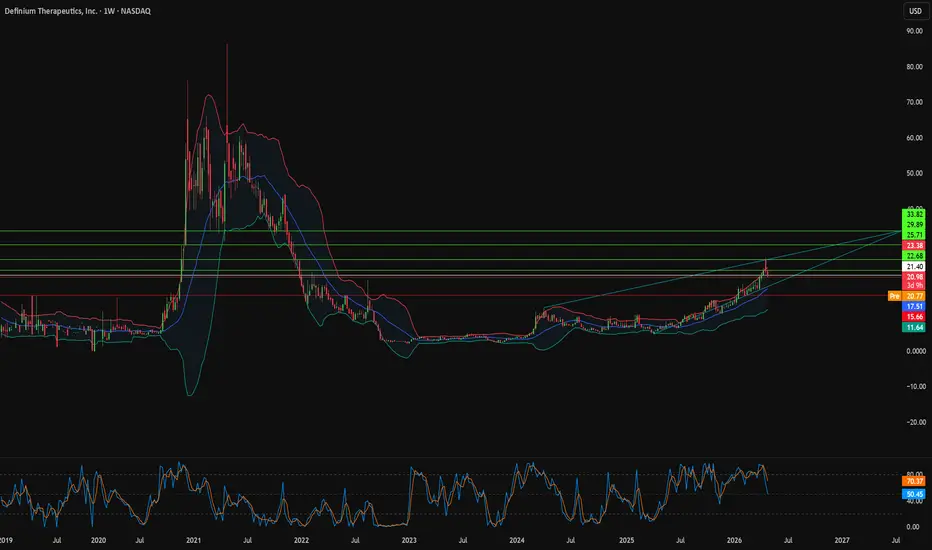
Definium Therapeutics (DFTX), formerly Mind Medicine, rebranded in January 2026, has emerged as the leading clinical-stage company in psychedelic-assisted psychiatry, built on a focused pipeline of optimized lysergide formulations targeting generational-scale unmet needs. Its flagship asset, DT120 ODT, is a pharmaceutical-grade, orally disintegrating lysergide tartrate tablet developed using Zydis fast-dissolve technology, which improves tolerability and eliminates the logistical burdens of traditional psychedelic delivery. The science centers on serotonin-2A receptor agonism, which produces transient but profound neuroplastic shifts hypothesized to disrupt the entrenched neural patterns underlying major depressive disorder (MDD), generalized anxiety disorder (GAD), and PTSD. Four pivotal Phase 3 trials, EMERGE, ASCEND, VOYAGE, and PANORAMA, are advancing concurrently, with three topline readouts expected before year-end 2026, each representing a binary catalyst for the company's valuation.
Despite a hostile macroeconomic backdrop including oil above $118 per barrel, elevated Fed rates, and a broadly frozen biotech funding environment, Definium entered 2026 in a position of unusual financial resilience. The company raised $259 million in equity financing during late 2025 and reported total cash and investments of $411.6 million, providing a funded runway through 2028 that insulates it from the capital constraints suffocating smaller peers. On the regulatory front, the April 2026 White House Executive Order to accelerate psychedelic drug development provided historic federal validation for the sector, mandating cross-agency collaboration, priority review pathways, and swift DEA rescheduling upon FDA approval. This political tailwind, combined with Definium's rigorous clinical infrastructure, positions the company as the primary beneficiary of what amounts to an unprecedented policy opening.
Commercially, Definium is engineering DT120 to fit within existing interventional psychiatry infrastructure rather than requiring a wholesale overhaul of the care system. By eliminating mandatory psychotherapy sessions, management targets a streamlined five-to-eight-hour supervised dosing window per treatment, modeled closely after the Spravato (esketamine) reimbursement framework already accepted by Medicare, Medicaid, and commercial payers at approval rates exceeding 85%. Projected annual treatment costs of $28,000–$70,000 per patient, combined with analyst consensus revenue estimates of $206.9 million by 2029, illustrate the scale of the commercial opportunity, though the wide divergence between bullish and bearish revenue estimates reflects the binary nature of late-stage clinical risk. Layered over this is a robust intellectual property moat extending into the early-to-mid 2040s, supplemented by five years of regulatory exclusivity upon approval, giving Definium a formidable barrier against generic competition should its Phase 3 program succeed.

Connecting the dots to Decode the Invisible. This post is a summary. To understand the rigged game, you need the evidence. Access the Full Analysis + Raw Sources (Lab Reports, Patents, Academic Research & Cyber Intel). See the reality here ➜ udisview.com
Disclaimer
The information and publications are not meant to be, and do not constitute, financial, investment, trading, or other types of advice or recommendations supplied or endorsed by TradingView. Read more in the Terms of Use.