
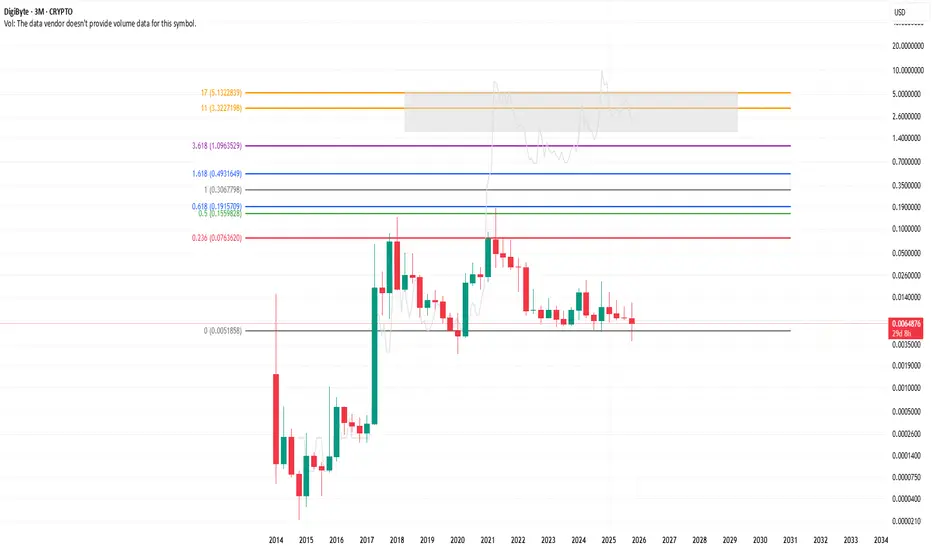
If DigiByte (DGB) were to follow Dogecoin’s price action from the last cycle, here’s what that implies: Dogecoin’s Last Cycle surged massively during the 2020–2021 bull run from ~$0.002 to an all-time high of ~$0.73 (a ~36,000% increase).
This was driven by Meme popularity, Social media hype (Elon Musk effect) and Retail speculation.
Applying Similar % Gain to DGB means $3.60 per DGB. With 21 billion max supply, at $3.60 per coin → $75.6 billion market cap.
This was driven by Meme popularity, Social media hype (Elon Musk effect) and Retail speculation.
Applying Similar % Gain to DGB means $3.60 per DGB. With 21 billion max supply, at $3.60 per coin → $75.6 billion market cap.
Note
Network & NodesActive unique peer IPs: ~11,475 cumulative over tracking period; ~3,400+ in the last month.
Decentralization: Thousands of nodes worldwide; network remains secure even if individual nodes go offline.
Comparison:
Bitcoin (BTC): ~24,000+ public nodes
Litecoin (LTC): ~940 nodes
DigiByte (DGB): ~11,475 cumulative peers
Trade active
DigiByte (DGB) is a Layer-1 blockchain that has quietly proven its resilience across some of the most extreme macro and market conditions of the last decade. Its strength does not come from hype cycles or liquidity-driven speculation, but from protocol design choices that allow it to survive prolonged stress without intervention.Battle-Tested Through Multiple Crises:
Since the late-2010s, the DGB network has operated continuously through:
The post-2017 crypto collapse, Trade-war driven macro uncertainty, The COVID pandemic market crash, the inflation shock and fastest global tightening (QT) cycle in modern history. During these periods of extreme volatility, DGB experienced deep price drawdowns, liquidity contraction, and infrastructure stress—yet the network never halted, never rolled back, and never required emergency governance actions. Blocks continued to be produced, transactions settled normally, and the protocol rules remained unchanged.
This matters because true resilience is not measured during bull markets, but during periods when incentives are weakest and participation is most fragile.
Structural Resilience by Design:
DGB’s durability is rooted in its architecture. Multi-algorithm Proof-of-Work distributes security across five mining algorithms, preventing dependence on a single hardware class or mining cartel.
High global node count ensures decentralization and reduces single points of failure.
Fast block times (~15 seconds) maintain liveness even during hash-rate fluctuations.
No central foundation or emergency controls, meaning the network survives purely on protocol incentives.
Unlike many networks that only function well when price is high, DGB has demonstrated that its security model remains intact even when valuation, hash power, and attention are under pressure.
Monetary Policy That Withstands Stress:
DGB uses a capped supply with a smooth, monthly reduction in issuance, rather than abrupt halving shocks. This approach:
Gradually reduces inflation without destabilizing miners;
Avoids reflexive dependence on price appreciation for security;
Encourages long-term sustainability instead of boom-bust incentives.
The result is a network that can operate through long periods of suppressed liquidity—exactly the environment created by global QT over the last three years.
Going Forward:
Global QT did not destroy liquidity; it concentrated particularly in money-market funds. As rates peak and liquidity begins to rotate, capital will look first for assets that are:
- Scarce and disinflationary
- Non-sovereign and issuer-free
- Liquid, permissionless, and globally accessible
- Proven to survive stress without intervention
- Assets that endured QT without breaking tend to reprice fastest when liquidity returns, because supply is tightly held and confidence is already established.
Bottom Line
DigiByte is considered battle-tested not because of price performance, but because it has survived multiple macro regimes—trade wars, pandemics, inflation shocks, and aggressive QT—without changing its rules or compromising decentralization.
In markets, longevity through adversity is rare.
When liquidity cycles turn, that resilience is often what gets repriced first.

Disclaimer
The information and publications are not meant to be, and do not constitute, financial, investment, trading, or other types of advice or recommendations supplied or endorsed by TradingView. Read more in the Terms of Use.
Disclaimer
The information and publications are not meant to be, and do not constitute, financial, investment, trading, or other types of advice or recommendations supplied or endorsed by TradingView. Read more in the Terms of Use.