
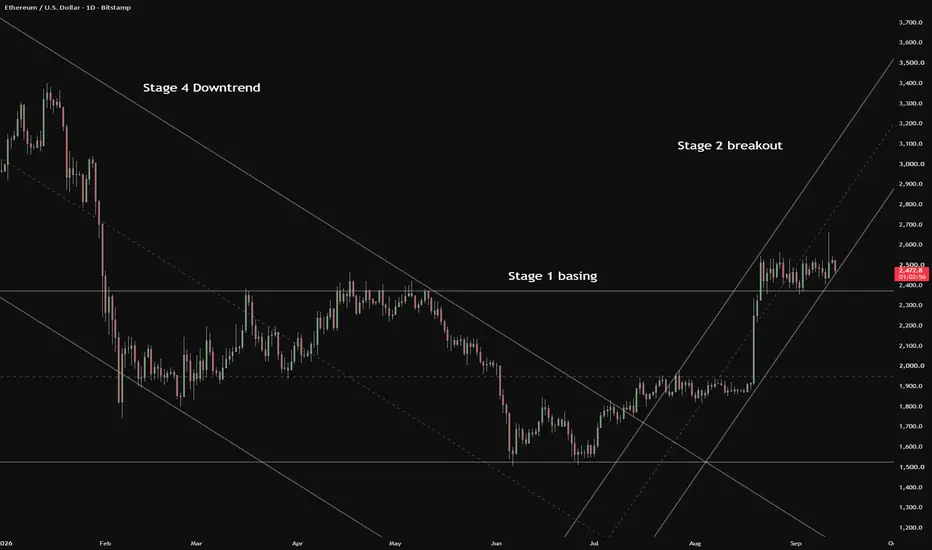
ETH daily is not mid-range noise. It is a completed stage sequence sitting on the first real test of the Stage 2 breakout.
The tape from the 2025 high is a clean Weinstein / cycle map:
That is why this area matters. Stage 2 is not “already won.” Stage 2 is accepted only if price holds the breakout structure and continues to put the old base underneath it.
What the chart is saying right now
Price has already done the hard part: it left the Stage 1 range with an impulsive daily expansion. Since that release, ETH has been digesting under the recent spike high near $2,650 (Sep 11) and oscillating around $2,480–$2,530.
This is the first real decision after the breakout:
The squeeze work is the reason the breakout was worth marking. Compression into the last yellow/gold box was the coiled spring. The large green expansion off that box was the release. After a release, the market almost always comes back to ask whether the new range is accepted. That test is happening now.
Levels I am using
Breakout / decision zone: $2,420–$2,500. This is the line between “Stage 2 still in force” and “back in the base.”
How I would trade the idea (not a signal)
This is a hold-the-structure long, not a chase-the-green-candle long.
Why this is the chart to watch
ETH has been technically cleaner than most majors on this cycle: the markdown, the base, the compression, and the release are all readable on the daily without forcing a narrative. The only question left on this timeframe is the one the market always asks after a Stage 2 lift-off:
Does the breakout become the new floor, or does it get given back?
I am long the Stage 2 structure while $2,420–$2,500 holds on a closing basis. I am not long the idea that ETH cannot return to the base. That is the whole point of marking the decision now, before the daily resolves it.
Not financial advice. Stages fail. Wait for the close, not the wick.
The tape from the 2025 high is a clean Weinstein / cycle map:
- Stage 4 — persistent markdown, red/lower-low structure, sellers in control.
- Stage 1 — long basing after the decline. Volatility compressed. Price stopped making meaningful lower lows and spent months coiling. That coil is the work that makes a later expansion tradeable.
- Stage 2 — the vertical release out of the final compression box. That is the change of character: the market stopped trading the base and started trading the advance.
That is why this area matters. Stage 2 is not “already won.” Stage 2 is accepted only if price holds the breakout structure and continues to put the old base underneath it.
What the chart is saying right now
Price has already done the hard part: it left the Stage 1 range with an impulsive daily expansion. Since that release, ETH has been digesting under the recent spike high near $2,650 (Sep 11) and oscillating around $2,480–$2,530.
This is the first real decision after the breakout:
- Continuation — daily closes hold the rising breakout channel / the top of the old base. Pullbacks stay constructive. That keeps ETH in Stage 2 and opens a measured continuation toward the next supply from the prior markdown ($3,000 area first, then the $3,400–$3,800 shelf if the channel remains intact).
- Failure — daily acceptance back into the Stage 1 box. That would reclassify the expansion as a breakout-then-return, not a new advancing phase. In that case the market is still basing, not trending.
The squeeze work is the reason the breakout was worth marking. Compression into the last yellow/gold box was the coiled spring. The large green expansion off that box was the release. After a release, the market almost always comes back to ask whether the new range is accepted. That test is happening now.
Levels I am using
Breakout / decision zone: $2,420–$2,500. This is the line between “Stage 2 still in force” and “back in the base.”
- Near-term supply: $2,540–$2,660. Reclaim and hold above the Sep 11 high is the next confirmation that the channel is expanding, not just digesting.
- Invalidation for the Stage 2 read: a daily close back through the last compression shelf and into the heart of the Stage 1 range (acceptance below ~$2,250–$2,300, not just a wick).
- Upside if the channel holds: $3,000 first. Stretch objectives only count if $2,420–$2,500 continues to act as demand.
How I would trade the idea (not a signal)
This is a hold-the-structure long, not a chase-the-green-candle long.
- Prefer strength after a hold of the decision zone, or a higher-low that stays above the old squeeze shelf.
- Do not treat a dip back into the middle of Stage 1 as “the same trade.” That is a different regime.
- If ETH loses the channel and accepts back inside the base, stand down. The thesis is the stage change, not a permanent bid on ETH.
Why this is the chart to watch
ETH has been technically cleaner than most majors on this cycle: the markdown, the base, the compression, and the release are all readable on the daily without forcing a narrative. The only question left on this timeframe is the one the market always asks after a Stage 2 lift-off:
Does the breakout become the new floor, or does it get given back?
I am long the Stage 2 structure while $2,420–$2,500 holds on a closing basis. I am not long the idea that ETH cannot return to the base. That is the whole point of marking the decision now, before the daily resolves it.
Not financial advice. Stages fail. Wait for the close, not the wick.

Your Friend Cryptic
Try our suite @ apxtrading.io
Try our suite @ apxtrading.io
Disclaimer
The information and publications are not meant to be, and do not constitute, financial, investment, trading, or other types of advice or recommendations supplied or endorsed by TradingView. Read more in the Terms of Use.