
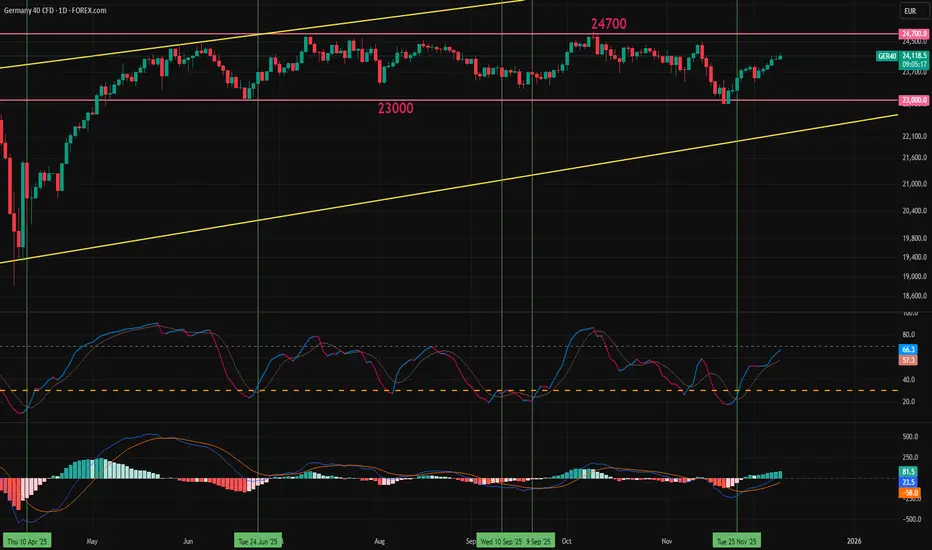
The DAX index has been moving sideways since May without any signs of a trend change. Weak German economic data, a struggling auto industry, ongoing Ukraine risks, and de-globalization moves from the US all limit the upside potential. However, with the new year approaching, incoming portfolio adjustments could provide a conservative boost to the index.
From the year start to the March top, the DAX rose more than 18% in a three-month period. After a big selloff and sharp recovery due to the April tariff announcement from Trump, returns from the start of the year reached over 23% by May. During this five-month period, the DAX positively diverged from the S&P 500, reaching above two standard deviations from the five-year average. Since then, the S&P 500 has continued to clinch gains while the DAX has been moving sideways in a 1,700-point-wide channel.
Germany's deep slump is expected to end in 2026, increasing GDP growth from 0.3% to 1% (market consensus). German CPI is expected to stay close to the 2% target like the rest of the EU, and lower ECB rates might give a conservative boost to investments. The changes are positive but not a significant boost for the DAX.
Now that the DAX/S&P 500 ratio has returned to its average, the correlation between the US stock market and the DAX might increase again. Currently, the relative momentum index (RMI) has generated a buy signal, similar to the MACD. Crossovers below “30” on the RMI and below “0” on the MACD usually provide decent bullish signals. However, the main focus will remain on the 24,700 resistance. Unless it is broken to the upside, the sideways move can be expected to continue.
Higher PMI, factory orders, and industrial production data have already shown a positive impact on the index, and post-COVID seasonality for December is historically bullish in December. The question is whether that will be enough to trigger a breakout.
From the year start to the March top, the DAX rose more than 18% in a three-month period. After a big selloff and sharp recovery due to the April tariff announcement from Trump, returns from the start of the year reached over 23% by May. During this five-month period, the DAX positively diverged from the S&P 500, reaching above two standard deviations from the five-year average. Since then, the S&P 500 has continued to clinch gains while the DAX has been moving sideways in a 1,700-point-wide channel.
Germany's deep slump is expected to end in 2026, increasing GDP growth from 0.3% to 1% (market consensus). German CPI is expected to stay close to the 2% target like the rest of the EU, and lower ECB rates might give a conservative boost to investments. The changes are positive but not a significant boost for the DAX.
Now that the DAX/S&P 500 ratio has returned to its average, the correlation between the US stock market and the DAX might increase again. Currently, the relative momentum index (RMI) has generated a buy signal, similar to the MACD. Crossovers below “30” on the RMI and below “0” on the MACD usually provide decent bullish signals. However, the main focus will remain on the 24,700 resistance. Unless it is broken to the upside, the sideways move can be expected to continue.
Higher PMI, factory orders, and industrial production data have already shown a positive impact on the index, and post-COVID seasonality for December is historically bullish in December. The question is whether that will be enough to trigger a breakout.

Related publications
Disclaimer
The information and publications are not meant to be, and do not constitute, financial, investment, trading, or other types of advice or recommendations supplied or endorsed by TradingView. Read more in the Terms of Use.
Related publications
Disclaimer
The information and publications are not meant to be, and do not constitute, financial, investment, trading, or other types of advice or recommendations supplied or endorsed by TradingView. Read more in the Terms of Use.