 GEV
GE Vernova - Strongest Fundamental Tailwinds In The Market. Two Elliott Wave Scenarios Define The Entry.
GE Vernova is not simply a beneficiary of the AI infrastructure boom. It is arguably the single most critical bottleneck in the entire AI supply chain, the company that makes the gas turbines without which none of the hyperscalers' data centers can operate at scale.
The numbers behind that statement are extraordinary. Q2 2026 revenue came in at $11.1 billion, up 22% year-over-year and ahead of analyst forecasts. Orders surged to a record $24.2 billion in the quarter, up 88% year-over-year, lifting the total backlog to $176 billion. Data centre-related orders alone exceeded $5 billion in 2026, more than double the entire total for 2025. Full-year 2026 revenue guidance has been raised to $45.5–$46.5 billion. Free cash flow guidance stands at $6.5–$7.5 billion. Amazon, Google, Microsoft, Oracle, Meta, OpenAI and Anthropic are all reportedly queuing for gas turbine capacity. GE Vernova's order book is full until 2029, with orders stretching as far as 2031. The company has hired 200 workers at its flagship Greenville, South Carolina turbine plant and is adding 300 more.
Gas turbine prices have risen approximately 300% over the past three years as demand has structurally overwhelmed supply. CEO Scott Strazik has repeatedly described this moment as the beginning of an electrification infrastructure supercycle and the order book validates every word of that description. Unlike chip and memory investments, which carry brutal cyclicality and inventory swings, turbine orders come with multi-year delivery schedules, grid equipment is bought against decade-long utility planning cycles, and service agreements generate recurring revenue for the life of the installed equipment. GE Vernova has the revenue visibility that the semiconductor complex cannot offer, attached to the same underlying AI demand driver.
118 prominent hedge funds held long positions in GE Vernova as of Q1 2026. Philippe Laffont's Coatue Management holds a $2.24 billion stake.
The one honest caveat: the Wind segment remains a drag. Wind revenue fell 23% in Q1 2026 and management expects approximately $400 million in EBITDA losses in that division this year. It is the one execution risk embedded in an otherwise exceptional fundamental story and it is manageable relative to the scale of the Power and Electrification tailwinds.
The Technical Structure
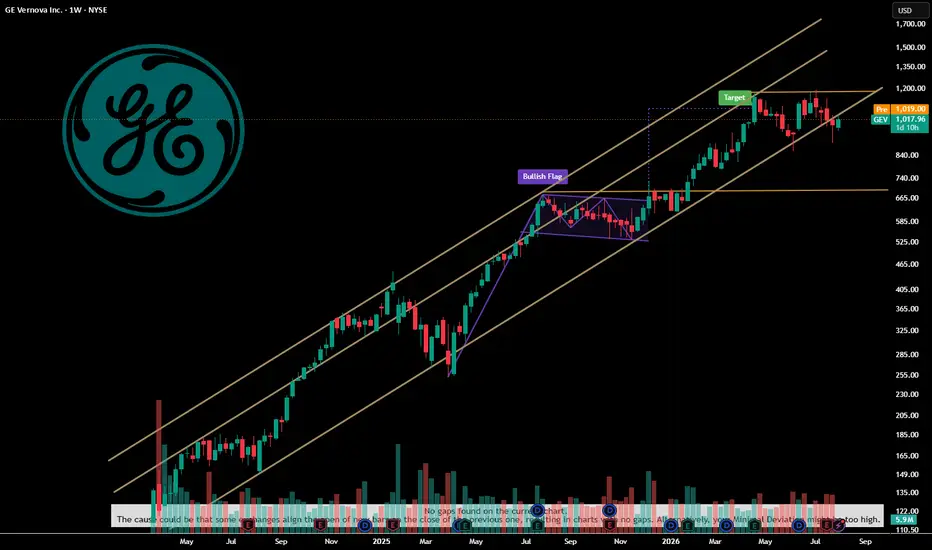
GE Vernova has been operating within a well-defined ascending channel since its IPO in March 2024, a structure that has contained every significant move in both directions across its short but eventful trading history.
In November 2025 the stock began its last major impulse move. That impulse is now complete, five waves up have been counted and the subsequent corrective structure has followed. The question the chart is now posing is which of two Elliott Wave interpretations proves correct. Both are legitimate. Both are supported by the structure. And they lead to very different outcomes.
Scenario 1 - Bullish (New Impulse Beginning)
In the bullish reading, the five-wave impulse from November 2025 has completed, and the subsequent correction, which retraced 50% of the entire impulse, constitutes a textbook ABC correction. A 50% retracement of an impulse is one of the most common and respected corrective targets in Elliott Wave theory. If this reading is correct, the ABC is complete, and we are now at the beginning of an entirely new five-wave impulse sequence.
Within that new impulse, the low that has just been established constitutes the end of Wave 2, the final corrective wave before Wave 3 begins. Wave 3 is historically the most powerful, most extended, and most profitable wave in any impulse sequence. It is the wave where institutions add aggressively, momentum builds, and breakouts sustain rather than fail. The confluence of the corrective ABC completing at exactly the 50% Fibonacci retracement level adds significant weight to this interpretation.
Scenario 2 - Bearish (Wave C Still Ahead)
In the bearish reading, the five-wave impulse has completed and the ABC correction is not yet finished. Wave A and Wave B have played out, but Wave C, which is always impulsive and typically the sharpest and most damaging move in a correction, remains ahead. If this reading is correct, the current price level is not the end of the correction but rather the beginning of a final leg lower that could take price significantly below current levels before the corrective structure completes.
We note that Wave C of an ABC correction, if it equals Wave A in length, would imply a meaningful further decline from current levels. We will not speculate on a price target for a scenario we will not be trading.
Why We Will Not Short This
We generally refrain from taking short positions in companies carrying the fundamental tailwinds described above. A $176 billion backlog, 88% order growth, and every major hyperscaler in the world queuing for your product is not a backdrop that rewards systematic shorting. Even if Scenario 2 plays out and Wave C unfolds as the bearish count suggests, the correction will happen against a fundamental story that remains intact, which means the recovery from whatever low Wave C reaches will be sharp and violent. Shorting into that environment requires precision that the risk/reward does not justify.
Our Entry Signal - And Why
Both scenarios share one common feature: if the bullish reading is correct and Wave 3 is beginning, the $1,180 horizontal resistance, which previously acted as a double top, will be broken and held. If the bearish reading is correct and Wave C is still unfolding, that same $1,180 level will contain any rally attempt and act as resistance.
The $1,180 level is therefore the definitive arbiter between the two scenarios. A weekly close above $1,180, held for one full week, tells us the bulls have absorbed the double top resistance and the market has chosen the bullish Elliott Wave reading. That is our entry signal, and it is non-negotiable.
Anything below that level and we are watching, not acting. Initiating a position below $1,180, regardless of how compelling the fundamental story, amounts to catching a falling knife in a structure that has not yet confirmed its direction. Patience is not optional here. It is the only rational response to genuine Elliott Wave ambiguity.
The fundamental case for GE Vernova is among the strongest we have encountered in this market. The AI power infrastructure supercycle is real, multi-year, and accelerating. GE Vernova sits at its centre with an order book that cannot be replicated by any competitor in the near term. When the technical structure confirms, this will be a high-conviction position.
We wait for $1,180. Not before.
Capital preservation first. Confirmation before conviction.

Vasileios Kairaktidis
Initium Asset Management
Initium Research | Independent Equity Research
Disclaimer
The information and publications are not meant to be, and do not constitute, financial, investment, trading, or other types of advice or recommendations supplied or endorsed by TradingView. Read more in the Terms of Use.