
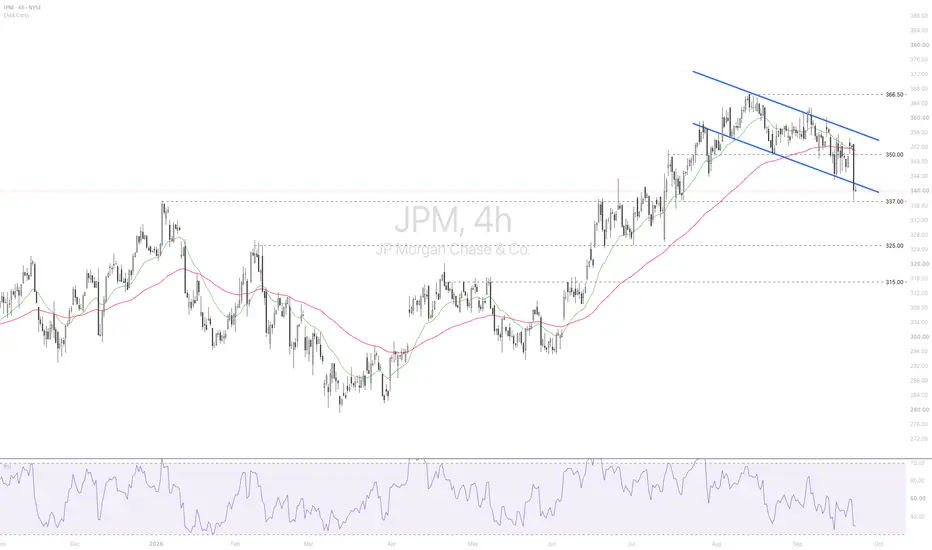
JPM | 4H Technical Analysis — Sep 23, 2026
JPMorgan is sliding after falling into the crosshairs of a broader market rotation around AI disruption risk. Goldman Sachs flagged telecom, insurance, and utilities as sectors most exposed if AI agents make it easier and cheaper for consumers to switch service providers, warning that companies have long profited from what it calls consumer inertia, the tendency for people to keep paying for services or products out of habit even when better alternatives exist. Goldman's consumer inertia basket, which spans telecom names like AT&T and T-Mobile, insurers like Allstate and Progressive, and travel and streaming names including Netflix and Expedia, sold off broadly on the thesis. JPMorgan itself dropped 3.42% as banks, insurers, and card companies were swept into the same AI disruption narrative.
The stock spent January through March in a choppy range between roughly 285 and 325 before breaking higher through April and climbing steadily into August, eventually peaking 365 inside an ascending channel. That channel has now clearly broken down, with price sliding from the 365 area through the low 350s and gapping sharply lower today to trade around 340, decisively piercing the channel's lower trendline in the process.
Price is now trading below both EMAs (349.85 fast, 351.06 slow), with the fast EMA crossing beneath the slow EMA for the first time since May. RSI has fallen to 34.74, approaching oversold territory and confirming the sharpness of today's AI disruption driven selloff.
The 337 level is the one to watch closely. It marks a prior consolidation shelf from April and May and sits just below current price, meaning a clean break here would open a much larger air gap back toward 325 and 315, levels not tested since the spring range.
Key levels to watch:
Resistance: 350 (broken EMA support, now overhead) / 366.50 (cycle high)
Support: 337 (April/May consolidation shelf) / 325 (spring range high) / 315 (spring range low)
Bear case: The Goldman Sachs consumer inertia thesis targets financial services directly, arguing AI agents could erode the switching costs that have historically protected bank and insurance customer relationships, and JPMorgan's outsized drop alongside Schwab and Raymond James suggests the market is taking the thesis seriously rather than treating it as a one day scare. A break below 337 would confirm the channel breakdown is extending into a deeper correction toward the 325 to 315 zone.
Bull case: The AI disruption thesis is speculative and long dated rather than an immediate earnings threat, and JPMorgan's underlying fundamentals have not changed on this news alone. RSI approaching oversold levels raises the odds of a near term bounce, and a reclaim of 350 would suggest today's selloff was a sentiment driven overreaction rather than the start of a structural repricing of bank valuations.
Bias is bearish while price holds below 350, with the AI disruption narrative giving today's channel breakdown a genuine fundamental catalyst rather than just technical exhaustion. The 337 level is the next real test, and how JPM behaves there will show whether this is a sharp but contained pullback or the start of a broader reassessment of financial sector valuations under the AI agent thesis.

Disclaimer
The information and publications are not meant to be, and do not constitute, financial, investment, trading, or other types of advice or recommendations supplied or endorsed by TradingView. Read more in the Terms of Use.
Disclaimer
The information and publications are not meant to be, and do not constitute, financial, investment, trading, or other types of advice or recommendations supplied or endorsed by TradingView. Read more in the Terms of Use.