
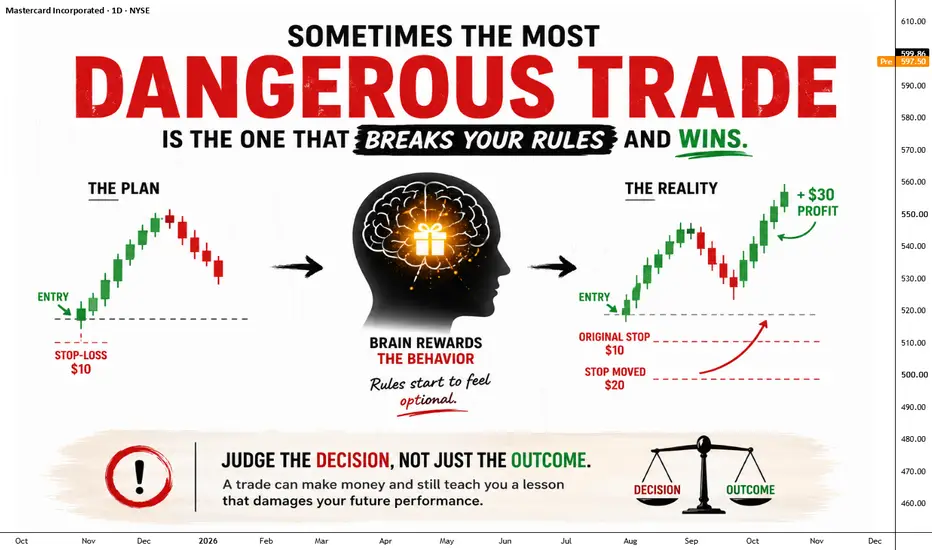
One of the most dangerous things that can happen to a trader is not losing money after breaking a rule. It is making money after breaking one. Imagine a trader plans a trade with a $10 stop-loss. Price moves against the position, comes close to the stop, and the trader thinks, “I’ll give it a little more room.” The stop is moved to $20. Ten minutes later, the market reverses and the trade closes with a $30 profit. The trader feels relieved, perhaps even clever. Nothing bad happened. In fact, the decision appears to have been correct.
But psychologically, something much more important happened: the brain just received a reward for breaking the rule.
The Dangerous Lesson Hidden Inside a Winning Trade:
Trading rules are supposed to create consistency, but the brain does not learn only from whether a trade was profitable. It also learns from the connection between an action and its consequence. If moving a stop repeatedly leads to losses, the behavior will probably become less attractive.
But when moving the stop occasionally saves the trade and produces a profit, the lesson becomes much more complicated. This is where intermittent reinforcement comes into play. A behavior that receives rewards unpredictably can become surprisingly persistent.
In trading, the cycle can look like this:
break the rule → sometimes lose → sometimes get rewarded → keep trying.
The trader may not realize it, but the market is slowly teaching their brain that the rules are optional.
The Lucky Trade Can Be More Dangerous Than the Losing Trade:
Suppose a trader has a simple rule: never widen a stop-loss. On Monday, they move the stop and lose $20. The lesson seems obvious: “That was a bad decision.” On Wednesday, they do exactly the same thing, but this time the market reverses and the trade makes $40.
The lesson suddenly changes to: “Maybe I was right to give it more room.” That winning trade can be more psychologically dangerous than the losing one because it provides evidence that supports the bad behavior.
The next time price approaches the original stop, the trader may no longer remember the rule first. They remember Wednesday. They remember that waiting worked once, and that memory starts influencing the next decision.
The Market Doesn't Need to Reward You Often:
A trader does not need to be rewarded every time they break a rule for the behavior to become persistent. They only need occasional rewards to keep the possibility alive.
Imagine moving a stop five times: four times it results in a loss, but once it saves the trade and produces a large profit. That one dramatic recovery can become more memorable than the four ordinary losses.
This is one reason trading mistakes can become habits even when they are not consistently profitable. The trader begins following memorable exceptions instead of following the statistical logic of the strategy. Eventually, “I shouldn't do this” turns into “I normally shouldn't do this, but this setup is different.”
The Same Thing Happens With Taking Profits:
The same psychological mechanism can appear on the other side of a trade. Imagine a trader's plan is to target a 1:3 risk-to-reward ratio. One day, the trade reaches 1:1, the trader becomes nervous, closes the position, and price immediately reverses.
The trader feels smart for getting out at the right time. The next time a trade reaches 1:1, the same memory comes back, so they close again. But this time, price continues toward the original 1:3 target.
The trader may think they are protecting profits, but they could actually be learning to react to the last emotionally powerful experience. One lucky early exit can slowly turn into a habit of cutting winners short.
Your Brain Doesn't Know Your Trading Plan Is Sacred:
A trading plan may look perfectly logical when you create it outside the market. You can define your entry, stop-loss, target and maximum risk without any emotional pressure. But once money is actually moving, your brain responds to immediate outcomes rather than simply obeying the plan.
If breaking a rule occasionally produces a dramatic reward, your brain can start assigning value to that behavior. This is why a profitable trade is not automatically a good trade. A trade can make money and still teach you a lesson that damages your future performance.
The result was profitable, but the behavior that produced it may have been destructive.
Judge the Decision, Not Just the Outcome:
The next time you break one of your trading rules and make money, don't immediately celebrate the result. Ask yourself a more uncomfortable question: **“If this exact decision had produced a loss, would I still consider it a good decision?”**
If the answer is no, you may be judging the quality of the decision by its outcome. That is a dangerous habit in a probabilistic environment like trading. A bad decision can make money, just as a good decision can lose money.
The important thing is whether the decision followed a process that you would be willing to repeat over hundreds of trades.
The market can forgive a bad decision once because price eventually moves in your favor. Your brain may not be so forgiving. It may remember the reward, ignore the rule, and wait for the next opportunity to repeat the behavior.
Sometimes the most dangerous trade is the one that breaks your rules and wins.

Related publications
Disclaimer
The information and publications are not meant to be, and do not constitute, financial, investment, trading, or other types of advice or recommendations supplied or endorsed by TradingView. Read more in the Terms of Use.
Related publications
Disclaimer
The information and publications are not meant to be, and do not constitute, financial, investment, trading, or other types of advice or recommendations supplied or endorsed by TradingView. Read more in the Terms of Use.