

I’ve never been much of a gambler.
I don’t chase roulette, I don’t play blackjack regularly, and casinos have never been my second home. But on the rare occasions when I did go—usually dragged by friends who actually like gambling—something strange happened to me.
I ended up losing considerable amounts of money.
- Not because I thought I’d win.
- Not because I had a “system.”
- Not because I felt lucky.
It was the environment:
- the lights
- the noise
- the adrenaline
- the drinks
- the atmosphere that hijacks logic
And the next morning, the internal monologue was always the same:
“See, idiot? Again you drank one too many and managed to lose a Hawaii vacation.”
- The regret is real.
- The pain is real.
- The stupidity is, HOHO, WAY TOO REAL.
But the disturbing part?
Even though I don’t gamble… even though I don’t chase casinos… the environment alone was enough to override my reasoning.
And if that can happen to someone who isn’t a gambler, imagine what happens to someone who willingly walks into a casino every day —because that’s exactly what crypto "investors" do.
Crypto markets are casinos with better screens, countless memes, screaming influencers and worse odds.
And "investors" forget far too quickly.
Crypto "Investors" Forget Too Quickly —
Just Like Casino Gamblers Who Keep Coming Back for More
Crypto "investors" have one of the shortest memories in financial markets.
- Not because they are stupid.
- Not because they don’t care.
- But because the entire crypto environment is engineered to erase pain and preserve hope — exactly like a casino.
Put a gambler in a casino, and he forgets last night’s disaster the moment he sees the lights again.
This comparison is not metaphorical.
It is psychologically identical.
Let’s break it down properly.
1. The Human Brain Is Not Built for Crypto — or Casinos
Both environments share the same psychological architecture:
- bright colors
- fast feedback loops
- uncertainty
- intermittent rewards
- emotional highs
- catastrophic lows
- near-wins that feel like wins
- an illusion of control
Neuroscience calls this:
Intermittent Reinforcement
The most addictive reward structure ever discovered.
Slot machines are built on it.
Most crypto charts mimic it.
Volatility fuels it.
When rewards arrive unpredictably:
- dopamine spikes
- memory of losses fades
- the brain overvalues the next opportunity
- the pain of the past gets overwritten
- the hope of future reward dominates
This is why gamblers return.
And this is why crypto "investors" buy the same s..ts.
2. The Crypto Cycle Erases Memory by Design
After every bull run for an obscure coin:
- big money is made (by insiders)
- screenshots are posted
- what if you have bought with 100usd appear
- influencers multiply
- everyone becomes a “trading wizard”
- Twitter becomes an ego playground
- greed replaces rationality
After every strong bear move:
- portfolios crash 90-95%
- people swear “never again”
- Telegram groups die
- influencers delete posts
- conviction collapses
- despair dominates
But then…
When a new "narrative" appears:
- Everything resets.
- Crypto "investors" forget instantly.
No other financial market resets memory this fast.
- In stocks, a crash leaves scars.
- In forex, blown accounts create caution.
- In real estate, downturns shape behavior for years.
But in crypto?
The new "narative"/ the new hyped coin erases the old one like chalk on a board.
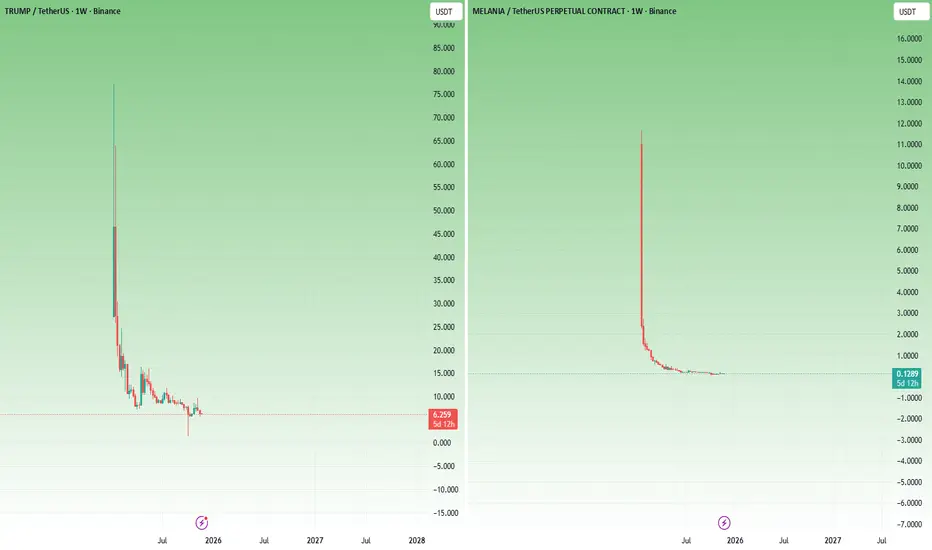
3. The TrumpCoin & MelaniaCoin Episode (Just an Example):
The Best Proof That Crypto Traders Forget Too Quickly
TrumpCoin and MelaniaCoin didn’t have real value.
They weren’t serious projects.
They weren’t even clever memes.
They were psychological traps built on celebrity gravity.
People bought because:
- the names were big
- the media amplified the narrative
- the symbolism felt powerful
- the story was exciting
And the wipeout was brutal.
But the key point is: traders forgot instantly.
Within weeks, they were already hunting for:
- “the next TrumpCoin”
- “the next politician meme”
- “the next celebrity pump”
- “the next token with a ‘name’ behind it”
- "the next 100x"
"the next, the next, the next" and is always the same
- Not the next valuable project.
- Not the next real innovation.
- Not the next sustainable investment.
No.
The next symbol.
This is not market behavior.
This is casino relapse psychology.
4. These Coins Didn’t Fail Because They Were Memes —They Failed Because They Were Nothing
TrumpCoin & MelaniaCoin (Again, is just an example) pretended to matter because the names mattered.
- Traders didn’t buy utility.
- They bought a fantasy.
The same way gamblers believe a “lucky table” changes their odds.
In crypto, people believe:
- the celebrity matters
- the narrative matters
- the hype matters
Reality doesn’t.
5. Why Crypto "Investors" Don’t Learn: Because They Don’t Remember
Crypto "investors" are not stupid.
They are forgetful.
They forget the months of pain and remember only the few happy moments.
They forget:
- drawdowns
- stress
- panic
- illusions
- scams
- broken promises
- influencers lies
They remember:
- one good run
- one moonshot
- one dream
This is why most altcoins and memes thrive.
Not because they deserve to.
But because forgetting resets demand every time.
6. The Industry Is Designed to Exploit This Amnesia
If traders remembered:
- Luna
- FTX
- SafeMoon
- ICO (2017) crashes
- NFT (2021) collapses
- Meme mania recently
…the most of the altcoin sector would evaporate overnight.
But "investors" forget —so altcoins with a "nice" story resurrect.
Like slot machines resetting after every gambler walks away.
7. The Cure: You Don’t Need Better Tools — You Need a Better Memory
The greatest edge in crypto is not fancy indicators, bots to be the first in, or whatever invention comes next.
It’s remembering.
Remember:
- why you lost
- how you lost
- which narrative fooled you
- how the market humiliated you
- what the casino environment does to your brain
- how celebrity tokens wiped people out
Crypto trading requires memory, not optimism.
Conclusion:
Crypto "Investors" Forget Too Quickly —And That’s Why They Keep Losing
Crypto "investors" don’t think like REAL investors.
They think like gamblers:
- emotional
- hopeful
- impulsive
- forgetful
convinced “this time will be different”
The latest meme mania proved this perfectly.
Crypto is not dangerous because it is volatile.
Crypto is dangerous because it erases your memory.
The "investor" who forgets loses.
The "investor" who remembers wins.
Because in crypto:
The moment you stop forgetting is the moment you finally start winning.
P.S. (A Necessary Clarification, Said Gently — and Honestly)
Throughout this article I used the word “investors” in quotation marks — and it wasn’t an accident.
Most of the people who call themselves investors in crypto are not actually investing.
They are speculating, chasing, hoping, and gambling on meme coins and obscure altcoins purely because “they have 100x potential.”
Let’s be honest:
- buying a token named after a frog
- or a coin launched yesterday by anonymous developers
- or a “next big narrative” pump with zero product
- or a celebrity meme coin
- or something that exists only on Twitter…is not investing.
It’s gambling dressed in nice vocabulary.
And that’s okay — as long as you know what it is.
Also, to be clear:
When I critique “altcoins,” I am not talking about all of them.
There are real infrastructure projects, real protocols, real technology, and real builders out there.
But let’s not pretend:
90% of altcoins exist for hype, for extraction, for speculation, and for the dopamine of “maybe this one will moon.”
I’m talking about those coins — the ones that behave like slot machines and survive only because traders forget too quickly.
If this article made you uncomfortable, good.
Sometimes the truth has to sting before it can help.
I don’t chase roulette, I don’t play blackjack regularly, and casinos have never been my second home. But on the rare occasions when I did go—usually dragged by friends who actually like gambling—something strange happened to me.
I ended up losing considerable amounts of money.
- Not because I thought I’d win.
- Not because I had a “system.”
- Not because I felt lucky.
It was the environment:
- the lights
- the noise
- the adrenaline
- the drinks
- the atmosphere that hijacks logic
And the next morning, the internal monologue was always the same:
“See, idiot? Again you drank one too many and managed to lose a Hawaii vacation.”
- The regret is real.
- The pain is real.
- The stupidity is, HOHO, WAY TOO REAL.
But the disturbing part?
Even though I don’t gamble… even though I don’t chase casinos… the environment alone was enough to override my reasoning.
And if that can happen to someone who isn’t a gambler, imagine what happens to someone who willingly walks into a casino every day —because that’s exactly what crypto "investors" do.
Crypto markets are casinos with better screens, countless memes, screaming influencers and worse odds.
And "investors" forget far too quickly.
Crypto "Investors" Forget Too Quickly —
Just Like Casino Gamblers Who Keep Coming Back for More
Crypto "investors" have one of the shortest memories in financial markets.
- Not because they are stupid.
- Not because they don’t care.
- But because the entire crypto environment is engineered to erase pain and preserve hope — exactly like a casino.
Put a gambler in a casino, and he forgets last night’s disaster the moment he sees the lights again.
This comparison is not metaphorical.
It is psychologically identical.
Let’s break it down properly.
1. The Human Brain Is Not Built for Crypto — or Casinos
Both environments share the same psychological architecture:
- bright colors
- fast feedback loops
- uncertainty
- intermittent rewards
- emotional highs
- catastrophic lows
- near-wins that feel like wins
- an illusion of control
Neuroscience calls this:
Intermittent Reinforcement
The most addictive reward structure ever discovered.
Slot machines are built on it.
Most crypto charts mimic it.
Volatility fuels it.
When rewards arrive unpredictably:
- dopamine spikes
- memory of losses fades
- the brain overvalues the next opportunity
- the pain of the past gets overwritten
- the hope of future reward dominates
This is why gamblers return.
And this is why crypto "investors" buy the same s..ts.
2. The Crypto Cycle Erases Memory by Design
After every bull run for an obscure coin:
- big money is made (by insiders)
- screenshots are posted
- what if you have bought with 100usd appear
- influencers multiply
- everyone becomes a “trading wizard”
- Twitter becomes an ego playground
- greed replaces rationality
After every strong bear move:
- portfolios crash 90-95%
- people swear “never again”
- Telegram groups die
- influencers delete posts
- conviction collapses
- despair dominates
But then…
When a new "narrative" appears:
- Everything resets.
- Crypto "investors" forget instantly.
No other financial market resets memory this fast.
- In stocks, a crash leaves scars.
- In forex, blown accounts create caution.
- In real estate, downturns shape behavior for years.
But in crypto?
The new "narative"/ the new hyped coin erases the old one like chalk on a board.
3. The TrumpCoin & MelaniaCoin Episode (Just an Example):
The Best Proof That Crypto Traders Forget Too Quickly
TrumpCoin and MelaniaCoin didn’t have real value.
They weren’t serious projects.
They weren’t even clever memes.
They were psychological traps built on celebrity gravity.
People bought because:
- the names were big
- the media amplified the narrative
- the symbolism felt powerful
- the story was exciting
And the wipeout was brutal.
But the key point is: traders forgot instantly.
Within weeks, they were already hunting for:
- “the next TrumpCoin”
- “the next politician meme”
- “the next celebrity pump”
- “the next token with a ‘name’ behind it”
- "the next 100x"
"the next, the next, the next" and is always the same
- Not the next valuable project.
- Not the next real innovation.
- Not the next sustainable investment.
No.
The next symbol.
This is not market behavior.
This is casino relapse psychology.
4. These Coins Didn’t Fail Because They Were Memes —They Failed Because They Were Nothing
TrumpCoin & MelaniaCoin (Again, is just an example) pretended to matter because the names mattered.
- Traders didn’t buy utility.
- They bought a fantasy.
The same way gamblers believe a “lucky table” changes their odds.
In crypto, people believe:
- the celebrity matters
- the narrative matters
- the hype matters
Reality doesn’t.
5. Why Crypto "Investors" Don’t Learn: Because They Don’t Remember
Crypto "investors" are not stupid.
They are forgetful.
They forget the months of pain and remember only the few happy moments.
They forget:
- drawdowns
- stress
- panic
- illusions
- scams
- broken promises
- influencers lies
They remember:
- one good run
- one moonshot
- one dream
This is why most altcoins and memes thrive.
Not because they deserve to.
But because forgetting resets demand every time.
6. The Industry Is Designed to Exploit This Amnesia
If traders remembered:
- Luna
- FTX
- SafeMoon
- ICO (2017) crashes
- NFT (2021) collapses
- Meme mania recently
…the most of the altcoin sector would evaporate overnight.
But "investors" forget —so altcoins with a "nice" story resurrect.
Like slot machines resetting after every gambler walks away.
7. The Cure: You Don’t Need Better Tools — You Need a Better Memory
The greatest edge in crypto is not fancy indicators, bots to be the first in, or whatever invention comes next.
It’s remembering.
Remember:
- why you lost
- how you lost
- which narrative fooled you
- how the market humiliated you
- what the casino environment does to your brain
- how celebrity tokens wiped people out
Crypto trading requires memory, not optimism.
Conclusion:
Crypto "Investors" Forget Too Quickly —And That’s Why They Keep Losing
Crypto "investors" don’t think like REAL investors.
They think like gamblers:
- emotional
- hopeful
- impulsive
- forgetful
convinced “this time will be different”
The latest meme mania proved this perfectly.
Crypto is not dangerous because it is volatile.
Crypto is dangerous because it erases your memory.
The "investor" who forgets loses.
The "investor" who remembers wins.
Because in crypto:
The moment you stop forgetting is the moment you finally start winning.
P.S. (A Necessary Clarification, Said Gently — and Honestly)
Throughout this article I used the word “investors” in quotation marks — and it wasn’t an accident.
Most of the people who call themselves investors in crypto are not actually investing.
They are speculating, chasing, hoping, and gambling on meme coins and obscure altcoins purely because “they have 100x potential.”
Let’s be honest:
- buying a token named after a frog
- or a coin launched yesterday by anonymous developers
- or a “next big narrative” pump with zero product
- or a celebrity meme coin
- or something that exists only on Twitter…is not investing.
It’s gambling dressed in nice vocabulary.
And that’s okay — as long as you know what it is.
Also, to be clear:
When I critique “altcoins,” I am not talking about all of them.
There are real infrastructure projects, real protocols, real technology, and real builders out there.
But let’s not pretend:
90% of altcoins exist for hype, for extraction, for speculation, and for the dopamine of “maybe this one will moon.”
I’m talking about those coins — the ones that behave like slot machines and survive only because traders forget too quickly.
If this article made you uncomfortable, good.
Sometimes the truth has to sting before it can help.

📈 Forex & XAU/USD Channel:
t.me/intradaytradingsignals
💎 Crypto Channel:
t.me/FanCryptocurrency
Related publications
Disclaimer
The information and publications are not meant to be, and do not constitute, financial, investment, trading, or other types of advice or recommendations supplied or endorsed by TradingView. Read more in the Terms of Use.
📈 Forex & XAU/USD Channel:
t.me/intradaytradingsignals
💎 Crypto Channel:
t.me/FanCryptocurrency
Related publications
Disclaimer
The information and publications are not meant to be, and do not constitute, financial, investment, trading, or other types of advice or recommendations supplied or endorsed by TradingView. Read more in the Terms of Use.