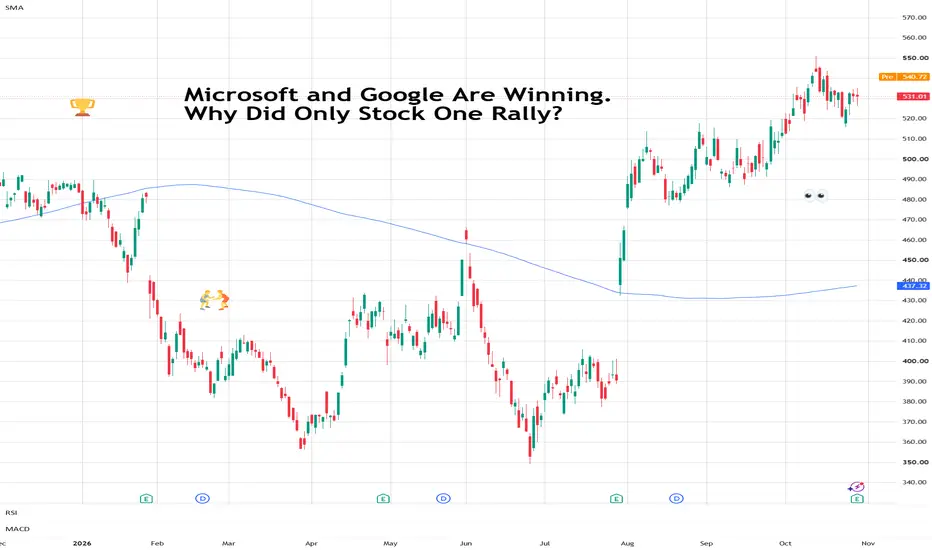
Two tech giants, two very different reactions. For a reason.
Microsoft MSFT and Alphabet
 GOOGL reported earnings Wednesday evening, giving Wall Street a fresh look at how the world's biggest technology companies are turning artificial intelligence into revenue.
Both had impressive numbers to share. Microsoft's Azure cloud business grew 48%, while Google Cloud more than doubled its revenue. Demand for AI computing remains exceptionally strong, and neither company appears particularly worried about running out of customers.
Investors, however, had very different reactions. Microsoft shares climbed more than 5% in after-hours trading, while Alphabet plunged more than 10% at one point, despite reporting 25% revenue growth. The earnings season is here and it just got a lot more exciting.
☁️ Microsoft Gives Wall Street What It Wants
Microsoft reported fiscal first-quarter revenue of $92.3 billion, up 19% from a year earlier and ahead of analysts' expectations. Adjusted earnings reached $4.89 per share, also beating forecasts.
The biggest attraction was Azure, Microsoft's cloud computing business, where revenue jumped 48% to $33.2 billion. That's faster growth than the previous quarter and another indication that businesses are spending heavily on AI infrastructure.
Microsoft also forecast Azure growth of 49% to 50% for the current quarter, suggesting demand has room to accelerate further.
But the most reassuring number may have been free cash flow.
Microsoft generated $18.6 billion in free cash flow, roughly $10 billion more than analysts expected. Free cash flow measures the cash remaining after a company's operating activities and capital investments.
It's particularly important for businesses spending enormous sums on data centers because it shows how much financial flexibility they retain.
Microsoft's capital expenditure reached $45.2 billion, below its earlier projection of more than $50 billion, partly because some infrastructure deliveries were delayed.
🔍 Google Cloud Is Booming. So What's Wrong?
Alphabet's results presented a more complicated picture. The Google parent reported $127.6 billion in third-quarter revenue, up 25% year over year. Google Cloud was the standout, with revenue surging 103% to $30.7 billion, comfortably ahead of expectations.
CEO Sundar Pichai highlighted the growing adoption of Google's AI products. The Gemini app has reached one billion users, while demand for the company's custom AI processors, known as tensor processing units, continues to expand.
However, Alphabet's earnings per share came in at $2.12, considerably below Wall Street's roughly $3.01 forecast.
Part of the shortfall reflected an $8.7 billion loss on equity investments, which reduced earnings by approximately 55 cents per share.
Google Search revenue grew 12% to $63.3 billion, but missed some analyst forecasts. Advertising remains Alphabet's largest source of revenue and an essential source of funding for its AI expansion.
That makes any signs of weaker-than-expected advertising performance particularly sensitive.
💰 The $9 Billion Cash Flow Problem
Perhaps the biggest difference between the two earnings reports was how much cash each company kept aside for rainy days.
While Microsoft delivered $18.6 billion in positive free cash flow, Alphabet reported negative free cash flow of approximately $9.1 billion, much worse than the $2.7 billion projected.
The shortfall reflects the enormous cost of expanding its cloud and AI infrastructure. Alphabet is investing heavily in data centers, computing equipment and the capacity needed to support growing demand for its services.
Management also indicated that capital expenditure would increase significantly in 2027.
Negative free cash flow isn't automatically a sign of financial trouble, particularly for a profitable company making substantial long-term investments. Alphabet's underlying businesses continue to generate considerable operating income.
But it does raise an important question for shareholders: how quickly will those investments begin producing enough additional cash to justify their cost?
That's becoming one of the defining questions of this earnings season.
🤖 AI Demand Is Strong. Returns Are Another Matter.
The results arrive as Wall Street grows increasingly concerned about the financial situation of the AI boom.
MicrosoftMSFT, Alphabet GOOGL, Amazon  AMZN and Meta
 META are collectively expected to spend more than $700 billion on AI infrastructure in 2026, according to their own company estimates.
Much of that investment is flowing into Nvidia NVDA processors, specialized networking equipment, data centers and electricity infrastructure.
The spending supports extraordinary growth across the semiconductor industry, but the companies financing it face a different challenge.
They need to turn computing capacity into revenue and eventually into profits and cash flow.
📉 Why Good Earnings Can Still Send a Stock Lower
There's another useful lesson in Wednesday's market reaction. Stock prices reflect expectations about the future, which means investors are constantly comparing actual results with what they had already anticipated.
Alphabet's 103% cloud growth was exceptional. But investors were also looking for stronger advertising performance, better earnings and more reassuring cash flow.
Microsoft, meanwhile, delivered stronger-than-expected Azure growth alongside substantial free cash generation and an encouraging outlook.
Wall Street, by the looks of it, is becoming less interested in how much money companies can spend on AI and more interested in how much money they can make from it.
Off to you: What do you make of that split between Microsoft and Alphabet? Excited to buy the dip in Google’s parent? Share your thoughts in the comments.
Microsoft
MSFT and Alphabet GOOGL reported earnings Wednesday evening, giving Wall Street a fresh look at how the world's biggest technology companies are turning artificial intelligence into revenue.Both had impressive numbers to share. Microsoft's Azure cloud business grew 48%, while Google Cloud more than doubled its revenue. Demand for AI computing remains exceptionally strong, and neither company appears particularly worried about running out of customers.
Investors, however, had very different reactions. Microsoft shares climbed more than 5% in after-hours trading, while Alphabet plunged more than 10% at one point, despite reporting 25% revenue growth. The earnings season is here and it just got a lot more exciting.
☁️ Microsoft Gives Wall Street What It Wants
Microsoft reported fiscal first-quarter revenue of $92.3 billion, up 19% from a year earlier and ahead of analysts' expectations. Adjusted earnings reached $4.89 per share, also beating forecasts.
The biggest attraction was Azure, Microsoft's cloud computing business, where revenue jumped 48% to $33.2 billion. That's faster growth than the previous quarter and another indication that businesses are spending heavily on AI infrastructure.
Microsoft also forecast Azure growth of 49% to 50% for the current quarter, suggesting demand has room to accelerate further.
But the most reassuring number may have been free cash flow.
Microsoft generated $18.6 billion in free cash flow, roughly $10 billion more than analysts expected. Free cash flow measures the cash remaining after a company's operating activities and capital investments.
It's particularly important for businesses spending enormous sums on data centers because it shows how much financial flexibility they retain.
Microsoft's capital expenditure reached $45.2 billion, below its earlier projection of more than $50 billion, partly because some infrastructure deliveries were delayed.
🔍 Google Cloud Is Booming. So What's Wrong?
Alphabet's results presented a more complicated picture. The Google parent reported $127.6 billion in third-quarter revenue, up 25% year over year. Google Cloud was the standout, with revenue surging 103% to $30.7 billion, comfortably ahead of expectations.
CEO Sundar Pichai highlighted the growing adoption of Google's AI products. The Gemini app has reached one billion users, while demand for the company's custom AI processors, known as tensor processing units, continues to expand.
However, Alphabet's earnings per share came in at $2.12, considerably below Wall Street's roughly $3.01 forecast.
Part of the shortfall reflected an $8.7 billion loss on equity investments, which reduced earnings by approximately 55 cents per share.
Google Search revenue grew 12% to $63.3 billion, but missed some analyst forecasts. Advertising remains Alphabet's largest source of revenue and an essential source of funding for its AI expansion.
That makes any signs of weaker-than-expected advertising performance particularly sensitive.
💰 The $9 Billion Cash Flow Problem
Perhaps the biggest difference between the two earnings reports was how much cash each company kept aside for rainy days.
While Microsoft delivered $18.6 billion in positive free cash flow, Alphabet reported negative free cash flow of approximately $9.1 billion, much worse than the $2.7 billion projected.
The shortfall reflects the enormous cost of expanding its cloud and AI infrastructure. Alphabet is investing heavily in data centers, computing equipment and the capacity needed to support growing demand for its services.
Management also indicated that capital expenditure would increase significantly in 2027.
Negative free cash flow isn't automatically a sign of financial trouble, particularly for a profitable company making substantial long-term investments. Alphabet's underlying businesses continue to generate considerable operating income.
But it does raise an important question for shareholders: how quickly will those investments begin producing enough additional cash to justify their cost?
That's becoming one of the defining questions of this earnings season.
🤖 AI Demand Is Strong. Returns Are Another Matter.
The results arrive as Wall Street grows increasingly concerned about the financial situation of the AI boom.
Microsoft
MSFT, Alphabet GOOGL, Amazon AMZN and Meta META are collectively expected to spend more than $700 billion on AI infrastructure in 2026, according to their own company estimates.Much of that investment is flowing into Nvidia
NVDA processors, specialized networking equipment, data centers and electricity infrastructure.The spending supports extraordinary growth across the semiconductor industry, but the companies financing it face a different challenge.
They need to turn computing capacity into revenue and eventually into profits and cash flow.
📉 Why Good Earnings Can Still Send a Stock Lower
There's another useful lesson in Wednesday's market reaction. Stock prices reflect expectations about the future, which means investors are constantly comparing actual results with what they had already anticipated.
Alphabet's 103% cloud growth was exceptional. But investors were also looking for stronger advertising performance, better earnings and more reassuring cash flow.
Microsoft, meanwhile, delivered stronger-than-expected Azure growth alongside substantial free cash generation and an encouraging outlook.
Wall Street, by the looks of it, is becoming less interested in how much money companies can spend on AI and more interested in how much money they can make from it.
Off to you: What do you make of that split between Microsoft and Alphabet? Excited to buy the dip in Google’s parent? Share your thoughts in the comments.

Share TradingView with a friend:
tradingview.com/share-your-love/
Check out all #tradingviewtips
tradingview.com/ideas/tradingviewtips/?type=education
New Tools and Features:
tradingview.com/blog/en/
tradingview.com/share-your-love/
Check out all #tradingviewtips
tradingview.com/ideas/tradingviewtips/?type=education
New Tools and Features:
tradingview.com/blog/en/
Related publications
Disclaimer
The information and publications are not meant to be, and do not constitute, financial, investment, trading, or other types of advice or recommendations supplied or endorsed by TradingView. Read more in the Terms of Use.