
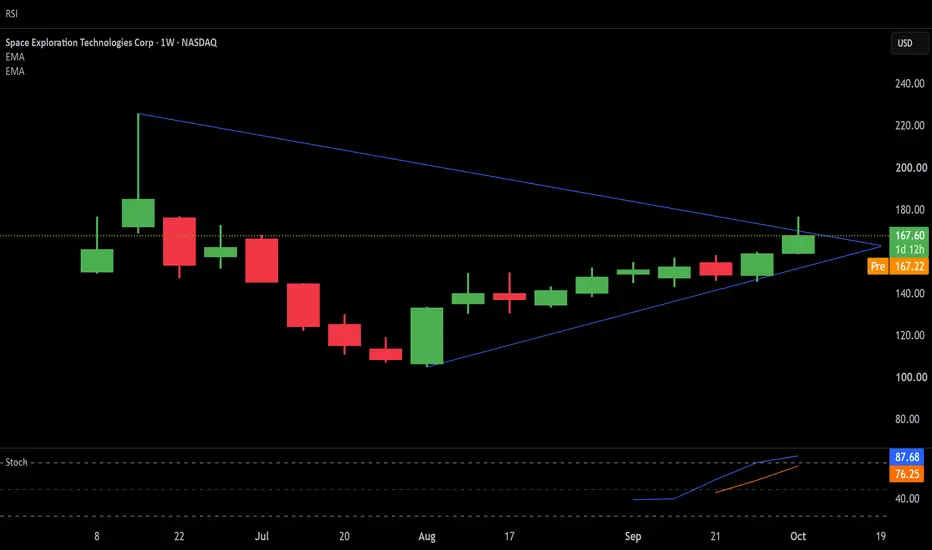
SpaceX stock closed at $171.09 on October 5, about 27% above its $135 IPO price and 24% below its $225.64 high. Two days later, the shares slid, and a key gauge of its credit risk hit a record after the Financial Times reported that SpaceX wants to borrow another $40 billion to buy Nvidia chips. A 328.4 million share unlock follows on October 9.
In our view, SpaceX now operates as a sovereign technology monolith that presents itself as an aerospace company. It owns the world's dominant launch business, the largest satellite constellation ever built, a classified spy satellite program and, since February, an artificial intelligence company that loses billions. Only one of those businesses makes money. This analysis examines what investors actually own.
The Numbers Behind SpaceX Stock
Start with the S-1, because it reshaped how markets see the company.
SpaceX filed its registration statement on May 20 and recast its 2025 results to include xAI, which it acquired in an all-stock deal in February that valued SpaceX at $1 trillion and xAI at $250 billion. Consolidated revenue rose 33% to $18.7 billion, but the company swung from a $791 million profit in 2024 to a $4.94 billion net loss. The 2025 segment breakdown reveals the internal divergence:
* Connectivity (Starlink): Generated $11.4 billion (61% of total revenue) with a $4.42 billion operating profit (39% margin).
* AI (xAI and X): Brought in $3.2 billion but posted a steep $6.36 billion operating loss.
* Space (Launch and Starship): Contributed roughly $4.1 billion but lost $657 million.
* Consolidated: Reached $18.7 billion in total revenue (up 33%), culminating in a $4.94 billion net loss.
Adjusted EBITDA reached $6.58 billion, and the AI segment consumed $12.7 billion of the company's $20.7 billion capital budget. Starlink is the only segment that makes money. The launch business, often described as a profit machine, lost money as Starship development absorbed its gains.
The pattern held after listing. Second-quarter revenue rose 92% to $7.8 billion, yet Starlink's $1.656 billion operating profit had to cover a $1.257 billion AI loss and a $542 million space loss.
The Bond Market Sends the Bill
The financing story moved from equity to debt within two weeks of the IPO.
SpaceX raised about $86 billion in its June IPO, the largest on record, then priced a $25 billion debut bond deal on June 22. It drew nearly $90 billion of orders and grew from an initial $20 billion target. The 2026 senior notes span five tranches:
Due 2031: $7.0 billion at 5.35%
Due 2033: $6.0 billion at 5.65%
Due 2036: $6.0 billion at 5.875%
Due 2046: $2.5 billion at 6.60%
Due 2056: $3.5 billion at 6.65%
Fitch rates the notes BBB+ and Moody's rates them Baa1. Demand did not translate into comfort. Investors crowded into the shorter maturities, the 10-year tranche priced at 140 basis points over Treasuries, and the bonds traded poorly in the secondary market. S&P expects SpaceX's cash drain to persist at least through 2030.
On October 6, the FT reported that SpaceX is in early talks to raise $40 billion more, about $10 billion from banks and $30 billion in investment-grade bonds, to buy Nvidia chips. Apollo is leading the effort, which may not close until 2027 and could still fall apart.
Credit markets reacted on October 7. The spread on the 2056 bonds widened 12 basis points to 238, against 175 at issue in June, and five-year credit default swaps rose to about 195 basis points, their highest level since trading began. Billionaire investor David Einhorn has criticized both the IPO valuation and the investment-grade rating.
The Lock-Up Calendar for SpaceX Stock
Share supply is the mechanical force acting on SpaceX stock, and SpaceX staged its schedule unusually.
Insiders did not wait until October to gain liquidity. SpaceX staggered its lock-up across nine tranches, and the first opened on August 6, when up to 911.5 million shares became eligible to trade. That single release more than doubled the public float. The full calendar of eligible unlocks proceeds as follows:
August 6, 2026: Up to 911.5 million shares
August 20 and September 9: Up to 319 million shares each
September 24: Up to 328.4 million shares
October 9: Up to 328.4 million shares
October 24: Up to 328.4 million shares
After third-quarter results: Up to 1.3 billion shares
December 8, 2026: Main 180-day expiry
June 12, 2027: Elon Musk's shares unlock
The stock has absorbed earlier releases better than feared. It rose 6% on the August unlock and slipped just 0.2% on September 24.
Control: One Man, Most of the Votes
The governance structure leaves no doubt about who decides.
After the IPO, Musk owns about 42% of SpaceX's shares but controls about 82% of the voting power through high-vote Class B stock. That makes SpaceX a controlled company under Nasdaq rules, which exempts it from certain board independence requirements. Gwynne Shotwell runs day-to-day operations as President and Chief Operating Officer, and Bret Johnsen serves as Chief Financial Officer.
Starshield and the Defense Advantage
The defense business is where SpaceX's strategic weight is clearest.
Its Starshield unit builds satellites for national security customers, including a proliferated network of reconnaissance satellites under a reported $1.8 billion National Reconnaissance Office contract. Former NORAD commander General Terrence O'Shaughnessy serves as a SpaceX vice president. Recent NRO missions underscore this cadence, with launches including NROL-146 (May 22, 2024), NROL-186 (June 2024), NROL-113 (September 2024), and NROL-57 (March 21, 2025).
NPR reports that SpaceX has won more than $8 billion of US defense contracts in 2026 alone, and the Pentagon also uses its Grok chatbot. On September 30, Defense Secretary Pete Hegseth named Musk, Anduril's Palmer Luckey and Newt Gingrich to lead Project Meridian, a 120-day study of AI-driven warfare that MITRE will run. Ethics experts, including former White House ethics lawyer Richard Painter, call the arrangement a conflict of interest.
In our view, Starshield shows how SpaceX bypasses the decade-long procurement cycles that defined legacy spy satellites. Hundreds of small, rapidly replaced satellites in low orbit are far harder to disable than a few large ones in high orbit. That model puts direct pressure on traditional primes such as Lockheed Martin and Boeing.
Launch Dominance and the Optical Mesh
Reusable rockets made SpaceX the price setter in launch.
SpaceX now flies more than 100 orbital missions a year, reusing first-stage boosters and landing them on autonomous drone ships. Expendable competitors such as United Launch Alliance and Arianespace struggle to match its pricing.
Its network advantage runs through space-based lasers. SpaceX reported more than 9,000 optical links in orbit by early 2024, carrying more than 42 petabytes of customer data a day. These links pass data directly between satellites, which reduces reliance on ground stations and limits exposure to jamming. The Space Development Agency has standardized optical links for government networks, which favors the operator with the most experience at scale.
Direct to Cell and the Spectrum Fight
The next battleground is your smartphone.
SpaceX began direct-to-cell service through T-Mobile, where today's satellites deliver roughly 4 Mbps, then bought 65 megahertz of nationwide spectrum from EchoStar for $17 billion. On October 6, the FCC approved its plan for 15,000 second-generation direct-to-cell satellites, which SpaceX says can deliver up to 150 Mbps per user. The order also lets SpaceX offer mobile service without a carrier partner, though it may use the EchoStar spectrum only for testing until that deal's second stage closes, scheduled for November 2027. Viasat, Globalstar, Iridium, SES, Eutelsat, and US astronomy groups opposed the application.
Starlink also took share in aviation and maritime connectivity, signing United Airlines to a fleet agreement in September 2024 and winning cruise operators including Royal Caribbean and Carnival.
The Vision Disconnect
Here the story moves from numbers to intent.
SpaceX's stated mission is to make humanity multiplanetary, and Mars inspires the engineers who build its rockets. In our view, that narrative also works as a powerful recruiting and public relations tool. Colonizing Mars does not require gigawatt AI data centers in Memphis, yet SpaceX absorbed xAI and now plans to borrow tens of billions for Nvidia chips.
We read the real objective as dominance over terrestrial data, communications, and logistics: a planetary-scale operating system funded by both government contracts and retail subscriptions. The xAI merger makes that ambition explicit.
Patents: What SpaceX Actually Owns
A widely shared analysis credited SpaceX with US Patent 10,170,843 on parabolic deployable antennas. Patent records show the California Institute of Technology owns it, from a team behind NASA's RainCube CubeSat antenna.
SpaceX's own filings tell a clearer story. US Patent 11,834,205 covers a spacecraft chassis that mounts heat-generating components directly to the body and radiates heat into space, a design suited to stacking many flat satellites per launch. In launch recovery, SpaceX challenged Blue Origin's sea-landing patent before the Patent Trial and Appeal Board in 2014, and it secures landed boosters with a robotic clamp known as the Octagrabber.
Space Science and Pharmaceuticals
Microgravity research is real, but coverage often overstates the commercial link.
Merck has run pembrolizumab crystallization experiments on the International Space Station since 2014. The FDA approved Keytruda Qlex, a subcutaneous version of the cancer drug, on September 19, 2025. That product relies on berahyaluronidase alfa, an enzyme Alteogen developed, to help the drug disperse under the skin. The ISS work informed Merck's formulation research, but space-grown crystals did not create the approved product.
Varda Space Industries, which launched its first drug-processing capsule on a Falcon 9, shows the opportunity. SpaceX carries much of this traffic, though it does not hold a monopoly, since Northrop Grumman's Cygnus also resupplies the station.
Orbital Traffic and Collision Risk
The constellation's size creates its own hazard.
SpaceX told the FCC that Starlink satellites performed 207,152 collision-avoidance maneuvers between December 2025 and May 2026, up from 148,696 in the prior six months. Across the year to May, they made more than 355,000 maneuvers, more than 40 per satellite, as the fleet passed 10,000 spacecraft. That works out to roughly one maneuver every 1.3 minutes. The system moves a satellite automatically when the collision probability exceeds 3 in 10 million.
University of Birmingham professor Hugh Lewis warned that a collision involving an operational Starlink satellite appears likely despite the maneuvers. SpaceX has applied to expand the constellation to 100,000 satellites. In mitigation, SpaceX designs its satellites to burn up fully on reentry and operates them at low altitudes, where failed spacecraft decay quickly.
Valuing SpaceX Stock
As of early October, the core valuation markers sit at:
Close (October 5): $171.09
IPO Price: $135
Record High: $225.64
52-Week Low: $104.83
Average Analyst Target: ~$235 (Strong Buy consensus)
Next Major Unlock: October 9 (328.4 million shares)
The bull case is the world's dominant launch business, a profitable Starlink growing fast, a defense franchise with deep government trust, and an AI platform that could compound in value. The bear case is a $4.94 billion annual loss, an AI segment that consumes most of the capital, a bond market that has turned skeptical, $40 billion of new borrowing under discussion, and steady insider supply through December.
The Risks That Matter for SpaceX Stock
AI cash burn: The AI segment lost $6.36 billion in 2025 and still loses more than a billion dollars a quarter.
Rising leverage: The $25 billion bond sale and the proposed $40 billion financing add decades of obligations, and credit default swaps just hit a record.
Share supply: Staged unlocks continue through December 8, with Musk's stake following in June 2027.
Key-person risk: Musk controls about 82% of the vote.
Starship execution: The space segment still loses money while Starship matures.
Regulation: Spectrum fights and orbital congestion rules could slow growth.
Political exposure: Government contracts, licenses, and Musk's Project Meridian role tie the business to policy shifts and ethics scrutiny.
Closing Thoughts
SpaceX has built assets no competitor can match: reusable rockets that set global launch prices, a laser-linked constellation of more than 10,000 satellites, a national security franchise in Starshield, and an AI business with global ambition. Starlink alone earned $4.42 billion of operating profit last year.
The verdict rests on one question: can Starlink's profits and the bond market keep funding an AI build-out that consumes most of the company's capital? Watch four markers: the October 9 and October 24 unlocks, the terms of the $40 billion financing, third-quarter segment results, and any Starship progress that turns the space segment profitable. In our view, SpaceX is the ultimate sovereign tech play. The open question is whether investors are paying for the parts that work or the parts that burn.

Stock N Roll!
Disclaimer
The information and publications are not meant to be, and do not constitute, financial, investment, trading, or other types of advice or recommendations supplied or endorsed by TradingView. Read more in the Terms of Use.
Stock N Roll!
Disclaimer
The information and publications are not meant to be, and do not constitute, financial, investment, trading, or other types of advice or recommendations supplied or endorsed by TradingView. Read more in the Terms of Use.