 S&P 500 Index
Education
Editors' picks
Why Markets Move Before the News Happens (And How to Trade That)
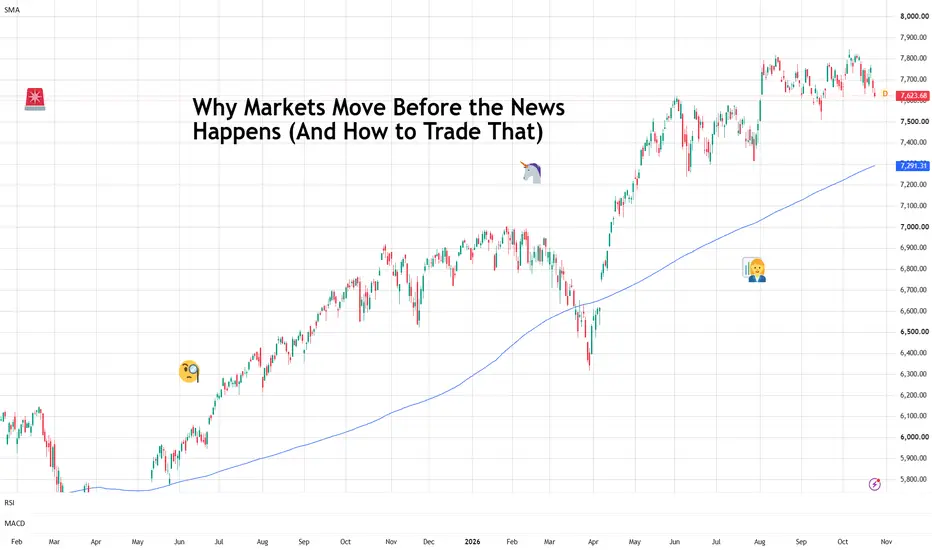
What to do when the market seems to know the news already?
You've probably seen it happen. A company is expected to report excellent earnings, its shares rally for weeks and analysts become increasingly optimistic. Then the company delivers exactly the strong results everyone anticipated, only for its stock to dive.
The same thing happens with Federal Reserve decisions USINTR, inflation reports USCPI and major product launches (Apple says hi).
It can be confusing, particularly when the headlines seem overwhelmingly positive. But there's a useful explanation: financial markets spend much of their time anticipating what might happen next.
Understanding how those expectations influence prices can help traders make better sense of market reactions, especially around major economic events.
🔮 Markets Think in Future Terms
When you buy a stock, you're paying for a share of a company's future earnings, not simply what it earned yesterday. Similarly, currency traders consider where interest rates might be heading, while commodity prices reflect expectations about future supply and demand.
This forward-looking behavior explains why markets rarely wait for an official announcement before reacting.
Imagine economists expect the Federal Reserve to cut interest rates at its next meeting. Investors may begin buying stocks and bonds weeks in advance, anticipating that lower borrowing costs will support economic activity and asset prices.
By the time the Fed actually announces the cut, much of the expected benefit may already be reflected in market prices. The next Fed decision is coming this week; are you paying attention to the Economic calendar?
This is what traders mean when they say something is priced in. The market has already adjusted to an anticipated outcome, at least to some extent.
The important detail is that expectations are rarely unanimous. Different investors assign different probabilities to possible outcomes, and those probabilities change as new information becomes available.
📊 It's the Surprise That Matters
Consider an upcoming inflation report. Economists expect annual inflation of 3%, compared with 3.5% the previous month. On the surface, a reading of 3.2% would still represent an improvement.
But markets might react negatively because inflation was higher than the 3% investors had anticipated.
Conversely, a reading of 2.8% could encourage buying, even though prices are still rising across the economy.
The difference between the expected result and the actual result is known as an economic surprise. It's often more important for short-term market movements than whether the headline number looks good or bad on its own.
Research from the Federal Reserve Bank of New York has examined how stocks, bonds and currencies respond to these unexpected components of economic announcements.
The same principle applies to earnings. A company might report 40% profit growth and still disappoint investors if expectations were closer to 50%.
This helps explain why strong results don't always produce strong stock performance. Because new data gets measured against an expectation, not a prior result.
💰 "Buy the Rumor, Sell the News"
One of Wall Street's oldest expressions describes another interesting market behavior.
"Buy the rumor, sell the news" refers to situations where traders buy an asset ahead of an anticipated positive development, then sell once that development is confirmed.
Imagine a technology company preparing to unveil a highly anticipated product. Investors expect strong demand, analysts raise their forecasts and the share price climbs 20% in the weeks leading up to the announcement.
When the product finally launches, the company delivers everything it promised. Yet the stock declines.
One possible explanation is that investors who bought earlier are taking profits. With the anticipated event now behind them, some decide to close their positions rather than wait for another catalyst.
This selling can outweigh new buying interest, even when the announcement itself is positive.
Of course, this pattern isn't inevitable. A genuinely unexpected development can push prices much higher, while disappointing news can accelerate an existing decline.
🧠 Positioning Can Change Everything
There's another factor that traders sometimes overlook: how much money has already been committed to a particular outcome.
This is called market positioning, and it describes the investments traders have made based on their expectations.
Suppose most investors expect the US dollar DXY to strengthen because US interest rates USINTR are likely to remain elevated. Many traders may already hold long dollar positions, meaning they've bought the currency expecting it to appreciate.
If the Fed confirms that rates will remain high, the dollar might barely move. Investors who wanted exposure may already have it.
But if the Fed unexpectedly signals a softer policy outlook, those positions could become uncomfortable very quickly.
As traders unwind dollar bets to reduce their exposure, the resulting selling pressure can amplify the currency's decline.
The same dynamic affects the S&P 500SPX, gold  XAUUSD, Bitcoin
 BTCUSD and other assets. When too many investors are positioned for the same outcome, even a relatively small surprise can trigger a substantial move.
🎯 How Can Traders Use This?
Understanding expectations doesn't mean you need to predict every announcement. It means looking beyond the headline to consider what investors were expecting beforehand.
Before a major event, it's worth checking analysts' forecasts, recent price movements and whether an asset has already enjoyed a substantial rally or selloff.
After the announcement, consider whether the result genuinely changed the outlook. Did the company raise its future guidance? Did the Fed signal a different interest-rate path? Was the inflation surprise large enough to influence monetary policy?
It's also worth allowing for volatility. Prices can move sharply in both directions immediately after important releases as traders process new information and adjust their positions.
Sometimes waiting for the initial reaction to settle provides a clearer picture than trying to anticipate the first move.
Off to you: How do you approach news-based trading? Do you wait for the event to drop first and then make your move, or do you build your position beforehand?
You've probably seen it happen. A company is expected to report excellent earnings, its shares rally for weeks and analysts become increasingly optimistic. Then the company delivers exactly the strong results everyone anticipated, only for its stock to dive.
The same thing happens with Federal Reserve decisions
USINTR, inflation reports USCPI and major product launches (Apple says hi).It can be confusing, particularly when the headlines seem overwhelmingly positive. But there's a useful explanation: financial markets spend much of their time anticipating what might happen next.
Understanding how those expectations influence prices can help traders make better sense of market reactions, especially around major economic events.
🔮 Markets Think in Future Terms
When you buy a stock, you're paying for a share of a company's future earnings, not simply what it earned yesterday. Similarly, currency traders consider where interest rates might be heading, while commodity prices reflect expectations about future supply and demand.
This forward-looking behavior explains why markets rarely wait for an official announcement before reacting.
Imagine economists expect the Federal Reserve to cut interest rates at its next meeting. Investors may begin buying stocks and bonds weeks in advance, anticipating that lower borrowing costs will support economic activity and asset prices.
By the time the Fed actually announces the cut, much of the expected benefit may already be reflected in market prices. The next Fed decision is coming this week; are you paying attention to the Economic calendar?
This is what traders mean when they say something is priced in. The market has already adjusted to an anticipated outcome, at least to some extent.
The important detail is that expectations are rarely unanimous. Different investors assign different probabilities to possible outcomes, and those probabilities change as new information becomes available.
📊 It's the Surprise That Matters
Consider an upcoming inflation report. Economists expect annual inflation of 3%, compared with 3.5% the previous month. On the surface, a reading of 3.2% would still represent an improvement.
But markets might react negatively because inflation was higher than the 3% investors had anticipated.
Conversely, a reading of 2.8% could encourage buying, even though prices are still rising across the economy.
The difference between the expected result and the actual result is known as an economic surprise. It's often more important for short-term market movements than whether the headline number looks good or bad on its own.
Research from the Federal Reserve Bank of New York has examined how stocks, bonds and currencies respond to these unexpected components of economic announcements.
The same principle applies to earnings. A company might report 40% profit growth and still disappoint investors if expectations were closer to 50%.
This helps explain why strong results don't always produce strong stock performance. Because new data gets measured against an expectation, not a prior result.
💰 "Buy the Rumor, Sell the News"
One of Wall Street's oldest expressions describes another interesting market behavior.
"Buy the rumor, sell the news" refers to situations where traders buy an asset ahead of an anticipated positive development, then sell once that development is confirmed.
Imagine a technology company preparing to unveil a highly anticipated product. Investors expect strong demand, analysts raise their forecasts and the share price climbs 20% in the weeks leading up to the announcement.
When the product finally launches, the company delivers everything it promised. Yet the stock declines.
One possible explanation is that investors who bought earlier are taking profits. With the anticipated event now behind them, some decide to close their positions rather than wait for another catalyst.
This selling can outweigh new buying interest, even when the announcement itself is positive.
Of course, this pattern isn't inevitable. A genuinely unexpected development can push prices much higher, while disappointing news can accelerate an existing decline.
🧠 Positioning Can Change Everything
There's another factor that traders sometimes overlook: how much money has already been committed to a particular outcome.
This is called market positioning, and it describes the investments traders have made based on their expectations.
Suppose most investors expect the US dollar
DXY to strengthen because US interest rates USINTR are likely to remain elevated. Many traders may already hold long dollar positions, meaning they've bought the currency expecting it to appreciate.If the Fed confirms that rates will remain high, the dollar might barely move. Investors who wanted exposure may already have it.
But if the Fed unexpectedly signals a softer policy outlook, those positions could become uncomfortable very quickly.
As traders unwind dollar bets to reduce their exposure, the resulting selling pressure can amplify the currency's decline.
The same dynamic affects the S&P 500
SPX, gold XAUUSD, Bitcoin BTCUSD and other assets. When too many investors are positioned for the same outcome, even a relatively small surprise can trigger a substantial move.🎯 How Can Traders Use This?
Understanding expectations doesn't mean you need to predict every announcement. It means looking beyond the headline to consider what investors were expecting beforehand.
Before a major event, it's worth checking analysts' forecasts, recent price movements and whether an asset has already enjoyed a substantial rally or selloff.
After the announcement, consider whether the result genuinely changed the outlook. Did the company raise its future guidance? Did the Fed signal a different interest-rate path? Was the inflation surprise large enough to influence monetary policy?
It's also worth allowing for volatility. Prices can move sharply in both directions immediately after important releases as traders process new information and adjust their positions.
Sometimes waiting for the initial reaction to settle provides a clearer picture than trying to anticipate the first move.
Off to you: How do you approach news-based trading? Do you wait for the event to drop first and then make your move, or do you build your position beforehand?

Share TradingView with a friend:
tradingview.com/share-your-love/
Check out all #tradingviewtips
tradingview.com/ideas/tradingviewtips/?type=education
New Tools and Features:
tradingview.com/blog/en/
tradingview.com/share-your-love/
Check out all #tradingviewtips
tradingview.com/ideas/tradingviewtips/?type=education
New Tools and Features:
tradingview.com/blog/en/
Related publications
Disclaimer
The information and publications are not meant to be, and do not constitute, financial, investment, trading, or other types of advice or recommendations supplied or endorsed by TradingView. Read more in the Terms of Use.