
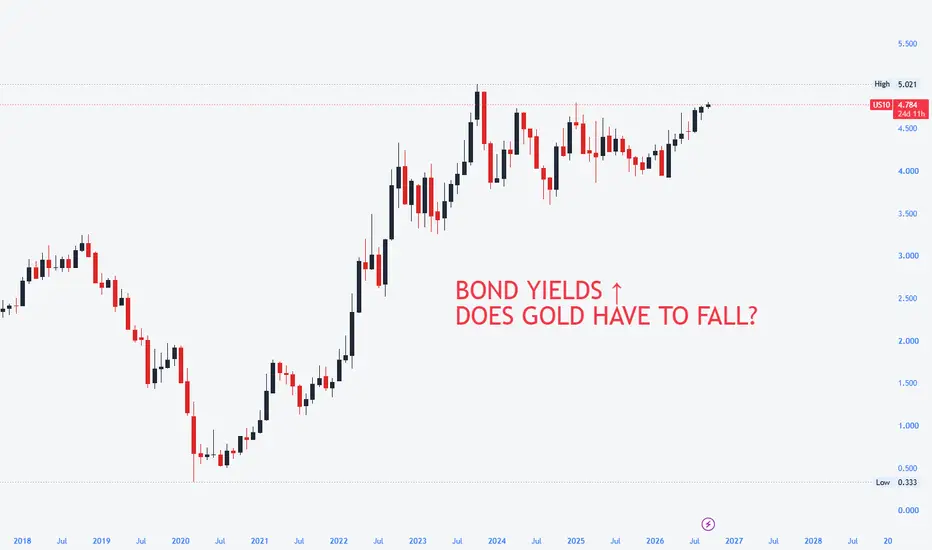
XAUUSD: Rising Bond Yields Do Not Necessarily Mean Gold Will Fall
Traders are often familiar with a simple formula:
Rising bond yields → Gold falls.
Falling bond yields → Gold rises.
Because bonds pay interest, while gold does not.
But the market is not always that simple.
What Are Yields?
Let’s use a simple example.
You buy a house for approximately $670,000 and rent it out for approximately $1,025 per month.
In one year, the income you receive is:
$1,025 × 12 months = $12,300 per year
The formula is:
Yield = Annual income ÷ Asset value
Therefore:
$12,300 ÷ $670,000 ≈ 1.84% per year
Simply put:
You invest approximately $670,000 and earn approximately $12,300 per year → the yield is approximately 1.84%.
What Happens If the House Price Changes?
Assume the rental income remains approximately $12,300 per year.
But the house price falls from approximately $670,000 to $395,000.
Now:
$12,300 ÷ $395,000 ≈ 3.12%
The house price falls → The yield rises.
Conversely, if the house price increases:
The asset price rises → The yield falls.
Bonds work in a similar way:
Bond prices fall → Yields rise.
Bond prices rise → Yields fall.
But This Is What Matters for Gold Traders:
Don’t Just Ask:
Are yields rising or falling?
Ask:
WHY ARE YIELDS CHANGING?
Case 1: Yields Rise Because the Economy Is Strong
For example:
The U.S. economy is performing well.
The labor market is strong.
Inflation is high.
The market believes the Fed will keep interest rates higher for longer.
In that case:
Bond yields rise.
Gold may come under pressure.
This is the scenario traders commonly encounter.
But There Is Another Scenario:
Yields are still rising.
But not because the economy is strong.
Instead, the market is becoming increasingly concerned about:
Inflation.
Government debt.
Budget deficits.
The government needing to borrow too much money.
Investors may start thinking:
“If you want me to lend you money for 10 or 30 years, the current yield is not attractive enough.”
They demand higher yields.
And:
Bond prices fall → Yields rise.
Yields are still rising.
But the story behind the move is completely different.
And That Is When Gold Does Not Necessarily Have to Fall.
Because this time, rising yields may be accompanied by:
MARKET ANXIETY.
If investors become increasingly concerned about:
Government debt.
Budget deficits.
Inflation.
Financial risks.
Then gold may still attract buying interest.
Conversely, Falling Yields Do Not Necessarily Mean Gold Will Rise Solely Because of Interest Rates.
We must also ask:
WHY ARE YIELDS FALLING?
If yields fall because the market expects the Fed to cut interest rates:
→ This may support gold.
But if yields fall because money is flowing into bonds as a safe haven amid market fears:
→ Gold may rise as well.
CONCLUSION
Rising bond yields do not necessarily mean gold will definitely fall.
Falling bond yields do not necessarily mean gold will definitely rise.
The same change in yields...
But the underlying reasons can be completely different.
As a trader, don’t just look at the number.
Look at why the number is changing.
And the most important question is always:
WHY?
What is the market expecting?
Or:
What is the market worried about?

Disclaimer
The information and publications are not meant to be, and do not constitute, financial, investment, trading, or other types of advice or recommendations supplied or endorsed by TradingView. Read more in the Terms of Use.
Disclaimer
The information and publications are not meant to be, and do not constitute, financial, investment, trading, or other types of advice or recommendations supplied or endorsed by TradingView. Read more in the Terms of Use.