

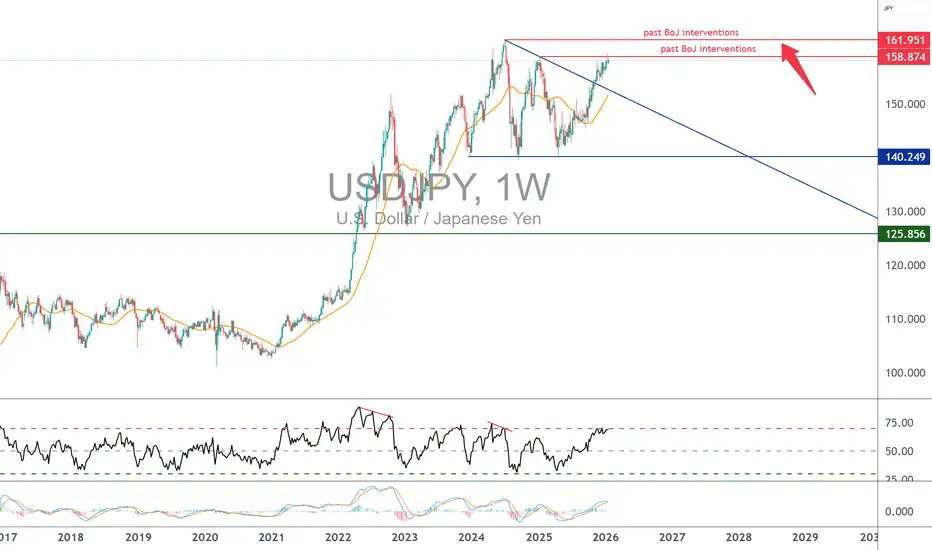
Japanese government bond yields have continued their sharp upward move, as Japan’s fiscal policy raises concerns in a country where public debt exceeds 250% of GDP. Meanwhile, the Japanese yen (JPY) remains at very low levels on the foreign exchange market, levels that have historically triggered intervention by Japanese authorities.
It is essential to keep the following two factors in mind:
• It is the Japanese government that decides on a foreign exchange market intervention, while the central bank (BoJ) executes it.
• Regarding a potential intervention to curb rising interest rates, the decision and execution rest solely with the central bank, as this falls strictly within monetary policy.

The rise in Japanese interest rates has entered a near-vertical phase, which could represent a major risk for the country’s debt dynamics. At the same time, the weakness of the yen (an upward trend in USD/JPY) poses a significant risk in terms of imported inflation and international investment attractiveness.
Taken together, these fundamental elements make an intervention by Japanese authorities increasingly likely, aimed at slowing the rise in yields and supporting the yen, especially as USD/JPY approaches the 162 level. Previous interventions by the Bank of Japan have had a strong bearish impact on USD/JPY.
However, it is crucial to distinguish between the probability of an intervention and its actual effectiveness. In the bond market, the Bank of Japan now finds itself in a delicate position. After years of yield curve control and massive purchases of Japanese government bonds, its balance sheet remains extremely large, limiting its room for maneuver without undermining the credibility of the ongoing monetary normalization. An overly aggressive intervention to contain long-term yields could be interpreted as a disguised return to yield control, sending contradictory signals to the market.

In the foreign exchange market, the situation is equally complex. A USD/JPY level close to 160–162 clearly represents a zone of political and social stress, as it amplifies imported price inflation, particularly for energy and food. However, as long as yen weakness is perceived as the direct consequence of interest rate differentials with the United States, rather than a disorderly move, authorities remain reluctant to intervene repeatedly. Past interventions have shown mainly short-term effectiveness, without durably altering the underlying trend.
Another key element lies in the yen carry trade. The combination of sharply rising Japanese interest rates and a persistently weak yen increases the risk of an abrupt unwinding of carry trade positions on a global scale. Such a scenario could trigger significant volatility across equity, bond and currency markets, well beyond Japan itself. It is precisely this systemic risk that could prompt the BoJ to intervene in a targeted manner if market moves become too rapid or disorderly.
In summary, an intervention remains possible but conditional. On interest rates, the BoJ would intervene only to preserve financial stability, not to defend a specific level. On the yen, the government could act if the psychological threshold of 160–162 JPY were crossed in a chaotic manner. In both cases, the message would be clear: curb excesses without calling into question the transition toward a more normalized monetary regime.
DISCLAIMER:
This content is intended for individuals who are familiar with financial markets and instruments and is for information purposes only. The presented idea (including market commentary, market data and observations) is not a work product of any research department of Swissquote or its affiliates. This material is intended to highlight market action and does not constitute investment, legal or tax advice. If you are a retail investor or lack experience in trading complex financial products, it is advisable to seek professional advice from licensed advisor before making any financial decisions.
This content is not intended to manipulate the market or encourage any specific financial behavior.
Swissquote makes no representation or warranty as to the quality, completeness, accuracy, comprehensiveness or non-infringement of such content. The views expressed are those of the consultant and are provided for educational purposes only. Any information provided relating to a product or market should not be construed as recommending an investment strategy or transaction. Past performance is not a guarantee of future results.
Swissquote and its employees and representatives shall in no event be held liable for any damages or losses arising directly or indirectly from decisions made on the basis of this content.
The use of any third-party brands or trademarks is for information only and does not imply endorsement by Swissquote, or that the trademark owner has authorised Swissquote to promote its products or services.
Swissquote is the marketing brand for the activities of Swissquote Bank Ltd (Switzerland) regulated by FINMA, Swissquote Capital Markets Limited regulated by CySEC (Cyprus), Swissquote Bank Europe SA (Luxembourg) regulated by the CSSF, Swissquote Ltd (UK) regulated by the FCA, Swissquote Financial Services (Malta) Ltd regulated by the Malta Financial Services Authority, Swissquote MEA Ltd. (UAE) regulated by the Dubai Financial Services Authority, Swissquote Pte Ltd (Singapore) regulated by the Monetary Authority of Singapore, Swissquote Asia Limited (Hong Kong) licensed by the Hong Kong Securities and Futures Commission (SFC) and Swissquote South Africa (Pty) Ltd supervised by the FSCA.
Products and services of Swissquote are only intended for those permitted to receive them under local law.
All investments carry a degree of risk. The risk of loss in trading or holding financial instruments can be substantial. The value of financial instruments, including but not limited to stocks, bonds, cryptocurrencies, and other assets, can fluctuate both upwards and downwards. There is a significant risk of financial loss when buying, selling, holding, staking, or investing in these instruments. SQBE makes no recommendations regarding any specific investment, transaction, or the use of any particular investment strategy.
CFDs are complex instruments and come with a high risk of losing money rapidly due to leverage. The vast majority of retail client accounts suffer capital losses when trading in CFDs. You should consider whether you understand how CFDs work and whether you can afford to take the high risk of losing your money.
Digital Assets are unregulated in most countries and consumer protection rules may not apply. As highly volatile speculative investments, Digital Assets are not suitable for investors without a high-risk tolerance. Make sure you understand each Digital Asset before you trade.
Cryptocurrencies are not considered legal tender in some jurisdictions and are subject to regulatory uncertainties.
The use of Internet-based systems can involve high risks, including, but not limited to, fraud, cyber-attacks, network and communication failures, as well as identity theft and phishing attacks related to crypto-assets.
It is essential to keep the following two factors in mind:
• It is the Japanese government that decides on a foreign exchange market intervention, while the central bank (BoJ) executes it.
• Regarding a potential intervention to curb rising interest rates, the decision and execution rest solely with the central bank, as this falls strictly within monetary policy.
The rise in Japanese interest rates has entered a near-vertical phase, which could represent a major risk for the country’s debt dynamics. At the same time, the weakness of the yen (an upward trend in USD/JPY) poses a significant risk in terms of imported inflation and international investment attractiveness.
Taken together, these fundamental elements make an intervention by Japanese authorities increasingly likely, aimed at slowing the rise in yields and supporting the yen, especially as USD/JPY approaches the 162 level. Previous interventions by the Bank of Japan have had a strong bearish impact on USD/JPY.
However, it is crucial to distinguish between the probability of an intervention and its actual effectiveness. In the bond market, the Bank of Japan now finds itself in a delicate position. After years of yield curve control and massive purchases of Japanese government bonds, its balance sheet remains extremely large, limiting its room for maneuver without undermining the credibility of the ongoing monetary normalization. An overly aggressive intervention to contain long-term yields could be interpreted as a disguised return to yield control, sending contradictory signals to the market.
In the foreign exchange market, the situation is equally complex. A USD/JPY level close to 160–162 clearly represents a zone of political and social stress, as it amplifies imported price inflation, particularly for energy and food. However, as long as yen weakness is perceived as the direct consequence of interest rate differentials with the United States, rather than a disorderly move, authorities remain reluctant to intervene repeatedly. Past interventions have shown mainly short-term effectiveness, without durably altering the underlying trend.
Another key element lies in the yen carry trade. The combination of sharply rising Japanese interest rates and a persistently weak yen increases the risk of an abrupt unwinding of carry trade positions on a global scale. Such a scenario could trigger significant volatility across equity, bond and currency markets, well beyond Japan itself. It is precisely this systemic risk that could prompt the BoJ to intervene in a targeted manner if market moves become too rapid or disorderly.
In summary, an intervention remains possible but conditional. On interest rates, the BoJ would intervene only to preserve financial stability, not to defend a specific level. On the yen, the government could act if the psychological threshold of 160–162 JPY were crossed in a chaotic manner. In both cases, the message would be clear: curb excesses without calling into question the transition toward a more normalized monetary regime.
DISCLAIMER:
This content is intended for individuals who are familiar with financial markets and instruments and is for information purposes only. The presented idea (including market commentary, market data and observations) is not a work product of any research department of Swissquote or its affiliates. This material is intended to highlight market action and does not constitute investment, legal or tax advice. If you are a retail investor or lack experience in trading complex financial products, it is advisable to seek professional advice from licensed advisor before making any financial decisions.
This content is not intended to manipulate the market or encourage any specific financial behavior.
Swissquote makes no representation or warranty as to the quality, completeness, accuracy, comprehensiveness or non-infringement of such content. The views expressed are those of the consultant and are provided for educational purposes only. Any information provided relating to a product or market should not be construed as recommending an investment strategy or transaction. Past performance is not a guarantee of future results.
Swissquote and its employees and representatives shall in no event be held liable for any damages or losses arising directly or indirectly from decisions made on the basis of this content.
The use of any third-party brands or trademarks is for information only and does not imply endorsement by Swissquote, or that the trademark owner has authorised Swissquote to promote its products or services.
Swissquote is the marketing brand for the activities of Swissquote Bank Ltd (Switzerland) regulated by FINMA, Swissquote Capital Markets Limited regulated by CySEC (Cyprus), Swissquote Bank Europe SA (Luxembourg) regulated by the CSSF, Swissquote Ltd (UK) regulated by the FCA, Swissquote Financial Services (Malta) Ltd regulated by the Malta Financial Services Authority, Swissquote MEA Ltd. (UAE) regulated by the Dubai Financial Services Authority, Swissquote Pte Ltd (Singapore) regulated by the Monetary Authority of Singapore, Swissquote Asia Limited (Hong Kong) licensed by the Hong Kong Securities and Futures Commission (SFC) and Swissquote South Africa (Pty) Ltd supervised by the FSCA.
Products and services of Swissquote are only intended for those permitted to receive them under local law.
All investments carry a degree of risk. The risk of loss in trading or holding financial instruments can be substantial. The value of financial instruments, including but not limited to stocks, bonds, cryptocurrencies, and other assets, can fluctuate both upwards and downwards. There is a significant risk of financial loss when buying, selling, holding, staking, or investing in these instruments. SQBE makes no recommendations regarding any specific investment, transaction, or the use of any particular investment strategy.
CFDs are complex instruments and come with a high risk of losing money rapidly due to leverage. The vast majority of retail client accounts suffer capital losses when trading in CFDs. You should consider whether you understand how CFDs work and whether you can afford to take the high risk of losing your money.
Digital Assets are unregulated in most countries and consumer protection rules may not apply. As highly volatile speculative investments, Digital Assets are not suitable for investors without a high-risk tolerance. Make sure you understand each Digital Asset before you trade.
Cryptocurrencies are not considered legal tender in some jurisdictions and are subject to regulatory uncertainties.
The use of Internet-based systems can involve high risks, including, but not limited to, fraud, cyber-attacks, network and communication failures, as well as identity theft and phishing attacks related to crypto-assets.

This content is written by Vincent Ganne for Swissquote.
This content is intended for individuals who are familiar with financial markets and instruments and is for information purposes only and does not constitute investment, legal or tax advice.
This content is intended for individuals who are familiar with financial markets and instruments and is for information purposes only and does not constitute investment, legal or tax advice.
Disclaimer
The information and publications are not meant to be, and do not constitute, financial, investment, trading, or other types of advice or recommendations supplied or endorsed by TradingView. Read more in the Terms of Use.