

The Investment Theme Outlook for 2026 (Ep.6/12)
Why the Norwegian Krone (USDNOK) Deserves Attention in 2026
This series consists of 12 research articles covering 12 instruments. Each episode combines fundamental and technical analysis to build a structured investment outlook for 2026.
This is Episode 6, focusing on the Norwegian krone (USDNOK) and the key drivers likely to shape its performance throughout 2026.
Macro Analysis
1. When investors think about defensive currencies in Europe, the Swiss franc often comes to mind first. However, for those looking beyond traditional safe havens, the Norwegian krone (NOK) stands out for a different reason: its underlying national balance sheet is exceptionally strong. Norway combines low public debt, a massive sovereign wealth fund, persistent external surpluses, and high-quality human capital, giving NOK one of the strongest long-term fundamental backdrops in Europe.
2. One of Norway’s biggest strengths is its fiscal credibility. The country’s public debt remains relatively low by developed-market standards, with the IMF noting debt at around 44% of GDP in the latest assessment. More importantly, Norway has built a strong policy framework around long-term resource management rather than short-term spending, which reinforces confidence in the country’s macro stability.
3. Another major pillar behind NOK is Norway’s Government Pension Fund Global, the world’s largest sovereign wealth fund. According to NBIM, the fund’s value stood at NOK 21,268 billion at the end of 2025. This gives Norway an extraordinary financial buffer and helps explain why investors often view the country as fundamentally stronger than many of its regional peers. In simple terms, Norway is not just a commodity exporter — it is a country that has converted commodity wealth into enduring national wealth.
4. Externally, Norway also remains very strong. The IMF reported that the country’s current account surplus reached 16.7% of GDP in 2024, following a decade-long average surplus of around 10.9% of GDP. That matters for currency investors because it means Norway consistently earns more from the rest of the world than it spends abroad, which is a structurally supportive factor for NOK over time.
5. Norway’s economy also benefits from its role as a key energy exporter, particularly to Europe. This gives NOK a natural link to oil and gas prices, making it one of the region’s clearest commodity-backed currencies. That advantage is especially relevant now, as energy prices are likely to remain elevated amid the conflict in the Middle East. In this environment, Norway may be well positioned to maintain high production and help offset supply disruptions from conflict-affected areas. As a result, NOK could benefit from stronger trade dynamics, improved fiscal revenues, and a further strengthening of the country’s balance sheet.
6. Looking ahead, the growth outlook remains constructive rather than spectacular. OECD projections show mainland GDP expanding by around 1.7% in 2025 and 1.9% in 2026, suggesting that even as petroleum activity gradually normalises, domestic demand and household income should continue to support the economy. This matters because it shows Norway is not purely dependent on oil; it still has a credible non-oil domestic foundation.
7. In summary, the Norwegian krone is attractive not because it is Europe’s safe haven, but because it is backed by one of the strongest national balance sheets in the region. Low public debt, a massive sovereign wealth fund, large external surpluses, strong energy revenues, and high-quality human capital all provide NOK with a solid long-term foundation. For investors, this makes NOK an appealing currency in periods when markets reward fundamental strength, commodity support, and fiscal credibility.
Technical analysis
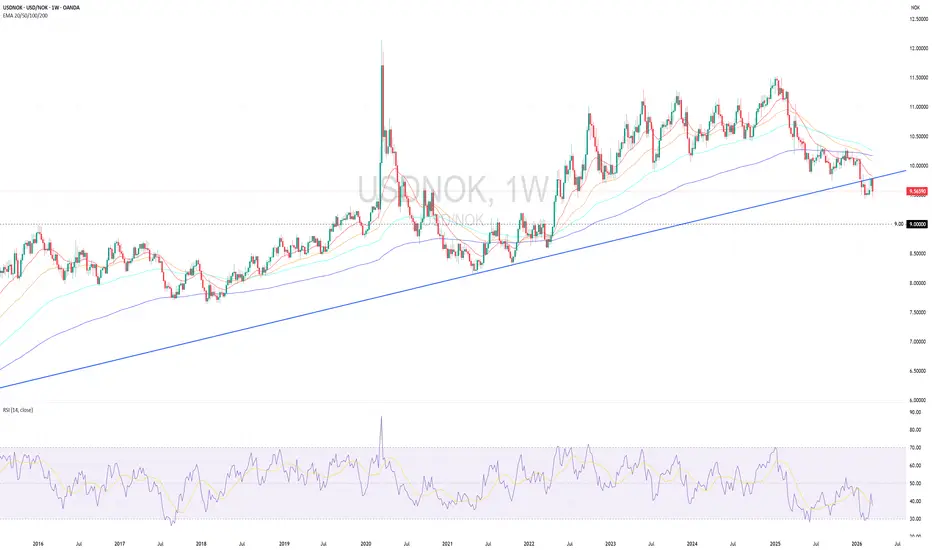
8. USDNOK had remained in a long-term uptrend above its ascending trendline since 2012. However, from early 2025, the pair began to decline, and by early 2026, USDNOK had broken below the ascending trendline. This signaled a confirmed long-term bearish reversal, supported by a bearish EMA stack and the formation of lower swings.
9. The break below the trendline was followed by a pullback to retest the breakout trendline, but the pair failed to move back above it, reinforcing the signal of bearish continuation.
10. If USDNOK cannot reclaim and hold above the ascending trendline, the next downside target is 9.00.
In the next epsode, we will present another safe-haven currency whose outlook going forward remains uncertain.
Analysis by: Krisada Yoonaisil, Financial Markets Strategist at Exness

Disclaimer
The information and publications are not meant to be, and do not constitute, financial, investment, trading, or other types of advice or recommendations supplied or endorsed by TradingView. Read more in the Terms of Use.
Disclaimer
The information and publications are not meant to be, and do not constitute, financial, investment, trading, or other types of advice or recommendations supplied or endorsed by TradingView. Read more in the Terms of Use.