

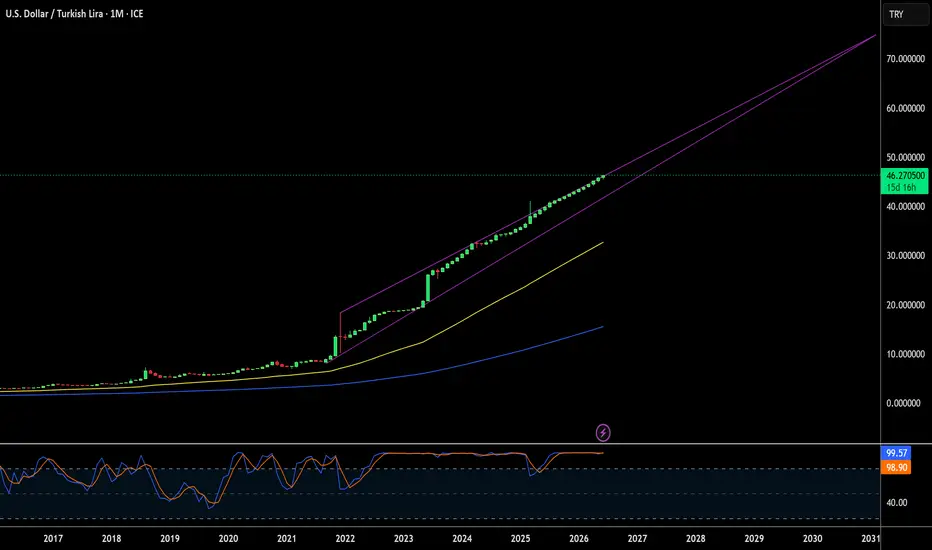
The Turkish lira has slid to a record low beyond 46 per dollar, leaving the Central Bank of the Republic of Turkey to defend it with an unusually blunt tool. The bank has held its policy rate at 37% for three straight meetings, with effective funding costs sitting near 40% as overnight lending stays elevated. That stance is built to break a persistent inflation cycle and reward holders of lira assets. The open question is whether rates this high can deliver genuine stability or merely slow a managed depreciation.
The macro backdrop offers a cautious positive. Turkey's current account deficit narrowed to $5.7 billion in April, helped by lower gold imports and a tighter goods trade gap, and the annualized shortfall fell for the first time since September 2025. Even so, the structural imbalances remain firmly in place. Inflation is still elevated, real rates are thin, and Deutsche Bank projects USD/TRY near 52 by year-end. The improvement is real, but it rests on a fragile base.
The lira's appeal sits almost entirely in the carry trade. Its wide rate gap makes it one of the most attractive high-yield positions in emerging markets, yet that crowded positioning is exactly what makes it dangerous. A regional shock this spring triggered the unwinding of roughly $15 billion in carry positions before an April truce restored calm and tempted investors back. Each round of inflows lifts the currency, and each shock forces a violent exit. This reflexivity, not the headline rate, is the lira's defining risk.
Politics and geopolitics ultimately set the ceiling. Renewed tension in the Middle East has lifted energy prices and fed back into Turkish inflation, while domestic political friction has tested the central bank's credibility just as it tries to anchor expectations. For now, a 37% rate buys time and a yield cushion, not a cure. Durable stability will require sustained disinflation and fiscal discipline, and until those arrive, the lira stays a high-reward position with a fat tail.

The5ers Funding Forex Traders & Growth Program. Get Funded with up to $2.56M
We Trade Forex - Come Join Us!
the5ers.com
We Trade Forex - Come Join Us!
the5ers.com
Disclaimer
The information and publications are not meant to be, and do not constitute, financial, investment, trading, or other types of advice or recommendations supplied or endorsed by TradingView. Read more in the Terms of Use.