
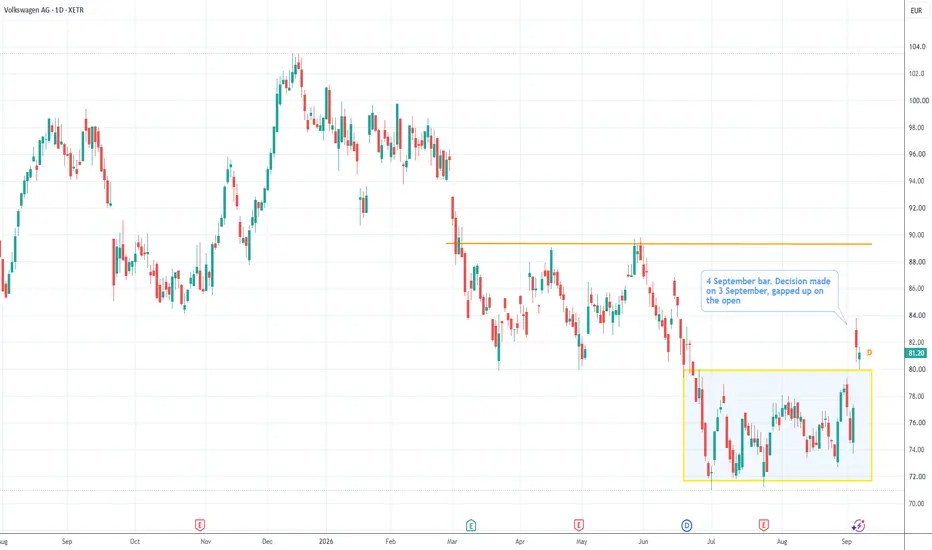
Last Thursday evening, Volkswagen's supervisory board unanimously approved Zukunftsplan 2030 — the Future Plan. On Friday the shares closed up about 6.5% at €81.30, the strongest name in the Stoxx 600 that day.
Nothing about the company's earnings changed in those 24 hours. What changed was that a room full of people who had been unable to agree, agreed.
What was approved
Around 50,000 further positions go, management included, on top of roughly 50,000 already agreed since late 2024. The model portfolio gets cut by about half by 2035 and offering complexity by around 75% — fewer nameplates, higher volume per model, shared platforms and electronics. Capital tightens, with the 2027–2031 capex and R&D budget set below the previous planning round, and the portfolio of shareholdings slimmed by roughly a third.
The target is nine million vehicles and a nine percent operating margin by 2030. VW's operating margin in the first half of 2026 was 3.8%.
Two things were deferred, and they were the two that would have been hardest politically: a possible spin-off of the core Volkswagen brand, and immediate plant closures. Europe carries more than 500,000 units of excess capacity. Four German plants — Emden, Zwickau, Hanover and Neckarsulm — have no secured follow-on product from 2031 to 2034. The full European production concept is due by the end of June 2027.
So the plants are not closing. They are scheduled for a decision about closing, in twenty-one months.
Worth noting that closure isn't the only option for a plant. Rheinmetall's CEO publicly identified a Volkswagen site as suitable for armoured vehicle production, and another German defence manufacturer has already converted a railcar factory to build tank components. Nothing has been agreed at any of the four plants named here, but it does mean the excess capacity line has a possible buyer attached to it.
Deutsche Bank's note afterwards put it plainly: the approval removed the concern about whether the company was still capable of making hard decisions at all.
That is a repricing of decision-making capacity, not of profit. A company that cannot decide has no path to any outcome. But the plan and the result are separated by four and a half years.
Four companies, one label
German autos get discussed as a single trade. Up close, they don't behave like one.
Every German carmaker is dealing with the same headline problems. China turned from profit engine into a shrinking, hostile market. US tariffs on European-built cars have been moved, negotiated, litigated and threatened repeatedly. The EV transition arrived slower and more expensively than planned. German cost and energy stayed high while European volumes stayed below pre-Covid levels.
Same weather, four boats. But the market has not priced them anywhere close to alike, and the gap between the valuations is far wider than the gap between the businesses.
Volkswagen
The volume problem in its purest form. An operating margin around 4% and a return on equity under 3%. Nine million vehicles a year produced by a company that struggles to make money on any of them.
The market's verdict is the most extreme in the sector: roughly a fifth of book value. When a company trades there, the market is not saying "bargain." It is saying that a large share of those assets — the plants, some of the brands, the Chinese joint ventures — will not earn their cost of capital. The bad outcome is already assumed.
BMW
This is the one quietly working, and it gets much less attention than the others.
More profit than Volkswagen on 40% of the revenue, on double the operating margin and more than double the return on equity.
Here is the cleanest way to see what that's worth. The two companies earn almost exactly the same amount per share: €10.46 at Volkswagen against €10.38 at BMW. Volkswagen's shares cost €81.30. BMW's cost €62.64.
Same earnings per share, and Volkswagen costs 30% more. Because the per-share figures are near-identical, the price gap is the valuation gap.
BMW also pays a higher dividend, posted the only earnings beat in the group last quarter, and is down more this year — roughly a third against Volkswagen's fifth.
BMW's China deliveries fell about 20% in the first half. It is not immune. It has simply been hit less hard, and it went into the downturn with a stronger mix and a more flexible plant structure.
Mercedes-Benz
The China luxury story, in full. First-half China sales fell roughly 28%.
Operating margin sits between VW and BMW, and the dividend yield is the highest of the four. But it is not the cheap one — Mercedes trades at a higher multiple of earnings than Volkswagen and considerably higher than BMW, and its payout ratio is the most stretched of the group at roughly two-thirds of earnings, against under 40% at the other two.
Mercedes carries a specific structural exposure the others don't share equally: a large share of what it sells in the US is built in Europe, which makes it more sensitive than most to whatever the tariff rate turns out to be.
Porsche AG
And then there's this one.
Porsche's China deliveries fell about a third in the first half — the worst of the four. The dividend has been cut. The most recent quarter was a loss.
It trades at roughly 1.9x book, against Volkswagen's 0.2x.
There is something that partly explains the premium. Porsche's EBITDA margin is about 23.6%, comfortably the highest of the four and well ahead of Volkswagen's 15%. The business is more profitable than the loss suggests — depreciation and charges are doing the damage. The market isn't only paying for the badge.
The comparison
Trailing P/E — Volkswagen ~7.8x, BMW ~6.0x, Mercedes ~9.0x, Porsche ~40x
Price to book — Volkswagen ~0.20x, BMW ~0.5x, Mercedes ~0.5x, Porsche ~1.9x
Dividend yield — Volkswagen 6.5%, BMW 7.0%, Mercedes 7.6%, Porsche 2.4%
H1 China deliveries — Volkswagen −26%, BMW −20%, Mercedes −28%, Porsche −32%
All four reported recently, into the same conditions. Volkswagen missed expectations by about 46%. BMW beat by roughly 9%. Mercedes missed by around 10%. Porsche lost money. One quarter is noisy and auto earnings are lumpy with provisions and charges — but four companies, one set of headwinds, four different results is the argument of this whole piece in a single row.
Now look at Volkswagen and Porsche together.
Volkswagen's entire market capitalisation is about €40.8 billion. Volkswagen owns roughly 75% of Porsche AG, which the market values at about €38.7 billion — so that stake alone is worth somewhere near €29 billion.
Which implies the market values everything else inside Volkswagen — nine million vehicles a year, Audi, Škoda, SEAT, Cupra, Bentley, Lamborghini, Ducati, the Traton truck group, PowerCo, financial services — at something like €12 billion.
Caution here, because this is the kind of observation that looks like free money and isn't. VW carries a large net debt position, most of it inside captive finance. Holding-company and conglomerate discounts are completely normal and usually permanent. A stake you cannot sell is not worth the same as cash.
What the charts say
I've marked the zones where price reacted on each one [VOW3, BMW, MBG, P911, weekly]
What they share: Volkswagen, BMW and Mercedes sit near the bottom of multi-year ranges.

Volkswagen has been in a trading range for about 4 years. It has bounced off a band near 69 that has now held twice. The zone above, around 101–109, is where the stock has been sold and price turned down again.
Four years of going nowhere is its own kind of information. A stock repeatedly sold at the top of its range and bought at the bottom is a stock the market has made up its mind about, and a fifth of book value is what that verdict looks like on the balance sheet. This is roughly where value investors do their shopping — after the damage, not during it.

BMW ranged widely between the high 50s and the mid 90s for four years and only arrived at the bottom of that range this summer - which puts the best numbers of the four at their lows for the first time in years.

Mercedes is also in a wide trading range. The line near 44 has held four times. In spring 2025 price fell through it and touched a lower support zone that had held since 2022. But price quickly reversed and moved up to the upper zone.

Porsche has spent more than a year inside a band roughly between 34 and 48. Its downtrend line broke over a year ago and it has been building a base since.
It's tempting to say the market has simply refused to reprice Porsche. It hasn't. Porsche fell about 65% from its 2023 peak — the worst of the four — and sits only a few percent above its all-time low. The repricing happened. It started from a level extravagant enough that losing two-thirds of the price didn't make it cheap.
What's actually shared, and what only looks shared
The headwinds are shared. The exposure isn't.
China hit all four, and hit the most expensive brands hardest — which is the opposite of what the valuations imply. Tariffs hit whoever builds in Europe and sells in America, which is Mercedes and Porsche far more than the others. Overcapacity and the German cost base are Volkswagen's problem far more than BMW's, because scale that can't be filled is only expensive when you have a lot of it. The EV transition is everyone's problem, but the money already sunk into it is very unevenly distributed.
So what it comes down to is this: the market has applied one discount to a sector containing four quite different companies, and then applied a completely separate rule to the one whose brand still commands a premium its reported earnings don't.
Whether that is a mistake or good judgement is the actual question here.
What I'd watch rather than predict
A few things that will tell you which way this goes before the 2030 targets do.
VW's June 2027 European production concept. That is the real test of whether capacity comes out or the deadline moves again.
Margin progression rather than margin targets. The gap from 3.8% to nine percent is enormous. Mid-single digits by 2028 would be a completely different story than flat.
Chinese relative share rather than absolute volume, since the whole market is shrinking and absolute numbers currently tell you as much about China as about any German carmaker.
Whether Volkswagen's next quarter looks anything like the last one. A 46% miss is one data point. Two in a row is a pattern.
And whether Porsche's premium survives another year of the numbers it has been printing. That gap closes eventually — the open question is from which direction.
Where I land personally
I might add some of these to my European dividend portfolio. Real assets that hold something in an inflationary environment. These carmakers will never move like the hot US tech and AI names, and that's fine, because that's not the job they're doing. As a European I also like holding assets in my home currency. Different portfolios, different logic, different risk profile.
And to be clear about what I'd be buying it for: two things, not one. The dividend is the part that pays for waiting. The re-rating is the part that pays if the turnaround is real. Neither alone would probably interest me much — a high yield on a business that keeps shrinking is just a slower way to lose money, and a turnaround with no income attached would mean paying to wait. Together they're a reasonable shape for me.
So this sector is naturally on my list. If I buy here, the bet is simple: that the turnaround is real, and that the market is currently paying me to wait while it happens.
Do I think the Germans can do it? On the manufacturing side, probably. This is a country that has spent a century being extremely good at building things, and Volkswagen's plan attacks the right variables — model sprawl, headcount, capital discipline, decision speed. Those are problems German industry has solved before.
What gives me more pause is the layer above the companies. Energy costs in Germany are among the highest in Europe, and that is a structural input none of these four control. They can fix their model portfolios. They cannot fix what it costs to run a factory in Lower Saxony. Some of what's weighing on these businesses is not a company problem at all.
Porsche I'd leave out either way because whatever discount I'd be buying, it isn't there. That doesn't mean the price can't go higher.
Beyond that I haven't yet decided, and the deciding is a decent mental exercise in itself. A few versions of the same idea:
Equal weight across Volkswagen, BMW and Mercedes. The lowest-conviction version — it takes the sector view without needing to be right about which company. The cost of not choosing is that you put the same money into the best-run one, and the cheapest on earnings, as into the most expensive one.
Tilted toward Volkswagen. Something like half in VW, a quarter each in the others. This is the restructuring bet: VW is by far the cheapest on assets, so it has the most to re-rate if the plan works. What you're accepting is that you're paying more per euro of current earnings than BMW asks, for a company with half the margin — and one that just missed expectations by 46%.
Tilted toward BMW. The mirror image, and the one the numbers point at more directly. Cheaper on earnings, double the margin, higher dividend, the only beat in the group last quarter. This isn't a bet on a turnaround at all — it's a bet that a company already working has been marked down with the sector and gets re-rated when the sector does.
Volkswagen alone. The highest-conviction version, and a different bet entirely — one company and timing, since it assumes the plan was the turn rather than just an event on the way. Both can be wrong independently, and the last quarter is a reminder that the operating business hasn't turned yet even if the governance has.
Or nothing yet. Wait for more data and monitor price action. After all, sidelines are a position, and there's no rule saying this has to be decided now.
Five versions, and they don't even agree on what cheap means. Volkswagen is cheapest on what it owns. BMW is cheapest on what it earns. Which of those you find more convincing decides most of the answer before you get to the weightings.
Three German carmakers is company diversification, not diversification. They share a sector, a country, a currency, a labour system and a tariff exposure. In the scenario that actually hurts — Chinese brands take another ten points of European share, or the trade situation goes the wrong way — all three go down together. It removes the risk of picking the wrong one. It does nothing about the risk of being wrong on the whole thesis.
The dividend makes the waiting bearable, not free. A 7% yield covers a 7% decline. It does not cover a 40% one. And it's calculated on earnings that have already fallen a long way — a payout that looks safe against depressed profits looks different again if profits fall further. It softens the wait. It is not a floor.
One thing before I finish
Everything above is dated 4 September 2026 and half of it will be wrong within a year. Auto data is genuinely messy — captive finance, equity-accounted joint ventures and one-off items land differently on different screens. Just check the date on anything that matters to a position.
Which of the four looks most interesting to you — the cheapest one, the best-run one, or the one whose premium hasn't cracked yet? Or no sound investment here? Feel free to get a discussion going in the comments.
Thanks for reading 😉
Nothing about the company's earnings changed in those 24 hours. What changed was that a room full of people who had been unable to agree, agreed.
What was approved
Around 50,000 further positions go, management included, on top of roughly 50,000 already agreed since late 2024. The model portfolio gets cut by about half by 2035 and offering complexity by around 75% — fewer nameplates, higher volume per model, shared platforms and electronics. Capital tightens, with the 2027–2031 capex and R&D budget set below the previous planning round, and the portfolio of shareholdings slimmed by roughly a third.
The target is nine million vehicles and a nine percent operating margin by 2030. VW's operating margin in the first half of 2026 was 3.8%.
Two things were deferred, and they were the two that would have been hardest politically: a possible spin-off of the core Volkswagen brand, and immediate plant closures. Europe carries more than 500,000 units of excess capacity. Four German plants — Emden, Zwickau, Hanover and Neckarsulm — have no secured follow-on product from 2031 to 2034. The full European production concept is due by the end of June 2027.
So the plants are not closing. They are scheduled for a decision about closing, in twenty-one months.
Worth noting that closure isn't the only option for a plant. Rheinmetall's CEO publicly identified a Volkswagen site as suitable for armoured vehicle production, and another German defence manufacturer has already converted a railcar factory to build tank components. Nothing has been agreed at any of the four plants named here, but it does mean the excess capacity line has a possible buyer attached to it.
Deutsche Bank's note afterwards put it plainly: the approval removed the concern about whether the company was still capable of making hard decisions at all.
That is a repricing of decision-making capacity, not of profit. A company that cannot decide has no path to any outcome. But the plan and the result are separated by four and a half years.
Four companies, one label
German autos get discussed as a single trade. Up close, they don't behave like one.
Every German carmaker is dealing with the same headline problems. China turned from profit engine into a shrinking, hostile market. US tariffs on European-built cars have been moved, negotiated, litigated and threatened repeatedly. The EV transition arrived slower and more expensively than planned. German cost and energy stayed high while European volumes stayed below pre-Covid levels.
Same weather, four boats. But the market has not priced them anywhere close to alike, and the gap between the valuations is far wider than the gap between the businesses.
Volkswagen
The volume problem in its purest form. An operating margin around 4% and a return on equity under 3%. Nine million vehicles a year produced by a company that struggles to make money on any of them.
The market's verdict is the most extreme in the sector: roughly a fifth of book value. When a company trades there, the market is not saying "bargain." It is saying that a large share of those assets — the plants, some of the brands, the Chinese joint ventures — will not earn their cost of capital. The bad outcome is already assumed.
BMW
This is the one quietly working, and it gets much less attention than the others.
More profit than Volkswagen on 40% of the revenue, on double the operating margin and more than double the return on equity.
Here is the cleanest way to see what that's worth. The two companies earn almost exactly the same amount per share: €10.46 at Volkswagen against €10.38 at BMW. Volkswagen's shares cost €81.30. BMW's cost €62.64.
Same earnings per share, and Volkswagen costs 30% more. Because the per-share figures are near-identical, the price gap is the valuation gap.
BMW also pays a higher dividend, posted the only earnings beat in the group last quarter, and is down more this year — roughly a third against Volkswagen's fifth.
BMW's China deliveries fell about 20% in the first half. It is not immune. It has simply been hit less hard, and it went into the downturn with a stronger mix and a more flexible plant structure.
Mercedes-Benz
The China luxury story, in full. First-half China sales fell roughly 28%.
Operating margin sits between VW and BMW, and the dividend yield is the highest of the four. But it is not the cheap one — Mercedes trades at a higher multiple of earnings than Volkswagen and considerably higher than BMW, and its payout ratio is the most stretched of the group at roughly two-thirds of earnings, against under 40% at the other two.
Mercedes carries a specific structural exposure the others don't share equally: a large share of what it sells in the US is built in Europe, which makes it more sensitive than most to whatever the tariff rate turns out to be.
Porsche AG
And then there's this one.
Porsche's China deliveries fell about a third in the first half — the worst of the four. The dividend has been cut. The most recent quarter was a loss.
It trades at roughly 1.9x book, against Volkswagen's 0.2x.
There is something that partly explains the premium. Porsche's EBITDA margin is about 23.6%, comfortably the highest of the four and well ahead of Volkswagen's 15%. The business is more profitable than the loss suggests — depreciation and charges are doing the damage. The market isn't only paying for the badge.
The comparison
Trailing P/E — Volkswagen ~7.8x, BMW ~6.0x, Mercedes ~9.0x, Porsche ~40x
Price to book — Volkswagen ~0.20x, BMW ~0.5x, Mercedes ~0.5x, Porsche ~1.9x
Dividend yield — Volkswagen 6.5%, BMW 7.0%, Mercedes 7.6%, Porsche 2.4%
H1 China deliveries — Volkswagen −26%, BMW −20%, Mercedes −28%, Porsche −32%
All four reported recently, into the same conditions. Volkswagen missed expectations by about 46%. BMW beat by roughly 9%. Mercedes missed by around 10%. Porsche lost money. One quarter is noisy and auto earnings are lumpy with provisions and charges — but four companies, one set of headwinds, four different results is the argument of this whole piece in a single row.
Now look at Volkswagen and Porsche together.
Volkswagen's entire market capitalisation is about €40.8 billion. Volkswagen owns roughly 75% of Porsche AG, which the market values at about €38.7 billion — so that stake alone is worth somewhere near €29 billion.
Which implies the market values everything else inside Volkswagen — nine million vehicles a year, Audi, Škoda, SEAT, Cupra, Bentley, Lamborghini, Ducati, the Traton truck group, PowerCo, financial services — at something like €12 billion.
Caution here, because this is the kind of observation that looks like free money and isn't. VW carries a large net debt position, most of it inside captive finance. Holding-company and conglomerate discounts are completely normal and usually permanent. A stake you cannot sell is not worth the same as cash.
What the charts say
I've marked the zones where price reacted on each one [VOW3, BMW, MBG, P911, weekly]
What they share: Volkswagen, BMW and Mercedes sit near the bottom of multi-year ranges.
Volkswagen has been in a trading range for about 4 years. It has bounced off a band near 69 that has now held twice. The zone above, around 101–109, is where the stock has been sold and price turned down again.
Four years of going nowhere is its own kind of information. A stock repeatedly sold at the top of its range and bought at the bottom is a stock the market has made up its mind about, and a fifth of book value is what that verdict looks like on the balance sheet. This is roughly where value investors do their shopping — after the damage, not during it.
BMW ranged widely between the high 50s and the mid 90s for four years and only arrived at the bottom of that range this summer - which puts the best numbers of the four at their lows for the first time in years.
Mercedes is also in a wide trading range. The line near 44 has held four times. In spring 2025 price fell through it and touched a lower support zone that had held since 2022. But price quickly reversed and moved up to the upper zone.
Porsche has spent more than a year inside a band roughly between 34 and 48. Its downtrend line broke over a year ago and it has been building a base since.
It's tempting to say the market has simply refused to reprice Porsche. It hasn't. Porsche fell about 65% from its 2023 peak — the worst of the four — and sits only a few percent above its all-time low. The repricing happened. It started from a level extravagant enough that losing two-thirds of the price didn't make it cheap.
What's actually shared, and what only looks shared
The headwinds are shared. The exposure isn't.
China hit all four, and hit the most expensive brands hardest — which is the opposite of what the valuations imply. Tariffs hit whoever builds in Europe and sells in America, which is Mercedes and Porsche far more than the others. Overcapacity and the German cost base are Volkswagen's problem far more than BMW's, because scale that can't be filled is only expensive when you have a lot of it. The EV transition is everyone's problem, but the money already sunk into it is very unevenly distributed.
So what it comes down to is this: the market has applied one discount to a sector containing four quite different companies, and then applied a completely separate rule to the one whose brand still commands a premium its reported earnings don't.
Whether that is a mistake or good judgement is the actual question here.
What I'd watch rather than predict
A few things that will tell you which way this goes before the 2030 targets do.
VW's June 2027 European production concept. That is the real test of whether capacity comes out or the deadline moves again.
Margin progression rather than margin targets. The gap from 3.8% to nine percent is enormous. Mid-single digits by 2028 would be a completely different story than flat.
Chinese relative share rather than absolute volume, since the whole market is shrinking and absolute numbers currently tell you as much about China as about any German carmaker.
Whether Volkswagen's next quarter looks anything like the last one. A 46% miss is one data point. Two in a row is a pattern.
And whether Porsche's premium survives another year of the numbers it has been printing. That gap closes eventually — the open question is from which direction.
Where I land personally
I might add some of these to my European dividend portfolio. Real assets that hold something in an inflationary environment. These carmakers will never move like the hot US tech and AI names, and that's fine, because that's not the job they're doing. As a European I also like holding assets in my home currency. Different portfolios, different logic, different risk profile.
And to be clear about what I'd be buying it for: two things, not one. The dividend is the part that pays for waiting. The re-rating is the part that pays if the turnaround is real. Neither alone would probably interest me much — a high yield on a business that keeps shrinking is just a slower way to lose money, and a turnaround with no income attached would mean paying to wait. Together they're a reasonable shape for me.
So this sector is naturally on my list. If I buy here, the bet is simple: that the turnaround is real, and that the market is currently paying me to wait while it happens.
Do I think the Germans can do it? On the manufacturing side, probably. This is a country that has spent a century being extremely good at building things, and Volkswagen's plan attacks the right variables — model sprawl, headcount, capital discipline, decision speed. Those are problems German industry has solved before.
What gives me more pause is the layer above the companies. Energy costs in Germany are among the highest in Europe, and that is a structural input none of these four control. They can fix their model portfolios. They cannot fix what it costs to run a factory in Lower Saxony. Some of what's weighing on these businesses is not a company problem at all.
Porsche I'd leave out either way because whatever discount I'd be buying, it isn't there. That doesn't mean the price can't go higher.
Beyond that I haven't yet decided, and the deciding is a decent mental exercise in itself. A few versions of the same idea:
Equal weight across Volkswagen, BMW and Mercedes. The lowest-conviction version — it takes the sector view without needing to be right about which company. The cost of not choosing is that you put the same money into the best-run one, and the cheapest on earnings, as into the most expensive one.
Tilted toward Volkswagen. Something like half in VW, a quarter each in the others. This is the restructuring bet: VW is by far the cheapest on assets, so it has the most to re-rate if the plan works. What you're accepting is that you're paying more per euro of current earnings than BMW asks, for a company with half the margin — and one that just missed expectations by 46%.
Tilted toward BMW. The mirror image, and the one the numbers point at more directly. Cheaper on earnings, double the margin, higher dividend, the only beat in the group last quarter. This isn't a bet on a turnaround at all — it's a bet that a company already working has been marked down with the sector and gets re-rated when the sector does.
Volkswagen alone. The highest-conviction version, and a different bet entirely — one company and timing, since it assumes the plan was the turn rather than just an event on the way. Both can be wrong independently, and the last quarter is a reminder that the operating business hasn't turned yet even if the governance has.
Or nothing yet. Wait for more data and monitor price action. After all, sidelines are a position, and there's no rule saying this has to be decided now.
Five versions, and they don't even agree on what cheap means. Volkswagen is cheapest on what it owns. BMW is cheapest on what it earns. Which of those you find more convincing decides most of the answer before you get to the weightings.
Three German carmakers is company diversification, not diversification. They share a sector, a country, a currency, a labour system and a tariff exposure. In the scenario that actually hurts — Chinese brands take another ten points of European share, or the trade situation goes the wrong way — all three go down together. It removes the risk of picking the wrong one. It does nothing about the risk of being wrong on the whole thesis.
The dividend makes the waiting bearable, not free. A 7% yield covers a 7% decline. It does not cover a 40% one. And it's calculated on earnings that have already fallen a long way — a payout that looks safe against depressed profits looks different again if profits fall further. It softens the wait. It is not a floor.
One thing before I finish
Everything above is dated 4 September 2026 and half of it will be wrong within a year. Auto data is genuinely messy — captive finance, equity-accounted joint ventures and one-off items land differently on different screens. Just check the date on anything that matters to a position.
Which of the four looks most interesting to you — the cheapest one, the best-run one, or the one whose premium hasn't cracked yet? Or no sound investment here? Feel free to get a discussion going in the comments.
Thanks for reading 😉

Disclaimer
The information and publications are not meant to be, and do not constitute, financial, investment, trading, or other types of advice or recommendations supplied or endorsed by TradingView. Read more in the Terms of Use.
Disclaimer
The information and publications are not meant to be, and do not constitute, financial, investment, trading, or other types of advice or recommendations supplied or endorsed by TradingView. Read more in the Terms of Use.