
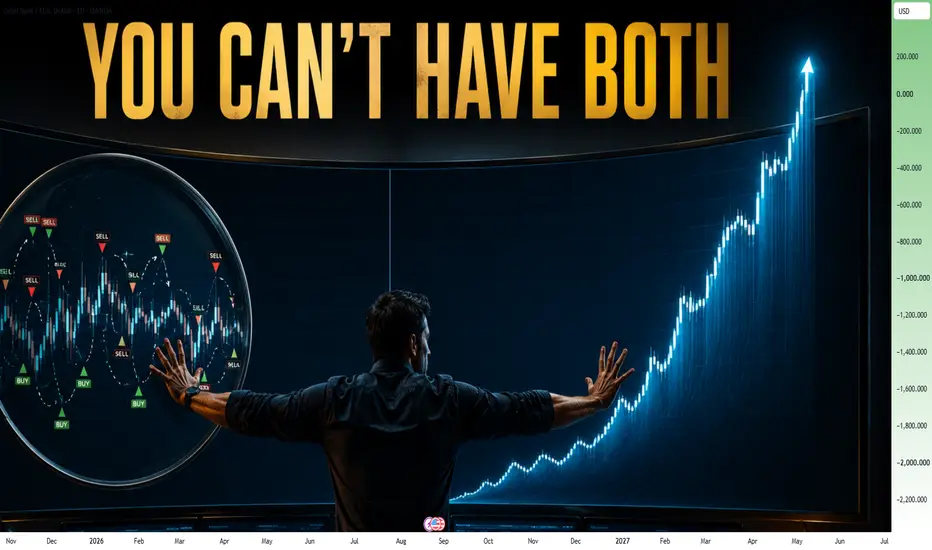
There is a very colourful Romanian saying, that couldn't be posted here...
But a polite English translation would be:
You can’t have it both ways.
And yet, this is exactly what most traders want.
They want to trade the one-minute chart, scalp every small fluctuation, close positions quickly and avoid the discomfort of holding through corrections.
But when they later see a 3,000-pip move on Gold or a massive Bitcoin rally, they look at the chart and complain:
“I missed the entire move.”
Of course you missed it.
You selected a trading style specifically designed to capture small movements.
Every trading style comes with a price
If you trade the 1-minute or 5-minute chart, your advantage is speed:
- You can find several opportunities during the day.
- Your trades do not need much time to develop.
- You avoid overnight and weekend exposure.
- You can finish the session and leave the market behind.
But there is a cost.
You will close trades quickly. You will be stopped by intraday noise. You will repeatedly enter and exit during a move that a swing trader may capture with one position.
Most importantly, you will NOT hold an entire 2,000- or 3,000-pip move.
That is not a failure of scalping.
That is the nature of scalping.
Swing trading has its own price
The swing trader has a better chance of catching a large move, but he must accept a completely different experience:
- Wider stop losses
- Big drawdown
- Smaller position sizes
- Overnight and even weekend exposure
- Deep corrections while still in profit
- Several days without a new entry
- The possibility of watching a large floating profit shrink
- The psychological pressure of holding while the market constantly questions the original idea
Everyone wants the 3,000-pip profit.
Very few traders want to endure the uncertainty, corrections and waiting required to capture it.
Looking at the completed move is easy. Holding it in real time is something else entirely.
The chart creates a psychological illusion
After the move has finished, the chart compresses several days of uncertainty into one clean candle sequence.
The corrections look small. The direction looks obvious. The entry appears easy, and the final target seems inevitable.
But that is not how the move felt while it was happening.
Every correction looked like a possible reversal. Every resistance could have stopped the move. Every economic release could have changed the structure.
The finished chart shows distance.
It does not show discomfort.
That is why traders constantly overestimate what they “could have made.” They calculate the entire move but conveniently ignore whether their strategy—and their psychology—could ever have held it.
Your timeframe defines your opportunity
A 1-minute entry does not automatically have to become a 3-day swing trade simply because the market eventually travels another 3,000 pips.
The trade must be managed according to the reason it was opened.
If you entered based on a one-minute setup, the structure supporting that trade may disappear after a relatively small move. If you suddenly decide to hold because the price is running, you are no longer following the original strategy.
You are improvising.
This is where traders make some of their biggest mistakes:
They enter like scalpers, but once the trade moves into profit, they begin dreaming like swing traders—suddenly expecting a 3,000-pip move from a setup originally designed to capture 100.
Even worse, they enter like scalpers, but when the market moves against them, they become swing traders. A position that should have been closed quickly is suddenly declared a “long-term trade”—not because the analysis supports it, but because they refuse to accept the loss.
And then there is the opposite mistake:
They enter like swing traders, with a valid higher-timeframe idea, but panic like scalpers at the first small correction—closing a perfectly good position because of meaningless lower-timeframe noise.
So they want swing-trading profits when they are winning, swing-trading patience when they are losing, and scalping exits whenever fear takes control.
The result is not the best of both worlds.
It is the worst of all three.
Decide what you are trading before you enter
Before opening a position, answer a simple question:
What kind of trade is this?
Is it:
- A scalp targeting the next intraday level?
- A day trade based on the current session structure?
- A swing trade targeting a major support or resistance zone?
That decision determines:
- Your stop-loss distance
- Your position size
- Your target
- The structure you should monitor
- The amount of time you must give the trade
- The corrections you must be willing to tolerate
You cannot choose the comfort of a scalp and later demand the reward of a swing trade.
Can you combine both?
Yes—but only if this is planned in advance.
For example, you can use two separate positions:
- Close the first at the intraday target.
- Leave the second running toward a larger swing objective.
But the runner must have appropriate size, structure and risk management from the beginning.
It cannot be an emotional decision made after the market starts moving.
And even then, the runner could return to entry or even get stopped before reaching the larger target. That is the price you pay for occasionally capturing the exceptional move.
Again, you cannot have it both ways.
Stop comparing incompatible results
A scalper should not judge himself for failing to capture a weekly move.
A swing trader should not judge himself for missing ten intraday opportunities.
They are playing different games.
The scalper extracts smaller pieces from repeated movements. The swing trader accepts fewer trades and more uncertainty in exchange for the possibility of capturing much larger distances.
Neither style is automatically better.
The problem begins when traders want the advantages of both while refusing to accept the disadvantages of either.
So, what do you actually want?
If you want frequent trades, fast results and limited market exposure, trade short-term—but stop crying about the 3,000-pip moves you did not capture.
If you want to capture those large moves, trade higher-timeframe structure—but accept wider stops, smaller volume, fewer entries and the discomfort of holding through corrections.
Choose your game and accept its rules.
Because in trading, as in life:
You cannot optimise simultaneously for comfort, frequency, precision and maximum profit per move.
Every choice has a cost.
And maturity begins when you stop complaining about the cost of the choice you made.

🎯 Want More Trading Ideas?
📈 Join the FREE Forex & Gold Channel
👉 t.me/intradaytradingsignals
💎Get Funded Up to $1 Million with SabioTrade
Use my exclusive link and get 30% OFF your challenge.
👉shorturl.at/b5yyz
📈 Join the FREE Forex & Gold Channel
👉 t.me/intradaytradingsignals
💎Get Funded Up to $1 Million with SabioTrade
Use my exclusive link and get 30% OFF your challenge.
👉shorturl.at/b5yyz
Related publications
Disclaimer
The information and publications are not meant to be, and do not constitute, financial, investment, trading, or other types of advice or recommendations supplied or endorsed by TradingView. Read more in the Terms of Use.