
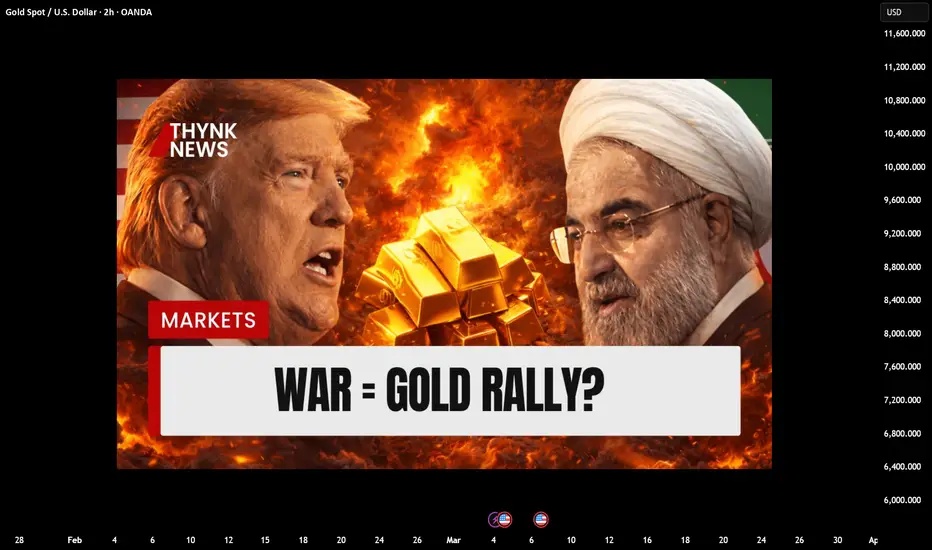
In the financial world, war-related news is often referred to as an “Exogenous Shock.”
To understand how the U.S.–Israel–Iran conflict may influence XAUUSD (Gold vs USD) in the long term, we need to examine several structural mechanisms that drive gold prices.
1. The Safe-Haven Mechanism and Global Capital Flows
When geopolitical conflicts escalate, the primary objective of institutional capital shifts from profit maximization to capital preservation.
Gold has historically been the ultimate safe-haven asset because it carries no counterparty risk. Unlike fiat currencies, bonds, or equities, gold does not depend on the stability of a government or a financial institution.
When missiles fly across the Middle East and geopolitical risk rises:
- Investors reduce exposure to risk assets (stocks, emerging markets).
- Capital rotates into defensive assets, primarily gold and U.S. Treasuries.
For XAUUSD, this dynamic often produces sudden liquidity inflows, pushing the price higher.
However, the relationship with the USD adds complexity. In early stages of a crisis, both gold and the USD may rise simultaneously, as investors seek liquidity and safety.
Long-term implication for XAUUSD:
As geopolitical instability persists, global portfolios gradually increase strategic allocations to gold, supporting a long-term bullish bias.
2. Energy Markets and the Inflation Transmission Channel
The Middle East conflict directly affects global energy markets, especially through the Strait of Hormuz, which transports more than 20 million barrels of oil per day.
If this chokepoint is disrupted:
Oil prices rise → Production costs increase → Global inflation pressures rise.
Inflation is historically one of the strongest macro drivers for gold.
When inflation accelerates:
- The real value of fiat currencies declines.
- Investors hedge purchasing power with gold exposure.
For XAUUSD, persistent energy-driven inflation tends to create long-term structural support, especially if inflation remains above central bank targets.
3. Monetary Policy Constraints and the Risk of Stagflation
The biggest macroeconomic risk created by war-driven inflation is stagflation, a combination of:
- Slow economic growth
- High inflation
This scenario creates a difficult dilemma for central banks such as the Federal Reserve.
If the Fed raises interest rates aggressively:
- The economy may slow sharply.
- Financial markets could face recessionary pressure.
If the Fed cuts rates to support growth:
- Inflation could accelerate further.
Historically, gold performs strongly during stagflationary environments, because investors lose confidence in both economic growth and monetary stability.
For XAUUSD, this environment tends to support multi-year upward cycles.
4. Structural Demand: Central Banks and De-Dollarization
Another long-term factor supporting gold is central bank accumulation.
In recent years, many countries have increased their gold reserves to reduce dependence on the U.S. dollar–based financial system.
Geopolitical conflicts accelerate this trend.
Countries facing sanctions or financial pressure often increase:
- Physical gold reserves
- Alternative settlement systems
This creates structural demand for gold, which supports the long-term bullish outlook for XAUUSD.
5. Long-Term Outlook for XAUUSD
From a macro perspective, the combination of:
- Geopolitical instability
- Energy-driven inflation
- Stagflation risk
- Central bank gold accumulation
creates a structural bullish foundation for gold in the long run.
This does not mean gold will move in a straight line. Markets often experience deep corrections and liquidity pullbacks, especially when the USD strengthens temporarily.
However, in periods where:
- Global uncertainty rises
- Real yields decline
- Central banks accumulate gold
XAUUSD historically enters long-term expansion phases.
I hope this article helps you gain deeper insight into the connection between current events and the movement of the global economy.
Would you like me to create a sample “asset accumulation plan” for an individual investor during this period of war?
Note
Good luck 
Related publications
Disclaimer
The information and publications are not meant to be, and do not constitute, financial, investment, trading, or other types of advice or recommendations supplied or endorsed by TradingView. Read more in the Terms of Use.
Related publications
Disclaimer
The information and publications are not meant to be, and do not constitute, financial, investment, trading, or other types of advice or recommendations supplied or endorsed by TradingView. Read more in the Terms of Use.