
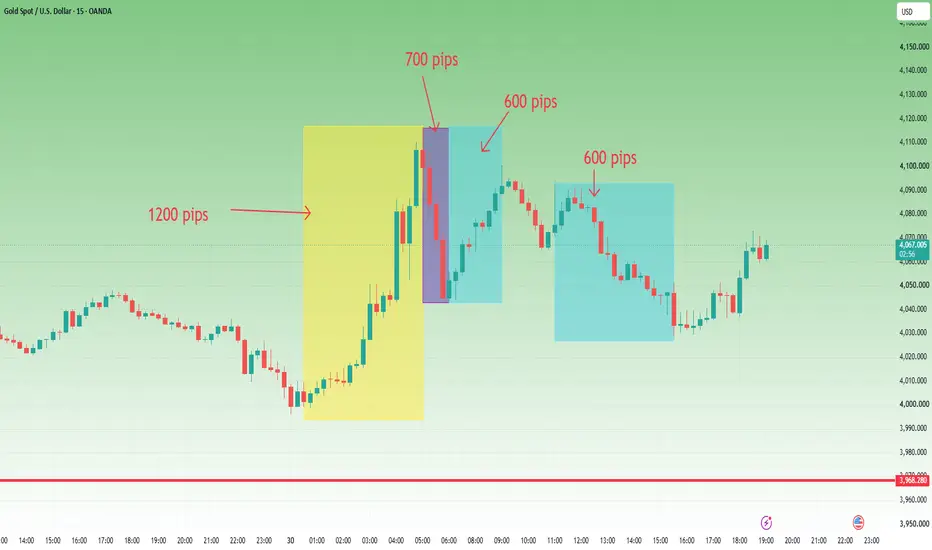
If you've traded Gold over the last few months, you've probably felt it.
Volatility is through the roof.
And although Gold has been my main trading instrument for more than 10 years, I can honestly say I've never seen it behave quite like this.
The market has always been volatile, but today it reacts to almost everything.
- Geopolitics.
- Interest rates.
- Inflation.
- Central bank comments.
- A single headline.
- A tweet
- A rumor.
A move that used to take an entire trading session can now happen in a matter of minutes. A $30 move while you're making coffee is no longer unusual—it's becoming normal.
So the question isn't whether Gold is volatile.
The real question is:
How do you adapt without becoming another victim of that volatility?
1. Forget Breakout Trading
In this environment, breakout trading is one of the fastest ways to get trapped.
Gold loves to fake a breakout, trigger retail stops, and reverse just as aggressively.
Instead of chasing candles, let the market come to you.
Focus on major support and resistance zones and use pending orders where the probabilities are already in your favor. Let price enter your zone instead of entering wherever price happens to be.
Patience has become a trading edge.
2. Widen Your Stops
If you're still using the same 50-pip stop loss you used 2 years ago, you're fighting today's market with yesterday's strategy.
You're cooked.
A normal intraday fluctuation today can easily travel hundreds of pips before the real move even begins.
Gold can move $10 while you're lighting a cigarette.
That doesn't mean you should accept bigger losses.
It means your position size must shrink while your stop loss reflects today's volatility. The market has changed, and your risk management has to change with it.
3. Think Bigger
Many traders are still looking for 100 or 200 pips.
Meanwhile, Gold moves 1,000 pips without breaking a sweat.
When volatility expands, your expectations should expand as well.
If your analysis is correct, don't suffocate the trade with tiny profit targets. Give the market enough room to reward the risk you're taking.
4. Demand Better Risk-to-Reward
With larger stops comes one simple rule:
Never sacrifice your Risk-to-Reward ratio.
Personally, I would rarely consider anything below 1:3 in the current environment.
If the market is asking you to risk more, then it should also pay you more.
Anything less simply doesn't compensate for the uncertainty.
5. Think in Money, Not in Pips
This is probably the most important point.
Most traders still think in pips.
If volatility doubles, your lot size should probably be reduced accordingly.
The goal isn't to make the same number of pips.
The goal is to maintain consistent dollar risk per trade.
Let volatility create the opportunities—not the losses.
Final Thoughts
Gold hasn't become impossible to trade.
It has simply become a different market.
The traders who keep using yesterday's methods will wonder why they keep getting stopped out.
The traders who adapt—by using pending orders, wider stops, smaller position sizes, ambitious but realistic targets, and disciplined risk management—will discover that extreme volatility is not an enemy.
It's an opportunity.
The market doesn't reward the smartest trader.
It rewards the trader who adapts the fastest.
Best of luck!
Mihai Iacob

🎯 Want More Trading Ideas?
📈 Join the FREE Forex & Gold Channel
👉 t.me/intradaytradingsignals
💎Get Funded Up to $1 Million with SabioTrade
Use my exclusive link and get 30% OFF your challenge.
👉shorturl.at/b5yyz
📈 Join the FREE Forex & Gold Channel
👉 t.me/intradaytradingsignals
💎Get Funded Up to $1 Million with SabioTrade
Use my exclusive link and get 30% OFF your challenge.
👉shorturl.at/b5yyz
Related publications
Disclaimer
The information and publications are not meant to be, and do not constitute, financial, investment, trading, or other types of advice or recommendations supplied or endorsed by TradingView. Read more in the Terms of Use.