
They do not hide inside secret indicators, manipulated markets or mysterious algorithms.
Most of the time, they are sitting right beside us.
They enter our minds after a loss, during a violent move, when we are bored, when we desperately need money or when we become too confident after several winning trades.
Some attack aggressively. Others are patient. They wait for the right emotional moment and then convince us that breaking one small rule is perfectly reasonable.
Together, they are responsible for destroying more trading accounts than any broker, institution or market maker ever could.
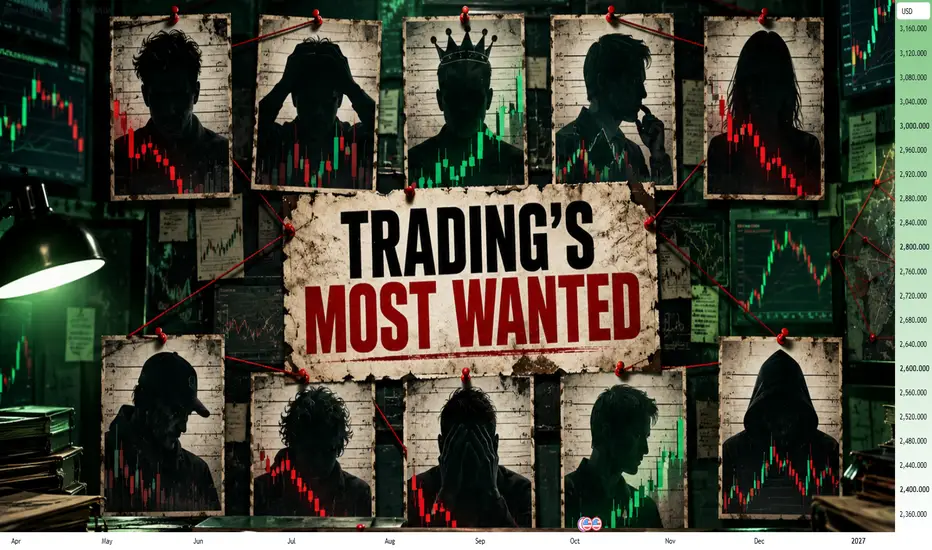
These are Trading’s Most Wanted.
1. Overtrading
Alias: “One More Trade”
Overtrading rarely begins with the intention to take twenty trades.
It usually begins with one perfectly reasonable trade.
If that trade loses, you see another opportunity to recover the money. If it wins, you feel sharp and want to take advantage of your excellent reading of the market.
Either way, the same voice appears:
“Take one more trade.”
The first trade is normally based on analysis. The fifth is often based on boredom, frustration or excitement.
Your standards slowly disappear. A strong setup becomes a decent setup. A decent setup becomes “It could work.” Eventually, a candle moving quickly is enough to make you press the button.
You are no longer trading your strategy. You are trading your need to participate.
Remember: You are not paid according to the number of trades you take. You are paid for the quality of the risk you accept.
Sometimes Gold can move 1,000 pips without offering you a clean entry, a digestible stop-loss and a reasonable risk-to-reward ratio.
Let it move.
Missing an opportunity costs nothing. Forcing one can cost much more.
The easiest way to control overtrading is to decide your limits before the session begins: maximum number of trades, maximum daily loss and the exact conditions that end your trading day.
If your rule says that you stop after two losses but you take a third trade, you do not have a two-loss rule.
You have no rule.
2. Revenge Trading
Alias: “I’ll Win It Back”
Revenge Trading usually appears immediately after a painful loss.
Maybe Gold touched your stop-loss by two pips, reversed and moved directly toward your original target.
You were right about the direction, but you still lost money.
Now it feels personal.
You are no longer analysing the market. You are analysing your account balance and calculating how quickly you can return to zero.
This is where a normal loss becomes dangerous.
The trader risks another 1% to recover the first 1%. When the second trade also loses, the position size increases. The setup becomes less important, the entries become faster and the need to recover becomes stronger.
Soon, one perfectly normal losing trade has turned into a disastrous session.
Revenge Trading is not always obvious. You may wait ten minutes, draw a new level and add another indicator before entering again. You can call it a new setup, but ask yourself one honest question:
Would I take this trade if my previous trade had been a winner?
If the answer is no, you are probably not trading the market.
You are trading the loss.
A loss is not a debt that the market owes you. It is a business expense. The next trade must have its own valid entry, stop-loss, target and reason for existing.
Your responsibility is not to recover the money immediately.
Your responsibility is to ensure that one ordinary loss remains one ordinary loss.
3. FOMO
Alias: “It’s Leaving Without Me”
FOMO does not appear while the market is quiet.
It waits until Gold explodes 500 pips in 30 minutes. Everyone in the chat is posting profits, social media is full of perfect entries and the candle keeps running without you.
You knew it would move.
You almost entered.
Now you feel that the market is leaving you behind.
So you chase it.
The problem is that the trade you originally wanted no longer exists. The entry is worse, the logical stop is farther away and much of the potential move has already happened.
To preserve the same target, you accept a terrible risk-to-reward ratio. To preserve the same risk-to-reward ratio, you place the stop somewhere that makes no structural sense.
You are not entering because the opportunity improved.
You are entering because the price moved without you.
This is how traders buy at the end of an impulsive rally or sell after an almost vertical drop—exactly where early traders begin taking profits.
And even when a FOMO trade wins, it remains dangerous. The profit teaches you that chasing works, encouraging you to repeat the same mistake with more confidence and perhaps a larger position.
A profitable mistake is still a mistake.
The market will open again tomorrow. Gold will move again. There will always be another breakout, another correction and another clean setup.
A missed trade does not damage your account.
The desperate attempt to catch it often does.
4. Moving the Stop-Loss
Alias: “Give It More Room”
Before entering, everything looked clear.
Your entry was calculated, your invalidation level was defined and the loss was acceptable.
Then the market moved against you.
Suddenly, the same stop-loss that looked logical before the trade now seems too tight. You convince yourself that Gold is volatile, that liquidity is being collected or that the market needs a little more room.
So you move the stop.
Not because the structure changed in your favour, but because you do not want to accept the loss.
A 1% risk becomes 2%. Then 3%. Sometimes the stop disappears completely, and a short-term trade becomes an “investment.”
The original analysis may have been wrong, but the trader refuses to accept this.
A stop-loss is not a random punishment placed on your chart. It is the price level where the reason for your trade is no longer valid.
If price reaches that level, the trade is finished.
Moving the stop farther away does not improve the analysis. It only increases the amount of money attached to an invalid idea.
If you regularly place stops that are too tight, improve your entry or reduce your position size so you can use a wider, technically valid stop.
But make that decision before entering.
The stop-loss is negotiated with yourself before the trade—not with the market after the trade.
5. Oversized Leverage
Alias: “The Account Accelerator”
Leverage is neither good nor evil. It is simply a tool.
The problem begins when traders confuse access to leverage with obligation to use it.
A broker may allow you to control a huge position with a small amount of capital. That does not mean the position is appropriate for your account.
Large leverage makes every normal market fluctuation emotionally significant. A minor pullback becomes a frightening loss. A normal spike forces you to close. A single candle can erase days or weeks of progress.
When the position is too large, you stop trading the chart.
You trade the money flashing on the screen.
You close good trades too early because the floating profit feels enormous. You hold bad trades too long because the floating loss is unbearable. You move your stop because accepting it would hurt too much.
In other words, oversized leverage does not only increase financial risk. It destroys decision-making.
Traders often use leverage because they want faster results. A small account feels too slow, so they try to force it to behave like a large account.
But leverage can accelerate the destruction of an account much more reliably than its growth.
Your position size should be determined by three things:
- The amount you are prepared to lose.
- The distance to the technically valid stop-loss.
- The size of your trading account.
Not by how much money you hope to make.
If the planned loss feels emotionally unbearable, the position is already too large.
6. Trading Without a Plan
Alias: “We’ll See What Happens”
A trader without a plan can explain every decision after it happens.
- He buys because the market is bullish.
- When price falls, he says it is only a correction.
- When it falls further, he says it is approaching support.
- When support breaks, he says it was a liquidity sweep.
If the trade recovers, he believes his analysis was brilliant. If it collapses, he blames manipulation.
Without a plan, any market behaviour can be used to justify staying in the position.
A real trading plan does not need to predict every candle, but it must answer several basic questions before the trade is opened:
- Where is the entry?
- Where is the trade invalidated?
- How much am I risking?
- Where is the target?
- Is the risk-to-reward ratio acceptable?
- What must happen before I enter?
- What would make me stay out?
If you cannot answer these questions, you do not have a trade.
You have an opinion with money attached to it.
A plan also prevents you from turning every market view into a position. You may be bullish on Gold over the next several weeks while having no reason to buy it today. You may expect lower prices but refuse to sell directly into major support.
Bias is not an entry. Analysis is not execution.
The plan is the bridge between them.
7. Averaging Down
Alias: “It’s Cheaper Now”
You buy at 4,300.
Gold falls to 4,280, so you buy again. Your average entry improves.
At 4,250, it looks even cheaper, so you add another position.
At 4,200, you no longer have a trade. You have a rescue operation.
Averaging down feels intelligent because every new entry reduces the price needed to return to breakeven. But it also increases exposure while the market is actively proving your original timing wrong.
The trader often says:
“If I liked it at 4,300, I should love it at 4,200.”
What may be reasonable for a long-term investor accumulating an asset according to a predefined plan.
It is not automatically reasonable for a leveraged trader whose original setup has already been invalidated.
There is an important difference between planned scaling and emotional averaging.
Planned scaling means the entry zones, total exposure and maximum loss were established before the first position was opened.
Emotional averaging means adding because the existing trade is losing and you desperately want a better exit.
The first is a strategy.
The second is usually denial.
Never add to a losing position merely because the price is better. Add only if the new entry is independently valid, the combined risk remains within your original limit and the market structure still supports the idea.
Otherwise, you are not improving the trade.
You are increasing your commitment to being wrong.
8. Blindly Following Influencers
Alias: “He Has 200,000 Followers”
Social media has created a market where confidence is often more valuable than competence.
Someone posts luxury cars, screenshots of enormous profits and ten winning trades in a row. The charts look perfect and every market prediction seems to work.
So you follow the next signal without understanding the entry, stop-loss, timeframe or total risk.
When the trade moves against you, you do not know what to do.
The person you copied may be trading a different timeframe. He may have hedged the position, reduced the risk, closed early or never taken the trade at all.
You only saw a screenshot.
There is nothing wrong with learning from another trader or considering someone else’s analysis. The problem begins when you outsource the responsibility for your money.
Even a skilled and honest analyst will be wrong. If you do not understand the trade, you cannot judge when the scenario has been invalidated.
Followers also tend to remember the spectacular winning calls and forget the deleted posts, vague predictions and losing trades.
“Gold will rise—but it could drop first” is not analysis. It is a sentence designed to remain correct under every possible outcome.
Use other traders for ideas, education and alternative perspectives.
But before risking money, make the trade your own.
If you do not understand why you are entering, you will not understand when to leave.
9. The Need to Be Right
Alias: “The Market is Wrong”
Many traders say they want to make money.
What they really want is to be right.
They publicly announce that Gold is going to 7,000, Bitcoin to 1 mil. or EURUSD has reached a major top. Once the opinion becomes part of their identity, changing it feels like humiliation.
New information arrives, the structure changes and price invalidates the scenario—but they continue defending the original prediction.
They move stops, add to losses and search for analysts who agree with them.
At this point, they are no longer trading Gold, Bitcoin or EURUSD.
They are defending their ego.
The market does not pay you for being right. You can correctly predict the direction and still lose because your timing, entry or risk management was poor.
You can also be wrong about the larger direction and make money from a well-executed short-term trade.
Being right and making money are not the same thing.
Professional trading requires the ability to hold a strong opinion loosely. You build a scenario, define the conditions that support it and clearly identify what would invalidate it.
If the market confirms the scenario, you act.
If it invalidates the scenario, you leave.
No drama. No loyalty. No argument.
Your job is not to prove that your analysis was correct. Your job is to protect capital while exploiting favourable probabilities.
10. Trading With Money You Need
Alias: “Scared Money”
This may be the most dangerous criminal on the entire list.
You need to pay the rent, the mortgage, the car lease or an unexpected bill. You open the platform knowing that you must make money.
Now every trade carries more than financial risk.
It carries your immediate future.
You force setups because waiting feels impossible. You take quick trades on Gold because you only need “a few hundred dollars.” You buy a cryptocurrency because an influencer says a 10x move is coming and you desperately need that possibility to be real.
When the trade moves slightly against you, fear takes control.
You also close winners too early because you cannot risk losing the profit. You hold losers because accepting the loss would make the real-life problem worse. You increase leverage because a normal return is no longer enough.
This is why scared money does not make money.
Not because fear magically changes the market, but because financial pressure changes your decisions.
The market offers probabilities—not salaries, guarantees or emergency loans.
You cannot demand that Gold provide your rent by Friday.
Money needed for living expenses should never be exposed to trading risk. Neither should borrowed money or capital whose loss would materially damage your life.
Trade only with money you can [b]genuinely afford to lose.
This does not mean you should not care about it. It means that losing one trade—or experiencing a normal drawdown—must not create a personal crisis.
The moment you need a trade to win, you have already lost the freedom to execute it properly.
They Rarely Work Alone
The most dangerous part is that these criminals do not operate independently.
- FOMO creates a bad entry.
- Oversized Leverage makes the normal pullback unbearable.
- Moving the Stop-Loss increases the damage.
- Averaging Down increases exposure.
- The Need to Be Right prevents you from closing.
- Revenge Trading begins after the loss.
- Overtrading finishes the account.
What appears to be one catastrophic trading day is often an entire chain of small decisions, with every broken rule opening the door for the next one.
That is why discipline is not one heroic action.
It is a series of boring decisions:
- Waiting for your level.
= Accepting that there is no trade.
- Using the correct position size.
- Taking the planned loss.
- Closing the platform when your limit is reached.
- Letting the market move without you.
None of these decisions will look impressive on social media.
But they are the decisions that keep you in the game.
Trading is not about eliminating losses. That is impossible.
It is about preventing one loss from becoming five, one opinion from becoming an obsession and one bad day from becoming a destroyed account.
The market will always be uncertain.
Your behaviour does not have to be.
MOST WANTED LIST
1. Overtrading — turns participation into compulsion.
2. Revenge Trading — turns one loss into a disaster.
3. FOMO — makes you chase opportunities that have already passed.
4. Moving the Stop-Loss — increases the cost of an invalid idea.
5. Oversized Leverage — makes rational execution emotionally impossible.
6. Trading Without a Plan — allows every decision to be justified afterward.
7. Averaging Down — adds exposure while the market proves you wrong.
8. Blindly Following Influencers — puts your money behind someone else’s conviction.
9. The Need to Be Right — protects the ego instead of the account.
10. Trading With Money You Need — turns probabilities into personal emergencies.
All ten remain active.
All ten are armed with leverage.
And every trader has allowed at least one of them into the account.

🎯 Want More Trading Ideas?
📈 Join the FREE Forex & Gold Channel
👉 t.me/intradaytradingsignals
💎Get Funded Up to $1 Million with SabioTrade
Use my exclusive link and get 30% OFF your challenge.
👉shorturl.at/b5yyz
📈 Join the FREE Forex & Gold Channel
👉 t.me/intradaytradingsignals
💎Get Funded Up to $1 Million with SabioTrade
Use my exclusive link and get 30% OFF your challenge.
👉shorturl.at/b5yyz
Related publications
Disclaimer
The information and publications are not meant to be, and do not constitute, financial, investment, trading, or other types of advice or recommendations supplied or endorsed by TradingView. Read more in the Terms of Use.