Consumer Price Index (CPI) Reports: A Complete Breakdown1. Purpose and Importance of CPI Reports
CPI reports serve several critical functions:
Inflation Measurement: CPI is the primary gauge of inflation, reflecting how prices for goods and services change over time. Inflation impacts monetary policy, interest rates, and economic planning.
Policy Decisions: Central banks use CPI data to adjust interest rates. Rising inflation may prompt tighter monetary policy (higher rates), while low inflation may encourage stimulus or rate cuts.
Cost-of-Living
Globalhealth
The Resources Commodity Super CycleA commodity super cycle refers to a long-term period—often lasting one to three decades—during which commodity prices remain well above their historical averages. Unlike short commodity booms driven by temporary supply disruptions or speculative demand, a super cycle is powered by structural changes in the global economy, especially rapid industrialization, urbanization, technological shifts, and large-scale infrastructure development. When such forces emerge simultaneously across regions, they
Globalization and Deglobalization An Evolving Economic NarrativeUnderstanding Globalization
Globalization refers to the process through which countries, businesses, and people become increasingly interconnected and interdependent across borders. This integration occurs through the movement of goods, services, capital, technology, information, and labor. The roots of globalization can be traced back centuries through trade routes like the Silk Road, but its modern form accelerated significantly after World War II.
Key drivers of globalization include advanc
US–China Trade War: Economic, Market, and Geopolitical ImpactsOrigins and Core Issues of the Trade War
The US–China trade war was primarily driven by concerns in the United States regarding persistent trade deficits, alleged unfair trade practices, intellectual property theft, forced technology transfers, and state subsidies to Chinese firms. China, on the other hand, viewed US actions as attempts to contain its economic rise and technological ambitions. As tariffs escalated on hundreds of billions of dollars’ worth of goods, trade relations deteriorated,
Driving Sustainable Growth in the Modern EconomyESG Investing and Green Finance:
In recent years, ESG investing and green finance have emerged as powerful forces reshaping global financial markets. As environmental challenges intensify, social expectations evolve, and governance standards become more demanding, investors, corporations, and governments are increasingly aligning financial decisions with sustainability goals. ESG investing and green finance go beyond traditional profit-focused models by integrating ethical, environmental, and l
The Forces Behind Exchange Rates and Economic Power1. Economic Fundamentals: The Core of Currency Valuation
At the heart of global currency valuation are economic fundamentals such as inflation, interest rates, gross domestic product (GDP), trade balances, and fiscal policy. A country with a strong and growing economy typically has a stronger currency because it attracts foreign investment. High interest rates, for example, can make a currency more attractive to investors seeking higher returns, while low inflation preserves purchasing power, b
Funds for the FutureWhy Index Funds Are the Cornerstone of Long-Term Wealth Creation
In an era marked by rapid technological change, global economic uncertainty, and evolving investment products, investors increasingly seek simple, transparent, and reliable ways to build long-term wealth. Among the many options available, index funds have emerged as one of the most powerful and future-ready investment vehicles. Designed to track the performance of a specific market index, index funds offer a low-cost, diversified,
Emerging Market Opportunities: BRICS, Latin America, and ASEAN Emerging markets have become one of the most powerful engines of global economic growth in the 21st century. As developed economies mature and face demographic constraints, slower productivity gains, and higher debt levels, regions such as BRICS (Brazil, Russia, India, China, South Africa), Latin America (LATAM), and ASEAN (Association of Southeast Asian Nations) are increasingly shaping the future of trade, investment, innovation, and consumption. These regions offer a unique combination of lar
Trading Global Indices: Opportunities, Strategies, and RisksUnderstanding Global Indices
A global index is a benchmark that tracks the performance of a group of stocks representing a specific market. Examples include the S&P 500 in the United States, the FTSE 100 in the United Kingdom, the DAX 40 in Germany, the Nikkei 225 in Japan, and the Nifty 50 in India. There are also broader indices such as the MSCI World Index or MSCI Emerging Markets Index, which capture performance across multiple countries.
These indices are usually weighted by market capita
Pharmaceutical Stocks: Growth, Stability, and OpportunitiesThe Healthcare Market
Pharmaceutical stocks represent companies engaged in the research, development, manufacturing, and marketing of medicines and healthcare products. These stocks play a crucial role in global equity markets because healthcare is a basic necessity, largely independent of economic cycles. As populations grow, age, and face new health challenges, the demand for medicines continues to rise, making the pharmaceutical sector one of the most resilient and strategically important in
The Role of Shipping in the World MarketShipping as the Engine of Global Trade
At its core, shipping facilitates international trade by transporting goods between countries and regions. Nations differ in natural resources, labor skills, technology, and capital availability. Shipping allows countries to specialize in what they produce most efficiently and trade with others, following the principle of comparative advantage. For example, crude oil from the Middle East, iron ore from Australia, manufactured electronics from East Asia, an
Oil Market Volatility: An In-Depth Analysis1. Nature of Oil Market Volatility
Oil is a commodity with characteristics that make it inherently volatile. Unlike many other goods, its supply and demand are sensitive to a wide array of factors including geopolitical events, macroeconomic conditions, technological changes, and environmental policies. Volatility in the oil market is typically measured using statistical methods, such as standard deviation of price returns, implied volatility from futures options, or historical price ranges. Hi
International Market Insights1. What Are International Markets?
International markets refer to financial markets operating across countries—where global investors trade stocks, currencies, bonds, commodities, and derivatives. These markets include:
a) Global Stock Markets
Major exchanges such as:
NYSE & Nasdaq (USA)
London Stock Exchange (UK)
Tokyo Stock Exchange (Japan)
Shanghai & Hong Kong Stock Exchange (China)
Euronext (Europe)
India's NSE & BSE (Emerging Markets)
International stock markets reflect global cor
Regional Growth Strategies in the Global Market1. Understanding Regional Market Dynamics
A critical first step in developing a regional growth strategy is a deep understanding of the regional market dynamics. Each region possesses unique characteristics that influence business performance:
Economic Factors: GDP growth, income levels, employment rates, and inflation directly impact purchasing power and consumer demand. For instance, luxury brands often target high-income urban areas, whereas essential goods companies may focus on price-sens
The Role of the Bond Market in the Global Market1. Foundation for Government Financing
One of the primary roles of the bond market is enabling governments to finance their operations, budget deficits, infrastructure development, and long-term national projects. Every country—whether a developed economy like the United States or an emerging market like India—issues bonds to fund expenditures beyond tax revenues.
Government bonds, often considered “risk-free” in stable countries, act as the backbone of global capital markets. Investors such as
How International Finance Has Transformed1. From Gold Standard to Fiat and Floating Exchange Rates
One of the most significant transformations occurred in the 20th century when countries moved away from the gold standard, where currencies were directly linked to gold reserves. This system promoted stability but limited monetary flexibility. The shift began after the Great Depression and was finalized when the Bretton Woods system collapsed in 1971, allowing currencies to float freely.
This change reshaped international finance in sev
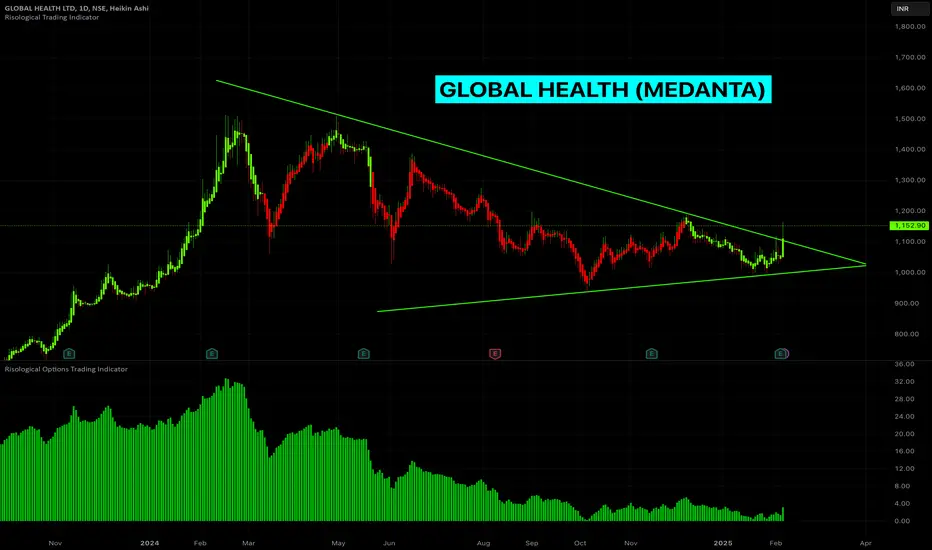
GLOBAL HEALTH LTD - Symmetrical Triangle BreakoutThis is still an open candle and need to wait till this candle closes in GREEN on Friday end of the day. If the candle is green and is clearly breaking out from the triangle on Friday, it is a Bullish sign.
On the daily time frame, the daily candle has closed in GREEN, which is a good sign.
The Risological indicators confirm the bullish movement as seen below.
ENTRY:
The stock can be purchased on the daily time frame as the Risological indicators gave the confirmation
EXIT:
Hold
Can Market Turbulence Create Future Innovation?In a dramatic turn of events that sent shockwaves through the pharmaceutical industry, Novo Nordisk's recent setback with its experimental obesity drug CagriSema presents a fascinating case study in market resilience and scientific progress. The company's stock plummeted 24% after trial results showed a 22.7% weight reduction efficacy, falling short of the anticipated 25% target. Yet, beneath this apparent disappointment lies a deeper story of pharmaceutical innovation and market adaptation.
Th