$ANGELONE: F&O Powerhouse Transitioning to a Wealth SupermarketWhile the casual trading crowd focuses purely on headline active user counts—crowding into platforms like #Groww—serious capital looks at unit economics, monetisation, and operating leverage.
If you are tracking the massive 2-year Inverted Head & Shoulders bottoming structure developing on the weekly chart, the fundamentals explain exactly why this coil is ready to spring.
Let's break down why Angel One (#ANGELONE) holds a fundamental edge that its purely digital peers can't easily replicate.1
. The Monetisation Moat: Volatility-Proof F&O Volume Headline client numbers are great for venture capital pitch decks, but Average Revenue Per User (ARPU) is what funds aggressive corporate compounding.
The Reality: A massive portion of competitor user bases consists of passive, low-ticket equity SIP investors who generate minimal transactional fees.
The Angel One Edge: Angel One has strategically cultivated a high-velocity user base geared heavily toward the Futures & Options (F&O) and intraday segments.
Broking drives the vast majority of their income, with F&O brokerage acting as the primary anchor.
The Dynamic: When the Nifty gets choppy or encounters regulatory speedbumps, passive investors pause. Active derivative traders, however, ramp up their volume to trade the volatility. Angel One acts as a transaction-fee sponge, generating revenue regardless of whether the weekly candle flips red or green.
2. The Structural Pivot: Cross-Selling to 37M+ Captive ClientsDoes Angel One need to be the #1 broker by pure active client count to hit our macro targets?
Absolutely not. The alpha lies in their structural transition from a transactional broker into a diversified financial supermarket.
The company is aggressively rolling out its non-broking ecosystem to capitalise on India's secular financialization wave:
Wealth Management Expansion: Angel One has built out a dedicated wealth management arm to capture High-Net-Worth Individuals (HNIs).
Asset Distribution: They are rapidly scaling the cross-selling of mutual funds, insurance, bonds, and consumer lending products across their rapidly growing base of over 37 million clients.
The Result: This shifts the company's valuation framework from a cyclical "high-beta broker" to a sticky, recurring "asset-gatherer"
model.3. "Phygital" Distribution vs. Bleeding CACPurely digital apps rely almost entirely on expensive, cyclical online ad spend to buy growth. Angel One uses a highly efficient, asset-light hybrid model.
By utilising a massive network of thousands of "Authorised Persons" (franchisees) across Tier-2, Tier-3, and deeper geographical regions, they onboard high-value clients with highly competitive Customer Acquisition Costs (CAC).
This structural distribution network takes decades to replicate.
The Technical Confluence: Look back at the weekly chart structure.
The horizontal neckline resistance between 332.60 and 338.60 is the definitive battleground. The market has spent months digesting regulatory transitions and shifts in margin requirements.
As the technical micro bull flag tightens right under the macro neckline, the fundamental engine is primed to back up the breakout toward the linear target of 489.10 and the macro log target of 609.20.
Risk Management Note: Keep a close eye on the volume signatures at the neckline breakout. Real structural moves require institutional volume validation.
Friday's #RBI policy meeting delivered exactly what a macro-focused trader needs to see: stability over speed.
In the face of intense global headwinds—specifically the ongoing West Asia conflict, fluctuating energy prices, and threat of an El Niño monsoon—the MPC unanimously voted to hold the repo rate flat at 5.25% and maintained its "neutral" stance.
The headline data point that gave the market a quick pause was the slight upward revision of the FY27 inflation projection to 5.1% and a downward calibration of GDP growth to 6.6%.
However, looking past the surface numbers reveals how this policy acts as a long-term engine for the Nifty and plays directly into Angel One’s compounding playbook.
1. The Impact on Nifty: Protecting the Floor Initially, a lowered GDP forecast (6.6% from 6.9%) looks like a hindrance. But the market already knew global conditions were fluid. The real benefit to the #Nifty came from the structural financial defensive plays introduced by Governor Sanjay Malhotra: Forex and Rupee Defense: The RBI aggressively opened the taps to defend the currency by liberalising Foreign Portfolio Investment (FPI) norms for government bonds and expanding equity limits for NRIs.
The immediate 50-paise spike in the Rupee (to 95.24/$ after the policy) proves it worked.
Macro Stability Wins: By ensuring deep liquidity in the banking system and aggressively trying to cushion against global supply-side shocks, the RBI is building a hard floor under corporate India.
The index might not shoot up in a vertical line tomorrow, but it reduces the risk of an aggressive, unhedged breakdown.
2. The Impact on Angel One: The Ultimate Beneficiary? A flat interest rate environment paired with volatile, headline-driven macro data is arguably the best possible operational sandbox for a high-volume broker.
🟢 The Benefits:The Volatility Multiplier: Because the RBI explicitly called out supply-side uncertainties and geopolitical tensions, individual sectors are going to rotate rapidly.
To an active F&O trader, this constant macro headline flux is pure oxygen. It triggers continuous volume hedging, index trading, and high-frequency execution.
As long as the tape keeps moving to digest these news cycles, Angel One collects its transaction flat fees.
The Capital Inflow Funnel: The RBI's explicit goal to ease investment limits for NRIs and OCIs into domestic equities directly expands Angel One’s prospective target audience for its newly funded Wealth Management arm.
🔴 The Hindrances (The Speedbumps):Retail Growth Cap: A projected bump in food inflation or a sub-normal monsoon means the average Tier-2/Tier-3 retail investor might have slightly less discretionary income for casual market speculation.
However, since Angel One doesn't rely heavily on casual investors for the bulk of its revenue, this hit is heavily mitigated by their institutional and heavy F&O derivatives desk.
🎯 Bringing it Back to the Chart Structure
The market has spent Friday digesting the RBI's hawkish caution.
This is exactly why the stock is coiling in that tiny micro bull flag right underneath the 332.60 - 338.60 neckline.
The RBI didn't give the market an aggressive reason to crash, nor did they give an emergency rate cut to send it parabolic. Instead, they provided orderly stability.
This gives the Inverted Head & Shoulders pattern the perfect, calculated baseline it needs to build a genuine, volume-supported breakout over the neckline, rather than a fake-out pumped on hot money.
Keep your eyes on the volume bars over the next few sessions—the fundamental script is written, now the tape just needs to execute
💬 Let's Open the Tape:Markets are a battle of perspectives.
Are you positioned for the structural wealth pivot, or do you think regulatory headwinds keep the capita markets sector capped?
Drop your thoughts, targets, or counter-thesis below.
If you want to follow the compounding journey on this setup, hit the Follow button for live updates!
Rbi
Can the Indian Rupee Survive the Ultimate Dollar Surge?Macroeconomics and Economics: The Dollar Squeeze
The Indian rupee plunged to fresh historic lows in May 2026. USD/INR breached the 95 mark on May 4-5, 2026, then hit an all-time high of 95.80 on May 13 . Late May saw the pair approach 97 per US dollar, the deepest level on record.
Foreign portfolio investors pulled approximately $21 billion from Indian equities during March and April 2026. March alone delivered a record monthly outflow of ₹1.17 trillion, the largest single-month FPI exit ever. April followed with ₹60,847 crore ($6.5 billion) in additional withdrawals.
The massive capital flight aggressively strains domestic economic stability. Total 2026 FPI outflows reached ₹1.92 trillion in just four months, exceeding the entire 2025 total . Month-end dollar demand from oil importers further exacerbates the rapid currency depreciation.
Furthermore, global uncertainty consistently drives investors toward the US dollar as a safe-haven ass et. Investors redirected capital toward South Korea and Taiwan AI chip plays through Q2 2026. The absence of a major AI value chain in Indian equities accelerated the reallocation. Consequently, India faces imported inflation that threatens everyday household budgets.
Geopolitics and Geostrategy: The Hormuz Chokepoint
Geopolitical tensions in the Middle East directly cripple the Indian currency. The US-Israel war on Iran began February 28, 2026, triggering an immediate global oil shock. Iran responded by effectively closing the Strait of Hormuz to commercial shipping.
The strategic bottleneck severely disrupts global oil and gas supply chains. WTI crude surged from $65 pre-conflict to a $119.50 peak on March 9, 2026. Brent crude briefly approached $126 per barrel during the same window.
India imports approximately 85-88% of its crude oil requirements. Because international oil markets mandate dollar payments, India suffers a severe double blow from elevated prices and currency depreciation. Dented peace deal hopes guarantee prolonged geostrategic instability across the region.
Furthermore, sustained Iran tensions keep oil prices elevated through Q2 2026. Renaissance Investment Managers estimates $85-95 sustained oil could trigger $40-50 billion in additional FPI outflows. India's net oil imports equal roughly 3.5% of GDP, making it among the most oil-vulnerable economies globally. The government recently raised import duties on gold to reduce non-essential dollar drains.
Industry Trends, Business Models, and Leadership
A weaker rupee dramatically shifts global industry trends and corporate strategies. Import-dependent sectors face crushing margin compression as raw material costs explode . Management teams must immediately overhaul their business models to survive the currency shock.
Decisive leadership remains critical as executives hedge forex risks aggressively. Conversely, export-driven industries reap massive windfall profits from rupee weakness.
Pharmaceuticals, software services, and textiles benefit substantially from dollar-denominated revenue streams. Companies like Infosys, TCS, and Wipro capture material exchange rate disparities through 2026. Indian generic drug manufacturers also gain pricing power in US export markets.
Moreover, the RBI announced a substantial $5 billion USD/INR buy/sell swap in late May 2026. The central bank reactivated its monetary toolkit including possible rate hikes, special deposit schemes, and tighter outbound FDI scrutiny. The aggressive central bank posturing temporarily firmed the currency against relentless downward pressure. Bloomberg confirmed RBI intervention through state-run banks selling dollars in spot markets.
Technology, Cybersecurity, and High-Tech Innovation
India's massive technology sector navigates a complex dual reality amidst currency depreciation. IT service exporters generate tremendous rupee-denominated revenue boosts from dollar-paying global clients. Tata Consultancy Services, Infosys, and Wipro capture the largest windfall from the rupee's collapse.
However, domestic high-tech innovation suffers significantly due to exorbitant hardware import costs. Procuring advanced semiconductors and specialized electronics now drains domestic capital rapidly.
The AI capital flight away from India compounds the technology sector's structural challenge. FPIs hold roughly $1.75 trillion across three major global semiconductor firms versus just $750 billion in India's entire equity market. Indian firms cannot compete for the global AI infrastructure dollar without local chip manufacturing scale.
Furthermore, cybersecurity budgets face severe strain across enterprise India. Companies must purchase critical security infrastructure and software licenses in premium US dollars. Protecting digital assets becomes exponentially more expensive during a currency crisis. Tech leaders must balance windfall software profits against soaring infrastructure expenses.
Science, Patents, and Company Culture
Currency volatility directly impacts scientific research and global patent analysis. Indian firms filing international patents face sharply higher dollar-denominated legal and registration fees. The financial barrier stifles global intellectual property expansion for emerging startups.
Meanwhile, multinational corporations increasingly leverage Indian talent to optimize their operations. Indian-born CEOs lead numerous trillion-dollar American tech giants.
A robust company culture of engineering excellence consistently drives this remarkable corporate dominance. Ultimately, the falling rupee accelerates the outsourcing of scientific research to Indian laboratories. Global pharmaceutical, semiconductor, and software firms capitalize on currency arbitrage to fund cutting-edge innovation cheaply.
Moreover, India faces 2026 as potentially the worst FPI year since markets opened to overseas investment in 1993. Chief Economic Adviser V. Anantha Nageswaran noted profits for the 500 largest Indian publicly traded companies grew over 30% annually since the pandemic. Strong corporate profitability provides a domestic cushion as retail investors step up participation. However, the broader rupee trajectory depends on Hormuz developments, US bond yields, and the speed of FPI reversal.
USD/INR 2026: Forces Reshaping the RupeeThe USD/INR exchange rate sits at approximately ₹92.6 today, up roughly 3% year-to-date. Behind that number lies a collision of geopolitical shocks, monetary innovation, technological disruption, and a quiet but seismic shift in how India values hard assets. This article dissects every layer.
Macroeconomic Backdrop: The Rate Differential Problem
India's RBI cut its benchmark repo rate to 6.00% in April 2026, while the U.S. Federal Reserve holds the federal funds rate at 4.25–4.50%. That 175–200 basis-point differential persistently favors dollar-denominated assets. Foreign institutional investors rotate capital toward higher-yielding dollar assets during uncertainty, mechanically weakening the rupee. Imports of crude oil and electronics structurally drive India's current-account deficit, adding a second layer of persistent INR demand weakness. Until India narrows that gap through export acceleration or import substitution, upward USD/INR pressure remains a gravitational constant.
Geopolitics: The Iran War Premium
The rupee's most acute 2026 pressure point is the Iran conflict. India sources roughly 15–18% of its crude from Gulf suppliers, and the Iran war has elevated Brent crude to above $90/barrel. Every $10 rise in oil costs India approximately $12–15 billion in additional annual import expenditure. The RBI responded by restricting speculative forward transactions and barring corporates from rebooking cancelled FX contracts. Those emergency measures stabilized USD/INR near ₹93 but revealed how thin India's foreign-exchange reserve buffer has grown, declining by nearly $40 billion in just four weeks amid the market turbulence.
Geostrategy: De-Dollarization and the BRICS Dimension
India's long-term USD/INR trajectory links directly to the global de-dollarization debate. As a senior BRICS economy, India actively negotiates bilateral trade settlement in non-dollar currencies with Russia, Iran, and the UAE. The RBI's endorsement of silver as formal banking collateral, effective April 1, 2026, represents a structural step toward building a domestic credit architecture independent of dollar-denominated benchmarks. By enabling ₹2.5 lakh ($3,000) loans against physical silver at a 10:1 gold-silver collateral ratio, India reduces millions of households' need to rely on dollar-linked instruments. Over time, this domestic credit expansion could lower India's structural dollar demand, applying soft downward pressure on USD/INR.
Monetary Innovation: The RBI's Silver Play
The RBI's decision to accept silver jewelry and ornaments as loan collateral across banks and NBFCs represents the most consequential precious-metals policy of this decade. With India estimated to hold between 125,000 and 250,000 metric tons of privately held silver, the RBI has effectively "monetized" dormant household wealth without printing a single rupee. SEBI simultaneously mandated that gold and silver ETFs shift valuation from LBMA AM-fix pricing to domestic exchange-traded spot prices from April 1, 2026. This dual reform collateral expansion plus domestic-price anchoring — severs two legacy dependencies on London and New York benchmarks. For USD/INR, the implication is structural: India increasingly sets the price of its own hard assets in rupees, not dollars.
Industry Trends: Silver Demand Reshapes Import Dynamics
Silver's new monetary status intersects with India's industrial ambitions. India is the world's largest silver importer, absorbing 5,000–6,000 metric tons annually. Industrial consumption of solar photovoltaic cells, EV battery management systems, medical electronics, and defense components already absorbed roughly 60% of that volume before the RBI's collateral reform. If household silver now migrates into bank vaults as loan collateral rather than remaining liquid for resale, effective domestic supply tightens. Jewelers and small-scale fabricators will compete for a smaller float. Import demand rises. Silver purchases in dollars amplify the current-account deficit, adding marginal pressure on the rupee. Policymakers must balance financial-inclusion gains against import-cost consequences.
Technology and Fintech: Digital Rails Accelerating INR Velocity
India's UPI payment system now processes over 16 billion transactions per month, making the rupee one of the most digitally active currencies in the world. Fintech platforms PhonePe, Paytm, and Razorpay are increasingly offering FX-linked services such as cross-border remittances and multi-currency wallets. India receives over $120 billion annually in remittances, making it the world's top recipient. Each inflow represents structural dollar supply into the INR system, providing a natural hedge against the current-account deficit. The NPCI's expansion of UPI to Singapore, the UAE, France, and Mauritius now allows rupee-denominated settlement for overseas Indians, reducing the friction of dollar conversion and supporting long-run rupee liquidity.
Cybersecurity: FX Infrastructure Under Threat
India's currency infrastructure faces growing cyber risks. State-linked threat actors attributed to both Pakistan-based groups and Chinese APT clusters have targeted SWIFT-connected Indian banking nodes with increasing frequency in 2025–2026. A successful breach of interbank FX systems could trigger flash-crash volatility in USD/INR, as automated trading systems amplify thin-liquidity moves. The RBI's April 2026 crackdown on offshore derivative pricing discrepancies, which widened the gap between onshore and NDF (non-deliverable forward) markets, inadvertently created a secondary vulnerability: tighter NDF controls push speculative activity to less-regulated venues, which carry greater cyberexposure. Financial institutions must treat cyber resilience as a direct FX risk management imperative.
Business Models: IT Export Earnings and the Hedge Equation
India's IT sector, led by TCS, Infosys, Wipro, and HCLTech, generates approximately $250 billion annually in software and services exports, almost entirely in dollars. Every rupee of depreciation expands rupee-denominated revenue for these firms, creating a powerful corporate lobby that benefits from a weaker INR. However, these same firms face the cost of hedging 12–18 months of dollar receivables. When USD/INR volatility spikes as it did in March 2026, when the rate touched ₹94.86, hedging premiums surge, squeezing margins for mid-cap IT exporters who lack the treasury infrastructure of Tier-1 firms. Volatility itself, not just direction, constitutes the primary FX business risk.
Management and Leadership: RBI's Credibility Test
RBI Governor Sanjay Malhotra faces a defining credibility test. His decision to restrict forward contract rebooking and cap banks' open FX positions demonstrates tactical agility. But currency defense through administrative controls carries a long-run cost: reduced hedging efficiency, wider bid-ask spreads, and capital-account uncertainty for foreign portfolio investors. The RBI's April 8, 2026, policy meeting, where markets priced a 25 bps rate cut, forces a textbook trilemma choice: defend the rupee, stimulate growth, or maintain financial openness. Malhotra's communication strategy, calm, data-driven, and forward-guided, has maintained institutional credibility. Markets reward that credibility with reduced speculative pressure, providing a soft floor under the rupee.
Science and High-Tech: India's Patent Pipeline as Currency Signal
India's patent output is an underappreciated long-run INR support signal. Indian patent filings at the USPTO grew 18% year-on-year in 2025, driven by semiconductors, green hydrogen, and pharmaceutical processes. ISRO's commercial launch successes and the PLI scheme's acceleration of domestic chip manufacturing reduce India's dependency on technology imports, structurally compressing the current-account deficit over a 5–10 year horizon. Every dollar India stops importing technology is a dollar it stops spending. That import substitution, if sustained, gradually reduces structural USD demand within India's balance of payments, applying long-term appreciation pressure on the rupee against the dollar.
Company Culture and Innovation: Domestic Champions Reduce FX Dependency
India's "Atmanirbhar Bharat" (self-reliant India) industrial policy has catalyzed a generation of domestic manufacturers. Tata Motors, Ola Electric, and Reliance's Jio platforms invest billions in import-substituting production. Tata's semiconductor joint venture with PSMC and the Foxconn iPhone manufacturing expansion reduce India's electronics import bill, currently the second-largest after crude oil. Corporate cultures that prioritize domestic supply chains over global sourcing directly reduce dollar demand. As India's manufacturing base matures, the structural forces driving rupee depreciation, energy and technology imports, begin to erode, providing a medium-term tailwind for INR.
Outlook: Three Scenarios for USD/INR by December 2026
Bull case for INR (₹87–89/USD): U.S.–India trade deal signed; Fed cuts rates twice; oil retreats below $75; RBI restores reserve buffer. Silver collateral reform stimulates rural credit without inflating imports.
Base case (₹92–94/USD): Current-account deficit persists; RBI holds rates steady; oil stabilizes near $85–90; IT export hedging demand keeps the pair rangebound. Administrative FX controls contain downside.
Bear case for INR (₹97–100/USD): Iran war escalates, closing Strait of Hormuz; FPI outflows accelerate; RBI forced to choose between rate hikes and rupee defense. Silver imports surge, widening the deficit.
Tuesday’s triple risk: Tariffs, RBA rate cut, and U.S. inflationTraders face a busy Tuesday with developments on U.S. China trade talks, a RBA policy decision, and the latest U.S. inflation data.
U.S. China tariff deadline – Tuesday
The current truce between the U.S. and China is set to expire on 12 August, with U.S. Commerce Secretary Lutnick indicating it will likely be extended by 90 days. China may also face an additional 25% tariff on Russian oil imports, like measures already applied to India.
RBA announcement – Tuesday
The Reserve Bank of Australia is widely expected to cut rates, with a Reuters poll showing all 40 surveyed economists anticipating a 25bp reduction to 3.60%. The broader market is pricing a 98% probability of that outcome and a 2% chance of a larger 50bp cut.
U.S. CPI – Tuesday
Headline U.S. CPI for July is expected to rise 0.2% month-on-month taking the annual rate to 2.8% from 2.7%. Wells Fargo notes that the figures may show further signs of higher tariffs feeding into consumer prices.
NIFTY 50 ANALYSIS ON RBI'S MEETINGmarkets fell, indicators supporting!!
rising wedge pattern is formed.
RSI will react in the same way as there previous ones are.
markets will reach its bottom point of its crucial trend line support, and will start moving up the next week. this week's was a crucial point, as FED'S meeting led to fall in our markets, and a further fall due to RBI's announcement. markets will be correcting till the decision comes, hence this two days, markets will reach 16520.
BANKNIFTY levels, RBI likely to Announce Repo Rate tomorrowWelcome to BANKNIFTY Futures and options
and optionchain data analysis for friday...
🛑 RBI will likely to announce Repo and interest Repo rates tomorrow morning at 10AM, due this major event volatility will likely toincreases,
◽ Right now every traders eye is on RBI
◽ Banknifty weekly pivot is at 37500
◽And monthly pivot is at 37300,
🛑 if we see day frame chart of BANKNIFTY currnetly trading above 21Day , 50 Day , 100 Day moving averages
🎯 Key levels to watch out for day trader
🛑 Major resistance zone for BankNifty is at 38050-38100 ( if see the option chain data on call 38000 CE strike holding more number for short position which will act as strong resistance area to bank Nifty )
◽ If market breakout resistance then we can see Target of 38300
◽ Whenever until breakout that resistance level don't trade
◽ Stop loss will be 37950
◽If gap down or slight gap up happens then 37900 will be resistance zone
🛑 Major support level for BankNifty
◽ Support level for nifty lies at 37550-37460
◽ Whenever until breakdown this level don't take a trade
◽ if Market successfully breakdown this level then we can take a trade
◽ And we can see the Target 1 will be 37300
◽STOP loss will be 37550
🛑 levels for banknifty futures will be also same
◽Go long on banknifty Futures if it breakout the resistance ie . 38050-38100
◽ Don't short the market until below the 37500
Don't take a trade if market open above or below our levels bcz market don't like gaps let the market to consolidate first and then take a trade
If you like it do follow for more
have a nice day 😊
Expiry day Blueprint for BankniftyBanknifty has shown resilience to FII selling, RBI announcement today seems to have altered the nature of market. However not much has changed we presume three possibilities around which a probable expiry day plan can be traced.
A strangle of 33100CE and 32800 PE trading around 373 a pair seems a good bet to ride tomorrow .
All the best
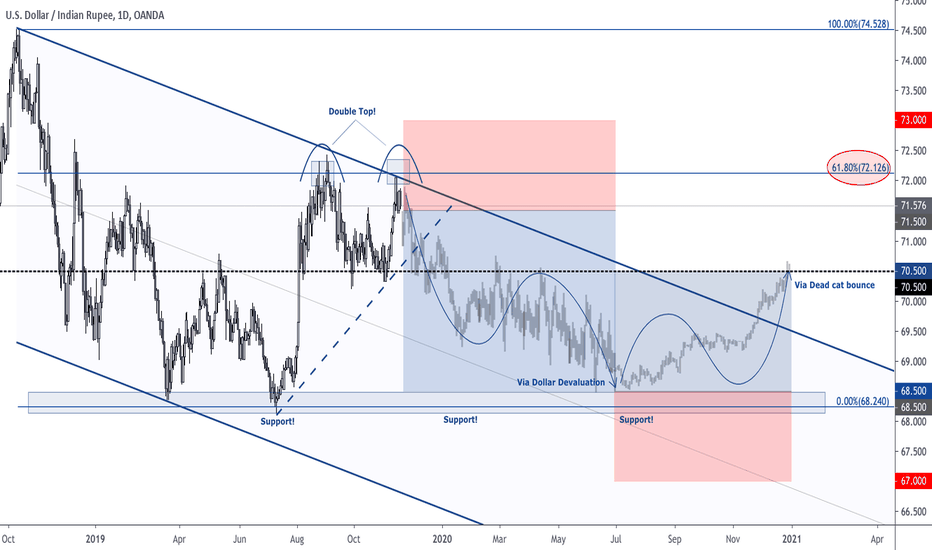
Large Swing In Play For USDINR in 2020Here we are tracking the 2020 macro map for USDINR, a high yielding EM currency. The expansion in volatility here will come from CB coordination, and being short USDINR which generally would also support a view for better risk appetite means it acts a great portfolio hedge for those looking for high carry.
On the INR side, macro figures are starting to indicate further upside although still stuck in low gears. The tax cuts from the fiscal side doing some of the heavy lifting thanks to Modi (India's version of Trump). Inflation is subdue with a lot more slack left in the labour market and a cheap commodity board.
Should investors see the deficit handled appropriately then all boxes are checked for capital flows into India. Demand for INR looks set to improve and combined with the USD devaluation theme it makes a great few months for INR to see some appreciation.
Risks to my thesis come from US-China protectionism, private capex not picking up (low odds after the attractive tax cuts) and to a lesser extent if RBI push the INR down by accumulating.
UShort
Brexit, trade wars, oil and ruble problems April 12, 2019 is the official Brexit date. There are two options: leaving without a deal (both are afraid of it, Britain and the EU, therefore, we regard this outcome as highly unlikely) or a delay. In our opinion, the second option is alternative. It is all about the terms. The EU summit will show whether it takes a year, as the EU wants, or a couple of months, as the Britain wants. Our trading tactics are unchanged so far - we buy a pound on descents.
Trade negotiations between the US and China over the end of the trade wars continue. This week promises to be quite intensive in terms of the negotiation process. Recall that the completion of trade wars is viewed by markets as positive for the world economy as a whole and for individual markets (commodity, stock) in particular.
Oil has reached its maximum in the last 5 months. The reasons for this we have already listed. The main thing is the OPEC + No.2 agreement, which provides for an artificial supply reduction in the oil market by 1.2 million b / d. In addition, a sharp drop in the level of mining in Venezuela and problems in Libya only only thrown oil on the flames. The result - the growth of oil quotations despite an increase in the production of shale in the USA. We continue to look for points for asset purchases on the intraday basis with small stops.
We recommend yesterday’s ruble appreciation in the foreign exchange market as a pretext for its selling. “Deadly” sanctions are already under consideration by Congress. Recall that one of the main strikes from the new package will impact banking system. Analysts of Raiffeisen bank calculated the total volume of problem assets on the balance of credit institutions of the Russian Federation in 2019 exceeded 10 trillion (problematic is considered “mortgage with indicators of impairment”, which include bad, toxic and simply non-performing loans). The coverage ratio of bank reserves of problem debts is only 54%, i.e. the amount of uncovered problem assets is estimated at 4.7 trillion rubles. The banks will not be able to cover this hole with their own capital - it simply will not be enough. Thus, the banking system is more vulnerable than ever, and sanctions may well destroy the delicate balance and lead to collapse. In this light, we recall our basic recommendation to sell the ruble at every available opportunity.
We want to highlight a recommendation on the dollar sales, as well as purchases of gold.
Notice issued by Delhi High Court to RBI and OthersA petition filed by Kali Digital EcoSystem cryptocurrency startup based in Ahmedabad in Delhi High Court and High Court issued a notice to The Union of India through Secretary, Ministry of Finance, GST council and Reserve Bank of India (RBI).
Read More- Notice by Delhi High Court to RBI
Bank Nifty Oversold BankNifty has taken a near 20% hit since the beginning of this year due to bearish economic outlook as well as a massive burden of 7 lakh crore + NPA. The budget has been published and the government has pledged to recapitalize PSUs by a measly 25k crore for now. I believe that the banking sector is yet to see its real lows however for the time being a stabilization in sentiment and a retrace from the fear induced overselling should push banknifty closer to the 15.5k range before it makes its next leg down. There is also a possibility that it can break out of this downwards channel and test supply zone at 17k depending on sentiment in the coming months. Within 2 years I expect banknifty to reach lows well below 10k.
First TP 14.8. Second TP 15.5. Third TP 17k. SL @ 12.6
Bank Of Baroda LongAs RBI is facing tremendous pressure to bail out PS/Corporate banks I believe that we will slowly begin to see a short term correction in the bank sector. I expected BOB to either break out and test supply zone at 190 before potentially making another leg up. The second scenario is that the bearish sentiment forces BOB to test demand zone at 100-120 before it continues to test the supply zone. This is big short term reversal point for BANKNIFTY. RR at this level is high.