What is goodwill in accounting?
Goodwill is the amount a company pays to acquire another business above the fair value of that business's identifiable net assets. It reflects things that can't be separated and valued on their own, such as an established workforce, reputation, and expected cost savings from combining the two companies. Goodwill shows how much of a company's balance sheet comes from paying a premium for acquisitions, and whether those acquisitions keep their value depends on how the acquired businesses perform.
How is goodwill calculated?
Goodwill equals the price paid for a business minus the fair value of its identifiable net assets:
Goodwill = Purchase price − Fair value of identifiable net assets
- Purchase price: The total consideration the buyer pays, including cash, shares, and any payments that depend on the acquired business's future results.
- Fair value of identifiable net assets: The acquired business's assets, including intangible assets such as trademarks and customer contracts, minus its liabilities, all measured at their fair value on the acquisition date.
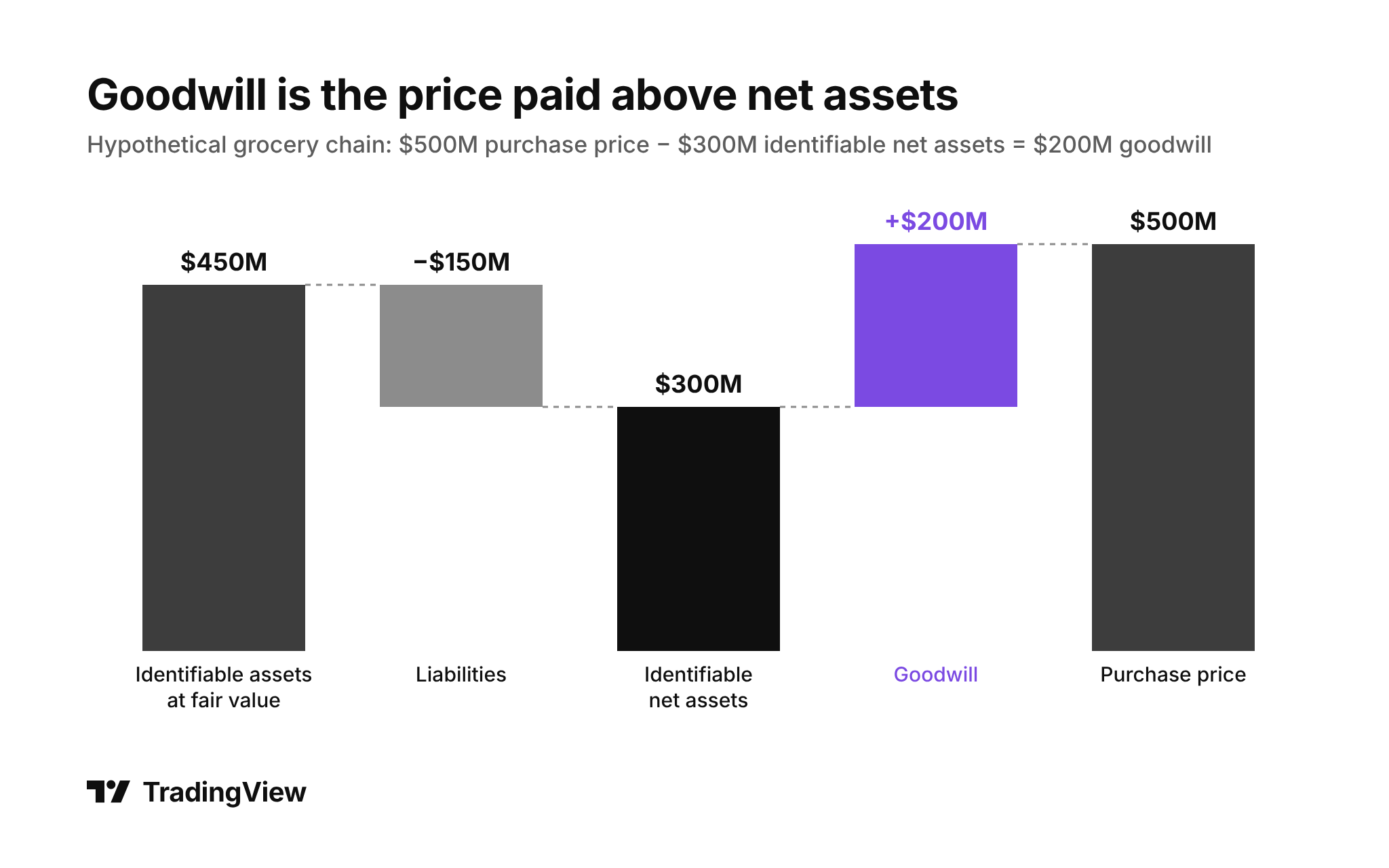
For example, a regional grocery chain buys a bakery chain for $500 million. The bakery chain's stores, equipment, inventory, and brand are worth $450 million at fair value, and its debts and other liabilities are $150 million, so its identifiable net assets are $300 million. The grocery chain records goodwill of $500 million − $300 million = $200 million.
When the buyer acquires less than 100% of a business, the remaining owners' share is recorded as minority interest, and goodwill is calculated on the whole business. If the price is below the fair value of the net assets, there's no goodwill: the difference is recorded as a gain on a bargain purchase in the income statement.
Where does the data for goodwill come from?
Goodwill comes from the balance sheet, where it's a non-current asset. On TradingView, it's part of net intangible assets, which roll into total non-current assets and total assets. The reported figure is usually the gross amount of goodwill minus accumulated impairments, and for companies that amortize goodwill, minus accumulated amortization as well.
The balance sheet shows amounts at a point in time, the end of a quarter or fiscal year, so compare goodwill on the same reporting dates, such as one year-end with the next. Between those dates, goodwill rises with new acquisitions and falls with impairments, disposals of acquired businesses, and, for companies reporting in other currencies, exchange rate changes.
How is goodwill tested for impairment?
Under US GAAP for public companies and under IFRS, goodwill isn't amortized. Instead, companies test it for impairment at least once a year and whenever events suggest its value may have fallen, such as a drop in the acquired business's results or in the company's share price:
- US GAAP: Goodwill is tested for each reporting unit, a business segment or one level below it. An impairment equals the amount by which the unit's carrying amount exceeds its fair value, up to the amount of its goodwill. Private companies can elect to amortize goodwill instead, over a period of up to 10 years.
- IFRS: Goodwill is tested for each cash-generating unit or group of units, the smallest group of assets that generates cash flows independently. An impairment is recorded when the unit's carrying amount exceeds its recoverable amount.
Under both frameworks, a goodwill impairment can't be reversed later. Some national accounting standards still require goodwill to be amortized.
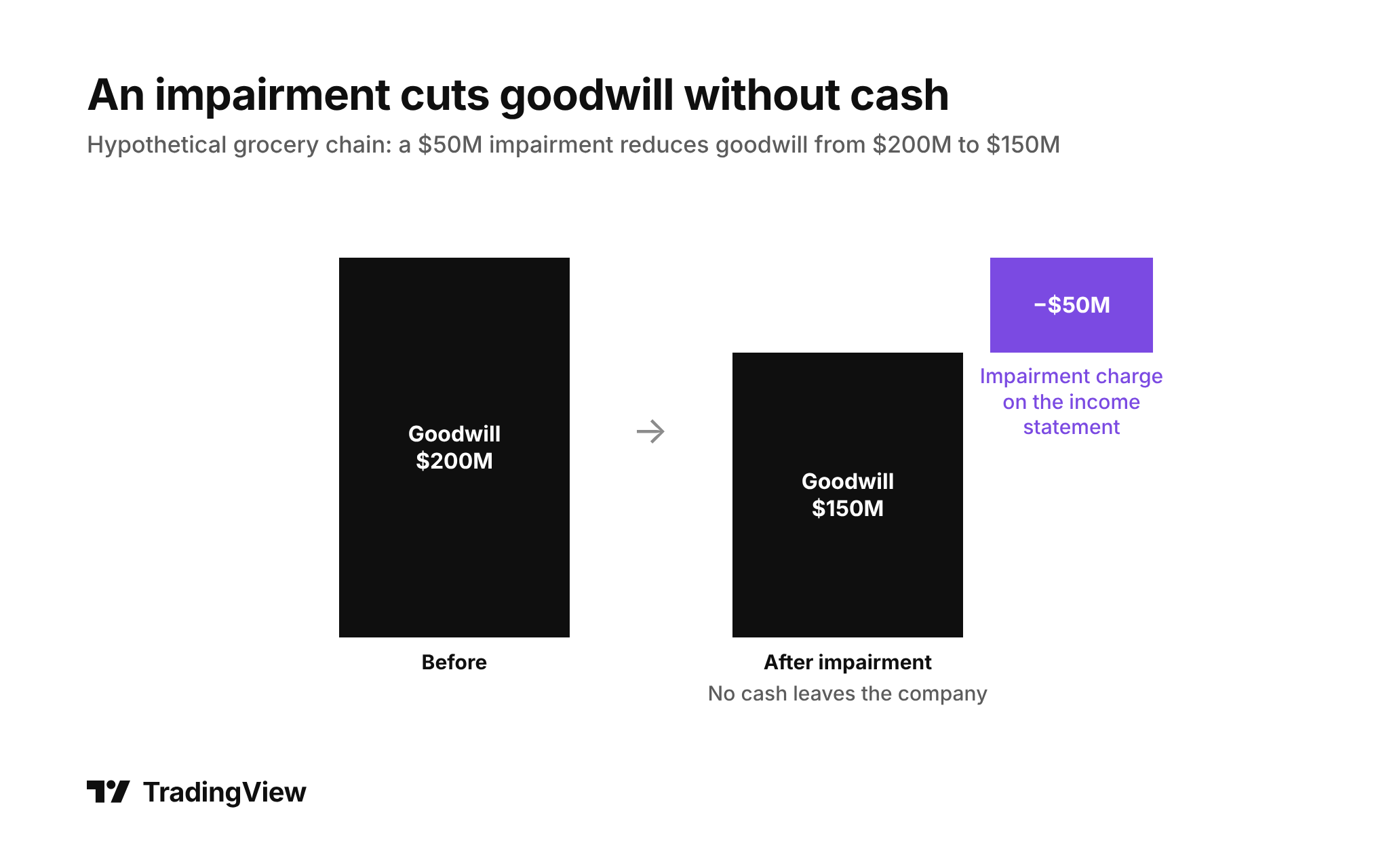
Suppose the bakery chain loses several large customers and its fair value falls. The grocery chain records a $50 million impairment, and its goodwill falls from $200 million to $150 million. The charge appears in impairments on the income statement and reduces net income, but no cash leaves the company.
How is goodwill interpreted?
Goodwill is interpreted by comparison with the company's own history and with peers, because no amount of goodwill is healthy for every company. Analysts often look at:
- Share of total assets: Goodwill divided by total assets shows how much of the balance sheet comes from acquisition premiums. If the grocery chain has $2 billion in total assets, goodwill of $200 million makes up 10% of them.
- Goodwill relative to equity: When goodwill is large compared with shareholders' equity, an impairment can reduce book value sharply.
- Tangible book value: Equity minus goodwill and other intangible assets shows the book value backed by assets that can be separately valued. TradingView shows tangible book value per share.
- Impairment history: Repeated or large impairments can reflect that a company has overpaid for acquisitions or that acquired businesses have weakened.
A rise in goodwill means the company has made acquisitions. It doesn't show whether those acquisitions created value, which depends on the profits and cash flow they bring in.
How does goodwill differ from other intangible assets?
Goodwill differs from other intangible assets in that it can't be identified and valued on its own. Patents, trademarks, licenses, and customer contracts can be separated from the business or arise from legal rights, so they're valued individually and reported as net other intangibles. Goodwill is what's left of the purchase price after all of them are counted.
After the acquisition, intangible assets with a limited life, such as customer contracts, are amortized, which reduces profit every year, while goodwill changes only through impairments. In the grocery chain example, if the buyer had valued the bakery chain's customer contracts $40 million higher, goodwill would have been $40 million lower and the company's yearly amortization expense higher.
What are the limitations of goodwill?
Goodwill reflects past purchase prices and management estimates:
- Acquired value only: Goodwill appears only after an acquisition. A company that builds its brand and workforce itself reports no goodwill for them.
- Price paid, not value created: Goodwill records what the buyer was willing to pay, which can include an overpayment.
- Delayed recognition: Impairment tests rely on management's forecasts, so impairments are often recorded after an acquired business has already weakened.
- Different standards: Companies that amortize goodwill report lower balances than those that only test it for impairment.
Analysts usually read goodwill alongside:
- Net income and impairments: These lines show whether acquisitions contribute profit and when their value has been written down.
- Total debt: Many acquisitions are financed with borrowing, and total debt shows what the company owes after them.
For example, two companies with $200 million of goodwill each carry different risks if one's acquired businesses grow profits and the other borrows to keep buying.
Exploring goodwill with TradingView
TradingView shows goodwill with the rest of a company's balance sheet, so you can track it across reporting dates and compare companies.
- Check goodwill in a company's financials. Open the Financials section of a stock's symbol page and find the balance sheet. Compare the same reporting dates, such as one year-end with the next. Our guide on how to read financial statements explains the other lines in the table.
- Plot balance sheet data on a chart. Fundamental metrics from a company's financial statements can be added to Supercharts. Each metric appears in a separate pane below the price chart and changes only when the company publishes a new report.
- Filter and compare companies. In the Stock Screener, add the Goodwill column for the latest fiscal quarter or fiscal year, together with Total assets. Use the same period for every company and compare within one industry.
- Watch upcoming reports. The Earnings Calendar shows when companies are scheduled to release results. New goodwill figures, and any impairments, appear after each report.
TradingView figures are standardized, so check the goodwill note in a company's filings for its segments and impairment tests before drawing conclusions.
Reading goodwill as a record of acquisitions
Goodwill shows how much a company has paid for acquisitions beyond the separately identifiable value of the businesses it bought. Steady goodwill alongside growing profits can reflect acquired businesses that are holding up, while an impairment marks the point where management accepts that part of a premium won't be recovered. Following goodwill, impairments, net income, and debt together over several reporting dates on TradingView can show how an acquisition strategy plays out. These figures rely on management's estimates and past prices, so they don't show what the acquired businesses are worth today.