EUR/USD Channel Breakout PatternSetup Overview
EUR/USD is showing signs of a bullish recovery on the 4H timeframe after breaking above the upper boundary of its descending channel.
After spending several weeks trading inside this downward-sloping structure, buyers have finally managed to push price above the channel resistance.
Euro / U.S. Dollar
No trades
No trades
Peers for comparison
Pair info
The most traded currency pairs in the world are called “the Majors” and the EURUSD leads this group as the most traded pair in the world. This pair represents the world two largest economies and has faced most volatility since the inception of the euro in 1999.
EURUSD: Repeated Resistance Failures Keep the Lower TargetHello everyone, here is my breakdown of the current EURUSD setup.
Market Analysis
EURUSD previously formed a Rounding Top and declined under the Trend Line into a range. Price then tested the Resistance Zone near 1.1270 with breakouts and was rejected, confirming the bearish bias.
Currently, EUR
EUR/USD H4 | SMC Liquidity Sweep & Bullish Reversal Setup📊 Detailed Technical Analysis – EUR/USD (4H)
EUR/USD is showing an interesting price-action structure after an extended bearish move. Price has declined from the 1.1340 area and is now trading near 1.11368, approaching a significant demand zone that could become an important decision area for the n
EURUSD 3H: Support Holds as Bulls Prepare for a Potential Trendl EURUSD 3H: Support Holds as Bulls Prepare for a Potential Trendline Breakout
EURUSD is showing signs of recovery after reacting from the 1.1100–1.1120 support zone. Price is attempting to regain bullish momentum near the descending trendline. A confirmed breakout could open the way toward the mark
A Rising Wedge, a Fading Rally, and a Decision ApproachingHello traders! Here’s my technical outlook based on the current EURUSD (1H) chart structure. EURUSD previously turned around from the Seller Zone and formed an ascending wedge pattern. Price then tested the upper boundary and is showing signs of rejection.Currently, EURUSD is trading below the 1.128
EURUSDHello Traders! 👋
What are your thoughts on EURUSD?
EURUSD continues to trade within a well-defined descending channel, with price gradually approaching the lower boundary of the channel.
The upcoming support area is particularly significant, as it coincides with the lower boundary of the descendi
EURUSD 4H Analysis | Trendline Breakout, Liquidity & Key SupportEURUSD 4H Analysis | Trendline Breakout, Liquidity & Key Support Levels
Market Overview
EURUSD is currently showing a recovery attempt after an extended bearish move on the 4-hour timeframe. Price has moved upward from the lower demand area and is now trading around 1.12258, according to the provi
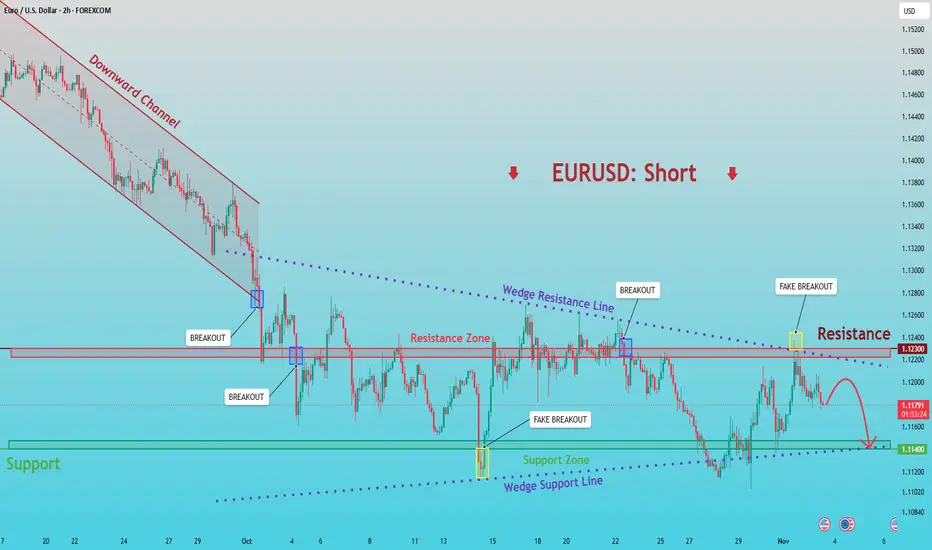
EURUSD: The 1.1230 Barrier Continues to Define Market ConditionsHello everyone, here is my breakdown of the current EURUSD setup.
Market Analysis
EURUSD previously traded inside a downward channel and wedge structure before testing the Resistance Zone near 1.1230. Price then faced multiple rejections and fake breakouts, confirming the bearish bias.
Currently
EURUSD - Developing triangle breakout setup
The pair is trapped within a 🔺 descending triangle on the hourly timeframe, oscillating between a descending resistance line and a horizontal support pivot. Recent price action confirms a bullish bias as it holds above the key floor, reflecting steady absorption of sellers.
Increasing compression
EURUSD - BULLISH WEDGE REBOUND
The pair is oscillating within an 🔺 ascending wedge on the 2h timeframe, currently testing the primary support line. Price action shows consistent higher lows, reflecting a persistent 🧭 bullish bias as buyers repeatedly defend this floor to maintain the broader upward structure.
Downside pressure
See all ideas
Summarizing what the indicators are suggesting.
Oscillators
Neutral
Oscillators
Neutral
Summary
Neutral
Summary
Neutral
Summary
Neutral
Moving Averages
Neutral
Moving Averages
Neutral
Displays a symbol's price movements over previous years to identify recurring trends.
Frequently asked questions
Today, EUR/USD rate is 1.12240 USD.
For broader market analysis, dive into the technicals on the EURUSD live chart and read the latest EURUSD news:
– Dollar sellers hit pause for US inflation data
– Dollar slips against major currencies as Iran talks lift risk appetite
– Dollar weakens against euro, yen as Iran talks lift risk appetite
Markets don't sleep, here's what's going on with EURUSD at the moment:
– Dollar sellers hit pause for US inflation data
– Dollar slips against major currencies as Iran talks lift risk appetite
– Dollar weakens against euro, yen as Iran talks lift risk appetite
See more updates in real-time with our News Flow.
– Dollar sellers hit pause for US inflation data
– Dollar slips against major currencies as Iran talks lift risk appetite
– Dollar weakens against euro, yen as Iran talks lift risk appetite
See more updates in real-time with our News Flow.
The safest way to trade EURUSD is through a reliable broker. Create an account, fund it, and place a buy order.
You can trade EURUSD directly from TradingView:
– Choose a broker: Explore our supported trading partners and pick one that fits your needs
– Compare options: View available brokers side by side to evaluate fees and features
– Connect your account: Open Supercharts, click "Trade", select your broker, and log in
– Start trading: Place orders without leaving the chart
Tip: If you're new to trading, try paper trading first — it lets you practice strategies in real market conditions without risking funds.
It's worth checking EURUSD rate change for various periods to get the full picture:
– 1 day — +0.48%
– 1 week — +0.34%
– 1 month — −0.13%
EURUSD's all-time low was 0.82250 USD (Oct 26, 2000), and its highest price is 1.60180 USD (Apr 22, 2008). Track the dynamics with the latest forex news right on TradingView.
– 1 day — +0.48%
– 1 week — +0.34%
– 1 month — −0.13%
EURUSD's all-time low was 0.82250 USD (Oct 26, 2000), and its highest price is 1.60180 USD (Apr 22, 2008). Track the dynamics with the latest forex news right on TradingView.
When trading EURUSD, one should keep in mind many factors.
First, analyze the fundamentals:
– Macroeconomic data: Inflation, GDP, employment, and other key indicators in the economies behind both currencies
– Central bank policy: Interest rate decisions and monetary policy from the respective central banks
– Market sentiment: Check what other traders anticipate
– News flow: Geopolitical events and economic releases
Then check technical ratings:
– Today — neutral
– 1-week — sell
– 1-month — sell
Identify the trend, watch key levels (support and resistance), consider volatility and upcoming economic events. Then, you'll be closer to an informed decision.
EURUSD is a major currency pair, meaning it combines one of the world's most traded currencies with the US dollar.
What it means for traders:
– High liquidity: Actively traded with large market participation
– Tight spreads: Typically lower trading costs
– Global relevance: Often reflects major economic trends
What you should remember about major pairs:
– Macro-driven: Influenced by key economic data and central bank decisions
– Stable execution: High volume usually means smoother price movement
– Popular among traders: Widely used for both short-term and long-term strategies
Track rate movements on the EURUSD chart and follow the latest forex news to stay updated.
EURUSD volatility measures how much the exchange rate fluctuates over time, i.e. how quickly and how strongly it moves up or down.
The current volatility rating is 0.13%.
What it means for traders:
– Higher volatility: Larger and faster price swings → higher risk and opportunity
– Lower volatility: More stable price movement → smaller trading ranges
– Market behavior: Volatility often increases during major economic news or central bank decisions
Volatility helps traders estimate risk and position sizing. It's also useful for adapting strategies to market conditions.
How to use volatility:
– Compare volatility across other currency pairs
– Combine with technical analysis (trends, support/resistance)
– Monitor economic events that may increase market movement
EURUSD is quoted as how many USD (quote currency) it takes to buy one EUR (base currency).
For example, if the pair trades at 1.50, it means 1 EUR = 1.50 USD.
What can influence the rate:
– Supply and demand: Driven by trade, investment flows, and speculation
– Economic data: Inflation, GDP, employment reports
– Central bank policy: Interest rates and monetary decisions
Follow these and more events in the Economic Calendar.