Understanding How Crypto Exchanges Influence Coin PricesUnderstanding How Crypto Exchanges Influence Coin Prices
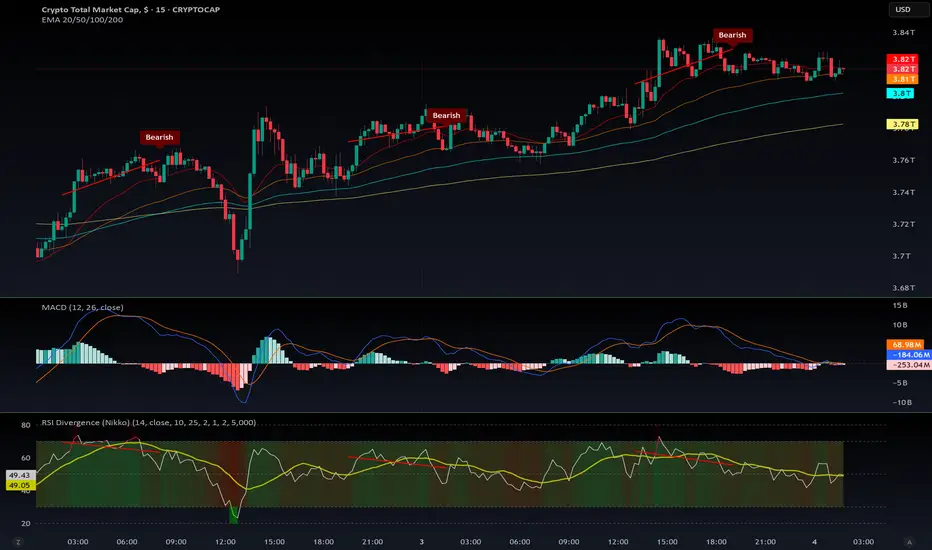
Cryptocurrency markets often appear unpredictable, with sudden price surges or drops that seem to defy logic. For example, when Bitcoin ( CRYPTOCAP:BTC ) experiences a sharp upward spike—a "green candle"—many altcoins follow almost instantly. Why does this happen so quickly? This tutorial explores the theory that centralized exchanges (e.g., Binance, Coinbase) can manipulate coin prices by adjusting internal database values rather than executing real on-chain trades, and how they may use "pegging ratios" to control price movements of specific coins or ecosystems.
The Myth of Instant Market Reactions
When CRYPTOCAP:BTC surges, altcoins often move in lockstep, seemingly without delay. A common assumption is that millions of investors or market-making bots react simultaneously, causing this synchronized movement. However, natural market reactions typically involve some lag due to order book processing, trader decisions, or bot algorithms. So why is the movement near-instantaneous?
The answer may lie in how centralized exchanges operate. Unlike decentralized exchanges (DEXs), which rely on transparent on-chain transactions, centralized exchanges manage trades internally using their own databases. This means they control virtual coin balances, not necessarily actual blockchain assets. When an exchange wants to "pump" a coin (e.g., increase its price by 10% following a CRYPTOCAP:BTC spike), it doesn't need to buy real coins on the blockchain. Instead, it can simply adjust the coin's value in its database, creating the appearance of market activity without requiring reserve assets.
This internal manipulation allows exchanges to influence prices rapidly, explaining the lack of lag in altcoin movements.
------------------
How Exchanges Peg Coins to Major Assets
Exchanges often peg the price movements of altcoins to major cryptocurrencies like CRYPTOCAP:BTC , CRYPTOCAP:ETH , or CRYPTOCAP:SOL , using a weighted ratio that determines how closely a coin follows these leaders. This pegging isn't a fixed value but a dynamic relationship that can vary by coin or ecosystem. For instance:
Typical Pegging Structure:
50% tied to CRYPTOCAP:BTC (the dominant market driver).
50% tied to other ecosystems (e.g., CRYPTOCAP:ETH for Ethereum-based tokens, CRYPTOCAP:SOL for Solana-based tokens).
Example: A meme coin on the Ethereum blockchain might be pegged 50% to CRYPTOCAP:BTC , 25% to CRYPTOCAP:ETH , and 25% to a general "meme coin" index.
This pegging explains why some coins pump or dump more aggressively than others during market trends. Each coin's price movement is a weighted response to the assets it's tied to.
The Role of Pegging Ratios: Pumps vs. Dumps
Exchanges don't apply uniform ratios for upward and downward price movements. Instead, they may assign positive or negative ratios to influence a coin's trajectory:
Positive Ratio: A coin rises faster than its pegged assets during pumps (upward movements) and falls slower during dumps (downward movements). This increases the coin's value over time, often because the exchange holds a large position and plans to sell later for profit.
Example: CRYPTOCAP:SOL might have a 2:1 positive ratio, rising twice as fast as CRYPTOCAP:BTC during a pump and falling half as fast during a dump.
Other Examples: CRYPTOCAP:BNB (Binance's token) and GETTEX:HYPE often show positive ratios, benefiting from exchange favoritism.
Negative Ratio: A coin rises slower than its pegged assets during pumps and falls faster during dumps. This can gradually erode a coin's value, often used by exchanges to liquidate or delist coins they no longer favor.
Example: SEED_DONKEYDAN_MARKET_CAP:ORDI , pegged to CRYPTOCAP:BTC , may fall faster than CRYPTOCAP:BTC during dumps and rise slower during pumps, leading to a net decline.
Other Examples: CRYPTOCAP:INJ , NYSE:SEI , LSE:TIA often exhibit negative ratios.
Meme coins are a special case, typically pegged to both CRYPTOCAP:BTC and their native blockchain:
CRYPTOCAP:PEPE (Ethereum-based) may have a neutral ratio, moving evenly with CRYPTOCAP:BTC and $ETH.
SEED_DONKEYDAN_MARKET_CAP:BONK (Solana-based) might have a negative ratio, falling faster than CRYPTOCAP:BTC and $SOL.
------------------
Exchange Strategies: Controlling Ecosystems and Liquidation
Exchanges can manipulate entire ecosystems by adjusting ratios for categories of coins. For example:
Setting a 2:1 ratio on all meme coins could make them rise twice as fast as CRYPTOCAP:BTC during a pump, creating hype and attracting retail investors.
Conversely, assigning a negative ratio to an ecosystem (e.g., certain layer-2 tokens) can suppress their value, allowing the exchange to accumulate or liquidate positions.
A notable strategy is slow liquidation:
Exchanges may apply a negative ratio to a coin they wish to delist (e.g., SEED_DONKEYDAN_MARKET_CAP:ORDI ). Over time, the coin's value erodes until it reaches a level where the exchange can justify delisting it, citing "low trading volume" or "lack of interest."
This process creates space for new coins the exchange favors, often ones they hold or have partnerships with.
------------------
Why This Matters for Traders?
The idea that coin prices are driven purely by investor sentiment and organic price action is overly simplistic. Centralized exchanges, with their control over internal databases, can heavily influence price trends. Understanding this can help traders:
Identify Positive-Ratio Coins: These are likely to increase in value over the mid-to-long term. Accumulating coins like CRYPTOCAP:SOL or CRYPTOCAP:BNB during dips could yield profits if their positive ratios persist.
Avoid Negative-Ratio Coins: Coins like SEED_DONKEYDAN_MARKET_CAP:ORDI or CRYPTOCAP:INJ may bleed value over time, draining portfolios unless traded carefully.
Monitor Ecosystem Shifts: Watch for exchange announcements (e.g., new listings, delistings) or unusual price movements that deviate from $BTC/ CRYPTOCAP:ETH trends, as these may signal ratio changes.
------------------
Important Notes
Dynamic Ratios: Pegging ratios are not fixed and can change daily based on exchange strategies, market conditions, or liquidity needs. Always verify current trends with real-time data.
Data Sources: Use tools like CoinGecko, CoinMarketCap, or on-chain analytics (e.g., tradingview) to track correlations between coins and their pegged assets.
Risks of Centralized Exchanges: This tutorial focuses on centralized platforms, not DEXs, where on-chain transparency limits such manipulation. Consider diversifying to DEXs for more predictable trading.
Speculative Nature: While this theory is based on observed market patterns, it remains speculative. Exchanges rarely disclose internal mechanisms, so traders should combine this knowledge with technical analysis and risk management.
------------------
Conclusion
Crypto exchanges wield significant power over coin prices by adjusting virtual balances in their databases and using dynamic pegging ratios. By understanding positive and negative ratios, traders can make informed decisions about which coins to hold or avoid. Always conduct your own research, monitor market trends, and use secure platforms to protect your investments. The crypto market may be rigged in some ways, but knowledge of these mechanics can give you an edge.
Exchanges
All Binance Coins Watchlist 2025 JULY If you want to create a full list of all coins from the exchange you use, you can:
1. Go to Screeners
2. Set these filters:
a. Exchange (eg. Binance)
b. Quote currency - USDT
c. Symbol type - Perpetual
3. Keep Scrolling till the end of the list so that all coins are populated. There should be about 400+ coins.
4. Select one of the coins, then click Ctrl A to select all.
5. Right click > Add to an existing Watchlist or Create a new watchlist.
Here's my list i created on 4th July 2025. You can import it if you want.
www.tradingview.com
Institute of Intermediation and 24 Coffee LoversWhen the market is efficient, the most efficient strategy will yield zero financial return for the investor. Therefore, firstly, it is necessary to strive to find inefficiencies in the market itself to apply a strategy that will be effective for it.
What creates market inefficiency? First, there are delays in disseminating important information about the company, such as the approval of a contract with a major customer or an accident at a plant. If current and potential investors do not receive this information immediately, the market becomes inefficient at the time such an event occurs. In other words, objective reality is not considered by market participants. This makes the stock price obsolete.
Secondly, the market becomes inefficient during periods of high volatility. I would describe it this way: when uncertainty hits everyone, emotions become the main force influencing prices. At such times, the market value of a company can change significantly within a single day. Investors have too many different assessments of what is happening to find the necessary balance. Volatility can be triggered by the bankruptcy of a systemically important company (for example, as happened with Lehman Brothers), the outbreak of military action, or a natural disaster.
Third, there is the massive action of large players in a limited market - a "bull in a china shop" situation. A great example is the story of 2021, when the Reddit community drove up the price of GameStop shares, forcing hedge funds to cover their short positions at sky-high prices.
Fourthly, these are ineffective strategies of the market participants themselves. On August 1, 2012, American stock market trading company Knight Capital caused abnormal volatility in more than 100 stocks by sending millions of orders to the exchange over a 45-minute period. For example, Wizzard Software Corporation shares rose from $3.50 to $14.76. This behavior was caused by a bug in the code that Knight Capital used for algorithmic trading.
The combination of these and other factors creates inefficiencies that are exploited by trained traders or investors to make a profit. However, there are market participants who receive their income in any market. They are above the fray and are engaged in supporting and developing the infrastructure itself.
In mathematics, there is a concept called a “zero-sum game”. This is any game where the sum of the possible gains is equal to the sum of the losses. For example, the derivatives market is a perfect embodiment of a zero-sum game. If someone makes a profit on a futures contract, he always has a partner with a similar loss. However, if you dive deeper, you will realize that this is a negative-sum game, since in addition to profit and loss, there are commissions that you pay to the infrastructure: brokers, exchanges, regulators, etc.
To understand the value of these market participants and that you are paying them well, imagine a modern world without them. There is only a company issuing shares and investors in them.
Such a company has its own software, and you connect to it via the Internet to buy or sell shares. The company offers you a quote for buying and selling shares ( bid-ask spread ). The asking price ( ask ) will be influenced by the company's desire to offer a price that will help it not lose control over the company, consider all expected income, dividends, etc. The purchase price ( bid ) will be influenced by the company's desire to preserve the cash received in the capital market, as well as to earn money on its own shares by offering a lower price. In general, in such a situation, you will most likely get a huge difference between the purchase and sale prices - a wide bid-ask spread .
Of course, the company understands that the wider the bid-ask spread , the less interest investors have in participating in such trading. Therefore, it would be advisable to allow investors to participate in the formation of quotes. In other words, a company can open its order book to anyone who wants to participate. Under such conditions, the bid-ask spread will be narrowed by bids from a wide range of investors.
As a result, we will get a situation where each company will have its own order book and its own software to connect to it. From a portfolio investor's perspective, this would be a real nightmare. In such a world, investing in not one, but several companies would require managing multiple applications and accounts for each company at the same time. This will create a demand from investors for one app and one account to manage investments in multiple companies. Such a request will also be supported by the company issuing the shares, as it will allow it to attract investors from other companies. This is where the broker comes in.
Now everything is much better and more convenient. Investors get the opportunity to invest in multiple companies through one account and one application, and companies get investors from each other. However, the stock market will still be segmented, as not all brokers will support cooperation with individual companies, for technical or other reasons. The market will be fragmented among many brokerage companies.
The logical solution would be to create another market participant that would have contracts with each of the companies and universal software for trading their shares. The only thing is that it will be brokers, not investors, who will connect to such a system. You may have already guessed that this is an exchange.
On the one hand, the exchange registers shares of companies, on the other hand, it provides access to trading them through brokers who are its members. Of course, the modern structure of the stock market is more complex: it involves clearing, depository companies, registrars of rights to shares, etc.* The formation of such institutions and their licensing is handled by a regulator, for example, the Securities and Exchange Commission in the United States ( SEC ). As a rule, the regulator is responsible for legislative initiatives in the field of the securities market, licensing of market participants, monitoring violations in the market and supporting its efficiency, protecting investors from unfair manipulation.
*Clearing services are activities to determine, control and fulfill obligations under transactions of financial market participants. Depository services - services for the storage of securities and the recording of rights to them.
Thus, by making a transaction on the exchange, we contribute to the maintenance of this necessary infrastructure. Despite the fashion for decentralization, it is still difficult to imagine how one can ensure speed, convenience and access to a wide range of assets due to the absence of an intermediary institution. The other side of the coin of this institution is infrastructure risk. You can show phenomenal results in the market, but if your broker goes bankrupt, all your efforts will be nullified.
Therefore, before choosing an intermediary, it is useful to conduct a mental survey of the person you will be dealing with. Below you will find different types of intermediaries, which I have arranged according to their distance from the central elements of the infrastructure (exchanges, clearing houses, depositories).
Prime broker
Exchange Membership: mandatory
License: mandatory
Acceptance and accounting of your funds/shares: mandatory
Order execution: mandatory
Clearing and depository services: mandatory
Marginal services: mandatory
Remuneration: commission income from trades, clearing, depository and margin services
This category includes well-known financial houses with history and high capitalization. They are easily verified through lists of exchange members, clearing and depository companies. They provide services not only to individuals, but also to banks, funds and next-level brokers.
Broker
Exchange membership: mandatory
License: mandatory
Acceptance and accounting of your funds/shares: mandatory
Order execution: mandatory
Clearing and depository services: on the prime broker side
Margin services: on the prime broker side or own
Remuneration: commission income from trades and margin services
This category includes intermediaries with a focus on order routing. They delegate participation in depository and clearing services to a prime broker. However, such brokers can also be easily verified in the lists of exchange members.
Sub-broker
Exchange Membership: no
License: mandatory
Acceptance and accounting of your funds/shares: mandatory
Order execution: on the broker or prime broker side
Clearing and depository services: on the prime broker side
Margin services: on the broker or prime broker side
Remuneration: commission income from trades
This category includes brokers who have a brokerage license in their country, but do not have membership in foreign exchanges. To provide trading services on these exchanges, they enter into agreements with brokers or prime brokers from another country. They can be easily verified by license on the website of the regulator of the country of registration.
Introducing Broker
Exchange Membership: no
License: optional, depending on the country of regulation
Acceptance and accounting of your funds / shares: no
Order execution: on the side of the sub-broker, broker or prime broker
Clearing and depository services: on the prime broker side
Margin services: on the broker or prime broker side
Remuneration: commission income for the attracted client and/or a share of the commissions paid by them
This category includes companies that are not members of the exchange. Their activities may not require a license, since they do not accept funds from clients, but only assist in opening an account with one of the top-tier brokers. This is a less transparent level, since such an intermediary cannot be verified through the exchange and regulator’s website (unless licensing is required). Therefore, if an intermediary of this level asks you to transfer some money to his account, most likely you are dealing with a fraudster.
All four categories of participants are typical for the stock market. Its advantage over the over-the-counter market is that you can always check the financial instrument on the exchange website, as well as those who provide services for its trading (membership - on the exchange website, license - on the regulator's website).
Pay attention to the country of origin of the broker's license. You will receive maximum protection in the country where you have citizenship. In case of any claims against the broker, communication with the regulator of another country may be difficult.
As for the over-the-counter market, this segment typically trades shares of small-cap companies (not listed on the exchange), complex derivatives and contracts for difference ( CFD ). This is a market where dealers rule, not brokers and exchanges. Unlike a broker, they sell you their open position, often with a lot of leverage. Therefore, trading with a dealer is a priori a more significant risk.
In conclusion, it should be noted that the institution of intermediation plays a key role in the development of the stock market. It arose as a natural need of its participants for concentration of supply and demand, greater speed and security of financial transactions. To get a feel for this, let me tell you a story.
New Amsterdam, 1640s
A warm wind from the Hudson brought the smell of salt and freshly cut wood. The damp logs of the palisade, dug into the ground along the northern boundary of the settlement, smelled of resin and new hopes. Here, on the edge of civilization, where Dutch colonists were reclaiming their homes and future fortunes from the wild forest, everything was built quickly, but with a view to lasting for centuries.
The wooden wall built around the northern border of the town was not only a defense against raids, but also a symbol. A symbol of the border between order and chaos, between the ambitions of European settlers and the freedom of these lands. Over the years, the fortification evolved into a real fortification: by 1653, Peter Stuyvesant, appointed governor of New Netherland by the West India Company, ordered the wall to be reinforced with a palisade. It was now twelve feet high, and armed sentries stood on guard towers.
But even the strongest walls do not last forever. Half a century after their construction, in 1685, a road was built along the powerful palisade. The street received a simple and logical name - Wall Street. It soon became a bustling commercial artery for the growing city. In 1699, when the English authorities had already established themselves here finally, the wall was dismantled. She disappeared, but Wall Street remained.
A century has passed
Now, at the end of the 18th century, there were no walls or guard towers on this street. Instead, a plane tree grew here - a large, spreading one, the only witness to the times when the Dutch still owned this city. Traders, dealers, and sea captains met under its shadow. Opposite the buttonwood tree stood the Tontine Coffee House, a place where not just respectable people gathered, but those who understood that money makes this world go round.
They exchanged securities right on the pavement, negotiated over a cup of steaming coffee, and discussed deals that could change someone's fate. Decisions were made quickly - a word, backed up by a handshake, was enough. It was a time when honor was worth more than gold.
But the world was changing. The volume of trades grew, and chaos demanded rules.
May 17, 1792
That spring day turned out to be decisive. Under the branches of an old buttonwood tree, 24 New York brokers gathered to start a new order. The paper they signed contained only two points: trades are made only between their own, without auctioneers, and the commission is fixed at 0.25%.
The document was short but historic. It was called the Buttonwood Agreement, after the tree under which it was signed.
Here, amid the smell of fresh coffee and ink, the New York Stock Exchange was born.
Soon, deals were being concluded under the new rules. The first papers to be traded were those of The Bank of New York , whose headquarters were just a few steps away at 1 Wall Street. Thus, under the shade of an old tree, the history of Wall Street began. A story that will one day change the whole world.
Buttonwood Agreement. A fresco by an unknown artist who adorns the walls of the New York Stock Exchange.
The fascinating history of derivatives!I do not know how many people are interested in this. I know I am.
I am not a historian, I am exposing here what I know, some of it might be inaccurate.
For those that do not know a derivative is a financial product derived from an underlying asset or reliant on it.
So in other words currencies, indices, bonds, interest rates, commodities, stocks.
65 million years ago or more: Primates
25 million years ago: First hominoids (apes). Bipedalism & loss of body hair speculated to happen 5-7 million years ago.
4 million years ago: First Australopithecus. Said to be as smart as modern chimps (I don't know if other apes 4 million years ago were smarter or not).
2.5 million years ago: Homo genus. Homo habilis. Not the first to use stone tools, but they are more advanced. Start of the paleolithic (old stone age).
2 to 0.5 million years ago: different human species. Not sure if sapiens descends from habilis or erectus or both. First known use of fire by Homo Erectus.
1.2 million years ago skin pigmentation appears, probably because of a megadrought. Sweating is older than this I think. I don't know much about the evolution of speech, stamina, opposable thumbs etc. I know the world temperature is in a downtrend for the past 50 million years. I don't really know all the ice ages and everything. Alot of very big very strong mammals with low intelligence disappeared. CO2 levels started being really very low. It is likely in my opinion that with the glacial periods, the droughts, the low CO2, apes had to get smarter, as well as start hunting meat (homo species have the digestive system of herbivores but consume meat) at some point using the help of dogs (not sure when that first started, but at least 15 thousand years ago). Human species might have started to save food for harsh times that I don't know.
Eating meat (eating everything even bone marrow and potatoes perhaps) allowed humans to make evolutionary leaps because they spent less time looking for food and eating.
Tribes might have traded with each other I don't know.
0.8-0.3 million years ago: Neanderthal, Denisovan
0.5 million years ago: H. Sapiens, a champion, is born. The species starts its path to absolute world domination and Super Apex predator, dominating all biomes, land, sky, upper ocean, the depths too, and even the bacteria living deep down in earth crust.
300,000 BC: Earliest evidence of long distance trade network. It is highly likely I think, that short distance trade networks precede that.
From wikipedia: "The use of barter-like methods may date back to at least 100,000 years ago. There is no evidence, historical or contemporary, of a society in which barter is the main mode of exchange; instead, non-monetary societies operated largely along the principles of gift economy and debt. When barter did in fact occur, it was usually between either complete strangers or potential enemies."
Yes, debt is pretty old. Everything that was invented was for a reason, because it made sense, and was necessary.
Buying cheap to sell low might be very very old...
Possible more than 100,000 BC: Brace yourselves... Some people think money evolved as a convenient way to replace barter (I have rice I want apples he has apples but wants something other than rice...) but this has not much evidence, and a theory that makes more sense is since it all started with IOUs which can be hard to keep track of (plus there's no proof) then money was first a debt and later became a medium of exchange and (lol) a store of value (I guess we devolved).
10,000 BC: With CO2 levels going up and the climate improving, agriculture appears (probably for the first time).
8000 BC: Oldest evidence of derivatives.
Clay tokens used in Sumer (Iraq) as forwards or futures. Climate was not constant, yields would fluctuate. So it makes sense that they needed a way to hedge against fluctuations in supply.
5400 BC: Earliest "City", Eridu, in the Iraq region, not a city by our standards but they considered it so.
~3000 BC: Mathematics history begins in the region of Iraq/Egypt/Syria/Turkey.
3000 BC: The mesopotamian may be the first to develop a large-scale economy using commodity money.
The shekel, a specific weight of barley. They had an advanced economic system with rules on debt, credit, contracts, private property, full blown capitalism...
Urban Revolution: When rural villages turned into urban societies. It all began back then...
Long distance (between different cities with different "kings") trade is regular.
Obviously, writting was required.
Iraq 3500 BC
Egypt 3100 BC
India/Pakistan 3000 BC
China 2500 BC
"The civilized life that emerged at Sumer was shaped by two conflicting factors: the unpredictability of the Tigris and Euphrates rivers, which at any time could unleash devastating floods that wiped out entire peoples, and the extreme fecundity of the river valleys, caused by centuries-old deposits of soil. Thus, while the river valleys of southern Mesopotamia attracted migrations of neighboring peoples and made possible, for the first time in history, the growing of surplus food, the volatility of the rivers necessitated a form of collective management to protect the marshy, low-lying land from flooding. As surplus production increased and as collective management became more advanced, a process of urbanization evolved and Sumerian civilization took root".
1750 BC: Code of Hammurabi , the first lawyer book. It set rules on contracts & on trading including "finance". We still have copies!
Who knows how many traders profitted off spreads arbitrage speculation and more back then.
First derivative exchanges (in Babylon temples), very likeky to have lasted 1000 years or more.
3000BC-300BC: Evidences of derivatives used in other areas than Iraq but no market/exchange that we know of.
500 BC: Thales said to have made a fortune with a put option on oil back then. He speculated on options over the counter, as there were no known exchange (Greece).
330 BC: Alexander army/followers notice derivatives and see their advantage, the concept makes its way to Greece & Rome.
Which is why it is very likely Babylon exchanges lasted more than 1000 years (1750BC to 330BC at least).
300 BC - 500 AC: Evidence of derivative trades, but I don't know if there were markets, all was probably OTC.
476 AC - 1492 AC: The dark ages in Europe. The Arab world have their age of enlightement but I don't know about finance there. The rest of the world doesn't make any progress in that area as far as I know. CO2 levels dropped and times were tough. Hunger and scapegoating is common (middle aged and old women with no husband were seen as useless mouths to feed and often ended being called a witch then burned or drowned, the arab world developped polygamy to adapt to high male mortality so afaik they didn't burn their women). The church before the tough times of low CO2 used to say about people that accused someone of witchcraft that they were supersticious uncivilised pagans.
The church sees derivatives & interests as "gambling" and "evil", so it becomes clandestine.
Not a very interesting period prone to advancements, not much in science, not much in standard of living, maths, finance...
Some exceptions: Late 1200s Monty Shares, 1300-1800 Loggia in the Piazza dei Banchi.
1 big exceptions: There was a gigantic futures operation. Ran by the Church. Give them money against a sacred contract for eternal life. It is a form of futures contract.
1530: Charles V of the Netherlands helps bring back a derivatives market.
1531: Antwerp Stock exchange (Hurray).
1571: Ancestor of the London Metal Exchange.
1637: Tulip Bubble
1730: Dojima Rice Exchange (and first known use of Technical Analysis)
1789: French revolution. Followed by terror, Napoleon etc.
1800: CO2 level pops off. Time to accelerate progress.
~1800: Industrial Revolution, emergence of labor (arguably "wageslaving").
Shortly followed by Karl Marx, and the 20th century will be the century of socialism & communism & fascism.
In particular the terror communism following the russian revolution, similarly to France.
First time in history where capitalism is questionned?
Early 1800s: The UK bans regular slavery (wage labor or wageslavery means this is not required anymore...)
At the time labor was compared to slavery, there was no argument against private property or capitalism thought.
1848: CME CBOT. Not sure when stocks only had their exchange and when commodity futures did. FX never did until recently but most of the trading is still OTC I think, with a lot of swap trading thought.
1945: Gold standard, following the great depression and WW2 result of high inequality and the Reichbank money printing.
1971: Gold standard abandonned, back to FIAT money printing and inequality uptrend.
1990s: Trading makes its way to the internet
2000: I am not sure but I think this is when "macro trading" (Oil, world economy, FX) got big. Retail trading from home develops. Everything got more and more correlated as a result.
2010s: As an answer to wild money printing, in particular after 2009 bank bailout, new improved crypto currencies are created, in particular Bitcoin.
Still FIAT currencies, and not meant to be store of values if I remember Satoshi whitepaper correctly, but with a limited supply as well as no central control to prevent what happened in Zimbabwe & Germany. Exchanges (crypto ones) are completely online and anyone can be a market maker, money transactions are (well depends on the crypto) quick simple fast.
Crypto exchanges are open 24/7!