MRAM — Persistent Memory for Mission-Critical AI & EdgeCompany Overview
Everspin is the market pioneer in NASDAQ:MRAM (~30% share), supplying Toggle MRAM, STT-MRAM, and TMR sensors for industrial, automotive, aerospace, and data-center use—where speed, durability, low power, and persistence are non-negotiable.
Key Catalysts
Secular tailwinds: MRAM market poised for ~13% CAGR through 2033, driven by AI at the edge, automotive electrification, and industrial automation.
Product leadership: 2025 launch of PERSYST MRAM targets aerospace/defense/industrial—segments that value high endurance + radiation tolerance, enabling premium pricing.
Momentum into 2026: Shares have pushed to multi-year highs near $17 on heavy volume as investors recognize MRAM’s role in fast, persistent scratchpads, black-box logging, and instant-on systems.
Balanced portfolio: Toggle for extreme endurance + STT-MRAM for higher density → covers a wide range of latency, write-endurance, and power envelopes.
Why it matters
✅ Mission-critical reliability vs. volatile DRAM or wear-limited NAND
✅ Deterministic writes for safety-class automotive and avionics
✅ Lower system power (no refresh) → smaller thermal budgets at the edge
Investment Outlook
Bullish above: $11–$12
Target: $20–$22 — supported by category leadership, premium end-markets, and expanding MRAM use-cases across AI/edge and transportation.
Automotive
Mobileye 2026: Reclaiming the ADAS Throne with EyeQ6HMobileye (MBLY) kicked off 2026 with a decisive victory, securing a massive production deal with a top-10 U.S. automaker. This agreement integrates Mobileye’s "Surround ADAS" into millions of vehicles as standard equipment. The market responded immediately, sending shares up 7% in early January trading. This win signals a strategic pivot for the industry, prioritizing scalable safety over elusive fully autonomous dreams.
Geostrategy: Balancing the US-China Tech Divide
Global regulatory pressures are accelerating the adoption of Advanced Driver Assistance Systems (ADAS). Europe’s latest mandates for automatic braking and driver monitoring have forced automakers to seek rapid, reliable solutions. While Chinese OEMs lead in urban "Navigation on Autopilot," Western manufacturers are now fighting back. By securing a major U.S. player, Mobileye reinforces its position as the preferred partner for "Eyes-on, Hands-off" highway technology across North America and Europe.
Technology: The Efficiency of Heterogeneous Computing
The EyeQ6H chip is the crown jewel of this new partnership. Unlike competitors who focus solely on raw "TOPS" (Tera Operations Per Second), Mobileye emphasizes power efficiency and hardware-software co-design. The EyeQ6H utilizes a specialized architecture, including Vector Microcode Processors (VMP) and Deep Learning Accelerators (XNN). This design allows a single chip to process data from up to 11 sensors, enabling highway speeds of 81 mph (130 kph) with minimal power draw.
Business Model: ECU Consolidation and Cost Leadership
Automakers are currently struggling with the rising complexity of vehicle electronics. Mobileye’s "Surround ADAS" offers a way to simplify this architecture. By consolidating multiple driving and safety functions onto a single Electronic Control Unit (ECU), manufacturers can significantly reduce production costs. This business model appeals directly to mass-market brands needing to offer premium features without premium price tags. The current deal targets 9 million units, proving that Mobileye’s "democratization of safety" is finally scaling.
Macroeconomics: Navigating the Post-Shutdown Recovery
The 43-day U.S. government shutdown in late 2025 created a vacuum in regulatory approvals and economic data. As federal agencies resume operations, the automotive sector is bracing for a wave of new safety certifications. Mobileye’s proven track record—with over 200 million vehicles already using its technology—gives it an edge in this "bottleneck" environment. Investors view this new contract as a high-visibility revenue bridge that offsets previous concerns about slower robotaxi deployments.
Innovation and Patent Moats: The REM Advantage
Mobileye’s true competitive moat lies in its Road Experience Management (REM) data. Over 8 million vehicles currently harvest anonymized, crowdsourced mapping data globally. This patented approach allows Mobileye-equipped cars to "see" the road with centimeter-level precision without expensive LiDAR. This scientific advantage in localization and mapping makes their systems easier to deploy at scale than "vision-only" or "LiDAR-heavy" alternatives.
Can Mobileye Turn a 19M-Unit Win Into Market Dominance?Mobileye Global Inc. has secured a transformative 19-million-unit pipeline through two major deals: 9 million EyeQ6H chips for a top-10 US automaker's next-generation ADAS and a previous Volkswagen commitment. This achievement comes during a challenging period marked by a 50% stock decline in 2025, yet it signals a fundamental shift in the company's business model. The transition from selling basic safety chips at $40–$50 per unit to offering a comprehensive "Surround ADAS" platform at $150–$200 per vehicle represents a tripling of revenue potential, establishing Mobileye as a software-centric platform provider rather than merely a component supplier.
The technical foundation of this strategy rests on the EyeQ6H chip, a 7nm processor capable of handling data from 11 sensors, while deliberately excluding the more expensive LiDAR technology. This cost-conscious design enables hands-free highway driving up to 130 km/h for mass-market vehicles, consolidating multiple functions into a single ECU and simplifying automaker production. The company's proprietary Road Experience Management (REM™) technology, which crowdsources data from millions of vehicles to create high-definition maps, provides a substantial intellectual property moat against competitors like Tesla and Nvidia. Over-the-air update capabilities ensure the platform remains current throughout a vehicle's lifecycle.
However, Mobileye faces significant headwinds that temper investor enthusiasm. With 3,000 of 4,300 employees based in Israel, geopolitical uncertainty affects valuation and operations, prompting a recent 5% workforce reduction of 200 employees. Competition from Chinese rivals like Huawei and Xpeng, who are developing in-house solutions, represents an existential threat to market share. The company characterizes 2025 as a "transition year" plagued by inventory challenges, but the massive order pipeline and improved revenue model position 2026 as potentially pivotal. Success hinges on flawless execution of product launches and the ability to maintain technological leadership while navigating both geopolitical tensions and intensifying competition in the autonomous driving space.
Stellantis | STLA | Long at $9.59Stellantis NYSE:STLA is the maker of the auto brands Fiat, Peugeot, Jeep, Citroën, Opel/Vauxhall, Ram Trucks, Dodge, Chrysler, Alfa Romeo, Maserati, DS Automobiles, Lancia, Abarth, and Vauxhall. The stock has fallen sharply due to a 70% profit drop in 2024, weak U.S. sales, high inventory, and tariff uncertainties. The turnaround for NYSE:STLA beyond 2025 hinges on new CEO Antonio Filosa’s focus on U.S. market recovery, new product launches (e.g., Ram 1500 Ramcharger, Jeep hybrids), pricing adjustments, aggressive marketing, $5B U.S. manufacturing investment, and mending dealer relations. The stock is trading at a P/E of 5.1x, debt-to-equity of 0.8x (not bad), a book value of $29 (undervalued), a tangible book value of $9.82, and earnings and revenue are forecasted to grow into 2028. Economic weakening and tariffs may hamper these predictions, but the new CEO and future interest rate drops may get this stock rolling again.
However, if NYSE:STLA shows zero sign of near-term recovery or other fundamental issues arise, I truly think this stock could enter the high $5-$6 range before a true reversal begins.
From a technical analysis perspective, the stock price is currently with my selected "crash" simple moving average. This area often signifies a near-term bottom, but like mentioned above, watchout out for the "major crash" simple moving average area currently between $5.83 and $7.09.
Regardless of bottom predictions, NYSE:STLA is in a personal buy zone at $9.59 with a greater position likely if it enters my "major crash" zone, as mentioned above.
Targets into 2027:
$12 (+25.1%)
$14 (+46.0%)
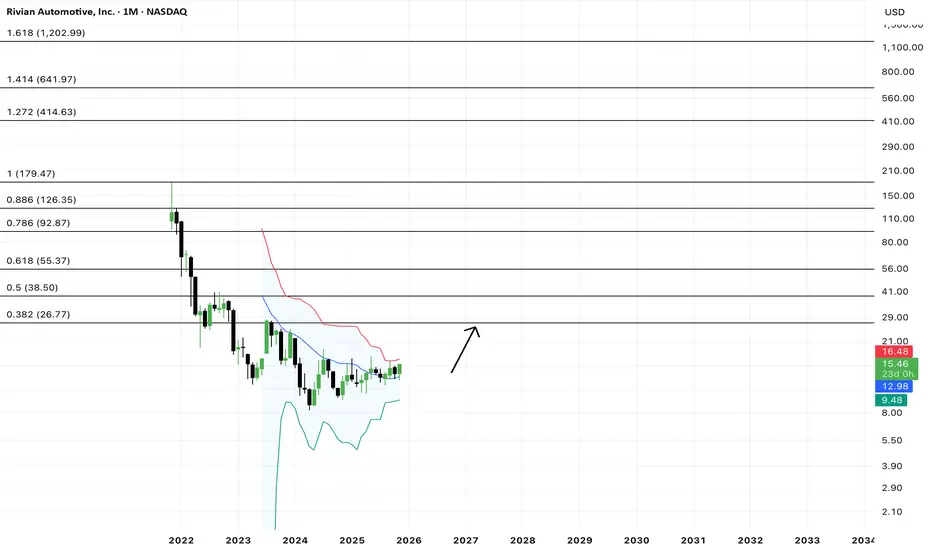
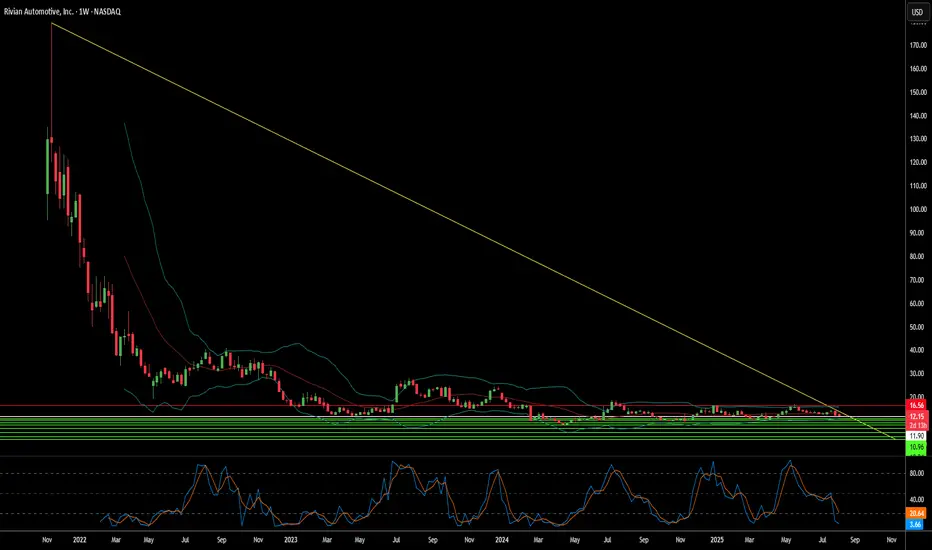
Can Rivian Survive the Perfect Storm of Challenges?Rivian Automotive reported mixed Q2 2025 results that underscore the electric vehicle startup's precarious position. While the company met revenue expectations with $1.3 billion in consolidated revenue, it significantly missed earnings forecasts with a loss per share of $0.97 versus the anticipated $0.66 loss - a 47% deviation. Most concerning, gross profit returned to negative territory at -$206 million after two consecutive positive quarters, highlighting persistent manufacturing inefficiencies and cost management challenges.
The company faces a confluence of external pressures that threaten its path to profitability. Geopolitically, China's dominance over rare earth elements - controlling 60% of production and 90% of processing capacity - creates supply chain vulnerabilities, while new Chinese export licensing rules complicate access to critical EV components. Domestically, the impending expiration of federal EV tax credits on September 30, 2025, combined with the effective end of CAFE fuel economy standards enforcement, eliminates key demand-side and supply-side incentives that have historically supported EV adoption.
Rivian's strategic response centers on three critical initiatives: the R2 model launch, the transformative Volkswagen partnership, and aggressive manufacturing scale-up. The R2 represents Rivian's pivot from niche, high-cost premium vehicles to mainstream, higher-volume products designed to achieve positive gross margins. The $5.8 billion Volkswagen joint venture provides essential capital and manufacturing expertise, while the Illinois plant expansion to 215,000 annual units by 2026 aims to deliver the economies of scale necessary for profitability.
Despite maintaining a strong cash position of $7.5 billion and securing the Volkswagen investment, Rivian's widened EBITDA loss guidance of $2.0-2.25 billion for 2025 and target of EBITDA breakeven by 2027 represent a high-stakes race against time and capital burn. The company's success hinges on flawless execution of the R2 launch, achieving planned production scale, and leveraging its software capabilities and patent portfolio in V2X/V2L technologies to diversify revenue streams beyond traditional vehicle sales in an increasingly challenging regulatory and competitive environment.
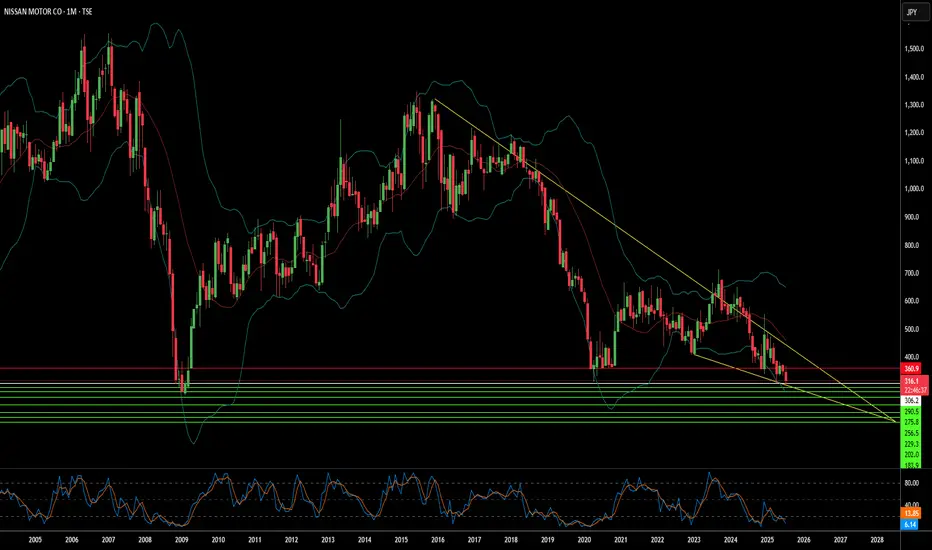
Is Nissan's Future Fading or Forging Ahead?Nissan Motor Company, once a titan of the global automotive industry, navigates a complex landscape. Recent events highlight the immediate vulnerabilities. A powerful 8.8-magnitude earthquake off Russia's Kamchatka Peninsula on July 30, 2025, triggered Pacific-wide tsunami alerts. This seismic event prompted Nissan to **suspend operations at certain domestic factories in Japan**, prioritizing employee safety. While a necessary precaution, such disruptions underscore the fragility of global supply chains and manufacturing, potentially impacting production targets and delivery schedules. This immediate response follows a period of significant operational adjustments as Nissan grapples with broader economic, geopolitical, and technological headwinds.
Beyond natural disasters, Nissan faces substantial financial and market share challenges. Although Fiscal Year 2023 saw operating profit and net income increases, global sales volume remained largely stagnant at 3.44 million units, signaling intensified market competition. Projections for Fiscal Year 2024 indicate a **forecasted revenue decline**, and recent U.S. sales figures show an 8% year-on-year drop in Q1 2025. Macroeconomic pressures, including inflation, volatile currency fluctuations, and a significant hit from **billions of dollars in lease losses** due to plummeting used car values, have directly impacted profitability. Geopolitical tensions, particularly the threat of a 24% U.S. tariff on Japanese auto exports, further threaten Nissan's crucial North American market.
Nissan's struggles extend into the technological arena and its innovation strategy. Despite holding a **remarkable patent portfolio** with over 10,000 active families, the company faces criticism for **lagging in electric vehicle (EV) adoption** and perceived technological stagnation. The slow rollout and underwhelming market impact of new EV models, coupled with a notable absence in the booming hybrid market, have allowed competitors to gain significant ground. Moreover, the brand has contended with **multiple cybersecurity breaches**, compromising customer and employee data, which damages trust and incurs remediation costs. Internal factors, including the lingering effects of the **Carlos Ghosn scandal**, management instability, and costly product recalls—like the recent July 2025 recall of over 480,000 vehicles due to engine defects—have further eroded investor confidence and brand reputation. Nissan's journey ahead remains uncertain as it strives to regain its competitive edge amidst these multifaceted pressures.
Renault’s €2.2 BILLION Loss SHOCKER: Nissan’s Costs Hit Hard!Renault’s €2.2 BILLION Loss SHOCKER 💥: Nissan’s Turnaround Costs Hit Hard! 🚗💸
Imagine Renault and Nissan are like best friends 🤝 who share a big toy car company 🏎️. Renault owns a big piece of Nissan, kind of like having a lot of the toy car's parts 🛠️. But Nissan had a tough year because fewer people bought their cars 📉, especially in places like China 🇨🇳. To fix this, Nissan is making some big changes, like making fewer cars 🚘 and saying goodbye to some workers 👋. These changes cost a lot of money 💰, and because Renault owns part of Nissan, Renault has to share the cost 😓. This means Renault will lose some money this year, about 2.2 billion euros 💶, which is like losing a giant pile of coins! 🪙 But Renault's bosses think these changes will help Nissan make better cars and sell more in the future 🌟, so both friends can be strong again 💪.
Analysis (Up to May 13, 2025):
Renault Group’s announcement of a €2.2 billion hit to its first-quarter earnings 📊 stemming from its 35.71% stake in Nissan reflects the interconnected financial dynamics of their strategic alliance 🤝, as well as broader challenges in the global automotive industry 🌍. Below is an institutional-level analysis of the situation, incorporating the provided data and contextualizing it within the current market environment as of May 13, 2025 🕑.
1. Financial Impact and Impairment Context 📉
Renault’s Exposure to Nissan: Renault’s €2.2 billion earnings hit 💥 is directly tied to Nissan’s reported net loss of approximately $5 billion 📅 for the fiscal year ending March 2025. This loss includes impairments (writing down the value of assets like factories 🏭 or inventory 📦 that are no longer worth as much) and restructuring costs (expenses for layoffs 👥 and factory reductions 🔽). As a 35.71% shareholder, Renault absorbs a proportional share of Nissan’s financial setbacks 📉, which are booked as a negative contribution to Renault’s earnings 💸.
Accounting Implications: The impairments reflect Nissan’s need to adjust the book value of its assets 📜 to align with weaker market performance 📊, particularly in China 🇨🇳, where sales have significantly declined 📉. Restructuring costs are linked to Nissan’s November 2024 announcement of cutting 9,000 jobs 🚫 and reducing global production capacity by 20% 🔧. These measures aim to streamline operations but involve upfront costs 💰, impacting Renault’s financials due to equity accounting rules for its Nissan stake 📈.
Market Reaction: Despite the earnings hit, Renault’s shares rose 1.2% to €48.46 in early trading on the announcement day 📈, suggesting investor confidence in the long-term benefits of Nissan’s turnaround plan 🌟 or optimism about Renault’s core operations 🚗. This resilience may also reflect broader market dynamics, such as stabilizing demand in Europe 🇪🇺 or positive sentiment toward Renault’s electrification strategy ⚡.
2. Nissan’s Turnaround Plan and Strategic Rationale 🔄
Sales Decline: Nissan’s fiscal 2025 sales fell 4.3% to 3.3 million units 📉, driven by weakness in China 🇨🇳, Japan 🇯🇵, and Europe 🇪🇺. China, the world’s largest auto market 🌐, has been a pain point for many global automakers due to intense competition from domestic brands like BYD 🚘 and declining demand for traditional vehicles amid an economic slowdown 📉.
Restructuring Efforts: Nissan’s turnaround plan, announced on April 24, 2025 📅, focuses on cost reduction 💸 and operational efficiency 🔧.
The 9,000 job cuts 🚫 and 20% reduction in production capacity 🔽 signal a shift toward leaner operations, prioritizing high-margin markets and products 📈. This aligns with industry trends, as automakers globally face pressure to adapt to lower demand for internal combustion engine vehicles 🚗 and invest heavily in electric vehicles (EVs) ⚡.
China Strategy: Nissan’s weak performance in China 🇨🇳 underscores the need for a revised market approach 🔄, potentially involving localized EV models ⚡ or partnerships to compete with dominant players 🏆. The impairments likely include devaluing assets tied to underperforming Chinese operations, such as factories 🏭 or unsold inventory 📦.
3. Renault-Nissan Alliance Dynamics 🤝
Historical Context: The Renault-Nissan-Mitsubishi Alliance, formed in 1999 🗓️, has been a cornerstone of both companies’ global strategies 🌍, enabling shared R&D 🧠, platforms, and cost efficiencies 💰. Renault’s significant stake in Nissan ties their financial fates closely 💸, but recent years have seen tensions 😬, including governance issues and strategic divergences, particularly after the 2018 Carlos Ghosn scandal 🚨.
Mutual Dependence: While Nissan’s challenges weigh on Renault ⚖️, the alliance remains critical for both. Renault benefits from Nissan’s scale in markets like North America 🇺🇸 and Asia 🌏, while Nissan leverages Renault’s expertise in Europe 🇪🇺 and EV technology ⚡ (e.g., Renault’s success with models like the Megane E-Tech 🚗).
The €2.2 billion hit 💥 underscores the risks of this interdependence but also highlights Renault’s commitment to supporting Nissan’s recovery 🌟, likely viewing it as essential for the alliance’s long-term viability 📅.
Potential Risks: If Nissan’s turnaround falters 🚫, Renault could face further financial strain 😓, including additional impairments 📉 or pressure to dilute its stake. Conversely, a successful restructuring could strengthen the alliance 💪, boosting shared EV development ⚡ and cost synergies 💸.
4. Industry and Macro Context (Up to May 13, 2025) 🌍
Global Auto Industry: The automotive sector faces a complex transition in 2025 🔄, balancing the shift to EVs ⚡, supply chain disruptions 🚚, and regional demand variations 📊. European automakers like Renault are under pressure to meet stringent EU emissions targets 🌿, while Japanese firms like Nissan grapple with declining relevance in markets like China 🇨🇳, where EV adoption is accelerating ⚡.
China’s Role: China’s market challenges are systemic 🌐, with global automakers losing share to local brands 🚗. Nissan’s sales drop 📉 reflects this trend, and Renault’s indirect exposure via Nissan amplifies its vulnerability to China’s slowdown 😓.
EV Transition: Both Renault and Nissan are investing in electrification ⚡, but Nissan’s restructuring may delay its EV rollout 📅, potentially ceding ground to competitors 🏆. Renault, with its stronger EV portfolio in Europe 🇪🇺, may need to lead alliance efforts in this area 🚗.
Macro Factors: Rising interest rates 📈, inflation 📊, and geopolitical uncertainties 🌍 (e.g., trade tensions) continue to impact consumer demand and production costs 💰. These factors likely exacerbate Nissan’s sales declines 📉 and Renault’s financial hit 💸.
5. Long-Term Outlook (4-10 Year Horizon) 🔮
Nissan’s Recovery Potential: If Nissan’s restructuring succeeds ✅, it could emerge leaner and more competitive by 2029 📅, with a focus on high-growth segments like EVs ⚡ and markets like North America 🇺🇸. This would benefit Renault through improved equity income and alliance synergies 🤝.
Renault’s Strategy: Renault is likely to prioritize its European operations 🇪🇺 and EV leadership ⚡ while supporting Nissan’s recovery 🌟. Divesting its Nissan stake seems unlikely in the near term 🚫, given the strategic importance of the alliance, but Renault may seek to diversify its portfolio to mitigate risks 🛡️.
Alliance Evolution: Over the next 4-10 years 📅, the Renault-Nissan-Mitsubishi Alliance could deepen integration in EV platforms ⚡ and autonomous driving 🤖 or face pressure to restructure if financial strains persist 😓. External partnerships (e.g., with Chinese firms for Nissan 🇨🇳) or mergers could reshape the alliance’s structure 🔄.
Risks to Monitor: Key risks include prolonged weakness in China 🇨🇳, failure to execute EV strategies 🚫, and macroeconomic volatility 🌍. Regulatory changes, such as stricter emissions rules 🌿 or trade barriers 🚧, could further complicate the alliance’s plans 📜.
Conclusion 🎯
Renault’s €2.2 billion earnings hit 💥 reflects the immediate financial burden of Nissan’s restructuring and market challenges, particularly in China 🇨🇳. However, the institutional perspective sees this as a strategic investment in Nissan’s long-term recovery 🌟, critical for the Renault-Nissan-Mitsubishi Alliance’s competitiveness in a rapidly evolving industry 🚗. For a 4 to 10 year old, it’s like Renault helping a struggling friend fix their toy car 🛠️, taking a short-term loss 💸 to ensure both can play better in the future 🎉. Over the next 4-10 years 📅, the success of Nissan’s turnaround and the alliance’s ability to navigate the EV transition ⚡ will determine whether this hit becomes a stepping stone 🪜 or a recurring burden ⚖️.
BMW: Stability, Innovation, and Opportunity in a Changing WorldIn times of market turbulence, great opportunities often lie hidden beneath temporary setbacks. Recent tariff-related ripples may have rattled BMW’s price, but for those looking to invest for the long haul, this dip is a golden opportunity to buy into one of the world’s most reliable automakers.
www.youtube.com
Resilient Amid Tariff Turbulence
Global trade frictions and tariff uncertainties have impacted many companies, and BMW is no exception. Yet, unlike many peers that retreat during such times, BMW remains steadfast—confident in its strategy and outlook. With industry insiders predicting that these tariffs are only temporary, BMW’s fundamentals remain ironclad. Its robust global presence and proactive planning have positioned it to weather these short-term shocks and bounce back stronger.
A Diverse, Future-Ready Product Lineup
While some high-profile names in the auto space chase trends with empty promises, BMW consistently delivers. Rather than focusing solely on electric vehicles like Tesla, BMW offers a balanced portfolio:
- Low-Emission Fossil Fuel Cars: Advanced, efficient engines that still serve a significant market segment.
- Hybrid and Electric Vehicles: Designed for the evolving demand for cleaner mobility, these models blend performance with environmental responsibility.
- Pioneering Hydrogen Technology: In collaboration with strategic partners, BMW is blazing a trail in hydrogen-powered vehicles—a potential game changer that ensures adaptability as the energy landscape shifts.
This diverse lineup not only meets current market needs but also positions BMW at the forefront of future mobility, delivering real, tangible products that work.
World-Class Manufacturing and Advanced Robotics
BMW’s reputation for engineering excellence isn’t just about beautiful design—it’s rooted in its state-of-the-art manufacturing. The company has embraced advanced robotics and automation, ensuring precision, efficiency, and consistent quality. With production facilities spanning the globe—including significant plants in the United States—BMW solidifies its stature as a truly international enterprise.
A Stable, Dividend-Paying Investment
In a market that often rewards volatile “meme” stocks and empty promises, BMW stands apart as a beacon of stability. Unlike Tesla, which currently pays no dividends, BMW offers a juicy dividend yield of over 5%, providing investors with regular, attractive returns. This dividend, coupled with its solid operational fundamentals, makes BMW a safe bet—one that rewards shareholders consistently even during turbulent times.
The Time to Invest Is Now
BMW is more than just a carmaker—it’s a symbol of resilience, innovation, and pragmatic progress. While market chatter may cast doubt amid temporary tariff-induced lows, the company’s diversified product mix, global manufacturing footprint, and commitment to delivering real, advanced technology create a compelling investment thesis.
For investors seeking stability, reliability, and the promise of long-term growth, BMW offers an opportunity to ride out the storm and benefit from a future where the company’s innovations in hybrids, electrics, and hydrogen continue to shape mobility worldwide. Now is the time to look beyond short-term market jitters and invest in a legacy built on quality, performance, and consistent returns.
Embrace the opportunity—BMW’s bright future is not just a promise; it’s already in motion.
XETR:BMW SIX:BMW NASDAQ:TSLA NYSE:GM NYSE:F
HTZ UP AROUND 22% TODAY. ACTIVIST INVESTOR BOUGHT $46.5M SHARES!HERTZ (HTZ) Surged nearly 22% today. A recently report revealed "Activist" Investor Bill Ackman had acquired $46.5 million shares . Should you hop on the bullish trend? Or will price cool off once the hype is over? What are your thoughts?
Disclaimer: Not Financial Advice
Stellantis Long Play despite the tariffsI'm a deep value investor.
Current price 8.58 euros per share
I've been looking at Stellantis for a while now and I've done a deep dive in the company's financial and its fundamental value. It's my opinion that the company is fundamentally strong but being traded at a lower price right now. it has dropped 65% since last year and almost 6% today.
The 65% drop has been a significant overreaction to the a missed earnings forecast which has been due to forign currency depriciation in turkish lira (once you do a deep dive in the company's accounts). but the company is still significantly profitable and has a growing revenue and earnings forecast.
Today's 6% drop is an understandable yet overreaction to trump's tariffs as most of the company's buiness is done outside the US and they are betting big on EU and GB car sales (and have been growing in it)
Bottom line is the company is currently priced way below its intrinsic value. its beeing traded at 0.3 times its book value while automotives are being traded at an average 1.7 time book value, and its price to earnings ration (at this time) is 4.57 while automotives average P/E is 11.79 (slightly lifted by TSLA but still)
I'm expecting a target of 12.6 euros per share within the next 6 months.
If you didn't see my last position on CMC markets see my account.
Eyes Off the Road, But On the Prize?While Tesla often dominates the autonomous driving narrative, the reality is far more nuanced. This article posits that Mobileye, with its recent significant collaboration with Volkswagen, stands as the only true competitor in this high-stakes technological race. Volkswagen's decision to integrate Mobileye's advanced camera, radar, and mapping technologies into its high-volume models underscores a growing industry trend: established automakers are increasingly relying on specialized technology providers to navigate the complexities of assisted and autonomous driving. This partnership not only validates Mobileye's technological prowess but also signals a potential shift in the autonomous driving landscape, moving beyond Tesla's proprietary approach.
Mobileye's strategic advantage lies in its comprehensive suite of technologies, notably the Surround ADAS platform powered by the EyeQ™6 High processor. This vertically integrated solution delivers sophisticated Level 2+ capabilities, including hands-free driving in specific conditions, and is designed for scalability across mass-market vehicles. Complementing this is Mobileye's innovative Road Experience Management™ (REM™) technology, a crowdsourced mapping system that leverages data from millions of vehicles to create and maintain high-definition maps globally. This approach offers near real-time updates and superior local accuracy, providing a critical foundation for future autonomous capabilities and contrasting with Tesla's reliance on its fleet data.
The fundamental difference in business models further distinguishes the two companies. Mobileye operates as a technology supplier, forging partnerships with over 50 automakers and integrating its solutions into numerous vehicle models. This strategy allows for a diverse and expansive collection of real-world driving data. In contrast, Tesla's vertically integrated model confines its autonomous driving technology primarily to its vehicles, potentially limiting its market reach and the breadth of its data acquisition. While Tesla champions an in-house approach, Mobileye's collaborative strategy positions it as a key enabler for the wider automotive industry's autonomous transition.
Ultimately, Mobileye's current focus on delivering robust and scalable Level 2+ systems, exemplified by the Volkswagen partnership, reflects a pragmatic evolution towards full autonomy. Coupled with positive analyst outlooks and a solid financial foundation, Mobileye is not just a contender but the most significant challenger to Tesla's autonomous driving ambitions, offering a compelling alternative path in the pursuit of a driverless future.
Bearish Divergence on Weekly TF but... there is a Breakout..Bearish Divergence on Weekly TF.
However, Breakout on Daily TF from 452 - 453.
Weekly Closing above this level would
be a positive sign.
Upside Targets can be around 495 - 500
& if this level is Sustained, with Good
Volumes , we may witness 540 - 550.
Should not break 400, otherwise, we may see
heavy Selling pressure.
TOYOTA: Excellent conditions for a long term buy.Toyota is neutral both on its 1D (RSI = 51.295, MACD = 2.650, ADX = 28.284) and 1W technical outlook. On the last week of December it got rejected on the 1W MA50 and if it finds support on the 1W MA200, we expect it to recreate the bottom pattern of March 2023. For almost the past 5 years the pattern is a Channel Up. Both prior bullish waves rose by +97% but we will pursue a more modest target (TP = 230.00), the 0.786 Fibonacci retracement level, which during the previous bullish wave was hit on September 18th 2023.
## If you like our free content follow our profile to get more daily ideas. ##
## Comments and likes are greatly appreciated. ##
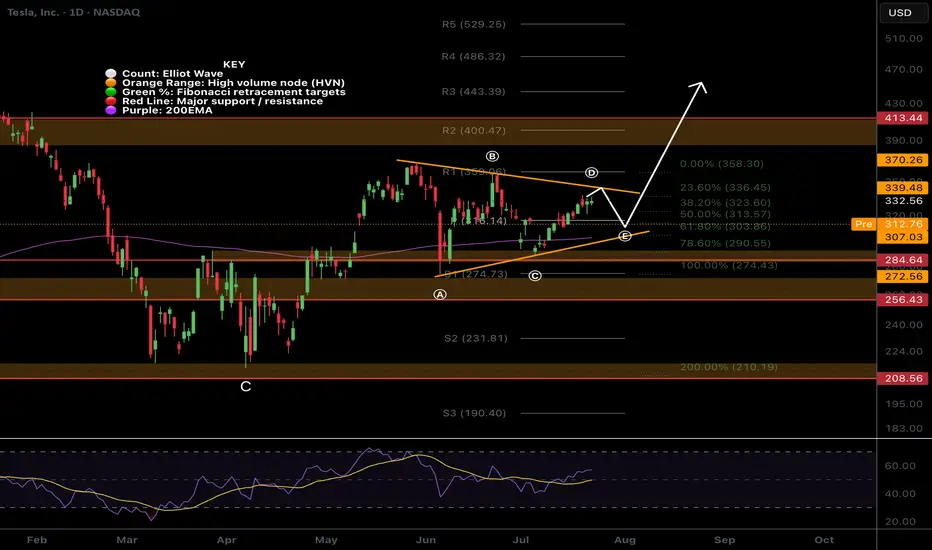
Ford (F): Struggling to Reclaim ResistanceFord was unable to flip its resistance and is now back trading near the support level, with the situation becoming increasingly precarious. NYSE:F has closely followed the Elliott wave count until recently, but now signs of weakness are emerging. If the $9.4 support level is lost, it will invalidate the previous wave count.
Analysts remain pessimistic about Ford’s outlook due to persistent challenges. The company faces potential pricing pressures on internal combustion engine vehicles and continued struggles in the electric vehicle market amid an ongoing price war. Additionally, possible tariffs on imports from Canada and Mexico under Donald Trump’s policies could further complicate the situation.
At this point, we do not see any compelling opportunities in the current market for $F. A long opportunity may arise only if Ford manages to reclaim the significant resistance level. Until then, the risk-to-reward ratio does not justify any immediate action.
STELLANTIS (STLAM): Opportunity or crisis? Stellantis CEO Carlos Tavares submitted his resignation to the board of directors chaired by John Elkann, which accepted it. The announcement had come last October that Tavares would lead the carmaker until 2026, helping the company in its search for a new CEO. However, falling profits and the company's collapse on the stock market led the parties to an immediate separation.
The price of Stellantis has fallen by more than 50% over the past year reaching 2022 price levels.
The RSI technical indicator suggests a bullish divergence that could indicate a recovery in the short-medium term.
Volatility is high and is around levels considered to be high volatility, which could suggest a cooling of the price decline and a temporary recovery.
Assuming a bullish scenario in which today's news is read positively by investors, the price could point to two different levels €15 and €20. Instead, negative investor sentiment could drive the price towards the €10 level.
And what do you think about Stellantis? Will you use this drop to accumulate new shares or will you go short?
Return to the mean?Automotive dealers started marking up autos above MSRP in March 2021. Automakers, jealous of their dealers, followed with the MSRP increases, taking advantage of buzzwords like inflation, chip shortage, supply chain shortages, etc. The return to the mean will be interesting, if there is one.
Subaru is Cheap!FUJHY is cheap by several metrics and warrants a multiple expansion!
- TTM GAAP PE is 71% below sector median
- FWD GAAP PE is 70% below sector median and 53% below its 5 year average.
-EV/EBITDA TTM and FWD are 92 and 94% below sector media; both are about 72% its 5 year avg
-P/S, P/FCF, P/B all are substantially below sector median and its 5 year avg
-DCF based on FCF and 7% discount rate implies a margin of safety at 89.1%
-Shiller PE is 8.34, during the past 10 years, Subaru's highest Shiller PE Ratio was 31.54. The lowest was 6.70. And the median was 10.74. Subaru's shiller PE is ranked better than 84% of 739 companies in the vehicle and parts industry.
-Technically, FUJHY is sitting near the bottom of a long term uptrend and appears to be finding a bottom within a flat channel and starting to trend up.
Subaru has been able to recover to its 2017-2018 profitability and net income range while projecting FWD growth. Given these considerations Subaru appears to be very cheap on several time frames and metrics.
Li Auto in the Fast Lane! Li Auto (LI) is building strong bullish momentum, with a gap forming at the $26.00 level. A breakout above the $30.50 resistance would confirm further strength, positioning the stock to reach the $47.33 weekly resistance. With a favorable 3.33 risk-to-reward ratio, this trade offers a compelling opportunity, while a stop-loss at $23.97 ensures controlled risk.
Li Auto’s leadership in the hybrid electric vehicle (EV) market plays a key role in its growth, offering extended-range EVs that appeal to a broader consumer base. As China’s economy begins to recover, supported by easing policies and increasing domestic consumption, the demand for EVs is expected to rise. With production capacity expanding and government incentives favoring hybrid and electric vehicles, Li Auto is well-positioned to capitalize on this rebound.
This combination of technical momentum, market fundamentals, and the economic recovery in China sets the stage for Li Auto’s push toward the $47.33 target.
NASDAQ:LI