Can Speed Win Wars? Textron's Billion-Dollar BetTextron Inc. has transformed from a diversified conglomerate into a focused aerospace and defense integrator positioned at the intersection of geopolitical urgency and technological innovation. The company's strategic pivot centers on the accelerated fielding of the Bell MV-75 tiltrotor aircraft for the U.S. Army's Future Long-Range Assault Aircraft (FLRAA) program, which addresses critical Indo-Pacific operational requirements. With the ability to fly twice as fast and far as legacy Black Hawk helicopters, the MV-75 solves the "tyranny of distance" problem in Pacific theater operations. Simultaneously, Textron Systems has secured significant contracts for unmanned surface vessels and armored vehicles supporting Ukraine, while the Aviation segment maintains robust demand with a $7.7 billion backlog despite supply chain constraints.
The company's Q3 2025 results demonstrated operational strength with adjusted EPS of $1.55, beating consensus estimates, 5% year-over-year revenue growth to $3.6 billion, and impressive 26% segment profit expansion. Management has executed a disciplined capital allocation strategy, divesting underperforming assets like the Arctic Cat powersports business to concentrate resources on high-margin aerospace and defense opportunities. The Aviation segment generated $1.5 billion in revenue with strong pricing power, while Bell's $8.2 billion backlog reflects the long-term nature of defense contracts. Textron's technological moat includes critical patents on High-Speed VTOL systems with folding rotors, additive manufacturing capabilities, and the Nuuva V300 electric cargo drone that achieved first flight in January 2026.
Financial analysts suggest significant undervaluation, with DCF models indicating intrinsic value at $135 per share compared to current trading levels, implying a 30% discount as the market has not fully priced in the FLRAA production ramp. The convergence of expected Federal Reserve interest rate cuts, sustained business jet demand from high-net-worth individuals, and accelerated defense modernization creates multiple tailwinds. While supply chain bottlenecks for titanium and skilled labor shortages remain constraints, Textron's investments in automation, CMMC cybersecurity compliance, and strategic focus position it as a prime architect of next-generation warfare and transport systems with revenue visibility extending through the decade.
Autonomoussystems
Can a Former Penny Stock Become a Defense Tech Powerhouse?Ondas Holdings Inc. (NASDAQ: ONDS) has executed a remarkable 30% surge, climbing from early-year lows of $0.57 to near its 52-week high of $11.70. This dramatic recovery reflects more than market momentum; it signals a fundamental transformation from a collection of disparate assets into a unified defense technology platform. The company's rebranding to "Ondas Inc." in Q1 2026, along with its strategic relocation to West Palm Beach, Florida, underscores management's commitment to establishing a cohesive identity within the aerospace and defense sector.
The company's growth trajectory is anchored by substantial contract wins and an expanding product ecosystem. Ondas secured a landmark government tender to deploy thousands of autonomous drones for border protection, while recording $16.4 million in counter-UAS orders from major European airports. With revenue targets of at least $110 million for 2026, representing 200% growth over 2025's $36 million, the company is positioning itself for a transition from small-cap to mid-cap visibility. This forecast is supported by a record $23.3 million backlog and a strengthened balance sheet featuring $68.6 million in cash reserves.
Ondas has built competitive advantages through strategic acquisitions and proprietary technology. The acquisition of Sentrycs brought advanced "Cyber-over-RF" capabilities that enable non-jamming drone mitigation—critical for operations in dense urban environments. Combined with its FullMAX platform for mission-critical IoT and precision optics IP from SPO, Ondas offers end-to-end multi-domain autonomy solutions. The company's recent AI-powered humanitarian demining pilot in the Middle East, which identified nearly 150 hazardous items across 22 acres, demonstrates the versatility of its technology beyond traditional defense applications. As global demand for autonomous security solutions intensifies, Ondas appears positioned to capture significant market share across border security, infrastructure protection, and humanitarian operations.
Can One Company Own the Ocean Floor?Kraken Robotics has emerged as a dominant force in subsea intelligence, riding three converging megatrends: the weaponization of seabed infrastructure, the global energy transition to offshore wind, and the technological obsolescence of legacy sonar systems. The company's Synthetic Aperture Sonar (SAS) technology delivers range-independent 3cm resolution, 15 times superior to conventional systems. At the same time, its pressure-tolerant SeaPower batteries solve the endurance bottleneck that has plagued autonomous underwater vehicles for decades. This technological moat, protected by 31 granted patents across 19 families, has transformed Kraken from a niche sensor manufacturer into a vertically integrated subsea intelligence platform.
The financial metamorphosis validates this strategic positioning. Q3 2025 revenue surged 60% Year-Over-Year to $31.3 million, with gross margins expanding to 59% and adjusted EBITDA growing 92% to $8.0 million. The balance sheet fortress of $126.6 million in cash, up 750% from the prior year, provides the capital to pursue a dual strategy: organic growth through NATO's Critical Undersea Infrastructure initiative and strategic acquisitions, such as the $17 million purchase of 3D at Depth, which added subsea LiDAR capabilities. The market's 1,000% re-rating since 2023 reflects not speculative excess but a fundamental recognition that Kraken controls critical infrastructure for the emerging blue economy.
Geopolitical tensions have accelerated demand, with the Nord Stream sabotage serving as an inflection point for defense procurement. NATO's Baltic Sentry mission and the alliance-wide focus on protecting 97% of internet traffic carried by undersea cables create sustained tailwinds. Kraken's technology participated in seven naval teams at REPMUS 2025, demonstrating platform-agnostic interoperability that positions it as the universal standard. Combined with exposure to the offshore wind supercycle (250 GW by 2030) and potential deep-sea mining operations valued at $177 trillion in resources, Kraken has positioned itself as the indispensable "picks and shovels" provider for multiple secular growth vectors simultaneously.
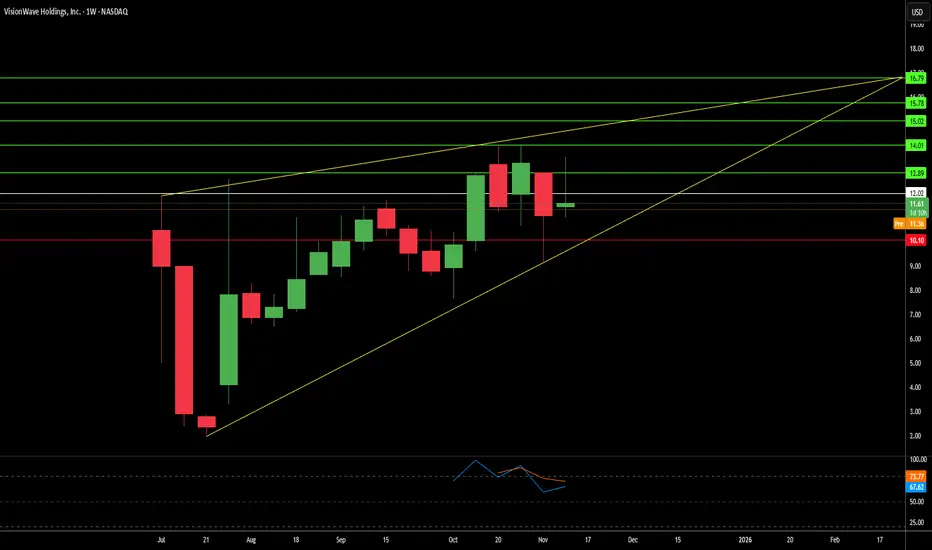
Can AI See What Bullets Cannot?VisionWave Holdings is transforming from an emerging defense technology provider into a critical AI infrastructure and platform integrator, positioning itself to capitalize on urgent global demand for autonomous military systems. The company's strategic evolution is driven by heightened geopolitical instability in Eastern Europe and the Indo-Pacific, where conflicts, such as the war in Ukraine, have fundamentally shifted battlefield doctrine away from traditional heavy armor toward agile, autonomous platforms. With the military unmanned ground vehicle market projected to reach $2.87 billion by 2030 and a structural shift toward Manned-Unmanned Teaming doctrine adding sustained long-term demand, VisionWave's timing aligns with accelerating procurement cycles across NATO allies.
The company's competitive advantage centers on its Varan UGV platform, which integrates proprietary 4D imaging radar technology and independently actuated suspension to deliver superior mission resilience in extreme environments. Unlike conventional sensors, VisionWave's 4D radar adds elevation data to standard measurements, achieving detection ranges exceeding 300 meters while maintaining reliable operation through fog, rain, and darkness capabilities essential for 24/7 military readiness. This technological foundation is strengthened by the company's partnership with PVML Ltd., which creates a "secure digital backbone" that resolves the critical Security-Speed Paradox by enabling rapid autonomous operations while maintaining strict security protocols through real-time permission enforcement.
VisionWave's recent institutional validation underscores its transition from emerging player to credible defense-AI equity. The company raised $4.64 million through warrant exercises without issuing new equity, demonstrating financial discipline and strong shareholder confidence while minimizing dilution. Strategic appointments of Admiral Eli Marum and Ambassador Ned L. Siegel to its Advisory Board establish crucial operational bridges to complex international defense procurement systems, accelerating the company's path from pilot validations in 2025 to scaled commercialization. Combined with S&P Total Market Index inclusion and a 5/5 technical rating from Nasdaq Dorsey Wright, VisionWave presents a comprehensive value proposition at the intersection of urgent geopolitical demand and next-generation autonomous defense technology.