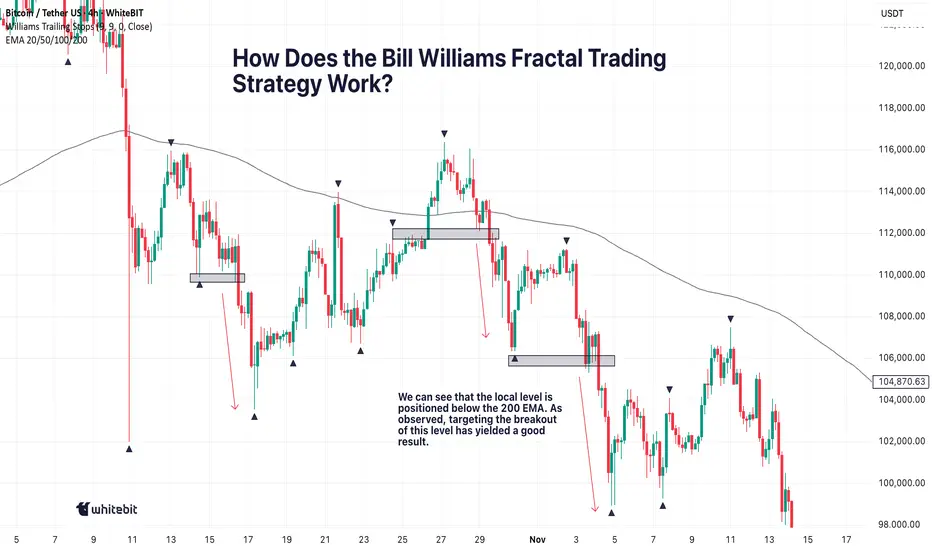
The Bill Williams Strategy ExplainedWe all know the market doesn’t always play nice, but the Bill Williams Fractal Indicator can help you read between the lines. If you're focused on fine-tuning your entries and exits, let’s break down how fractals can be a useful tool in your strategy.
What is the Bill Williams Fractal Indicator?
At its core, the Bill Williams Fractal Indicator is a technical analysis tool that identifies potential reversal points in the market. This indicator is based on the fractal definition by Bill Williams, who described fractals as price patterns that can be used to predict potential shifts in price direction.
In simple terms, a fractal pattern consists of five consecutive bars or candlesticks on a chart. The middle bar of this pattern represents a local peak or trough, while the two bars on either side of it are smaller. A bullish fractal occurs when the middle bar is a higher high than the surrounding bars, and a bearish fractal appears when the middle bar is a lower low.
Bill Williams Fractal Definition
The Bill Williams Fractal is defined by a sequence of five consecutive bars. The middle bar represents the peak (for bearish fractals) or trough (for bullish fractals), surrounded by smaller bars on both sides. When price breaks the high (for bearish fractals) or low (for bullish fractals) of this central bar, it signals a potential breakout.
How Does the Bill Williams Fractal Trading Strategy Work?
The Bill Williams Fractal Strategy is a proven approach in crypto trading. Whether you're a beginner or an experienced trader, using the fractal strategy can provide valuable insights into potential market reversals and breakouts. By combining the Bill Williams Fractal Indicator with effective risk management, you can improve your trading edge.
A common method is to use the 200 EMA to gauge the overall trend. If the price is below the 200 EMA, traders tend to focus on lower fractals and look for short opportunities, while if the price is above the 200 EMA, they focus on upper fractals and consider long trades. However, always remember to confirm the breakout of local levels for greater reliability in your trades.
Master the Bill Williams Fractal Strategy
The Bill Williams Fractal Strategy is a well-established method in crypto trading. Whether you're just starting out or you're an experienced trader, incorporating the fractal strategy can provide useful insights into potential market reversals and breakouts. By combining the Bill Williams Fractal Indicator with a solid risk management plan, you can enhance your trading approach.
That said, remember that no strategy guarantees success. Fractal trading isn't about predicting the market with absolute certainty — it's about managing your entries and exits with precision and maintaining discipline. Always make sure to think critically and adapt to market conditions. So, when you spot a Bill Williams Fractal on your chart, use it as a guide, but always trust your analysis and approach. Happy trading!
Billwilliam
Taming the Trend: Mastering the Williams Alligator IndicatorEver wondered how to spot when the market is sleeping or ready to roar? At Xuantify , we use the Williams Alligator Indicator to decode market behavior with precision. Whether you're trading crypto, forex, stocks, or indices — this tool adapts across all markets. Let's take a closer look using BINANCE:BTCUSDT
🧠 How We Use It at Xuantify
We treat the Alligator as a trend confirmation and timing tool . We don’t just look for crossovers — we analyze the distance , angle , and alignment of the lines to gauge market momentum and trend maturity. It’s especially powerful when combined with volume and volatility filters.
⭐ Key Features
Three Smoothed Moving Averages
Jaw (Blue) : 13-period, shifted 8 bars forward
Teeth (Red) : 8-period, shifted 5 bars forward
Lips (Green) : 5-period, shifted 3 bars forward
Visual Trend Clarity :
The spacing and direction of the lines reveal trend strength and direction
Built-in Delay :
Forward shifting helps anticipate rather than react
💡 Benefits Compared to Other Indicators
Trend Clarity
Alligator : Strong — bold trend visualization
Moving Averages : Moderate — can lag or overlap
MACD : Good — clear histogram and signal line
Noise Filtering
Alligator : Excellent — smooths out market noise
Moving Averages : Low — sensitive to short-term fluctuations
MACD : Good — filters minor moves
Early Signals
Alligator : Moderate — waits for confirmation
Moving Averages : Fast — quick crossovers
MACD : Fast — early divergence signals
Visual Simplicity
Alligator : Clear — easy to interpret trend phases
Moving Averages : Cluttered — multiple lines can overlap
MACD : Complex — requires interpretation of histogram + lines
⚙️ Settings That Matter
For shorter timeframes : Reduce periods (e.g., 8-5-3) for faster signals
For longer timeframes : Stick with defaults or increase smoothing for clarity
Shift values : Keep them forward-shifted to maintain predictive edge
📊 Enhancing Signal Accuracy
Wait for clear separation between the lines
Confirm with volume spikes or breakouts
Use price action (e.g., higher highs/lows) as confirmation
🧩 Best Combinations with This Indicator
Fractals : For entry/exit signals
ATR : For dynamic stop-loss placement
RSI or Stochastic : To avoid overbought/oversold traps
Volume Profile : To validate breakout zones
⚠️ What to Watch Out For
Flat Alligator = No Trade Zone : Avoid trading when lines are tangled
Lag in Fast Markets : In high-volatility assets, the Alligator may react late
Over-reliance : Always combine with other tools for confirmation
🚀 Final Thoughts
The Williams Alligator isn’t just an indicator — it’s a market behavior model . At Xuantify, we use it to stay aligned with the market’s rhythm, avoid chop, and ride trends with confidence.
🔔 Follow us for more educational insights and strategy breakdowns!
BTC Bears Feeling the HornsJob well done Bulls. You blasted thru the overhead resistance I mentioned in yesterday's video, and have hit the first target (NT Wave).
In this video I discuss further upside targets, should be manage to stay above the cloud on the Daily.
As always, good luck, have fun and practice solid risk management.
EURUSD didn't get the memo...Perhaps "this time IS different".... as Global macro seems irrelevant to markets. EURUSD has been pumping this week, even though EUROPE is apparently in a recession, as per the recent GDP numbers.
So long as Bulls can hold above the 4hr cloud/forecast lines, up is the name of the game, and 1.09 looks like the next "logical" target.
As always, good luck, have fun, and practice solid risk management.
Mastering Forex Trading with the Alligator IndicatorForex traders are always looking for ways to improve their trading strategies and make better decisions when it comes to buying and selling currency pairs. One tool that can be helpful in this regard is the Alligator indicator. This technical indicator is designed to identify market trends and determine ideal entry and exit points based on the trend's strength.
What is the Alligator indicator?
The Alligator indicator consists of three lines: the jaw, teeth, and lip. These lines can identify when a trend is forming and its continuation or reversal possibilities. The jaw represents a 13-period moving average line, while the teeth represent an 8-period moving average line and the lips represent a 5-period moving average line. These lines can indicate if a bullish or bearish trend is in effect and where it is going to move in the future.
How to use the Alligator indicator in forex trading?
To use the Alligator indicator, traders should first select the currency pair they want to trade and monitor the market for a strong trend potential. When the Alligator is applied to a weak current trend, it is known as a sleeping Alligator. Traders should look for a weak trend that is converting into a strong trend, identified when all three lines are close to each other but not entwining. As the red and blue lines start moving in the same direction and the green line passes through them, a strong trend begins to form.
If all three lines are moving upwards, with the green line above the red line and the red line above the blue line, there is an uptrend signaling long orders. Conversely, if the three lines are moving downwards with the green line at the bottom, red in the middle, and blue at the top, it indicates a downtrend signaling short orders.
Traders can place an order in the same direction as the trend identified by the Alligator indicator. After entering a trade, traders can hold onto it until the green line crosses the red and blue lines simultaneously. At this point, the candlestick will close below the three lines, enabling traders to exit the position or execute a short order with an expectation of a falling market.
Traders should always monitor the market and wait until the Alligator lines are not crossing each other before exiting a trade. It is also possible to use the Alligator indicator in combination with other technical indicators such as the CCI indicator to identify overbought and oversold market conditions and place long or short orders accordingly.
In conclusion, the Alligator indicator can be a powerful tool for forex traders looking to identify market trends and make better trading decisions. By understanding how to use this indicator, traders can improve their strategies and increase their chances of success in the forex market.