btc update now btc is currently exhibiting a significant shift in market structure on the 15-minute timeframe. After a steady climb within an ascending channel, the price has encountered heavy selling pressure at the 5,115 - 5,125 supply zone. This rejection has led to a decisive break below the primary trendline support, signaling a potential trend reversal.
Technical Breakdown:
Supply Interaction: The purple resistance box represents a high-interest area where buyers failed to maintain momentum, leading to a "double top" like exhaustion.
Trendline Breach: The breakdown of the ascending channel suggests that the previous bullish cycle is over, and the market is now seeking lower liquidity pools.
Entry Logic: The current setup follows a "Break and Retest" pattern. We are looking for the price to stabilize below the broken trendline before expanding toward the downside.
Target Levels: The primary take-profit objective is set at 4,924, which aligns with a major structural low and a significant liquidity gap.
Risk Management: To maintain a high risk-to-reward ratio, the invalidation point (Stop Loss) is placed at 5,148, just above the recent swing high.
Summary: This is a high-probability bearish setup based on a structural shift (ChoCh). We expect further downside expansion as long as the price remains below the immediate resistance level of 5,077.
Btc-e
Bitcoin Targeting 84.450 - watching for point D CompletionOn the Bitcoin daily chart, i am observing a very intersting harmonic pattern that is gaining more technical significance every day. Everything points to a developing GARTLEY FORMATION, where point B is already clearly visible, and following the BC bounce, the market is currently heading towards completing the entire structure. My key decision-makin area is the around 84.450 level, which is where point D of the formation sits. I have identified this zone based on significant reference points, such as the lower shadows from early December and the lows from December 18th. I'm now waiting for this setup to fully complete and I intend to trade it once the price precisely reaches that designated level.
BTC Bitcoin MONSTER Trade in Play | Planning Our Next MoveIn this video, we continue managing our BTC Bitcoin MONSTER trade 🥇💪. We break down our strategy and how this can be a lifge changing opportunity.. now planning our next move. Price is printing clear higher highs and higher lows on the 30-minute chart ⏱️📊, and we’re looking to capitalize on the next swing high and retracement.
BTC is not reversing — A bearish pullback into EMA resistanceBitcoin remains firmly in a bearish market structure on the H1 timeframe, with price consistently trading below the EMA 98, which is acting as dynamic resistance rather than support. The recent bounce is corrective in nature, occurring after a sharp sell-off, and shows overlapping candles with weak upside momentum a typical bearish pullback rather than the start of a new impulsive leg. Notably, price was previously rejected aggressively at the EMA 98 zone, confirming that sellers are still in control and using this level to reload shorts. As long as BTC fails to reclaim and hold above the EMA 98 with acceptance, the path of least resistance remains to the downside, with lower highs continuing to form and downside liquidity still untested. The bearish scenario remains the higher-probability outcome, targeting the previous demand and liquidity zone below, while any bullish alternative would require a clean break and sustained acceptance above EMA 98 something the market has not shown yet.
ETH bounce = resistance test, not a reversal.On the 1H timeframe, ETH remains structurally bearish despite the sharp rebound from the recent sell-off. Price is still trading below the declining EMA 98, which continues to act as dynamic resistance, aligning closely with the descending trendline a confluence that reinforces seller control. The current bounce shows corrective characteristics: overlapping candles, weak follow-through, and rejection near the 2,880–2,900 zone rather than impulsive continuation. This suggests short-covering and mean reversion, not fresh demand. As long as ETH fails to reclaim and hold above the EMA 98 with strong momentum, the dominant scenario favors another leg down, with downside targets toward 2,838 first and potentially the 2,780–2,800 demand pocket if selling pressure resumes. Only a clean break and acceptance above the EMA 98 would invalidate this bearish continuation bias.
From Panic to Opportunity: Demand Absorption Is Shaping Bitcoin has just completed a textbook liquidity-driven sell-off, followed by a sharp reaction from higher-timeframe demand, and the current structure suggests the market is transitioning from panic to stabilization. After failing to hold below the descending EMA cluster, BTC accelerated lower and swept sell-side liquidity aggressively, flushing late longs and triggering forced liquidations into the 86,000–86,800 demand zone. This move was emotional and fast a classic signature of capitulation, not healthy trend continuation. Immediately after tapping this demand, price reacted strongly, reclaiming intraday structure and pushing back above 88,000, confirming that buyers were waiting below, not absent. From a market structure perspective, Bitcoin is still technically in a broader corrective phase, but the downside momentum has clearly slowed. The impulsive sell-off has transitioned into a higher-low recovery, which tells us that selling pressure is no longer dominant. Price is now attempting to build acceptance above 88,000–88,500, an important equilibrium area inside the prior range. As long as Bitcoin continues to hold above the demand zone and prints higher lows, this recovery should be viewed as a developing corrective leg upward, not a dead-cat bounce.
Looking at liquidity and order flow, the current price action makes sense. Sell-side liquidity below 87,000 has already been taken, and the market now has an incentive to move higher toward buy-side liquidity resting above 89,500, 90,500, and into the major resistance zone near 90,800–91,200. This is where trapped shorts from the breakdown and breakout traders from the previous range have their stops clustered. The projected zigzag path higher reflects how the market typically rebalances — partial pullbacks to trap premature longs, followed by continuation to the next liquidity pool.
From a psychological standpoint, sentiment has just shifted from fear to hesitation. Many traders are still biased bearish after the sharp drop and are selling too early into strength. That hesitation is fuel for continuation. As long as price does not collapse back into the 86,000 demand zone, bears lack follow-through. Meanwhile, dip buyers are becoming more confident, especially as volatility compresses after the sell-off.
On the macro and narrative side, Bitcoin remains sensitive to risk sentiment, U.S. dollar movement, and real yields. Any pause or pullback in the U.S. dollar, combined with stabilization in equity markets, supports further upside relief in BTC. Importantly, this is still a range recovery, not a confirmed macro bull continuation — which means resistance must be respected, especially near the 90,800–91,200 supply zone.
Bullish scenario:
As long as BTC holds above 86,000–86,800, price is likely to continue grinding higher toward 89,500, then 90,500, and potentially a full test of the 90,800–91,200 resistance zone.
Bearish invalidation:
A decisive breakdown and acceptance below 86,000 would signal that demand has failed and open the door for a deeper continuation toward 84,000–82,500.
Bias: Short-term recovery, medium-term range
Key demand: 86,000–86,800
Key resistance: 90,800–91,200
This is not a market to chase emotionally. Bitcoin is doing what it always does after a liquidity sweep reset sentiment, rebuild structure, and hunt the next pool of liquidity.
CUSD (1H) — The breakdown isn’t the danger. The failed retestOn the 1H timeframe, Bitcoin is playing out a very textbook range–liquidity–breakdown sequence. Price spent a prolonged period consolidating inside a sideways range between 88,200 and 90,250, allowing liquidity to build on both sides of the box. Once that liquidity matured, the market executed a clean breakdown below the 88,200 support, triggering stop-losses from late longs and breakout traders a classic sell side liquidity sweep. The sharp bounce that followed is not bullish by default; it is a natural reaction after liquidity has been consumed. At this stage, the rally should be treated as a relief bounce, not a confirmed trend reversal.
Structurally, the short-term market remains bearish. The EMA is still sloping downward, and price has not yet reclaimed any key resistance. This makes the retest zone between 88,200 and 88,600 the most critical area on the chart. If price rallies into this zone and shows rejection long upper wicks, bearish closes, or increased sell volume. it would confirm that former support has flipped into resistance. In that scenario, the market is likely transitioning into distribution below resistance, with high probability of another leg lower toward the 86,000–86,500 liquidity pocket, where unfilled orders and resting buy-side liquidity are likely sitting below the recent low.
From a liquidity and psychology perspective, this area is extremely sensitive. Traders who were stopped out during the breakdown are now emotionally inclined to sell near breakeven, while aggressive shorts often enter late after the flush. This creates the perfect environment for a failed retest, where sellers regain control and push price lower once again. Conversely, the bullish invalidation is very clear and objective: if Bitcoin reclaims and holds above 88,600, with a strong hourly or four-hour close and a successful retest, then the breakdown would be classified as a false break / stop-hunt. In that case, price could rotate back into the prior range and target 90,250 first, followed by 91,270, and ultimately the higher resistance zone near 93,500.
From a macro standpoint, Bitcoin remains tightly correlated with risk sentiment. Any sudden moves in U.S. dollar strength, bond yields, or Federal Reserve rate-cut expectations can act as catalysts for sharp liquidity-driven moves. During periods of thin liquidity, the market often exaggerates reactions to news, producing wicks designed to trap emotional traders before the real direction unfolds. This is why confirmation at structure levels matters far more than prediction.
Trading plan summary:
– Bearish base case: Look for rejection signals in the 88,200–88,600 retest zone. Failure here favors continuation toward 86,000 and below.
– Bullish invalidation: Only shift bullish if price reclaims and holds above 88,600, opening the path back toward 90,250 → 91,270 → 93,500.
Until that reclaim happens, this market should be treated as a corrective bounce within a bearish structure, not a confirmed reversal. Risk management remains key.
Coinranger| BTCUSDT. Continuing decline to 85,000🔥News
🔹No important news today. Only an old data on american market will be released, which is usually considered preliminary.
🔥BTC
🔹Fell down last night and broke through previous peak. Current levels:
1️⃣ The levels above can only be calculated tentatively. 88,500 is the first level for the end of the pullback.
2️⃣ The levels below - 85,000 and 84,700 - almost coincident potential ends of the downward sets of waves on h1 and h4.
Without news, we could either continue the decline, or make a pullback, and then, for example, fall further.
---------------
Share your opinion in the comments!
#GBPJPY , Another Short ??📊 Morning Market Brief | London Session Prep
🔎 Instrument Focus: #GBPJPY
⚠️ Risk Environment: High
📈 Technical Overview:
Maybe , We can have GJ again but this time would be so Risky.
🚀 Trading Plan:
• Check Momentum around Entry point . if it be high momentum , SKIP IT
• LTF ENTRY NEEDED
🧠 Stay updated with real time news and macro events, visit 👉 @News_Ash_TheTrader_Bot
#Ash_TheTrader #Forex #EURUSD #MarketInsight #PriceAction #TradingPlan #RiskManagement #LondonSession #Scalping #Futures #NQ #Gold
BTC will face hell this year - bottom will set in at 45,379$!its safe to say we are in a bear market.
the bottom will set in at 45,379$ and lift off will occur to 300,000£ at the minimum.
I would advise you all to DCA anything below 50k usd.
you will probably get till mid 2027 to fill your usdt bag and enter the market before lift off.
Bitcoin will never totally fail, but it works in miraculous cycles to clean out the dead weight and those not in the know.
our recent projections of price hitting 61,382$ are coming to fruition.
main areas of support whereby we expect brief support are at 80,934$ and 69,675$ before then.
please see linked ideas and our page, you will realise how scarily accurate our dooms day predictions are.
GBPUSD (4H chart pattern)...GBPUSD (4H chart pattern).
I’ve got a descending channel breakout + impulsive bullish move, so the clean targets are based on structure + imbalance fill:
🎯 Targets
TP1: 1.3525 – 1.3530
→ Prior structure / midpoint reaction zone (my first marked target)
TP2: 1.3350 – 1.3370
→ Channel projection + strong demand area (main swing target)
🧠 How I’m reading it
Price broke out strongly from the descending channel
After such an impulsive leg up, a pullback to rebalance is very common
First pause usually at previous support-turned-resistance
Deeper pullback aligns with channel measured move
⚠️ Invalidation
As long as price holds above ~1.3600, the structure stays bullish
A clean break back below that weakens the setup
If i want, tell me:
Are i buying pullbacks or selling retracement?
Intraday or swing trade?
USDJPY (4H chart pattern)...USDJPY (4H chart pattern).
Based on the structure and the levels my’ve already marked, here are clean, logical targets (pure technicals, not financial advice):
🎯 Upside targets (if price continues the bounce)
Target 1: 155.60 – 155.70
→ First reaction zone / minor resistance (price already respecting this area)
Target 2: 156.20 – 156.30
→ Strong level (Ichimoku / previous support-resistance flip)
Target 3: 158.40 – 158.60
→ Major resistance / previous high area
→ This is the extended target if momentum really kicks in
⚠️ Downside risk (in case bounce fails)
154.00
153.50 (last demand / swing low)
📌 Market read
The dump was aggressive → impulsive sell
Current candles look like corrective pullback
Expect reaction first at 155.6, then decision
If my want, tell me:
👉 Buy or sell bias?
👉 Scalp, intraday, or swing?
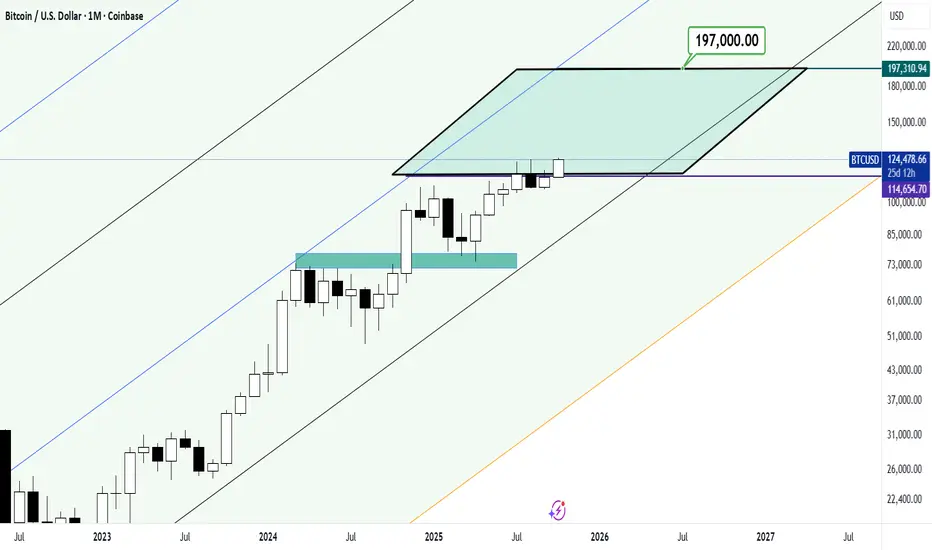
BITCOINI believe Bitcoin is brewing up a couple of big moves for this year. However, I also think that it's going to trick a lot of people before the true move takes place.
I analyze four "main charts" for directional bias, and I use the others as fillers. Currently, I'm getting half & half with my bias, where two is telling me bear and the other two is leaning towards bull. The two smallest TFs is bear at the moment, and I'm viewing that as a precursor for what's to come in the future.
In my opinion, Bitcoin's price must bleed before the next bull run takes place. Price action is near not only the daily low, but it's hovering over the current weekly & monthly low, too! I would like to see the bulls takeover on the daily and weekly TFs in order for price to rally to the highs, but only for it to run into huge bear barriers.
Bear Barriers:
1. Monthly IMB (untouched)
2. 3M wick (untouched)
3. Bear range ($130K - $160K)
4. S/R ($122,100K)
If the bears do come into the market around the $130K - $160K range, I'm anticipating a massive drop in price around $40K - $60K. Sounds crazy right?! I have my reasons why, but I'll keep it close to the chest until things starts to unfold with this crypto.
In conclusion, I'm currently stuck in the middle with my bias until the two smallest TFs flip back to bull, but price can throw a curve ball and demolish the monthly low to turn it bear... we shall see how this plays out, and I'll share my thoughts as it progress.
$BTC Tops Then $SPXThe stock market normally tops ~1.5 months after BTC, but it has now continued to rip to ATHs ~3x that amount of time!
Dec 11, 2017 (BTC peak) to Jan 22, 2018 (SPX peak) = 43 days
Nov 8, 2021 (BTC peak) to Dec 27, 2021 (SPX peak) = 44 days
Oct 6, 2025 (BTC peak) to January 26, 2026 (SPX today’s date ATH) = 113 days
Is crypto broken?
Example of How to Check Support
Hello, fellow traders.
By "Following," you'll always get the latest information quickly.
Have a great day.
-------------------------------------
How can we confirm that the price is supported at support and resistance levels?
While support can be determined over time, it's not always easy to tell when support is being tested.
The indicators we focus on are the HA-Low and HA-High indicators.
Then, in combination with the DOM(-60) and DOM(60) indicators, we identify low and high ranges and respond based on whether they are supported.
In other words, we can use the basic trading strategy of buying if support is found in the DOM(-60) to HA-Low range, and selling if resistance is found in the HA-High to DOM(60) range.
-
The current price is located near the DOM(-60) ~ HA-Low range.
The DOM(-60) indicator has been maintained since its creation.
Therefore, we can see that support is currently being tested near the DOM(-60) ~ HA-Low range.
So, how can we determine if support is found and an upward trend is possible?
This can be predicted by observing the movements of the OBV, StochRSI, and TC indicators.
Since the current price is located near the HA-Low indicator, for the HA-Low indicator to support the price and move upward, the StochRSI, TC, and OBV indicators must be trending upward.
If possible,
1. The StochRSI indicator should not have entered the overbought zone.
2. The TC indicator should remain above zero.
3. The OBV indicator should remain above the High Line.
Applying the above conditions, we can see that support is still present and the likelihood of an upward trend is low.
Even under these conditions, if the price remains near the DOM(-60) ~ HA-Low range, we can say that support is present.
-
To examine the situation in more detail, let's examine the movement on the 15m chart.
To determine whether support exists near the HA-Low indicator point on the 1D chart, I've marked the HA-Low indicator point on the 1D chart.
The DOM(-60) and HA-Low indicators are generated on the 15m chart, and the upward movement is testing support as it meets the DOM(60) indicator.
Therefore, even if the price declines from the HA-Low indicator point (87944.84) on the 1D chart, if it maintains around the DOM (-60) ~ HA-Low range on the 15m chart, it will likely attempt to rise again.
To achieve this, as mentioned earlier, we must monitor the movements of the StochRSI, TC, and OBV indicators.
If the StochRSI indicator enters the overbought zone, the upward movement may be limited.
Therefore, to sustain the uptrend, it is best to ensure the StochRSI indicator has not entered the overbought zone.
The TC indicator is a comprehensive evaluation of the OBV + PVT + StochRSI indicators. An increase above the zero point indicates that buying pressure is dominant, while a decrease indicates that selling pressure is dominant.
Therefore, even if the TC indicator shows an upward trend, the uptrend is likely to continue only if it rises above the zero point.
The OBV indicator should be divided into three sections:
1. Low Line ~ High Line
2. Above the High Line
3. Below the Low Line
1. Low Line ~ High Line
If the OBV indicator is within the Low Line ~ High Line range, it is best to assume that the price has entered a sideways trading range.
Whether this sideways trading range is bullish or bearish can be determined by examining the trend of the channel formed by the Low Line ~ High Line.
Since the channel formed by the Low Line ~ High Line is currently forming an upward channel, it should be interpreted as being within a bullish sideways trading range.
2. Above the High Line
For the price to break out of the sideways trading range and enter an uptrend, it must rise above the High Line.
3. Below the Low Line
For the price to break out of the sideways trading range and enter a downtrend, it must fall below the Low Line.
Therefore, based on the movements of the StochRSI, TC, and OBV indicators, we should consider the current price unlikely to continue its upward trend and develop a response strategy.
-
Support may require observing the price movement for 1 to 3 days.
However, the price has been held near the DOM (-60) ~ HA-Low range for over two months.
Therefore, it's correct to interpret the current price as being in an upward sideways range.
If the OBV indicator falls below the Low Line and then below the DOM (-60) indicator, it will break out of the sideways range and enter a downtrend.
This is the answer to the question of whether the current price is supported.
For the price to show an upward trend, it must rise above at least DOM(-60) to HA-Low.
To create a stepwise uptrend, or a full-blown uptrend, it must rise above HA-High to DOM(60).
Therefore, if the current price rises from the DOM(-60) to HA-Low range, the resistance zone will be the HA-High to DOM(60) range.
Since the HA-High and HA-Low indicators are the most important indicators, the price must rise above the HA-High indicator and remain there for a full-blown uptrend to occur.
-
Thank you for reading to the end.
I wish you successful trading.
--------------------------------------------------
BTC Forecast Update – January 14, 2026 (EN - 26.01.2026)Good day, folks!
As promised, here is my updated view of the market.
Daily-chart snapshot
The range-bound phase is over: buyers have accumulated positions and launched an attack.
What I expect next
• After a breakout and solid close above USD 98 400, I’m looking for a three-week accumulation cycle. During this pause, longs will partially take profit while re-loading for the next push toward USD 113 500.
• A decisive assault on the USD 122 500 target is very likely.
• Based on the likely news flow, speculative positions will probably be trimmed by autumn, opening the door to a deep year-end correction.
• Longer-term, I still see an objective at USD 103 400.
Tactics right now
Today’s spike will almost certainly stall around the current level. This is an ideal zone to lock in gains and watch from the sidelines until fresh confirmation appears.
My broader stance on BTC and rates was laid out in earlier posts on dominance—see the linked ideas.
What I love about markets (and math) as a die-hard techie is their cyclicality. That’s exactly what we’re witnessing on this chart.
Key check-in dates: late February, late May, July–August.
P.S. English translation of my 14-Jan-2026 outlook.
NFA. DYOR.
#BTC #SinnSeed
As of 26 Jan 2026, the targets remain unchange
BTCUSDT – 4H Chart Update. BTCUSDT – 4H Chart Update.
Price is moving inside a rising channel.
BTC is currently testing the lower trendline support.
This area looks like a potential bounce zone.
If support holds, a move back toward 92k → 96k → 98–100k is possible.
A clear breakdown below 86k can lead to an 84k–82k support test.
Cautiously bullish while above channel support.
⚠️ Wait for confirmation and manage risk.
BTC/USDT — Bearish Continuation After Pennant Breakdown✔️ The week closed with a bearish candle below previous closes.
Combined with last week’s structure, this confirms a bearish setup.
🟢 Hidden QE continues.
🟢 The longer conditions stay weak, the closer we get to relief — there are no stronger bullish arguments for now.
🟠 Fear has become the market’s baseline.
🟠 Gold at 5100 is historically overbought. A sharp correction looks likely — the only question is whether it becomes a trend reversal.
🔴 Significant ETF selling continues.
🔴 Negative cumulative delta: –$1.23B.
🔴 Geopolitical risk remains elevated. As the Greenland issue faded, escalation risks around Iran emerged. Markets are reacting lower.
🔴 Price broke down from a bearish pennant. The probability of sweeping lows below 80k has increased materially.
🧠 Markets can remain irrational longer than traders can remain solvent.
Equities currently look relatively rational.
Metals and commodities are reacting logically to geopolitics.
Crypto, however, absorbs all the irrationality — amplified.
A few more liquidation waves, and the reversal usually follows.
[LOI] - BTR - BTR
Key Points
Purpose : Bitlayer is a Layer 2 network built on Bitcoin, designed to enable scalable DeFi applications while maintaining Bitcoin's security through BitVM technology. It aims to unlock Bitcoin's capital for broader use in smart contracts and decentralized finance.
Problem Solved: Bitcoin's native limitations in scalability, programmability, and transaction throughput hinder complex DeFi; Bitlayer addresses this by providing Turing-complete contracts via an optimistic validation scheme, allowing high-throughput execution without compromising Bitcoin's consensus.
Bullish Case for Demand : With Bitcoin's ecosystem gaining traction in 2026 amid BTCFi narratives, Bitlayer's EVM compatibility, yield-generating assets like YBTC, and upcoming enhancements could drive adoption; its low market cap (~$30M) suggests high growth potential but also volatility, making it risky to short as pumps (e.g., recent 46%+ daily gains) indicate strong speculative interest.
Partnerships : Key collaborations include mining pools (Antpool, F2Pool, SpiderPool) controlling ~40% of Bitcoin hashrate, DeFi platforms like Kamino Finance and Orca for YBTC integration on Solana, infrastructure ties with AWS and Chainlink, and ecosystem links with Sui, Base, Arbitrum, and Cardano.
Current Market Cap : Approximately $30.6 million, with a circulating supply of 261.6 million BTR out of 1 billion total; this low cap amplifies upside potential in a bullish BTC L2 market but heightens risk.
Recent Announcements : January 2026 funding surge of $29 million to enhance BTC and multi-chain integrations; anticipated mainnet upgrade in February 2026; USDC token contract update; outlook for further growth including Bitcoin event participation.
Notes on how I personally use my charts/NFA:
Each level L1-L3 and TP1-TP3 (Or S1-S3) has a deployment percentage. The idea is to flag these levels so I can buy 11% at L1 , 28% at L2 and if L3 deploy 61% of assigned dry powder. The same in reverse goes for TP. TP1: 61%, TP2:28% and TP3:11%. If chart pivots between TP's, in-between or in Between Sell levels these percentages are still respected. I like to use the trading range to accumulate by using this tactic.
Just my personal way of using this. This is not intended or made to constitute any financial advice.
This is not intended or made to constitute any financial advice.
NOT INVESTMENT ADVICE
I am not a financial advisor.
The Content in this TradingView Idea is for informational purposes only, you should not construe any such information or other material as legal, tax, investment, financial, or other advice. Nothing contained within this idea constitutes a solicitation, recommendation, endorsement, or offer to buy or sell any securities or other financial instruments in this or in in any other jurisdiction in which such solicitation or offer would be unlawful under the securities laws of such jurisdiction.
All Content on this idea post is information of a general nature and does not address the circumstances of any particular individual or entity. Nothing in the idea/post constitutes professional and/or financial advice, nor does any information on the idea/post constitute a comprehensive or complete statement of the matters discussed or the law relating thereto. You alone assume the sole responsibility of evaluating the merits and risks associated with the use of any information or other Content on the idea/post before making any decisions based on such information.
Sir. Galahad - QUANT
Disclaimer
The information and publications are not meant to be, and do not constitute, financial, investment, trading, or other types of advice or recommendations supplied or endorsed by.
Why You Should Backtest (Before You Trust Any Strategy)Most traders ask the wrong question.
They ask:
“Does this strategy work?”
The better question is:
“When does this strategy stop working?”
Backtesting exists to answer that.
1. A Single Backtest Is Not Proof
One profitable run does not mean a strategy is good.
It means it worked once, under one set of assumptions.
Markets change.
Volatility changes.
Behavior changes.
Backtesting across parameters, symbols, and timeframes shows whether performance is structural or accidental.
2. Drawdown Matters More Than Profit
Profit attracts attention.
Drawdown determines survival.
Two strategies can both make money.
Only one lets you stay disciplined long enough to compound.
Backtesting reveals:
Worst historical drawdown
Length of drawdowns
Recovery behavior
If you don’t know those, you don’t know the strategy.
3. Most Strategies Fail From Fragility
Many strategies look great until you:
Change RSI length by 2
Shift timeframe slightly
Switch from BTC to ETH
If performance collapses from small changes, the edge isn’t robust.
Backtesting exposes fragility before the market does.
4. Backtesting Protects You From Yourself
Most trading mistakes aren’t technical.
They’re emotional.
Backtesting:
Sets realistic expectations
Reduces overconfidence
Prevents panic exits during normal variance
Confidence comes from data, not conviction.
5. Backtesting Is About Risk, Not Prediction
Backtesting doesn’t predict the future.
It defines boundaries.
It tells you:
What’s normal
What’s abnormal
When something is truly broken
That’s the difference between trading and guessing.
Final Thought
Strategies don’t fail because they’re bad.
They fail because traders never tested their limits.
Backtesting isn’t optional.
It’s the cost of taking trading seriously.
The Trendline Just Broke. Here's What Happens Next:We're at $88,050, sitting dead center between the recent $97,932 high and $84,408 low. The structure just flipped bearish with a confirmed CHoCH, and that ascending trendline that held for 21 touches? It broke. Now it's resistance at $89,028, and we need to map the probabilities from here.
1. THE STRUCTURAL SHIFT 📉
• CHoCH Bearish confirmed - swing structure officially flipped from bullish to bearish
• Trendline break: Ascending support from $86,355 broken after 21 touches, now resistance at $89,028
• EMA rejection: Trading below all three majors (EMA20 $88,520, EMA50 $89,909, EMA200 $90,955)
• Converging wedge active: Width $7,187, midline $92,621, descending resistance at $96,215
2. THE INDICATORS ⚖️
Bearish Signals:
• Volume 26% below average ($12,204 vs $16,521) - weak conviction
• Trading below middle Bollinger Band at $88,683
• MFI 37.7 shows weak money flow
• ADX 30.8 confirms moderate directional bias present
Bullish Signals:
• RSI 36.0 approaching oversold (not there yet)
• MACD showing tiny bullish crossover (MACD -743.6 vs Signal -756.0)
• Lower wick dominance 47.6% - buyers attempting defense
The Conflict:
We're seeing early MACD divergence, but price structure hasn't confirmed anything bullish. The buying attempts lack follow-through, and volume suggests neither side has conviction yet.
3. THE TRADE SETUP 🎯
🔴 Scenario A: Downside Continuation (Higher Probability)
• Trigger: Rejection at $88,800-$89,028 (broken trendline zone) OR failure to reclaim bearish order block
• Entry: $88,800 on rejection confirmation
• TP1: $87,205 (1.8% move, support test)
• TP2: $86,966 (bullish FVG fill - unfilled imbalance)
• Support zone: $87,849-$87,189 (bullish order block demand)
• Stop: $91,400 (above bearish OB invalidation)
• R:R: Approximately 1:2.5
Key Resistance Zone: Bearish order block $91,195-$89,438 - expect heavy sellers if we bounce
🟢 Scenario B: Bullish Reclaim
• Trigger: 4H close above $91,195 (breaks bearish order block)
• Confirmation: Reclaim $94,551 (premium territory)
• Invalidation: CHoCH bullish reversal negates entire bearish thesis
• This is where you flip bias immediately
MY VERDICT
The setup favors downside continuation. CHoCH confirmed, trendline broken, weak volume in a downtrend typically precedes another leg lower. But if we reclaim $91,195 with conviction and volume, the thesis breaks and you don't marry your bias. Confidence: 68% bearish.
Why Default Strategy Settings Break Down Across MarketsThe Assumption: Defaults Are Good Enough
Most traders start with default indicator settings . RSI at 14. MACD at 12, 26, 9. Moving averages set to familiar values.
Defaults feel safe because they are familiar. They feel reasonable because they are widely used.
The problem: defaults are not designed to work across all symbols, timeframes, or market conditions.
The solution: instead of assuming defaults are acceptable, test how those settings behave when parameters are varied. Small changes often reveal whether a strategy is stable or dependent on coincidence.
The Assumption: If It Works on One Chart, It Should Work Elsewhere
A strategy looks clean on a single chart. Entries make sense. Losses feel explainable. Confidence builds.
The problem: one chart is not a market. Performance on a single symbol or timeframe says very little about robustness.
The solution: test the same logic across multiple symbols and timeframes. When behavior changes dramatically, it’s not failure, it’s information. Consistency across variation is what signals durability.
The Assumption: Indicator Logic Is the Edge
Traders often focus heavily on the logic behind indicators. Momentum, trend, mean reversion. The reasoning feels solid.
The problem: good logic does not guarantee good behavior. Two parameter sets can follow the same logic and produce completely different risk profiles.
The solution: explore how performance shifts as parameters move. Testing ranges, not single values, shows whether logic holds up under pressure or collapses when assumptions change.
The Assumption: Profit Tells the Full Story
Many traders judge strategies by net profit alone.
The problem: profit without context hides risk. Large drawdowns, unstable equity curves, or long stagnation periods often go unnoticed until they’re experienced live.
The solution: test for drawdown, consistency, and trade distribution alongside profit. Seeing how risk expands or contracts across parameter combinations changes how strategies are evaluated.
The Assumption: Defaults Fail Because Markets Changed
When defaults stop performing, traders often blame the market.
The problem: markets always change. A strategy that only works under narrow conditions was fragile from the start.
The solution: testing across broader conditions reveals whether a strategy is regime-dependent or structurally resilient. This allows expectations to adjust before capital is exposed.
What Testing Actually Replaces
Testing doesn’t replace strategy logic.
It replaces assumptions.
It replaces:
“This should work”
“This looks reasonable”
“Everyone uses this”
With:
“This is how it behaves”
“This is where it struggles”
“This is how sensitive it is”
Final Thought
Default settings are not wrong.
They are incomplete.
They are a starting point, not a conclusion.
The moment defaults are tested across parameters, symbols, and timeframes, they stop being assumptions and start becoming data. That shift is where real understanding begins.