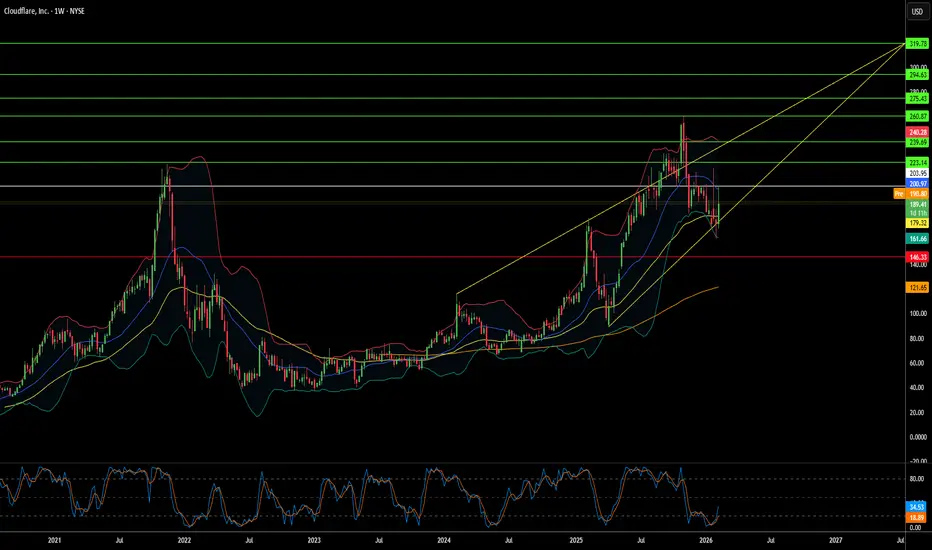
Can Cloudflare Become the Nervous System of the AI Internet?Cloudflare has evolved far beyond its origins as a content delivery network to emerge as a unified "connectivity cloud" that sits at the critical intersection of security, performance, and programmable compute. The company's fourth-quarter 2025 results reveal a remarkable 34% year-over-year revenue surge to $614.5 million, driven by its strategic positioning in what CEO Matthew Prince calls the "Agentic AI" era. With Cloudflare now handling 60% of all internet traffic via APIs and 31% of traffic originating from bots, the company has built infrastructure specifically designed for autonomous AI agents that execute complex tasks across the web. Its Workers platform enables developers to run code at the network edge, physically closer to users, dramatically reducing latency for real-time AI interactions. Recent acquisitions of Astro, Human Native, and Replicate demonstrate a comprehensive strategy to own the entire AI lifecycle, from high-performance web development to AI model deployment and ethical data monetization.
The financial trajectory reinforces Cloudflare's competitive moat in an increasingly AI-centric economy. Management projects fiscal 2026 revenue of $2.79 billion, representing 29% growth, while institutional ownership has reached 82%, a vote of confidence in the company's long-term vision. Free cash flow more than doubled in the recent period, providing ammunition for continued strategic acquisitions without excessive leverage. Cloudflare's economic model disrupts traditional cloud providers through unmetered DDoS protection and zero-egress-fee storage via R2, creating a "virtuous flywheel" where increased traffic enhances machine learning models, which in turn attracts more customers. In a market where global IT spending is forecast to exceed $6 trillion in 2026, with cybersecurity spending up 12.5% and GenAI model spending surging 80.8,% Cloudflare addresses both priorities simultaneously through its integrated platform that 85% of tech leaders are using to consolidate redundant tools and eliminate "shadow IT."
Beyond growth metrics, Cloudflare has established critical technological and geopolitical advantages that will define its competitive position for the next decade. The company leads the industry in post-quantum cryptography adoption, with 52% of TLS traffic already quantum-secure using NIST-approved ML-KEM standards protecting against future "harvest now, decrypt later" attacks before competitors have even begun migration. Its Data Localization suite addresses the urgent need for digital sovereignty, allowing organizations to comply with regulations like GDPR while maintaining global scale. With 291 patents and a 98.6% USPTO grant rate, Cloudflare's intellectual property portfolio focuses heavily on AI networking and edge security. The company's "Firewall for AI" provides granular control over AI interactions, blocking prompt injections and preventing data leaks—critical capabilities as 93% of employees input sensitive information into unauthorized AI tools. As the internet fragments into regional silos and quantum computing threatens existing encryption standards, Cloudflare has positioned itself as the essential infrastructure layer for organizations navigating the "Technical Glass Ceiling" that separates modern enterprises from those trapped by legacy systems.
Ddosprotection
A10 Networks (ATEN) — DDoS, ADC, and Edge Security TailwindsCompany Overview
A10 Networks NYSE:ATEN provides advanced cybersecurity and application delivery across cloud, hybrid, and carrier networks—direct exposure to rising demand for DDoS protection, secure networking, and cloud infra security.
Key Catalysts
Threat Landscape & Compliance: Escalating global cyberattacks + stricter regs are accelerating adoption of Thunder ADC and ThreatX—mission-critical for high-performance, distributed environments.
Execution Momentum: Q3’25 revenue $75M (≈+5.6% beat) and EPS $0.17 (≈+9.7% beat) underscore resilient demand and leverage to a recovering IT spend cycle.
5G & AI Infrastructure: A10’s load balancing, DDoS, and edge security sit in the flow of 5G rollouts and AI data center growth, supporting multi-year capacity upgrades.
Platform Differentiation: Carrier-grade performance, automation, and visibility help consolidate point tools while optimizing latency and throughput.
Why It Matters
✅ Direct play on cloud + telco capex (5G/edge)
✅ Beneficiary of AI-era traffic growth and low-latency requirements
✅ Balanced mix of appliance, software, and subscription helps cushion cycles
Investment Outlook
Bullish above: $14.75–$15.00
Target: $22.00–$23.00 — driven by enterprise/telco upgrades, AI/edge security demand, and continued operating discipline.
📌 ATEN — securing next-gen networks with high-performance ADC and DDoS protection.
Can Specialized Depth Trump Market Breadth in Cybersecurity?NetScout Systems (NASDAQ: NTCT) has emerged as a compelling investment opportunity at the intersection of escalating global cyber threats and artificial intelligence innovation. With DDoS attacks surging to over 8 million globally in the first half of 2025—including record-breaking attacks reaching 7.3 terabits per second—NetScout's specialized position in network security has garnered analyst attention, including B. Riley's recent "Buy" rating with a $33 price target. The company's unique value proposition lies in its patented Adaptive Service Intelligence (ASI) and Deep Packet Inspection (DPI) technologies, which transform raw network traffic into actionable "smart data" without disrupting operations.
The company's financial performance reflects this strategic positioning, with Q1 FY26 revenue growing 7% year-over-year to $186.75 million, driven by a remarkable 19.3% growth in product revenue. NetScout's enterprise segment has been particularly robust, expanding 17.7% annually and comprising 59% of total revenue, while serving high-value clients across government, healthcare, financial services, and telecommunications sectors. The company's gross profit margins of nearly 79% and strong balance sheet with more cash than debt underscore its operational efficiency and financial stability.
NetScout's competitive advantage stems from its focused specialization rather than broad market dominance. While holding only 2.82% of the Application Performance Monitoring market, the company has been recognized as a "Technology Leader" and "Ace Performer" in DDoS mitigation—a critical niche where depth matters more than breadth. The integration of AI and machine learning into its Arbor DDoS protection suite, combined with the ATLAS Intelligence Feed providing global threat visibility, positions NetScout as a force multiplier for understaffed security teams facing increasingly sophisticated attacks.
The strategic outlook appears promising, with the global DDoS protection market projected to grow from $4.34 billion in 2025 to $13.90 billion by 2034 at a 13.81% CAGR. NetScout's 46% international revenue exposure aligns well with rapid cybersecurity growth in Asia-Pacific, where the market is expected to exceed $146 billion by 2030. Despite facing competitive pressure in some segments, the company's focus on AI-enhanced hybrid solutions for large enterprises, coupled with its patent-protected intellectual property, creates a defensible position in an increasingly complex and high-stakes cybersecurity landscape.