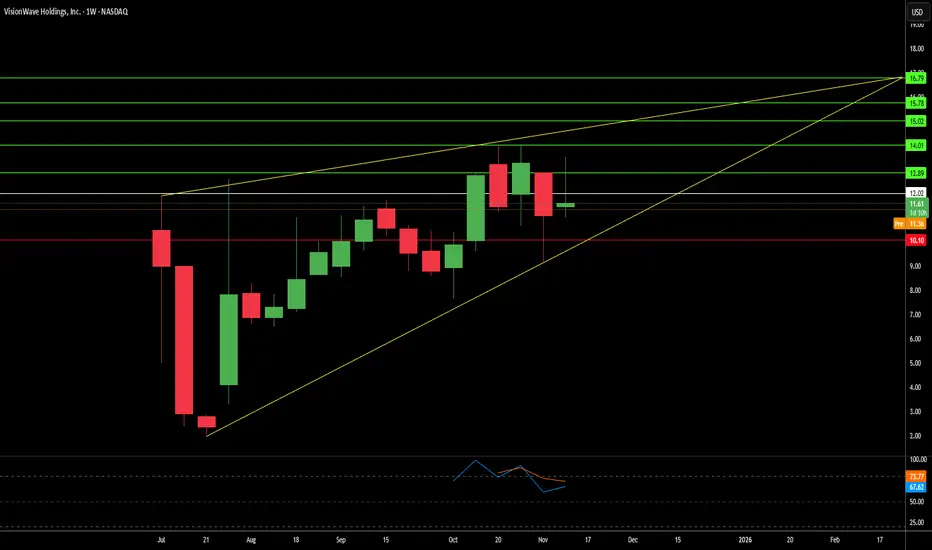
Can AI See What Bullets Cannot?VisionWave Holdings is transforming from an emerging defense technology provider into a critical AI infrastructure and platform integrator, positioning itself to capitalize on urgent global demand for autonomous military systems. The company's strategic evolution is driven by heightened geopolitical instability in Eastern Europe and the Indo-Pacific, where conflicts, such as the war in Ukraine, have fundamentally shifted battlefield doctrine away from traditional heavy armor toward agile, autonomous platforms. With the military unmanned ground vehicle market projected to reach $2.87 billion by 2030 and a structural shift toward Manned-Unmanned Teaming doctrine adding sustained long-term demand, VisionWave's timing aligns with accelerating procurement cycles across NATO allies.
The company's competitive advantage centers on its Varan UGV platform, which integrates proprietary 4D imaging radar technology and independently actuated suspension to deliver superior mission resilience in extreme environments. Unlike conventional sensors, VisionWave's 4D radar adds elevation data to standard measurements, achieving detection ranges exceeding 300 meters while maintaining reliable operation through fog, rain, and darkness capabilities essential for 24/7 military readiness. This technological foundation is strengthened by the company's partnership with PVML Ltd., which creates a "secure digital backbone" that resolves the critical Security-Speed Paradox by enabling rapid autonomous operations while maintaining strict security protocols through real-time permission enforcement.
VisionWave's recent institutional validation underscores its transition from emerging player to credible defense-AI equity. The company raised $4.64 million through warrant exercises without issuing new equity, demonstrating financial discipline and strong shareholder confidence while minimizing dilution. Strategic appointments of Admiral Eli Marum and Ambassador Ned L. Siegel to its Advisory Board establish crucial operational bridges to complex international defense procurement systems, accelerating the company's path from pilot validations in 2025 to scaled commercialization. Combined with S&P Total Market Index inclusion and a 5/5 technical rating from Nasdaq Dorsey Wright, VisionWave presents a comprehensive value proposition at the intersection of urgent geopolitical demand and next-generation autonomous defense technology.
Defenseinnovation
Can Regulatory Barriers Create Defense Monopolies?The Geopolitical Catalyst Behind Draganfly's Transformation
Draganfly Inc. (DPRO) is executing a strategic pivot from commercial drone innovation to a defense infrastructure supplier, a transformation driven by geopolitical necessity rather than market competition. The National Defense Authorization Act (NDAA) has created a regulatory moat that mandates the exclusion of foreign-made technology from U.S. critical supply chains, immediately disqualifying dominant players like China's DJI. As one of the few NDAA-compliant North American manufacturers, Draganfly gains exclusive access to billions in government contracts. The company's Commander 3XL platform, featuring a 22-lb payload capacity, patented modular design, and specialized software for GPS-denied environments, is already deployed across Department of Defense branches, validating its technical credibility in high-stakes military applications.
Strategic Positioning and Defense Ecosystem Integration
The company has de-risked its defense market entry through strategic partnerships with Global Ordnance, a Defense Logistics Agency prime contractor that provides crucial logistical expertise and regulatory compliance capabilities. The appointment of former Acting Defense Secretary Christopher Miller to the board further strengthens institutional credibility. Draganfly is rapidly scaling capacity through a new Tampa facility strategically located near major military clients, while maintaining an asset-light model with just 73 employees by leveraging AS9100-certified contract manufacturers. This approach minimizes capital expenditure risk while ensuring responsiveness to large government tenders. The company's intellectual property portfolio, 23 issued patents with a 100% USPTO grant rate, protects foundational innovations in VTOL flight control, modular airframe design, AI-powered tracking systems, and morphing robotics technology.
The Valuation Paradox and Growth Trajectory
Despite Q1 2025 comprehensive losses of $3.43 million on revenue of just $1.55 million, the market assigns Draganfly a premium 16.6x Price-to-Book valuation. This apparent disconnect reflects investor recognition that current losses represent necessary upfront investments in defense readiness facility expansion, manufacturing certification, and partnership development. Analysts forecast explosive growth exceeding 155% in 2026, driven by military contract execution. The military drone market is projected to more than double from $13.42 billion (2023) to $30.5 billion by 2035, with defense ministries worldwide accelerating investments in both offensive and defensive drone technologies. Draganfly's competitive advantage lies not in superior endurance or range AeroVironment's Puma 3 AE offers 2.5 hours flight time versus the Commander 3XL's 55 minutes but in heavy-lift payload capacity essential for deploying specialized equipment like Long Range LiDAR sensors and the M.A.G.I.C. demining system.
The Critical Question of Execution Risk
Draganfly's investment thesis centers on strategic governmental alignment outweighing current operational deficits. The company recently secured a U.S. Army contract for Flex FPV drone systems, including embedded manufacturing capabilities at overseas U.S. Forces facilities, a validation of both technical capability and supply chain flexibility. Integration projects like the M.A.G.I.C. minefield clearance system demonstrate mission-critical utility beyond conventional reconnaissance. However, the path to profitability depends entirely on execution: successfully scaling production capacity, navigating lengthy government procurement cycles, and converting the defense pipeline into realized revenue. The company is positioned to become a major player, specifically in the secure, NDAA-compliant, heavy-lift multirotor segment, not to dominate generalized fixed-wing ISR or mass-market commercial applications. The fundamental question remains whether Draganfly can execute its defense strategy fast enough to justify its premium valuation before competitors develop comparable NDAA-compliant capabilities.
Is Digital LiDAR the Eye of Autonomy's Future?Ouster, Inc. (NYSE: OUST), a key player in the small-cap technology landscape, recently experienced a significant boost in its share price following a crucial endorsement from the United States Department of Defense (DoD). This approval of Ouster's OS1 digital LiDAR sensor for unmanned aerial systems (UAS) validates the company's technology. It highlights the growing importance of advanced 3D vision solutions in both defense and commercial sectors. Ouster positions itself as a foundational enabler of autonomy, with its digital LiDAR distinguishing itself through enhanced affordability, reliability, and resolution compared to traditional analog systems.
The DoD's inclusion of the OS1 sensor within its Blue UAS Framework represents a strategic victory for Ouster. This rigorous vetting process ensures supply chain integrity and operational suitability, making the OS1 the first high-resolution 3D LiDAR sensor to receive such an endorsement. This approval significantly streamlines procurement for various DoD entities, promising expanded adoption beyond Ouster's existing defense engagements. The OS1's superior performance in weight, power efficiency, and rugged conditions further underscores its value in demanding applications.
Looking ahead, Ouster actively develops its next-generation Digital Flash (DF) Series, a solid-state LiDAR solution poised to revolutionize automotive and industrial applications. By eliminating moving parts, the DF series promises enhanced reliability, longevity, and cost-efficient mass production, addressing critical needs for autonomous driving and advanced driver-assistance systems (ADAS). This forward-looking innovation, combined with the recent DoD validation, firmly establishes Ouster as a pivotal innovator in the rapidly evolving landscape of autonomous technologies, driving its ambition to capture a substantial share of the $70 billion total addressable market for 3D vision.
Can AI Forge America's Next Shield?Palantir Technologies finds itself strategically positioned at the forefront of a potentially transformative U.S. defense initiative, the "Golden Dome" missile defense system. As a crucial partner in a consortium reportedly led by SpaceX and including Anduril Industries, Palantir is a leading contender for significant involvement in this multi-billion-dollar project. Golden Dome aims to establish a next-generation, networked shield against advanced missile threats, emphasizing rapid development and integration of space-based sensors and diverse defensive capabilities, moving beyond traditional procurement timelines.
Within this ambitious framework, Palantir's role leverages its core expertise in AI and large-scale data analytics. The company is anticipated to provide the essential software platform required to process and interpret data from potentially hundreds or thousands of tracking satellites, creating real-time situational awareness and enabling coordinated responses across the complex defense network. This involvement could also benefit from innovative procurement approaches, such as SpaceX's proposed subscription model, potentially securing stable, long-term revenue streams for Palantir.
Recent successes underscore Palantir's readiness for such a demanding role. The rapid adoption of its Maven Smart System by NATO validates its AI capabilities in high-stakes military environments, while its partnership with Vatn Systems demonstrates the utility of its platform in scaling and modernizing defense manufacturing. Securing a key position in the Golden Dome would represent a major strategic victory, solidifying Palantir's ascent as a disruptive force in the defense technology sector and signaling significant growth potential as it helps shape the future of national security.
What's Kratos' Secret to Defense Innovation?Kratos Defense & Security Solutions stands as a beacon of innovation in the defense sector, demonstrating a unique blend of technology and foresight that challenges traditional paradigms. From the rugged terrains of Québec’s forests to the cutting-edge arenas of hypersonic flight, Kratos is not just participating in the future of defense; it's actively shaping it. The company's autonomous truck platooning technology, which merges human oversight with AI autonomy, showcases a novel approach to solving logistical challenges, addressing not only the immediate issue of driver shortages but also enhancing safety and economic impact in rural communities.
This innovation extends into the skies with Kratos' significant strides in hypersonic technology, where it has secured monumental contracts, including a record-breaking $1.45 billion for hypersonic testbed development. These achievements are not merely about technological advancement; they represent a strategic pivot towards affordability and real-world application. By focusing on practical, deployable solutions rather than theoretical promises, Kratos is redefining what it means to deliver value in national security contexts, pushing the boundaries of what's possible in unmanned systems and high-speed travel.
The financial and analytical community has noted, that recent upgrades in stock evaluations reflect confidence in Kratos' trajectory. The company's robust revenue growth and strategic contracts with institutions like DARPA and the U.S. Marine Corps are testaments to its capability to innovate and execute at scale. This narrative of Kratos challenges us to rethink the integration of technology in defense logistics and warfare, prompting a deeper inquiry into how we can leverage such innovations to enhance national security and foster technological evolution across industries.
Archer Aviation (ACHR) AnalysisCompany Overview:
Archer Aviation NYSE:ACHR is a trailblazer in electric vertical takeoff and landing (eVTOL) aircraft, aiming to transform urban air mobility (UAM) with environmentally friendly, high-tech transportation solutions. Positioned at the intersection of aviation innovation and sustainability, Archer is set to unlock massive market potential.
Key Catalysts for Growth
Urban Air Mobility (UAM) Market Boom:
With the UAM market projected to grow exponentially, Archer’s eVTOL technology positions it as a frontrunner in urban transportation solutions.
Increasing urbanization and the push for decarbonized transport drive demand for advanced air mobility solutions.
Strategic Partnerships:
Stellantis Partnership: Accelerates Archer’s manufacturing scale, leveraging Stellantis’ automotive production expertise to ensure efficient mass production.
Anduril Industries Collaboration: Expansion into hybrid VTOL military aircraft opens a pathway to tap into lucrative defense budgets, creating a diversified revenue stream.
Financial Backing:
Archer’s $430 million equity infusion from blue-chip investors bolsters its balance sheet, enabling sustained investment in R&D and manufacturing expansion.
Regulatory Advancements:
Progress toward FAA certification supports Archer’s goal of launching commercial eVTOL services by 2025, further enhancing market confidence.
Defense Opportunities:
Developing military-grade hybrid aircraft provides entry into a stable and high-margin sector, aligning with national defense priorities for innovation and sustainability.
Market and Financial Outlook
Revenue Potential: As Archer scales production and initiates commercial operations, revenue growth could accelerate rapidly, supported by early-mover advantages and a growing addressable market.
Diversified Portfolio: Balancing urban air mobility and defense projects mitigates risks while enhancing long-term growth prospects.
Investment Thesis
Bullish Case:
Archer is uniquely positioned to benefit from the convergence of urban mobility innovation, sustainability goals, and defense modernization.
Entry Point: We are bullish on ACHR above $8.00-$8.20, reflecting a solid technical setup and strong fundamentals.
Upside Target: Our price target is $17.00-$18.00, underscoring confidence in Archer’s ability to execute on growth opportunities in the UAM and defense sectors.
🌟 ACHR—Pioneering the Future of Sustainable Aerial Transportation. #UrbanAirMobility #Sustainability #DefenseInnovation