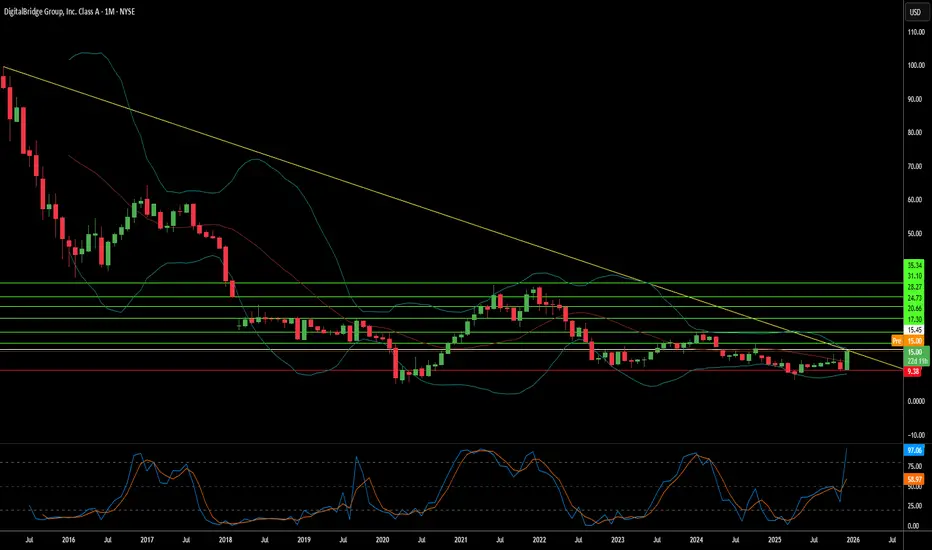
SoftBank's $4B AI Gamble: The DigitalBridge VerdictJapan's SoftBank recently committed $4 billion to acquire DigitalBridge (DBRG) in an all-cash deal. This move marks a pivot toward Masayoshi Son's vision of Artificial Super Intelligence (ASI). For investors, the question remains: is the $16-per-share price a ceiling or a launchpad?
Geopolitics and the Race for AI Sovereignty
AI infrastructure has transitioned from a corporate luxury to a national security asset. The United States and Asia are currently locked in a race for AI dominance. DigitalBridge controls the physical layer of this race data centers and fiber networks.
SoftBank’s acquisition secures a geostrategy foothold in Western and Asian digital assets. The deal integrates DigitalBridge into global AI infrastructure initiatives. This partnership aims to build hyperscale computing sites to ensure Western AI sovereignty.
Leadership and the "Fronthaul" Innovation
CEO Marc Ganzi successfully transformed the firm from a traditional real estate player into a digital powerhouse. His leadership focuses on "fronthauling" the network. This strategy prioritizes dense fiber and software-defined networks over older, slower architectures.
DigitalBridge’s innovation extends beyond physical towers. The firm recently partnered with KT Corporation to develop gigawatt-scale AI data centers in South Korea. This venture represents a rare crossover where an infrastructure manager dictates the hardware standards driving AI demand.
Macroeconomics and the Valuation Gap
By traditional metrics, DigitalBridge appears expensive. The stock recently traded at 250 times trailing earnings, far exceeding the industry average of nine. However, SoftBank is not buying current earnings; it is buying future capacity.
The $16 offer provides a 15% premium but effectively anchors the stock price until late 2026. High-interest rates previously pressured infrastructure REITs, but the AI boom has decoupled DBRG from standard economic cycles. SoftBank is betting that physical "bottlenecks" like power and land will make existing assets priceless.
Technical Moat: Fiber and Cyber Security
DigitalBridge manages $108 billion in assets, focusing on high-density compute and low-latency fiber. These assets form the "connective tissue" for AI. Unlike cloud software, physical fiber routes are difficult to replicate and offer a natural competitive moat.
The firm also emphasizes edge computing, placing data processing closer to the user. This reduces latency, which is critical for real-time AI applications and autonomous systems. As cyber threats evolve, owning the physical fiber provides an additional layer of hardware-level security that software providers cannot match.
---
Summary for Investors:
SoftBank’s buyout likely caps short-term stock gains at $16. However, the deal validates the immense value of the physical AI backbone. Investors should view this as a signal that the "hardware phase" of the AI revolution is just beginning.
Digitalinfrastructure
Can Power Infrastructure Outmaneuver Silicon in the AI Race?The reported SoftBank acquisition of DigitalBridge represents a fundamental shift in the AI value chain from semiconductors to the physical infrastructure that powers them. DigitalBridge's 20.9 gigawatt portfolio positions it as the gatekeeper to AI scaling, addressing what has become the industry's primary bottleneck: grid-connected power capacity. While chip availability has stabilized, the 3-5 year interconnection queue delays and PJM's capacity auction surge from $29 to $329 per megawatt-day reveal that electricity access now dictates competitive advantage. SoftBank's "Project Izanagi," a $100 billion AI semiconductor initiative, requires immediate deployment infrastructure that cannot be built within a commercially viable timeframe, making DigitalBridge's existing "power bank" an irreplaceable strategic asset.
The transaction thesis extends beyond real estate fundamentals to geopolitical positioning in the Sovereign AI era. DigitalBridge's diversified global footprint through Vantage, Switch, and Scala provides the territorial distribution that nation-states increasingly demand for data sovereignty. Switch's Tier 5 Platinum facilities, fortified by over 950 patent claims covering thermal management and security protocols, create a defensible moat around mission-critical government workloads. However, CFIUS scrutiny presents material execution risk; foreign ownership of infrastructure hosting DoD-classified data will likely require operational ring-fencing or potential divestiture of sensitive assets. The regulatory path mirrors SoftBank's Sprint precedent but operates in a heightened national security environment where data centers are now classified alongside telecommunications as critical infrastructure.
Financial markets initially mispriced DigitalBridge as a transitional REIT rather than a utility-grade infrastructure platform, with the stock trading below intrinsic value estimates of $25-35 before the 50% surge. Fee-Related Earnings grew 43% year-over-year in Q3 2025, reflecting institutional capital allocation into digital infrastructure that the market overlooked amid GAAP complexity. The strategic validation extends beyond SoftBank; any acquirer recognizes that replicating 21 GW of secured power capacity would cost multiples of DigitalBridge's enterprise value. Whether the deal consummates or not, the "SoftBank put" has established a valuation floor, signaling that in 2025's AI industrialization phase, land is sold by the megawatt, not the acre.
NET — AI Infrastructure Leader Launches Stablecoin InnovationCompany Overview:
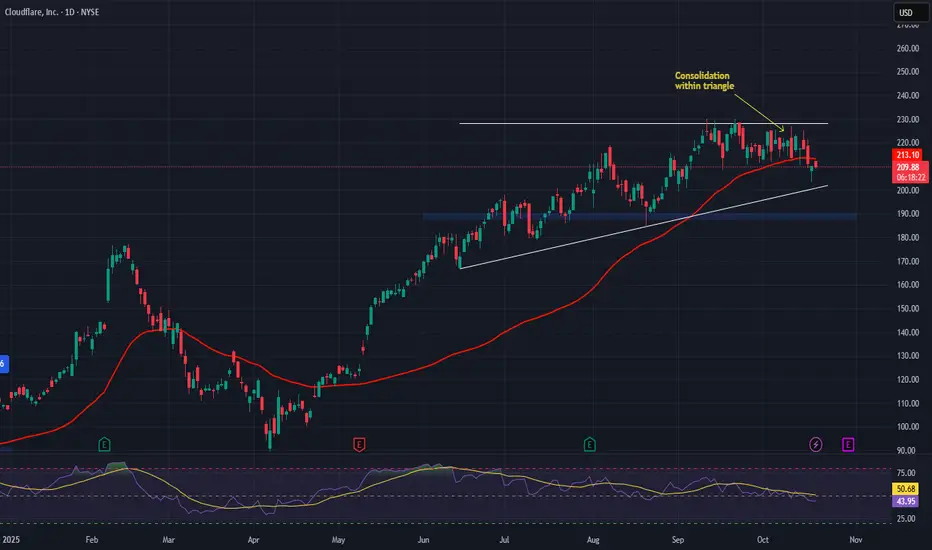
Cloudflare, Inc. NYSE:NET is a global leader in cloud connectivity and cybersecurity, delivering secure, scalable, and high-performance infrastructure for the modern internet. The company is evolving into a key enabler of AI-driven applications, with its Workers platform gaining strong enterprise traction to power large-scale intelligent workloads.
Key Catalysts:
Fintech breakthrough: The launch of the NET Dollar stablecoin bridges AI, cloud, and financial infrastructure, enabling automated machine-to-machine (M2M) payments and introducing new recurring revenue models.
Enterprise growth: Added 219 new large customers in Q2 2025, highlighting accelerating adoption and market leadership.
AI ecosystem expansion: Increasing integration of Cloudflare’s edge computing network within enterprise AI frameworks positions it at the core of the next-generation digital economy.
Investment Outlook:
Bullish above: $188–$190
Upside target: $380–$390, supported by AI infrastructure dominance, fintech innovation, and accelerating enterprise demand.
#Cloudflare #AI #Stablecoin #Cybersecurity #Fintech #DigitalInfrastructure #EdgeComputing #Investing #NET
Hut 8 Corp (HUT) From Miner to Digital Infrastructure PowerhouseCompany Overview:
Hut 8 NASDAQ:HUT is transforming into a next-gen digital infrastructure leader, blending Bitcoin mining, AI compute, and cloud services for diversified, long-term growth.
Key Catalysts:
Major Operational Upgrades ⛏️
79% QoQ jump in deployed hashrate and 37% fleet efficiency gain in Q1 2025.
Positions HUT for cost-effective BTC production as crypto markets rebound.
Massive Bitcoin Reserves ₿
10,264 BTC on balance sheet (~$847M as of Mar 31, 2025).
Acts as a digital asset custodian + infrastructure operator, offering leveraged upside to BTC.
Diversification into Compute & AI Infrastructure 🧠
Q1 Digital Infrastructure + Compute revenue tops $21M.
Reduces mining dependency and captures tailwinds from AI and HPC demand.
Investment Outlook:
Bullish Case: We remain bullish on HUT above $15.00–$16.00.
Upside Target: $30.00–$32.00, driven by crypto exposure, AI-driven growth, and operational scaling.
⚙️ Hut 8 – Mining the Future of Digital Infrastructure.
#HUT #Bitcoin #CryptoMining #DigitalInfrastructure #AICompute #HPC #Web3 #BTCExposure