Fundamental Market Analysis for January 2, 2026 USDJPYUSD/JPY is hovering near 156.800 amid mixed sentiment: the dollar gets some support from early-year flows, but demand for the yen remains steady due to uncertainty about global growth. The holiday effect is still limiting volumes, making the market more sensitive to official comments and unexpected news.
Fundamentally, the yen is supported by expectations that the Bank of Japan will continue policy normalization in 2026. Japanese yields rose notably into the end of 2025 as bond purchases were reduced and communication pointed to the possibility of additional rate increases, while officials closely monitor excessive yen weakness. Stronger normalization expectations reduce the appeal of yen-funded strategies and work against further upside in USD/JPY.
On the U.S. side, the key is the outlook for rates and yields: if the market keeps pricing Fed cuts in 2026, the yield gap between the U.S. and Japan should narrow, which favors the yen. If risk appetite deteriorates, demand for defensive assets may also strengthen, limiting the dollar against the yen. The base scenario for the next sessions is downward movement in the pair.
Trading recommendation: SELL 156.800, SL 157.300, TP 155.300
Dollaryen
Fundamental Market Analysis for December 18, 2025 USDJPYUSD/JPY is holding near 155.750 ahead of the Bank of Japan meeting on 18–19 December. Markets are leaning toward a rate hike, as inflation has remained above target for an extended period and wage growth continues to support domestic demand. Expectations for higher Japanese yields are gradually improving the yen’s position.
At the same time, the US dollar is staying firm due to cautious sentiment ahead of US inflation data and a busy central-bank calendar. Uncertainty about the Federal Reserve’s policy path for 2026 also matters: stronger US figures could keep expectations for relatively high rates in place, which would help the dollar.
If the Bank of Japan delivers a rate increase and signals that normalization can continue while inflation pressures persist, demand for the yen may strengthen further. In that case, USD/JPY could move lower, especially if overall risk appetite remains restrained.
Trading recommendation: SELL 155.750, SL 156.200, TP 154.400
Fundamental Market Analysis for December 15, 2025 USDJPYUSD/JPY is trading around 156.150 after a morning dip and remains sensitive to rate expectations in Japan and the US. The market is pricing in the Bank of Japan decision for December 18–19, so any news that increases the probability of a hike tends to support the yen quickly and cap upside in the pair.
Support for the Japanese currency is also coming from recent signals in the economy: the quarterly Tankan survey showed improved business conditions among large manufacturers, while inflation remains above the 2% target. Against this backdrop, investors are looking to the BoJ not only for a rate move but also for guidance on the next steps, which keeps demand for the yen elevated when risk appetite deteriorates.
On the US side, the dollar remains under pressure after the recent Fed rate cut and expectations that easing could continue into 2026. Additional uncertainty is linked to delayed US statistics: this week, markets will closely watch employment and inflation data, which can shift rate expectations. In the base scenario, the risks favor a stronger yen and a move lower in the pair.
Trading recommendation: SELL 156.150, SL 156.650, TP 154.650
Fundamental Market Analysis for December 10, 2025 USDJPYEvent to watch today:
21:00 EET. USD - FOMC Rate Decision
USDJPY:
The U.S.–Japan rate differential remains the dominant driver: even with discussion of BoJ normalization, U.S. yields are markedly higher, fueling interest in dollar assets. Into today’s decision, the yen fluctuates near 156 per dollar as participants await the Fed outcome and hints about the frequency of future steps.
In Japan, inflation stays moderately above target, but wage growth and domestic demand do not yet guarantee lasting normalization, keeping the BoJ gradual. The risk of sharp verbal intervention is lower while there is no shock capital outflow or dysfunction in the JGB market, and local measures along the curve only smooth volatility.
If the Fed confirms a modest move but retains a protective tone, the dollar’s yield advantage should persist and support USD/JPY. With neutral risk conditions and a calm global backdrop, the pair has scope to approach the upper end of the recent range, while only a clear BoJ readiness for faster rate hikes could shift the balance.
Trading recommendation: BUY 156.750, SL 155.850, TP 159.450
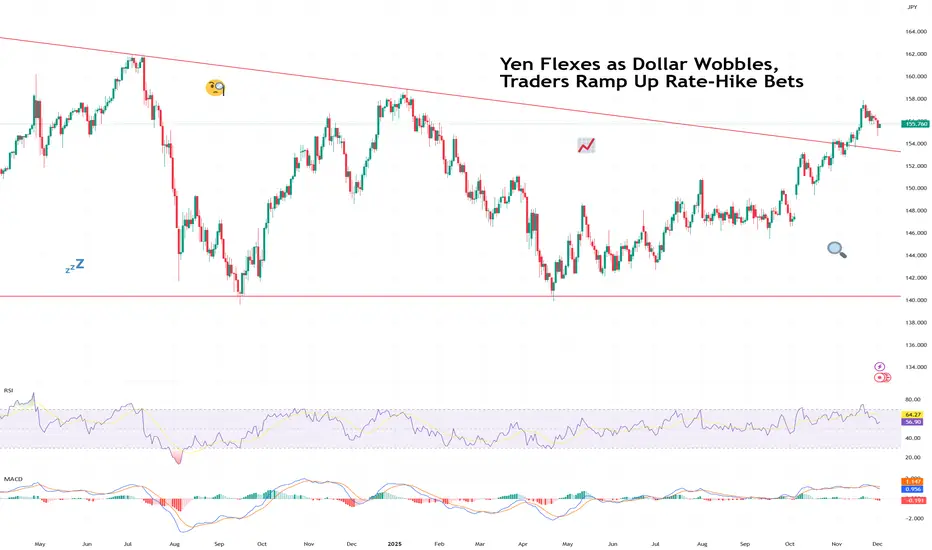
Yen Flexes as Dollar Wobbles, Traders Ramp Up Rate-Hike BetsThe yen came into Monday looking calm… and then proceeded to bench-press the dollar.
The FX:USDJPY pair slid under ¥155, hitting a session low of ¥154.65, after BoJ Governor Kazuo Ueda dropped one of the most powerful phrases in global FX:
“We will weigh the pros and cons of tightening.”
In Tokyo-speak, that’s basically suggesting “rate hike incoming!”
The greenback instantly shed over 100 pips (every day trader’s dream), a half-percent haircut that reminded traders just how exquisitely sensitive the yen is to hints of policy change after 30 years of ultra-loose money.
The next day, however, was a bit different. Early Tuesday morning, the pair gained back about half of what it lost the day before. Still, some things to note about Monday's slide:
It wasn’t just FX that reacted. The yen’s surge:
Knocked the Nikkei FX:JPN225 down 2%,
Pushed Japanese government bond yields to 17-year highs,
And forced traders to reprice Japan’s entire risk landscape in real time.
🕰️ The Market Has Been Waiting for This Moment
FX traders have been staring at the FX:USDJPY for months, waiting for a sign — any sign — that Japan was finally ready to pivot. In the meantime, officials have made a sport out of verbal interventions:
“We are watching FX moves with urgency.”
“We will not tolerate excessive yen weakness.”
“We have tools, and we are not afraid to use them.”
Translation: Stop shorting the yen, it stresses us out.
With Ueda openly weighing a rate hike at the December 19 Bank of Japan meeting, traders are scrambling to unwind one of the most crowded trades in global macro: the “short yen” position.
A country that’s really truly reluctant to raise rates is suddenly hinting at liftoff — or at least a step towards it.
📉 Dollar Wobbles as Macro Crosswinds Build
While Japan is drifting away from negative-rate territory, the US dollar faces a catalyst-packed December that could amplify or counter the yen’s breakout.
Four major US data releases stand between now and the BoJ’s meeting:
Dec 5: Fed’s preferred inflation gauge (PCE)
Dec 10: CPI inflation report
Dec 10: Fed interest-rate decision
Dec 16: Nonfarm payrolls (US jobs report)
If the Fed so much as hums a dovish note, yen strength could accelerate fast.
If Powell surprises with a hawkish tone, the dollar may find a floor.
Either way, this is the first time in years that both sides of the dollar-yen have meaningful rate catalysts.
🔄 A Trend Reversal in the Making?
Big macro traders — the same funds that spent the last year squeezing every drop out of the yen carry trade — are taking profits, reducing leverage, and even tiptoeing into long-yen bets.
When one of the world’s great one-way trades starts wobbling, liquidity thins, and volatility spikes.
This is precisely the environment where this volatile beast can swing 100 pips before your coffee cools.
And if Japan genuinely signals the start of a tightening cycle? Carry unwinds can get violent.
One central bank hint today can become a multi-month trend tomorrow.
🧭 So What Happens Next?
The yen’s flex this week may be just the opening act.
Everything now hinges on:
BoJ clarity on Dec 19
How soft (or not) US inflation comes in
Whether the Fed’s tone shifts on Dec 10
And how the labor market behaves into year-end
Watch the economic calendar and get ready for action. FX volatility is back on the menu.
Now that it’s happening, everyone’s asking the same question:
We’ll leave it to you : Was this a one-day pop — or the start of the yen’s long-awaited comeback tour? Share your views in the comments!
Fundamental Market Analysis for November 27, 2025 USDJPYThe yen firms on two overlapping forces: markets lean toward a gentler U.S. rate path next year, and Japan preserves the prospect of further normalization of monetary settings supported by wage agreements and stickier domestic prices. As U.S. Treasury yields edge lower, the relative appeal of dollar assets versus the yen decreases, pressuring the pair.
The risk of official comments from Japan’s financial authorities on the exchange rate also discourages aggressive dollar buying at elevated levels. The market remains sensitive to verbal signals and to willingness to prevent excessive volatility. Attention stays on Japanese government bond yields: a narrower U.S.–JGB yield premium reinforces downward pressure on USDJPY.
Holiday-thinned U.S. liquidity and month-end rebalancing can magnify reactions to news. In this setup, the pair retains scope for a corrective pullback if there are no fresh firm signals from the U.S. side and Japanese data remain neutral, with ongoing progress on inflation and wages supporting the yen over the medium term.
Trading recommendation: SELL 156.050, SL 156.350, TP 155.150
Fundamental Market Analysis for November 24, 2025 USDJPYThe pair holds above 156 amid a calm dollar, but the news flow from Japan raises reversal risks: the Ministry of Finance has stepped up warnings about readiness for currency actions if yen weakening accelerates, and this week’s liquidity may be thinner than usual. That restrains further upside at sensitive levels.
An additional factor is the signal that the Bank of Japan could consider steps toward normalization in the near term amid sustained wage and price growth. The yield gap in favor of the US remains significant, but the policy-market price of intervention risk for long USD/JPY positions has increased.
Given this, selling from 156.60 with protection at 157.000 and a target at 155.400 is preferable: stronger verbal signals from authorities and the possibility of changes in the central bank’s stance may trigger demand for the yen during another bout of dollar volatility.
Trading recommendation: SELL 156.600, SL 157.000, TP 155.400
US Dollar vs. Yen - Long Term Swing Analysis - 17' Nov 2025Yen reached a 40-week low, and it's on the edge of breaking the downfall. In the next couple of hours pair needs to close below the 155.00 mark and the last volatility to be like a false breakout.
There is a wedge A-B-C-D-E formation.
There is a test on the uptrend and downtrend lines of the wedge.
There are over 5 legs up, and the pair is showing exhaustion.
Fundamental Market Analysis for November 19, 2025 USDJPYEvent to watch today:
21:00 EET. USD - FOMC Meeting Minutes
USDJPY:
Risk-off conditions have revived interest in the yen: amid equity weakness and uncertainty around the timing of U.S. data releases, market participants are trimming dollar long positions versus JPY.
Japan-related signals add to the picture: the long end of the JGB curve is edging higher, bringing attention to inflation persistence and authorities’ readiness to react to excessive FX volatility. Cautious remarks from the finance ministry keep markets from setting fresh USD/JPY highs.
If headlines maintain a wary tone and expectations for a December Fed rate cut persist, the pair can retreat below 155 on safe-haven demand and the threat of verbal intervention.
Trade recommendation: SELL 155.500, SL 156.500, TP 154.500
Fundamental Market Analysis for November 12, 2025 USDJPYThe yen remains under pressure: the policy stance between the U.S. and Japan continues to diverge, and the Bank of Japan is still acting gradually and avoiding sharp steps so as not to choke off the economic recovery. In this environment, any rebound in global risk appetite quickly leads to yen weakness and a rise in USDJPY. The price environment for energy also matters: elevated energy import bills traditionally worsen the trade balance and support demand for the dollar against the yen.
In the U.S., Treasury yields have stabilized without signs of a major decline, which supports the dollar’s premium over the yen. The market is closely watching U.S. inflation and consumer activity data: the lack of a sharp slowdown in these series creates conditions for dollar-denominated assets to remain attractive to global investors, especially compared with Japanese instruments.
Risks of verbal signals from Japanese authorities and episodic “pauses” in the pair’s ascent remain, but without a change in the Bank of Japan’s approach to rates and yield control, a sustained downward reversal in USDJPY is not in sight. With a moderate news backdrop, the underlying balance of factors still favors the dollar.
Trading recommendation: BUY 154.350, SL 153.500, TP 155.500
Fundamental Market Analysis for October 30, 2025 USDJPYThe yen weakened after the Bank of Japan kept its policy rate near 0.50% today, again declining to back proposals from some members for a move to 0.75%. The statement keeps future steps “in view” but offers no timeline, reinforcing the yield differential in favor of the United States and supporting USD/JPY near the top of its recent range.
An additional impulse for USD comes from the Fed: while it delivered a 25 bps cut, Chair Powell stressed that subsequent actions are not predetermined. For USDJPY, what matters is not the single rate print but expectations for U.S. Treasury yields and risk appetite. Yields along the curve remain relatively high, and the Fed’s readiness to pause points to a slower easing cycle, which supports the dollar against the yen.
External factors round out the picture: moderately positive global risk sentiment and the absence of strong signals from Japan’s Ministry of Finance about interventions. Given the current monetary-policy trajectories in the U.S. and Japan, upward attempts in USDJPY persist while pullbacks look contained.
Trading recommendation: BUY 152.750, SL 152.100, TP 153.500
Fundamental Market Analysis for October 27, 2025 USDJPYUSD/JPY holds near multi-week highs thanks to the yield differential and a cautious tone among investors before the FOMC meeting. Elevated nominal and real US yields, alongside restrained monetary conditions in Japan, keep a positive differential in favor of the dollar and support buying interest in the pair.
On the domestic side for Japan, the market still expects very low funding costs in the near term and a gradual approach to any future changes by the Bank of Japan. Given modest domestic demand and uneven price dynamics, JGB yields remain contained, leaving the yen with few sustained drivers for appreciation.
External factors also favor the dollar: persistent inflows into US instruments amid global uncertainty underpin the trend. Proximity to areas that may trigger comments from Japanese authorities calls for careful risk management, but fundamentally there are still limited preconditions for a meaningful softening of the USD against the JPY.
Trading recommendation: BUY 152.900, SL 152.250, TP 153.900
Fundamental Market Analysis for October 22, 2025 USDJPYThe yen finds support amid rising market volatility and position trimming ahead of the Bank of Japan meeting on October 29–30. Political changes in Tokyo come with an emphasis on sustained wage growth as a condition for meeting the price objective, increasing market sensitivity to potential tightening signals in the coming months.
At the same time, expectations of a Fed rate cut at the end of October limit the upside in U.S. Treasury yields and reduce the dollar’s appeal versus the yen. The mere possibility that the BoJ may take further steps toward normalization keeps USDJPY from revisiting yearly highs.
Additional support for the yen comes from improving trade indicators and vigilance over the risk of verbal intervention by Japanese authorities if the currency weakens excessively. The combination of these factors provides a fundamental case for a downward correction in USDJPY.
Trade recommendation: SELL 151.650, SL 152.150, TP 150.900
Fundamental Market Analysis for October 15, 2025 USDJPYThe yen is strengthening on Wednesday, 15 October 2025, as the dollar loses support amid expectations of an imminent Fed rate cut. Heightened US–China trade frictions lift demand for defensive assets, including the yen, pulling the pair lower from the 152.000 area. Periodic risk-off episodes during the Asian session add to corrective pressure on the dollar versus the yen.
On a medium-term basis, Japan’s fundamentals are gradually improving: international institutions have raised growth estimates for 2025, and the scenario of cautious Bank of Japan normalization alongside persistent inflation remains in place. Even gradual policy adjustment by the BoJ—against potential easing in the US—narrows the rate differential and caps USD/JPY upside.
Another constraint for the pair is the market’s sensitivity to the possibility of Japanese authorities stepping in during abrupt currency swings. Taken together, these factors form a constructive setup for a tactical short in USD/JPY with a balanced risk-to-reward and clearly defined management levels.
Trading recommendation: SELL 151.500, SL 152.000, TP 150.500
Fundamental Market Analysis for October 6, 2025 USDJPYThe yen weakened sharply in response to political news in Japan: the outcome of the leadership race in the ruling party boosted expectations of expanded fiscal stimulus. The market interprets this as a factor of easier domestic financial conditions and a more prolonged period of low rates. Long-dated Japanese government bonds are under pressure, further reducing the yen’s appeal as a funding currency.
The yield differential between the U.S. and Japan remains substantial, and the probability of a Fed rate cut already in October does not fully offset this gap. At the same time, the Bank of Japan remains cautious about the pace of normalisation, watching wage dynamics and services inflation. So far, signals from the regulator do not point to readiness for a series of rate hikes, which keeps the upward bias in USDJPY.
In the short term the pair is sensitive to Japanese authorities’ comments on FX volatility; however, against the current backdrop the fundamental vector remains upward. A move toward 150.950 is our base case; risks include verbal intervention and an abrupt drop in U.S. yields on weak data.
Trading recommendation: BUY 149.950, SL 149.250, TP 150.950
Fundamental Market Analysis for September 18, 2025 USDJPYAfter the Fed’s rate cut, the U.S.–Japan yield differential narrowed slightly, supporting the yen and capping USD/JPY. The focus now is on tomorrow’s Bank of Japan meeting: the base case is unchanged policy settings, with heightened attention to assessments of inflation and wages as well as comments on the balance of risks over the coming months.
Even without immediate BoJ steps, expectations of further normalization of monetary policy in Japan later this year periodically boost demand for the yen. At the same time, the dollar enjoys short-term support after the Fed decision, though it is constrained by messaging about a gradual approach going forward, which limits the potential for a sustained rise in the pair.
Overall, the balance of factors tilts toward a tactical decline in USD/JPY, while warranting caution given the pair’s sensitivity to BoJ communication and U.S. yield dynamics. Selling with a moderate stop-loss and a conservative target is preferred.
Trade recommendation: SELL 146.900, SL 147.400, TP 146.000
Fundamental Market Analysis for September 15, 2025 USDJPYThe pair trades around 147.4. Last week the yen firmed after political headlines from Tokyo: the prime minister’s resignation increased uncertainty and supported safe-haven demand for JPY. At the same time, US yields pulled back on softer labor data and a mild PPI, narrowing the rate differential in the dollar’s favor.
On Japan’s side, debate has revived about further BoJ normalization as wages rise and inflation stabilizes. Even if the BoJ leaves settings unchanged at the next meeting, the risk balance is shifting from one-sidedly dovish toward more neutral, which limits USD/JPY upside as a Fed cut appears likely.
The combination of a prospective Fed cut on Wednesday and elevated political noise in Japan makes further downside drift plausible. We prefer selling at 147.500 with a 146.000 target and a 148.500 stop. A “hawkish” Fed reaction and/or an ultra-cautious BoJ could push the pair back toward 148+.
Trading recommendation: SELL 147.500, SL 148.500, TP 146.000
Fundamental Market Analysis for August 28, 2025 USDJPYThe yen remains under pressure due to the persistent yield differential between the US and Japan and the Bank of Japan’s cautious approach to policy normalization. The lack of readiness to tighten quickly supports carry dynamics and keeps USD/JPY near the top of its recent range whenever the dollar is stable.
In the US, expectations for a rate cut this autumn coexist with still-meaningful Treasury yields, limiting near-term JPY strength. Flows into dollar assets under a steady risk backdrop add support, while Japanese data (including Tokyo CPI later this week) could only briefly temper dollar demand unless it surprises decisively.
Our base case is for an orderly push toward 148.000+ provided the news backdrop remains calm and there are no signs of imminent intervention by Japanese authorities. Risk factors include a sharp drop in US yields or renewed “verbal intervention” from Japan’s Ministry of Finance.
Trading recommendation: BUY 147.150, SL 146.650, TP 148.150
Fundamental Market Analysis for August 25, 2025 USDJPYFollowing dovish-leaning Fed rhetoric, demand for the dollar has eased and U.S. yields have retreated, reducing support for USDJPY. The pair has pulled back from recent highs as markets price a September Fed cut, narrowing the U.S.–Japan yield spread and making long USD positions against the yen less compelling.
Japan’s recent macro data in August has been more resilient than expected, and the Bank of Japan continues a cautious normalization with an emphasis on wages and sustained inflation at target. Against this backdrop, a modest domestic impulse in Japan and lower U.S. yields support the yen. Another factor is the market’s sensitivity to potential verbal interventions from Japan’s Ministry of Finance if the yen were to weaken again.
Near-term, risks for USDJPY are skewed lower: a softer Fed, steadier Japanese data, and the authorities’ intervention risk management create a fundamental case for the pair to decline. Barring a renewed jump in U.S. yields, the probability of further yen strength remains elevated.
Trading recommendation: SELL 147.250, SL 147.950, TP 146.500
Fundamental Market Analysis for August 4, 2025 USDJPYAfter Friday’s weak U.S. jobs report, USD/JPY fell sharply, breaking below 150. At the start of the new week the pair stabilized around 147–148, yet the fundamental backdrop remains tilted against the dollar: expectations for Fed cuts in the coming months are weighing on U.S. yields and narrowing the U.S.–Japan yield spread—the primary long-run driver of USD/JPY.
Exclusive for our readers – a 202% bonus on deposits of $202 or more! Give the promo code PROFIT202 to customer support and start trading with TRIPLED capital. Full promo details are available via the link.
The Bank of Japan continues an ultra-loose stance, with forecasts showing inflation around target but little appetite for aggressive tightening in the near term. That leaves the main channel of yen support tied to U.S. yield dynamics and global demand for safe-haven assets. With softer U.S. yields and elevated U.S. political uncertainty, demand for defensive currencies may stay resilient.
Additional risk factors include commentary from Japan’s Ministry of Finance regarding the yen and potential bouts of volatility around Fed communications and incoming U.S. data. Today’s base case favors selling USD/JPY on corrective upticks toward 146, as pressure from lower U.S. yields persists.
Trade idea: SELL 147.550, SL 148.550, TP 146.050
Fundamental Market Analysis for July 29, 2025 EURUSDThe pair is consolidating at 148.500, leaving behind a nearly 1% gain since the start of the week. High Treasury yields (10-year bonds — 4.34%) are supporting demand for the dollar, while the easing of the US-Japan trade conflict is reducing defensive demand for the yen. As part of yesterday's statement by the US Treasury, tariffs on Japanese cars are being reduced to 10%, which improves the outlook for export-oriented corporations, but at the same time reduces investors' need for safe-haven currencies.
Despite inflation of 3.7% y/y and rising food costs, the Bank of Japan is likely to keep its rate at 0.5% following its July 30-31 meeting and only revise its CPI forecasts upward. Former Deputy Governor of the Central Bank Hiroshi Nakaso acknowledges that further increases are only possible after assessing the effect of US tariffs, i.e., not before 2026. This scenario reinforces negative real interest rates and a widening yield differential with the US.
In addition, the inflow of Japanese investment into foreign bonds has resumed amid confidence in a gradual, rather than sharp, normalization of BOJ policy. Taken together, these factors point to the likelihood of a test of 150.00 in the coming days in the absence of verbal intervention by the Japanese Ministry of Finance.
Trading recommendation: BUY 148.500, SL 147.900, TP 150.500