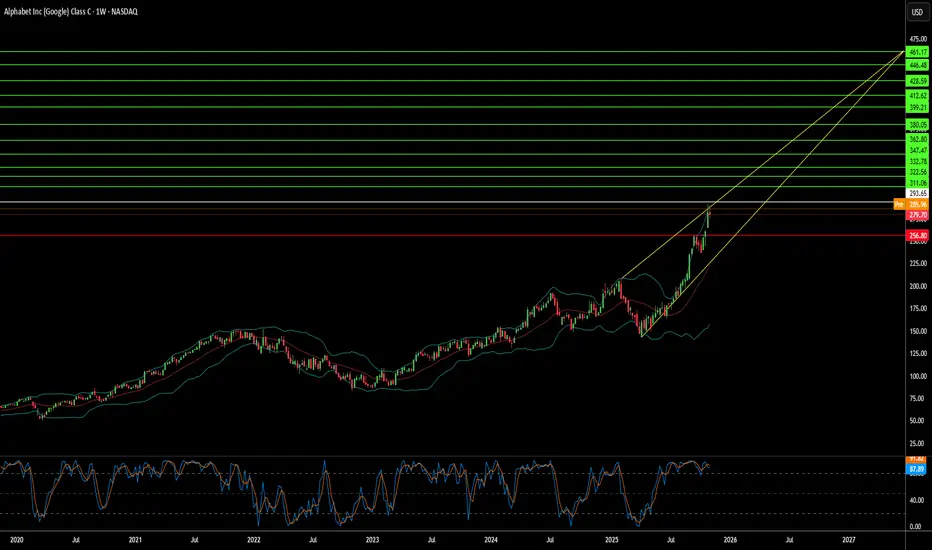
Can One Company Control Computing's Future?Google has executed a strategic transformation from a digital advertising platform to a full-stack technology infrastructure provider, positioning itself to dominate the next era of computation through proprietary hardware and breakthrough scientific discoveries. The company's vertical integration strategy centers on three pillars: custom Tensor Processing Units (TPUs) for AI workloads, quantum computing breakthroughs with verifiable advantages, and Nobel Prize-winning drug discovery capabilities through AlphaFold. This approach creates formidable competitive barriers by controlling foundational computational infrastructure rather than relying on commodity hardware.
The TPU strategy exemplifies Google's infrastructure lock-in model. By designing specialized chips optimized for machine learning tasks, Google achieved superior energy efficiency and performance scaling compared to general-purpose processors. The company's multibillion-dollar deal with Anthropic, deploying up to one million TPUs, transforms a potential cost center into a profit generator while locking competitors into Google's ecosystem. This technical dependence makes migration to rival platforms financially prohibitive, ensuring Google monetizes a significant portion of the generative AI market through its cloud services regardless of which AI models succeed.
Google's quantum computing achievement represents a paradigm shift from theoretical benchmarks to practical utility. The Willow chip's "Verifiable Quantum Advantage" demonstrates a 13,000-times speedup over classical supercomputers in physics simulations, with immediate applications in molecular structure mapping for drug discovery and materials science. Meanwhile, AlphaFold delivers quantifiable economic impact, reducing Phase I drug development costs by approximately 30% from over $100 million to $70 million per candidate. Isomorphic Labs has secured nearly $3 billion in pharmaceutical partnerships, validating this high-margin revenue stream independent of advertising.
The geopolitical implications are profound. Google holds the second-highest number of quantum technology patents globally, with strategic IP covering essential scaling technologies like chip tiling and error correction. This intellectual property portfolio creates a technical chokepoint, positioning Google as a mandatory licensing partner for nations seeking to deploy quantum technology. Combined with the dual-use nature of quantum computing for both commercial and military applications, Google's dominance extends beyond market competition to national security infrastructure. This convergence of proprietary hardware, scientific breakthroughs, and IP control justifies premium valuations as Google transitions from cyclical advertising dependence to an indispensable deep-tech infrastructure provider.
Drugdiscovery
Can Quantum Annealing Reshape Global Power?D-Wave Quantum Inc. has emerged as a distinctive player in commercial quantum computing by focusing on immediate utility through quantum annealing rather than waiting for fault-tolerant gate systems. The company's Advantage2™ system, featuring over 4,400 qubits, delivers production-grade solutions for complex optimization problems today, generating measurable ROI for clients like Ford Otosan, which reduced vehicle production scheduling from 30 minutes to under five minutes. This hybrid strategy of monetizing mature annealing technology while developing gate-model capabilities positions D-Wave to capture revenue now while hedging technological risk for the future. The quantum computing market's projected growth to $20.20 billion by 2030 (41.8% CAGR) and JPMorgan Chase's $1.5 trillion initiative, which explicitly includes quantum as a critical security technology, validate this sector beyond speculative investment.
D-Wave's recent scientific milestone, demonstrating "beyond-classical computation" on a magnetic materials simulation published in Science, marks a pivotal moment. The Advantage2™ prototype completed in minutes what would have required nearly one million years on classical supercomputers like Frontier, representing the first quantum supremacy claim on a commercially relevant, real-world problem. While classical researchers dispute aspects of the claim, the peer-reviewed validation drives enterprise confidence and accelerates bookings across manufacturing, pharmaceuticals, and energy sectors. Japan Tobacco's proof-of-concept using D-Wave's quantum-AI workflow generated drug candidates with superior properties compared to classical methods, addressing the pharmaceutical industry's 90%+ failure rate crisis.
Geopolitically, D-Wave has strategically embedded itself in European digital sovereignty initiatives, co-founding Italy's Q-Alliance to establish what aims to be the world's most powerful quantum hub. This dual-vendor partnership with IonQ provides Italy and the EU immediate access to D-Wave's production-ready annealing technology while hedging against future gate-model capabilities. Additional strategic deployments include Swiss Quantum Technology's €10 million investment and extended partnerships with Aramco Europe. The company's concentrated portfolio of 208 patent families in superconducting annealing creates defensible IP barriers, though significant risks remain: wider-than-expected losses despite 40% revenue growth, the Advantage2™ system's high cost barrier to adoption, and critical dependence on rare helium-3 supplies subject to geopolitical volatility.
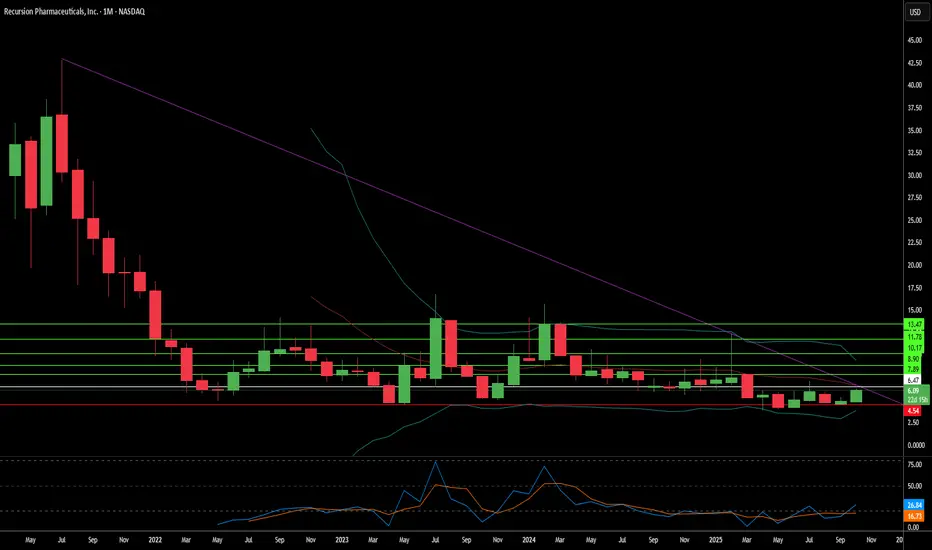
Can Machines Rewrite the DNA of Discovery?Recursion Pharmaceuticals is redefining the boundaries of biotech by positioning itself not as a traditional drug developer, but as a deep-technology platform built on artificial intelligence and automation. Its mission: to collapse the pharmaceutical industry’s notoriously slow and costly research model - one that can demand up to $3 billion and 14 years for a single approved drug. Through its integrated platform, Recursion aims to transform this inefficiency into a scalable engine for global health innovation, where value is driven not by one-off products but by the speed and reproducibility of discovery itself.
At the core of this transformation lies BioHive-2, a proprietary supercomputer powered by NVIDIA’s DGX H100 architecture. This computational behemoth fuels Recursion’s ability to iterate biological experiments at a pace that competitors cannot match. In collaboration with MIT’s CSAIL, Recursion co-developed Boltz-2, a biomolecular foundation model capable of predicting protein structures and binding affinities in seconds rather than weeks. By open-sourcing Boltz-2, the company has effectively shaped the scientific ecosystem around its standards, granting access to the community while retaining the true moat: its proprietary biological data and infrastructure.
Beyond its technological might, Recursion’s growing clinical pipeline provides proof of concept for its AI-driven discovery process. Early successes, including REC-617 (a CDK7 inhibitor) and REC-994 (for cerebral cavernous malformations), illustrate how computational prediction can rapidly yield viable drug candidates. The company’s ability to compress the time-to-market curve doesn’t merely improve profitability; it fundamentally redefines which diseases can be economically targeted, potentially democratizing innovation in previously neglected therapeutic spaces.
Yet with such power comes strategic responsibility. Recursion now operates at the intersection of biosecurity, data sovereignty, and geopolitics. Its commitment to rigorous compliance frameworks and aggressive global IP expansion underscores its dual identity as both a scientific and strategic asset. As investors and regulators watch closely, Recursion’s long-term value will hinge on its ability to transform computational speed into clinical success - turning the once-impossible dream of AI-driven drug discovery into an operational reality.