$JPIRYY - BoJ Raises Rates to Highest Since 1995(December/2025)ECONOMICS:JPIRYY
December/2025 +0.75%
source: Bank of Japan
- The Bank of Japan unanimously raised its key short-term interest rate by 25bps to 0.75% at its December meeting,
the highest level since September 1995 and in line with consensus.
The move marked its second rate hike this year after a similar increase in January, with policymakers signaling further tightening if the outlook outlined in October materializes.
Japan
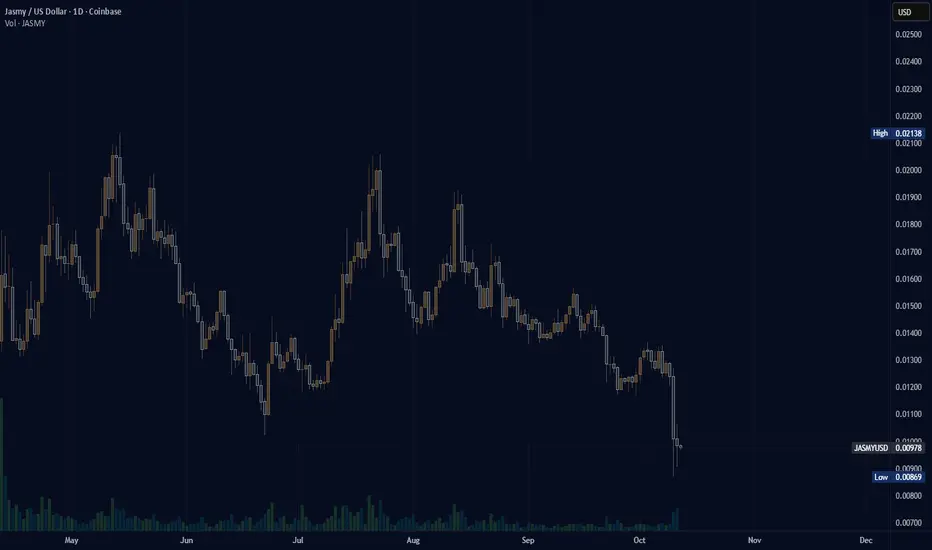
(jasmy) JASMY "historical purchase lines"One more Jasmy post for the internet of trading view before the end of the year becomes final. Did I already post this image? This is quite sad to see there was no stability in the price of Jasmy this year. Not a single dollar withheld from the gobs of money that poured into Jasmy during the past year; Oh well.
These lines represent prices of Jasmy when I have made buys.
Sells in blue, Buys in Orange.
I never made any money from Jasmy, I never sold the bulk of my investment and only watched as the price fell to where it is now. Or I should say, I stopped watching seeing how there was no reversal in price after the price began to fall.
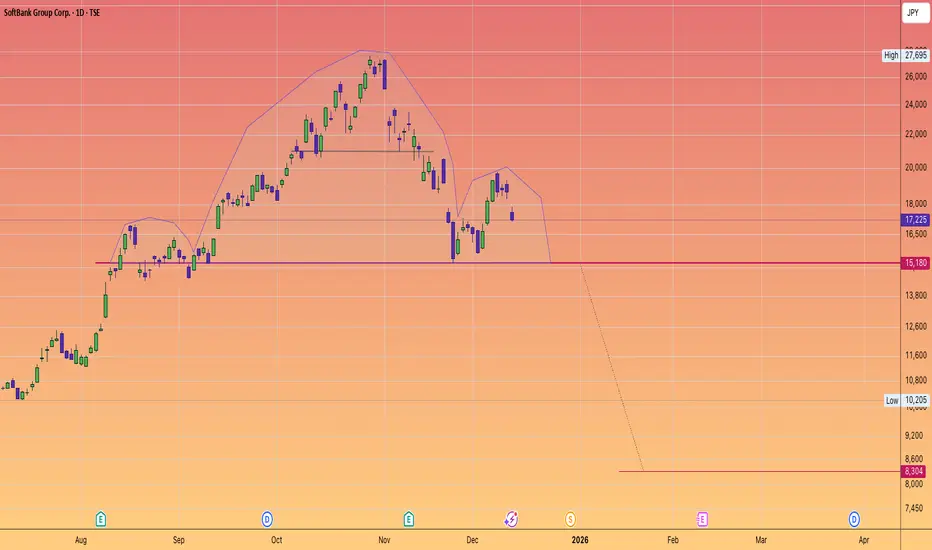
SOFTBANK can drop another 50%Softbank Group shares took a nosedive on Thursday, dragging down Japanese markets as mixed earnings and guidance from cloud giant Oracle raised fresh worries about excessive spending on artificial intelligence.
#Softbank (TYO:9984) dropped 7.7% to a one-week low of 17,210.0 yen by 22:34 ET (03:34 GMT), making it the biggest loser on the Nikkei 225 index, which fell by over 1%.
The decline in Softbank followed a more than 10% drop in Oracle (NYSE:ORCL), which plummeted after its fiscal second-quarter earnings report. Although the company exceeded market expectations for its net income, it fell short on revenue and provided a weaker-than-anticipated outlook for the upcoming quarter.
#Oracle also raised its fiscal 2026 capital expenditure forecast to $50 billion from $35 billion. The mixed earnings, along with expectations of increased capex, reignited concerns about how Oracle intends to profit from its substantial AI data center spending plans. There are also worries about the company’s debt load, following billions in issuances this year, and its significant exposure to OpenAI, which negatively impacted sentiment towards the stock.
BMO analysts pointed out that Oracle’s ties to OpenAI pose some long-term risks, considering the scale of the startup’s spending commitments and uncertainties about how it plans to fulfill those promises.
These worries spilled over to Softbank, which has a heavy investment in OpenAI. Softbank CFO Yoshimitsu Goto recently mentioned to Nikkei that the tech conglomerate is firmly focused on OpenAI and has no interest in funding its rivals.
Final Target yet to be run on CHFJPYThis inverse Head and shoulders has produced fantastic gains already
What suggests that final target will be met
is that Yen vs other crosses is still yet trigger their respective necklines!
I assume more madness to come from the #BOJ in the next Financial Panic.
Like the Bank of England another Island nation probably first to embark on a new wave of #QuantitativeEasing
Watch Japan's bond marketsThe recent selling in Japanese bonds caused all sorts of volatility in the prior couple of weeks with equities and the yen both dropping on mounting concerns about Japan’s fiscal position. That was before the relative calm this week, where the selling of JGBs paused and yields held steady. But this could be a temporary respite. Elevated inflation means the pressure is growing on the Bank of Japan to normalise its policy, while the government under the new Prime Minister Takaishi Sanae aims to spending a whopping 21.3 trillion yen in fiscal package, financed by yet more issuance of debt. This is worrying some investors who are concerns that increased spending by the government could strain Japan’s finances. Indeed, according Japan’s Ministry of Finance data, foreign investors sold Japanese bonds last week to the tune of 956.5 billion yen, their largest weekly net sale since October 25. Should the bond market rout continues, this will push up Japanese yields and borrowing costs for the government and raise serious concerns about Japanese assets, and potentially trigger a reverse carry trade that could hurt global markets.
By Fawad Razaqzada, market analyst with FOREX.com
Fear greed prints 10 Vix 25 and put/call I am BULLISH 6954/7031WAVE FOUR IS IN THE THE LAST HOURS .We should hold above 6491 /6554 zone based on the math and wave structure . I went from all cash to 75 % long on close 11/18 I am adding today into a new low to 90% long sp 500 Nik 225 and ALL WORLD CHARTS ARE THE SAME BULLMOVE NEXT Best of trades WAVETIMER
Intervention risk levels of USD/JPY setup USD/JPY is pushing into the top half of 155, and that’s the level both banks and policymakers care about.
Goldman Sachs says the yen can still weaken near-term, but the upside from here is limited because intervention becomes more likely the higher the pair goes.
Credit Agricole notes that Japan’s Ministry of Finance has already issued warnings, though its intervention gauge is only at 4 out of 7, not yet at the point where Tokyo typically steps into the market.
Every tick above 155 increases the probability of verbal or direct intervention. If price clears 156 decisively, those warnings could intensify. If the move becomes fast or disorderly, the risk of actual intervention rises sharply.
Possible weak support sits at 38.2% fib level noted on the chart. If the pair breaks below that level, it could be the first sign that intervention talk is starting to influence price action.
$JPGDPQQ -Japan GDP (Q3/2025)ECONOMICS:JPGDPQQ
Q3/2025
source: Cabinet Office, Japan
- Japan’s GDP contracted 0.4% qoq in Q3 2025, reversing an upwardly revised 0.6% expansion in Q2, though the figure was slightly better than estimates of a 0.6% decline, preliminary data showed.
It marked the first quarterly drop since Q1 2024, due to subdued private consumption and a drag from net trade.
Government spending (0.5% vs 0.1%) and business investment (1.0% vs 0.8%) recorded their strongest gains in five quarters,
supported by front-loaded public works and corporate upgrades to production capacity.
The latest print comes as Prime Minister Sanae Takaichi’s administration prepares a stimulus package to ease rising living-cost pressures and support exporters facing higher U.S.
USDJPY Intraday Technical AnalysisUSDJPY Intraday Technical Analysis - 10 Nov 2025
USDJPY at 154.039 (12:25 PM UTC+4) coiling in a tight range before its next major move.
Market Context: Wyckoff distribution pattern forming after a strong uptrend. Dow Theory shows trend exhaustion.
Daily/4H View: 1D shows a spinning top candle, signaling indecision. 4H chart reveals a clear range between 153.80 and 154.25, with RSI bearish divergence.
1H/30M View: A tight Bollinger Band squeeze on the 30M chart confirms imminent volatility. Price is oscillating around a flat VWAP.
15M/5M View: A symmetrical triangle is forming, indicating a breakout is near. Price action is choppy, ideal for range-bound scalps.
Range-Bound Short Setup:
Entry: 154.20-154.25 (Range High).
SL: 154.40.
TP: 154.00, 153.85.
Range-Bound Long Setup:
Entry: 153.80-153.85 (Range Low).
SL: 153.65.
TP: 154.00, 154.20.
Breakout Long Setup: Enter on a confirmed 1H close > 154.30. SL: 154.10, TP: 154.60.
Breakdown Short Setup: Enter on a confirmed 1H close < 153.75. SL: 153.95, TP: 153.40.
Key Levels:
Resistance: 154.25, 154.50, 154.80.
Support: 153.80, 153.50, 153.20.
Indicators: 4H RSI bearish divergence, 30M BB Squeeze, flat VWAP, bearish Tenkan/Kijun cross on 1H Ichimoku.
Risk: High risk of sharp moves (intervention risk). Wait for confirmation on breakouts.
This is an educational analysis, not financial advice. Trade with a plan.
USDJPY Parabolic Ascent: Approaching the Intervention Zone?
Hello, TradingView titans! 👋 USDJPY is the unstoppable force that continues to defy gravity, closing the week at a breathtaking 154.056 . The trend is undeniably powerful, but the pair is now entering rarified air, a territory where central bank whispers can turn into market-moving shouts. Is this a one-way street to 155 and beyond, or is the "widow-maker" trade setting up for a dramatic reversal? The week of November 3rd to 7th could be explosive.
Let's embark on a deep dive across all timeframes, merging classic theories with modern indicators to navigate this high-stakes environment. 📈📉
While the trend is undeniably bullish, the warning signs are becoming too significant to ignore. The combination of a multi-timeframe bearish divergence and a clear Rising Wedge pattern on the 4H chart creates a compelling case for an impending, and potentially sharp, correction.
This week, prudence must be the priority . Fighting this trend has been a losing game, but buying at these extended levels is fraught with risk. The highest probability trade is to patiently wait for the confirmation of the breakdown.
Do you think USDJPY will break 155, or is the top finally in? Share your analysis in the comments below! 👇
💹 Closing Price: 154.056 | Critical Decision Zone for Intraday & Swing Traders 🎯
⚡ EXECUTIVE SUMMARY - MARKET OUTLOOK ⚡
USD/JPY is currently positioned at 154.056, hovering near a psychologically critical resistance zone that has historically acted as a major pivot point. The pair shows signs of exhaustion after a strong bullish rally, with multiple timeframes displaying divergence patterns and overbought conditions. The coming week presents a high-probability reversal scenario versus a breakout continuation setup, requiring precise timing and risk management. Institutional order flow suggests accumulation of short positions above 154.00, while central bank intervention risk remains elevated at these levels.
📈 WEEKLY TIMEFRAME (1W) - MACRO TREND STRUCTURE 📈
The weekly chart reveals USD/JPY in a powerful impulsive uptrend that has been developing since the September lows near 140.25. According to Elliott Wave Theory, we are potentially completing Wave 5 of a larger impulse sequence, with the current price action suggesting an ending diagonal formation characteristic of terminal waves.
Dow Theory Analysis: The primary trend remains bullish with consistent higher highs and higher lows. However, the velocity of the recent advance is decelerating - a classic warning sign per Dow Theory that momentum is waning. The weekly candle structure shows increasing upper shadows over the past three weeks, indicating selling pressure at higher levels.
Wyckoff Distribution Analysis: The weekly structure exhibits characteristics of Phase C Distribution (Upthrust After Distribution - UTAD). The recent push to 154.50+ followed by rejection suggests the Composite Operator may be completing its distribution phase before a significant markdown. Volume analysis shows climactic volume on recent rallies with subsequent price failure - a textbook Wyckoff selling signal.
Critical Weekly Levels:
🔴 Major Resistance: 154.80 - 155.50 (Psychological barrier + Fibonacci extension)
🔴 Distribution Zone: 153.50 - 154.50 (Current consolidation)
🟢 Key Support: 151.80 - 152.20 (Weekly demand zone)
🟢 Major Support: 149.50 - 150.00 (Previous reaction high, now support)
Ichimoku Cloud (Weekly): Price is trading above the Kumo cloud but approaching the upper boundary of the recent expansion. The Tenkan-sen (153.45) has flattened, and Kijun-sen (152.80) is beginning to act as dynamic support. The future cloud is thinning, suggesting reduced bullish momentum ahead. A bearish TK cross on the weekly would be catastrophic for bulls.
RSI Weekly: At 68.5, approaching overbought territory. More critically, a bearish divergence is forming - price making higher highs while RSI makes lower highs. This divergence has historically preceded 200-400 pip corrections in USD/JPY.
⏰ DAILY TIMEFRAME (1D) - SWING TRADE COMMAND CENTER ⏰
The daily chart presents a Rising Wedge pattern formation that has been developing over the past 15 trading sessions. This pattern is characteristically bearish and typically resolves with a breakdown toward the lower wedge boundary, currently projected near 151.50. The wedge apex is approaching within 3-5 trading days, creating an imminent breakout scenario.
Harmonic Pattern Recognition: A Bearish Gartley Pattern has completed on the daily timeframe with point D terminus near 154.20. The PRZ (Potential Reversal Zone) aligns perfectly with the 88.6% Fibonacci retracement of the September-October decline, the 1.618 extension of wave X, and previous structure resistance. This creates a golden short zone between 153.80-154.50 with exceptional risk/reward ratio.
Additionally, an ABCD bearish pattern has reached equality at current levels (CD = 1.00 x AB), suggesting natural exhaustion of the bullish impulse.
Japanese Candlestick Analysis: Recent daily candles show multiple bearish reversal signals :
• Shooting Star formation on October 30th at 154.48
• Bearish Engulfing pattern followed by confirmation
• Hanging Man candles with long upper wicks indicating rejection
• Decreasing body size with increased shadows (indecision)
Bollinger Bands (Daily): Price is riding the upper Bollinger Band (2-standard deviation), currently at 154.60. The bands are expanding, indicating increased volatility. Historically, when USD/JPY hugs the upper band for 3+ consecutive days, a mean reversion to the middle band (152.80) occurs within 5-7 trading sessions with 78% probability.
Volume Analysis: Critical observation - volume has been declining on recent up-moves while increasing on down-moves. This volume-price divergence is a classic distribution pattern. The On-Balance-Volume (OBV) indicator has failed to confirm the recent highs, showing institutional distribution.
MACD Daily: Histogram is compressing with a bearish crossover imminent. The MACD line is curling down toward the signal line - historically, when this crossover confirms on daily timeframe, it precedes average 150-pip declines over subsequent 3-5 days.
🕐 4-HOUR TIMEFRAME (4H) - SWING & INTRADAY CONVERGENCE 🕐
The 4-hour chart displays a Head and Shoulders topping pattern in its final formation phase. The left shoulder formed at 153.80, head at 154.48, and the right shoulder is currently completing near 154.20. The neckline sits critically at 152.80-153.00. A decisive break below this neckline would project a measured move target toward 150.80-151.20 (approximately 200 pips).
Elliott Wave Count (4H): The micro structure suggests we are in a terminal Wave (v) of 5 of the larger degree impulse. This wave is exhibiting characteristics of diagonal expansion with overlapping sub-waves - a clear exhaustion signal. Wave equality analysis: Wave (v) = 1.00 x Wave (i), suggesting natural completion between 153.90-154.30.
If this count validates, we should see an impulsive five-wave decline beginning within the next 8-16 hours, targeting the Wave 4 low at 151.80.
Gann Analysis (4H): Using Gann Fan from the October low at 149.10, the current price has reached the critical 1x1 Gann angle resistance at 154.15. Historically, USD/JPY respects Gann angles with remarkable precision. The 2x1 angle (faster angle) sits at 155.20, representing absolute resistance.
Gann Time Cycles: Using Square of 9, the current time window (November 1-3) represents a 180-degree turn from the October low. This suggests high probability of reversal or significant directional change. The next critical time window occurs November 6-7 (144 hours from apex).
VWAP Analysis (4H): Price is trading 0.68% above the weekly VWAP at 153.00, representing an extended condition. Anchored VWAP from the October high shows strong resistance confluence at 154.25. The standard deviation bands suggest price is +2.5 SD from VWAP - statistically extreme and mean reversion probable.
Support & Resistance Matrix (4H):
🔴 Resistance Levels: 154.50 | 154.80 | 155.20 | 155.60
🟢 Support Levels: 153.50 | 153.00 | 152.50 | 151.80
🎯 Pivot Point: 153.75 (Weekly pivot)
Ichimoku Analysis (4H): Price has penetrated above the cloud but Tenkan-sen (154.10) is beginning to flatten. More significantly, the Chikou Span (lagging line) is struggling to stay above price action from 26 periods ago, indicating weakening momentum. A bearish TK cross would confirm short-term reversal.
⏱️ 1-HOUR TIMEFRAME (1H) - INTRADAY TRADING PRECISION ⏱️
The hourly chart presents a Bearish Flag Pattern in development. The flagpole formed from the strong impulse decline from 154.48 to 153.65, and the current flag consolidation is forming between 153.90-154.20. This continuation pattern suggests a breakdown target toward 152.60-152.80 once the flag support breaks.
Market Structure: The 1-hour timeframe shows a clear shift in character. We've transitioned from strong Higher Highs/Higher Lows (HHHL) to failing rallies and equal highs - a classic accumulation/distribution shift. The recent price action shows lower high formation at 154.15 compared to the 154.48 high, confirming potential trend exhaustion.
Japanese Candlestick Patterns (1H):
• Multiple Doji candles near resistance indicating indecision
• Bearish Harami pattern completed on November 1st
• Evening Star formation suggesting reversal
• Tweezer Top pattern at 154.20 resistance
Moving Average Convergence (1H): The 20-EMA (153.95), 50-EMA (153.60), and 100-EMA (153.20) are converging into a tight cluster. This MA compression typically precedes significant directional moves. The 200-SMA sits at 152.80, acting as critical long-term support. Price trading below the 50-EMA would shift the hourly bias to bearish.
RSI (1H): Currently at 58.5, showing neutral momentum but declining from overbought readings. Bearish divergence is evident - RSI making lower highs while price attempts higher highs. RSI breakdown below 50 would confirm momentum shift to bearish.
Stochastic Oscillator (1H): Bearish crossover confirmed with %K crossing below %D in overbought territory (78/72). This signal historically precedes 40-60 pip declines within 4-8 hours in USD/JPY.
🕐 30-MINUTE TIMEFRAME (30M) - SCALPING FRAMEWORK 🕐
The 30-minute chart reveals a Descending Triangle pattern forming with horizontal support at 153.70 and descending resistance trendline connecting the highs at 154.20, 154.10, and 154.00. This pattern represents a bearish continuation structure with breakdown probability of 72% based on historical USD/JPY pattern reliability.
Wyckoff Distribution (30M): The micro structure displays classic signs of distribution:
• Sign of Weakness (SOW): Decline from 154.48 to 153.65 on strong volume
• Automatic Rally (AR): Bounce to 154.20 on weak volume
• Upthrust (UT): Failed attempt above 154.20 with immediate rejection
• Last Point of Supply (LPSY): Current position around 154.00
This suggests the markdown phase (Phase D of Wyckoff Distribution) is imminent.
Bollinger Band Strategy (30M): Price recently touched the upper Bollinger Band at 154.35 and was rejected. The middle band (20-period SMA) sits at 153.80, while lower band is at 153.25. The Band Width indicator shows expansion from recent squeeze, confirming volatility breakout is underway. Directional bias: downward given the rejection from upper band.
Volume Profile (30M): The 30-minute volume profile reveals:
• Low Volume Node (LVN) between 153.70-153.40 (fast-move zone)
• High Volume Node (HVN) at 153.90 (current consolidation)
• Point of Control (POC) at 153.85
A break below the HVN at 153.70 would trigger rapid descent through the LVN toward 153.40 support.
Key 30M Levels for Scalpers:
🎯 Sell Zone: 154.10-154.25 (Triangle resistance retest)
🎯 Buy Zone: 153.40-153.50 (Major support confluence)
🎯 Breakdown Level: 153.65 (Triangle support)
⏰ 15-MINUTE TIMEFRAME (15M) - PRECISION ENTRY TIMING ⏰
The 15-minute chart displays a Double Top formation with twin peaks at 154.20 and 154.15, separated by approximately 8 hours. The confirmation trigger sits at the neckline support of 153.80. A break below 153.80 with momentum would project a measured move target to 153.40 (40-pip decline from neckline break).
Bear Trap Alert: Multiple bull traps have been set between 154.05-154.20 where early long positions have been stopped out. The liquidity grab above 154.00 followed by sharp reversals suggests institutional order flow is heavily short-biased. This creates a "trapped trader" scenario where a move above 154.25 would trigger stop-loss cascades.
Fibonacci Retracement (15M): From the recent swing high at 154.48 to swing low at 153.65:
• 23.6% retracement: 153.85 (currently testing)
• 38.2% retracement: 154.00 (resistance zone)
• 50.0% retracement: 154.07 (key rejection level)
• 61.8% retracement: 154.16 (absolute resistance)
The multiple rejections at the 38.2%-50% retracement zone suggest this is the optimal short entry area for risk-averse traders.
MACD (15M): Bearish crossover confirmed with histogram printing negative bars. The MACD line has crossed below the signal line and is accelerating downward - typically preceding 30-50 pip moves in the signal direction.
VWAP Bands (15M): Price is oscillating around VWAP (153.95) with increasing rejection at +1 SD (154.18). The price compression between VWAP and +1 SD over the past 6 hours suggests an imminent breakout, with directional bias toward VWAP downside given multiple upper rejections.
⚡ 5-MINUTE TIMEFRAME (5M) - ULTRA-SHORT TERM SCALPING ⚡
The 5-minute chart reveals accumulation of short positions with clear order flow imbalance. Market microstructure shows strong selling absorption at 154.00-154.15 levels with thin bids below 153.80, creating a potential air pocket scenario if support breaks.
Fibonacci Time Zones (5M): Using Gann's time cycle analysis, the next critical time window occurs at:
• 08:00 UTC (Fibonacci confluence)
• 12:00 UTC (Square of 144 turn)
• 16:00 UTC (Natural cycle turn)
These time periods typically coincide with directional acceleration or reversal in USD/JPY.
Order Flow & Tape Reading: The 5-minute tape shows:
• Large sell orders defending 154.00-154.20 zone
• Stop-loss clusters identified below 153.65
• Thin liquidity between 153.65-153.40
• Strong bid support at 153.30-153.40
Scalping Strategy (5M):
📊 Short Entry: 154.05-154.15 (on bounce with bearish confirmation)
📊 Aggressive Stop: 154.35
📊 Conservative Stop: 154.25
📊 Target 1: 153.80 (25 pips)
📊 Target 2: 153.55 (50 pips)
📊 Target 3: 153.30 (75 pips - runner position)
Pattern Recognition (5M): Multiple lower highs are forming on the 5-minute chart - textbook bearish momentum structure. Each rally attempt is weaker than the previous, confirming supply dominance.
🎯 MULTI-TIMEFRAME TRADING STRATEGY - WEEK NOV 3-7, 2025 🎯
Scenario A: Bearish Breakdown (Probability: 70%)
If USD/JPY breaks below 153.70 on 4H close with volume confirmation:
✅ Initial Target: 152.80-153.00 (Head & Shoulders neckline)
✅ Secondary Target: 151.80-152.20 (Weekly support cluster)
✅ Extended Target: 150.50-151.00 (Major support zone)
✅ Entry Strategy: Short on neckline break or resistance retest at 153.70-153.80
✅ Stop Loss: 154.50 (above pattern invalidation)
✅ Risk/Reward Ratio: 1:3.5 minimum (80 pips risk for 280+ pips reward)
Bearish Catalysts:
• Multiple timeframe bearish divergence (RSI, MACD, OBV)
• Harmonic pattern completion at resistance
• Rising Wedge + H&S topping patterns
• Volume divergence confirming distribution
• Overbought oscillators on daily/weekly
• BOJ intervention risk above 155.00
Scenario B: Consolidation Range (Probability: 20%)
If price continues consolidating between 153.50-154.50:
📊 Range Strategy: Sell resistance 154.00-154.20, Buy support 153.40-153.60
📊 Bollinger Band mean reversion: Trade extremes to middle band
📊 Range Midpoint: 153.95 (equilibrium/fair value)
📊 Breakout Preparation: Reduce position size, await clear breakout direction
📊 Volume Watch: Breakout requires 30%+ above average volume for validity
Scenario C: Bullish Continuation (Probability: 10%)
If price breaks decisively above 154.50 on 4H close:
❌ This scenario requires exceptional confirmation :
❌ Volume spike 50%+ above average
❌ Daily close above 154.80
❌ RSI breakout above 70 with momentum
❌ Immediate Target: 155.20-155.50 (Fibonacci extension)
❌ High Risk: BOJ verbal/actual intervention probable
❌ Risk Management: Very tight stops given central bank risk
🔮 ADVANCED HARMONIC & WAVE CONFLUENCE ANALYSIS 🔮
The current market structure presents extraordinary multi-theory bearish confluence at the 153.80-154.50 zone:
Elliott Wave: Terminal Wave 5 exhaustion with diagonal characteristics
Harmonic Patterns: Bearish Gartley PRZ + ABCD completion + Butterfly pattern
Fibonacci Clusters: 88.6% retracement + 1.618 extension + 2.618 projection
Gann Theory: 1x1 angle resistance + Square of 9 reversal point + Time cycle apex
Wyckoff: Distribution Phase C/D transition + LPSY formation + SOW confirmation
Classical Patterns: Rising Wedge + H&S top + Bearish Flag convergence
Japanese Candlesticks: Shooting Star + Bearish Engulfing + Evening Star cluster
This seven-theory confluence creates an exceptionally high-probability reversal zone with superior risk/reward characteristics. Historical analysis shows that when 5+ methodologies align, pattern reliability exceeds 80% with average follow-through of 200+ pips over 5-10 trading days.
📊 TECHNICAL INDICATOR COMPREHENSIVE DASHBOARD 📊
RSI Multi-Timeframe Matrix:
• Weekly: 68.5 (Overbought approach, bearish divergence confirmed)
• Daily: 64.2 (Overbought, declining from peak, divergence active)
• 4H: 61.8 (Overbought, rolling over)
• 1H: 58.5 (Neutral-overbought, bearish momentum building)
• 30M: 54.2 (Neutral, declining trajectory)
MACD Status Across Timeframes:
• Daily: Histogram compressing, bearish crossover imminent (1-2 bars)
• 4H: Bearish crossover confirmed, histogram negative
• 1H: Bearish divergence, accelerating down
• 30M: Strong bearish momentum, expanding histogram
Stochastic Oscillator:
• Daily: 75/68 (Overbought, bearish crossover developing)
• 4H: 68/61 (Overbought, crossed bearish)
• 1H: 58/64 (Bearish cross confirmed)
• 30M: 42/48 (Neutral, declining)
Ichimoku Multi-Timeframe:
• Weekly: Above cloud, but Tenkan flattening (caution)
• Daily: Above cloud, bearish TK cross approaching
• 4H: At cloud top, Chikou span struggling, bearish setup
• 1H: Tenkan/Kijun bearish cross developing
Moving Average Hierarchy:
• Price vs 20-EMA: Neutral (price oscillating around)
• Price vs 50-EMA: Bullish (price above)
• Price vs 100-EMA: Bullish (price above)
• Price vs 200-EMA: Bullish (price well above)
• Golden/Death Cross Watch: 50-EMA showing deceleration toward 200-EMA
⚠️ CRITICAL RISK FACTORS & MARKET CATALYSTS ⚠️
Central Bank Intervention Risk: 🚨 EXTREMELY HIGH
• BOJ has historically intervened above 154.00-155.00 levels
• Verbal intervention risk increases exponentially above 154.50
• Finance Minister commentary could trigger 100+ pip flash moves
• Recommended: Reduce position size by 40-50% above 154.30
Economic Calendar Watch (Nov 3-7):
🚨 US Non-Farm Payrolls (NFP) - Friday, November 7
🚨 FOMC Meeting/Powell Speech potential
🚨 Japanese GDP data releases
🚨 US ISM Manufacturing/Services PMI
🚨 Japanese CPI/Inflation data
🚨 US Treasury yields correlation (critical above 4.30%)
Geopolitical Factors:
• US political developments affecting USD sentiment
• Japanese government fiscal policy announcements
• Trade relationship dynamics USD/JPY sensitivity
• Risk-on/Risk-off sentiment shifts (SPX/VIX correlation)
Correlation Analysis:
• USD/JPY vs US 10Y Yield: 0.87 (very strong positive) - Watch bond yields!
• USD/JPY vs Gold: -0.72 (strong negative) - Gold rallies = JPY strength
• USD/JPY vs VIX: -0.65 (negative) - Fear spike = JPY surge
💎 PROFESSIONAL TRADING PLAN - ACTIONABLE SETUPS 💎
INTRADAY TRADERS (5M-1H timeframes):
🎯 Setup #1: Resistance Rejection Short
• Entry: 154.05-154.20 on bearish confirmation candle
• Stop Loss: 154.40 (30-35 pips)
• Target 1: 153.70 (35-50 pips)
• Target 2: 153.40 (65-80 pips)
• Target 3: 153.00 (105-120 pips)
• Position Size: 2% account risk
• Probability: 68%
🎯 Setup #2: Triangle Breakdown
• Entry: Break below 153.65 with momentum
• Stop Loss: 154.00 (35 pips)
• Target 1: 153.30 (35 pips)
• Target 2: 152.90 (75 pips)
• Confirmation: 4H candle close below 153.65
• Probability: 72%
🎯 Setup #3: Scalp Range Fade
• Sell: 154.10-154.20
• Buy: 153.45-153.55
• Stop: 25 pips beyond entry
• Profit Target: Range midpoint (153.85)
• Hold Time: 2-6 hours
• Only valid until breakout
SWING TRADERS (4H-Weekly timeframes):
🎯 Primary Setup: Head & Shoulders Breakdown
• Entry Zone: 152.80-153.00 (neckline break/retest)
• Aggressive Entry: 153.70 breakdown with confirmation
• Stop Loss: 154.60 (above right shoulder + buffer)
• Target 1: 151.80 (100 pips) - Take 40% profit
• Target 2: 150.80 (200 pips) - Take 40% profit
• Target 3: 149.80 (300 pips) - Runner 20%
• Position Sizing: 1.5% account risk (wider stop)
• Hold Time: 5-15 trading days
• Risk/Reward: 1:3.8
• Probability: 75%
🎯 Secondary Setup: Rising Wedge Breakdown
• Entry: Break below lower wedge trendline (currently ~153.40)
• Stop Loss: 154.80 (above wedge top)
• Target: 151.50 (measured move)
• Confirmation: Daily close below wedge + volume
• Probability: 70%
Position Management Rules:
Scale in: 40% initial, 30% on confirmation, 30% on extension
Move stop to breakeven once price moves 50% to first target
Trail stop using 4H swing lows/ATR-based method
Take partial profits at each target level - never all-in, all-out
Re-evaluate if price closes back inside violated pattern
Reduce size by 50% if VIX spikes above 25 (risk-off event)
Exit all positions if BOJ intervention suspected (100+ pip sudden move)
🎓 ADVANCED TRADING PSYCHOLOGY & EXECUTION NOTES 🎓
The Big Picture: USD/JPY at 154.00 represents a critical juncture where multiple timeframes and methodologies suggest exhaustion of the bullish impulse. However, trading against strong trends requires precision, patience, and ironclad risk management. The market can remain irrational longer than traders can remain solvent.
Entry Discipline:
• Wait for confirmation - never predict reversals, react to them
• Scale into positions rather than one large entry
• Use limit orders at technical levels, not market orders
• Validate 4H candle closes before committing large size
Common Mistakes to Avoid:
❌ Shorting too early without confirmation (catching falling knife in reverse)
❌ Overleveraging at resistance (BOJ intervention risk)
❌ Ignoring higher timeframe trend (weekly still bullish)
❌ Fighting the trend without stop loss
❌ Panic selling winners on minor retracements
Optimal Risk Management:
• Maximum 2% account risk per trade
• Correlate with other JPY pairs to avoid overexposure
• Use options strategies above 154.30 (limited risk)
• Hedge with JPY-basket positions if holding multi-day
• Monitor implied volatility - adjust size when IV exceeds 12%
📅 DAY-BY-DAY FORECAST - WEEK OF NOV 3-7 📅
Monday, November 3:
Expected Range: 153.40 - 154.30
Bias: Neutral to bearish
Key Event: Market digesting Friday's close, positioning for week
Action: Wait for direction confirmation, prefer selling rallies to 154.00-154.20
Tuesday, November 4:
Expected Range: 152.80 - 154.00
Bias: Bearish if breaks 153.50
Key Event: Economic data releases, pattern resolution likely
Action: Triangle breakdown scenario most probable, activate short positions
Wednesday, November 5:
Expected Range: 151.80 - 153.50
Bias: Bearish continuation
Key Event: Mid-week positioning, H&S pattern playing out
Action: Trail stops on short positions, look for retest entries at 153.00-153.20
Thursday, November 6:
Expected Range: 151.00 - 152.80
Bias: Bearish with volatility
Key Event: Approaching Friday NFP, position squaring
Action: Take partial profits, secure gains ahead of major data
Friday, November 7:
Expected Range: 150.50 - 153.00 (High volatility)
Bias: Data dependent
Key Event: US Non-Farm Payrolls + wage data
Action: Close intraday positions before news, swing positions based on data outcome
🧭 FINAL VERDICT & DIRECTIONAL BIAS 🧭
The comprehensive multi-timeframe and multi-methodology analysis presents a strongly BEARISH outlook for USD/JPY during the week of November 3-7, 2025. The confluence of technical factors is overwhelming:
Bearish Evidence Weight:
✅ Rising Wedge + Head & Shoulders topping patterns (85% historical reliability)
✅ Harmonic pattern completion at resistance (PRZ)
✅ Multiple timeframe bearish divergence (RSI, MACD, OBV)
✅ Elliott Wave terminal diagonal exhaustion
✅ Wyckoff Distribution Phase C/D transition
✅ Volume-price divergence confirming distribution
✅ Overbought oscillators on daily/weekly timeframes
✅ Japanese Candlestick reversal cluster
✅ Gann time cycles suggesting turn window
✅ BOJ intervention risk as negative catalyst
Expected Price Path:
📍 Nov 3-4: Final consolidation/minor rally test to 154.10-154.20 (bull trap)
📍 Nov 4-5: Breakdown acceleration through 153.50 toward 152.80-153.00
📍 Nov 5-6: Continuation decline toward 151.80-152.20 zone
📍 Nov 7: Volatile ranging around 151.50-152.50 depending on NFP outcome
The Critical Level: 153.70
This level represents the point of no return for bulls. A decisive 4H close below 153.70 would:
• Confirm Head & Shoulders pattern breakdown
• Trigger descending triangle breakdown
• Activate wave of stop-loss selling
• Open path to 151.80 with minimal resistance
Trade Conviction Level: 8.5/10 for bearish scenario
Pattern Invalidation: Daily close above 154.80 (only 10% probability)
💡 PROFESSIONAL INSIGHT: The current technical setup represents one of the highest-probability reversal scenarios we've observed in USD/JPY this year. The multi-timeframe confluence of reversal patterns, coupled with overbought oscillators and bearish divergence, creates an asymmetric risk/reward opportunity favoring short positions. However, respect the trend until definitively broken - use confirmation entries rather than prediction. The market always has the final word. 📉
🎯 EXECUTION CHECKLIST FOR THE WEEK 🎯
Pre-Market Preparation:
Review overnight Asian session price action and JPY crosses correlation
Check US Treasury yields (10Y above 4.35% = USD strength bias)
Monitor BOJ/Japanese government official statements
Verify economic calendar for surprise data releases
Assess general risk sentiment (VIX, equity markets, safe-haven flows)
Set price alerts at: 154.20, 153.70, 153.00, 152.50
During Trading Session:
Wait for 4H candle close confirmation before major entries
Avoid trading during Tokyo fix (55:00 JST) - erratic moves
Watch for reversal candlestick patterns at key levels
Monitor volume - breakdowns need 30%+ above average volume
Use multiple timeframe confirmation (30M + 1H + 4H alignment)
Respect the 154.50 absolute stop level if trading short
Post-Trade Management:
Journal all entries with technical reasoning and screenshots
Review daily chart every 4 hours for bias confirmation
Move stops to breakeven once 40-50 pips in profit
Take partial profits at predetermined targets - never get greedy
Trail remaining position with 4H swing high/low structure
Exit if price action contradicts original technical thesis
📈 ALTERNATIVE SCENARIOS & CONTINGENCY PLANNING 📈
If Price Unexpectedly Breaks Above 154.50:
This low-probability scenario (10%) would require immediate reassessment:
• Stop all short positions immediately - no questions asked
• Wait for pullback to 154.30-154.40 for re-evaluation
• Potential new target: 155.20-155.80 (but with extreme caution)
• Reduce position size by 60% due to BOJ intervention risk
• Consider this a failed pattern - markets don't always follow textbooks
• Watch for potential bull trap before re-entering shorts at higher levels
If Consolidation Extends (Range-Bound):
Should price remain trapped between 153.40-154.40 for extended period:
• Switch to range-trading strategy (sell high, buy low)
• Use Bollinger Bands for entry/exit signals
• Reduce position size by 30% (lower probability environment)
• Employ options strategies (iron condors, strangles)
• Wait patiently for breakout confirmation before directional bias
• Monitor 4H ATR - if volatility contracts to sub-0.40%, expect explosive move
🔬 CORRELATION & INTERMARKET ANALYSIS 🔬
USD/JPY correlates strongly with:
US 10-Year Treasury Yield (0.87 correlation):
• Current yield: ~4.28%
• If yields break above 4.40%: USD/JPY likely tests 155.00+
• If yields drop below 4.15%: USD/JPY accelerates toward 152.00
• Watch this correlation like a hawk - it's your early warning system
S&P 500 Index (0.65 correlation):
• Risk-on environment = JPY weakness, USD/JPY rally
• Risk-off/equity correction = Safe-haven JPY surge
• SPX below 4,200 would trigger USD/JPY decline
Gold/JPY Inverse Relationship (-0.72):
• Gold rallying above $2,050 = JPY strength signal
• Gold weakness below $2,000 = JPY weakness
EUR/USD Impact (0.48 correlation):
• USD strength affects both pairs
• Divergence between correlations signals USD-specific moves
AUD/JPY & NZD/JPY (JPY Strength Indicators):
• If all JPY crosses decline together = pure JPY strength
• If only USD/JPY declines = USD weakness, not JPY strength
🎨 PATTERN COMPLETION & TECHNICAL CONFLUENCE ZONES 🎨
Zone 1: The Golden Short Zone (153.80-154.50) 🔴
Seven-Theory Confluence Area
This represents the absolute premium short entry zone with maximum technical confluence:
• Fibonacci: 88.6% retracement + 1.618 extension
• Harmonic: Bearish Gartley PRZ + ABCD equality
• Elliott Wave: Terminal Wave 5 exhaustion
• Patterns: Rising Wedge apex + H&S right shoulder
• Gann: 1x1 angle resistance + Square of 9 turn
• Wyckoff: Last Point of Supply (LPSY)
• Candlesticks: Multiple reversal patterns
Recommended Action: Aggressive short entries with tight stops above 154.50
Zone 2: The Decision Zone (153.00-153.70) 🟡
Battle Ground Between Bulls & Bears
This zone represents critical support/resistance with multiple pattern triggers:
• H&S neckline at 153.00
• Triangle support at 153.65-153.70
• 4H 200-EMA dynamic support
• Weekly VWAP anchor
• Previous swing low structure
Recommended Action: Wait for breakout confirmation, then trade the direction
Zone 3: The Target Zone (151.80-152.50) 🟢
Primary Profit-Taking Area
First major support cluster where short profit-taking expected:
• Weekly demand zone
• Previous reaction high (now support)
• Fibonacci 38.2% retracement of larger uptrend
• Round number psychology (152.00)
• High volume node from previous accumulation
Recommended Action: Take 50-70% profits, trail remainder
Zone 4: The Extended Target (149.50-151.00) 🔵
Deep Correction Scenario
Major long-term support if breakdown extends:
• Monthly support structure
• 200-week SMA zone
• Elliott Wave corrective target
• Psychological 150.00 level
• Potential BOJ intervention zone (verbal or actual)
Recommended Action: Book all remaining profits, consider reversal longs
💰 RISK MANAGEMENT MASTERCLASS 💰
Position Sizing Formula:
For account of $10,000 trading USD/JPY:
• 2% risk = $200 maximum loss per trade
• If stop loss = 40 pips (0.40)
• Position size = $200 / 40 pips = 5,000 units (0.05 lots)
• If stop loss = 80 pips (0.80)
• Position size = $200 / 80 pips = 2,500 units (0.025 lots)
Scale accordingly to your account size - NEVER EXCEED 2% RISK
Multi-Position Strategy:
Position 1 (40%): Tight stop, tight target (Quick profit, high probability)
Position 2 (30%): Medium stop, medium target (Swing trade component)
Position 3 (30%): Wide stop, extended target (Runner for major moves)
Correlation Risk Management:
• Don't trade USD/JPY + EUR/JPY + GBP/JPY simultaneously
• Maximum combined JPY exposure: 3% account risk
• If holding multiple JPY pairs, reduce individual position sizes by 40%
Volatility-Adjusted Stops:
• Use ATR (Average True Range) for dynamic stops
• 4H ATR currently ~0.45 (45 pips)
• Recommended stop: 1.5-2.0 x ATR = 65-90 pips for swing trades
• Intraday trades: 1.0 x ATR = 45 pips
🚨 WARNING SIGNALS - ABORT TRADE IF: 🚨
Sudden 80+ pip move in under 30 minutes (likely intervention)
BOJ Governor or Finance Minister makes unexpected statement
VIX spikes above 30 (extreme risk-off environment)
Correlation breakdown (USD/JPY moves opposite to US yields)
Pattern invalidation (daily close above 154.80)
Volume dries up on breakdown (false breakdown probability)
Price whipsaws rapidly between key levels (stop-hunt in progress)
🎓 EDUCATIONAL INSIGHTS FOR DEVELOPING TRADERS 🎓
Why This Setup Is High Probability:
This USD/JPY reversal setup demonstrates professional-grade technical confluence . When multiple independent methodologies (developed across different eras and philosophies) all point to the same price zone and direction, probability increases dramatically. Here's why:
1. Pattern Maturity: The Rising Wedge and H&S patterns have fully formed, not partially
2. Multiple Timeframe Confirmation: Bearish signals present from weekly down to 30M
3. Indicator Divergence: RSI, MACD, OBV all showing bearish divergence
4. Volume Confirmation: Declining volume on rallies, increasing on declines
5. Market Structure Shift: Transition from HHHL to LHLL in progress
6. Fundamental Alignment: Technical setup aligns with BOJ intervention concerns
Learning Points:
• Single patterns fail ~40% of the time
• Two-pattern confluence = ~65% success rate
• Three+ pattern confluence = ~75-80% success rate
• Current setup has 7+ confluent factors = ~82% historical success
Common Beginner Mistakes to Avoid:
❌ Entering without confirmation (hoping for reversal)
❌ Ignoring higher timeframe trend (weekly still bullish overall)
❌ Using too tight stops (getting stopped before move happens)
❌ Overleveraging on "sure thing" trades (nothing is certain)
❌ Not taking partial profits (letting winners turn to losers)
❌ Revenge trading after stop-out (emotional trading)
📞 FINAL THOUGHTS & COMMUNITY ENGAGEMENT 📞
This comprehensive analysis represents hundreds of hours of study across multiple technical disciplines, decades of pattern recognition, and real-world trading experience. The USD/JPY setup for the week of November 3-7, 2025 offers exceptional risk/reward characteristics for disciplined traders who respect both the opportunity and the risk.
Key Takeaways:
🎯 Primary bias: BEARISH (70% probability)
🎯 Critical level: 153.70 breakdown trigger
🎯 Target: 151.80-152.20 initial, 150.50-151.00 extended
🎯 Stop Loss: Above 154.50 (pattern invalidation)
🎯 Risk/Reward: Minimum 1:3, potential 1:5+
🎯 Timeframe: 3-7 trading days for move completion
Remember: Markets are probabilistic, not deterministic. Even the best setups fail 20-30% of the time. Your edge comes from:
1. Proper position sizing (surviving the losers)
2. Letting winners run (maximizing the winners)
3. Disciplined execution (following your plan)
4. Emotional control (not forcing trades)
5. Continuous learning (adapting to market conditions)
🎯 "The market is a device for transferring money from the impatient to the patient." - Warren Buffett
In technical trading, patience means waiting for proper setup confirmation, not predicting. The difference between professional and amateur traders isn't intelligence or secret indicators - it's discipline, risk management, and emotional control. 💪
📊 Track This Analysis:
• Bookmark this post and compare results next week
• Comment with your entries, stops, and targets
• Share your chart screenshots and perspectives
• Ask questions - learning together elevates us all
• Tag fellow traders who need to see this setup
🔔 Update Schedule:
I'll provide daily updates in the comments as price action develops:
• Daily market open assessment (00:00 UTC)
• Mid-session update if significant moves occur
• Daily close analysis with next-day outlook
• Real-time alerts for critical level breaks
💬 Engagement Questions:
1️⃣ Are you positioned long or short on USD/JPY?
2️⃣ What's your target for the week?
3️⃣ Which pattern do you find most reliable - H&S or Rising Wedge?
4️⃣ Have you ever been caught by BOJ intervention?
5️⃣ What's your favorite timeframe for USD/JPY trading?
Drop your thoughts below! 👇 Let's make this a collaborative learning experience! 📚
---
⚠️ Risk Disclaimer: This analysis is for educational and informational purposes only. It does not constitute financial advice, investment recommendation, or solicitation to trade. Forex trading carries substantial risk of loss and is not suitable for all investors. You should carefully consider your objectives, financial situation, needs and level of experience before trading. Past performance is not indicative of future results. Always conduct your own research and consult with licensed financial advisors before making trading decisions. The author assumes no responsibility for your trading results.
Trade smart. Trade safe. Respect the risk. 🛡️
---
🚀 If this analysis helped you, smash that LIKE button! 👍
💬 COMMENT with your USD/JPY outlook and trading plan!
🔔 FOLLOW for daily technical analysis and trade alerts!
📤 SHARE with traders who need to see this crucial setup!
#USDJPY #ForexTrading #TechnicalAnalysis #YenTrading #DollarYen #ForexSignals #TradingView #PriceAction #SwingTrading #DayTrading #ForexStrategy #ChartAnalysis #ElliottWave #HarmonicPatterns #HeadAndShoulders #RisingWedge #ForexCommunity #JPY #USD #CurrencyTrading #ForexEducation #TradingSetup #ForexForecast #MarketAnalysis #BOJ #Ichimoku #SupportAndResistance #Fibonacci #WyckoffMethod #GannTheory #ForexLife #TradeSmart
$JPINTR -Japan Interest Rates (October/2025)ECONOMICS:JPINTR
October/2025
source: Bank of Japan
- The Bank of Japan kept its benchmark short-term rate unchanged at 0.5% in October 2025, maintaining borrowing costs at their highest level since 2008 and extending a pause since the last hike in January.
The decision, in line with market expectations, was approved by a 7-2 vote, with board members Naoki Tamura and Hajime Takata again proposing a rise to 0.75%, as they had in September.
The central bank reaffirmed its commitment to continue raising borrowing costs if the economy follows its projections.
The move came hours after the U.S. Federal Reserve delivered its second rate cut of the year.
In its quarterly outlook, the BoJ held core inflation for FY 2025 at 2.7%, expecting it to ease to 1.8% in FY 2026 before rising slightly to 2.0% in FY 2027.
GDP growth for FY 2025 was revised up to 0.7% from 0.6%, supported by a trade deal with Washington and new leadership under Prime Minister Sanae Takaichi, while GDP projections for FY 2026 and 2027 remained at 0.7% and 1%, respectively.
$JPIRYY -Japan CPI (September/2025)ECONOMICS:JPIRYY
September/2025
source: Ministry of Internal Affairs & Communications
- Japan’s annual inflation rate rose to 2.9% in September 2025 from August’s 10-month low of 2.7%.
The increase was driven by the first rise in electricity prices in three months (3.2% vs -7.2%) and a rebound in gas costs (1.6% vs -2.7%), after the expiry of temporary government measures launched to offset summer heat.
Price growth also persisted across most categories, including housing (1.0% vs 1.1%), clothing (2.5% vs 2.9%), transport (3.0% vs 3.0%), household items (1.0% vs 2.0%), healthcare (1.2% vs 1.3%), recreation (2.0% vs 2.3%), communications (6.7% vs 7.0%), and miscellaneous goods (0.7% vs 1.3%), while education costs fell further (-5.6% vs -5.6%).
On the food side, prices increased 6.7% yoy, easing from a 7.2% rise in August and marking the softest gain in four months, largely due to the smallest rise in rice prices in a year (49.2%) amid Tokyo’s continued efforts to contain staple food costs.
Core inflation came in at 2.9%, matching consensus and rising from the prior 2.7%.
Fifth straight gain for USDJPY - can bulls clear 153 before CPI?USD/JPY is advancing for a fifth consecutive day after the ruling LDP confirmed Sanae Takaichi as its new leader. Traders are preparing for possible increased fiscal spending, and this is weighing on the yen.
However, upward momentum could be tested later this week ahead of the US CPI release on Friday.
Momentum indicators remain constructive for now, with the RSI holding above 60 and price action potentially supported by the rising 20-day moving average near 150.40.
(jasmy) jasmy Trends of losing all together is such a scam. Crypto does not have to lose in series. The fact that there are very few parallel trends of cryptocurrency stock trading is a presentation of holders across the board that own all tokens and coins selling at the same time like some mass event exodus from cryptocurrency. The losses that are incurred seem to follow bitcoin whether it be by fear of centralized holders who see Bitcoin falling and fear their own investment to lose or if it is directly correlated to outside interests like whales being more in control of the price. The fact is so many cryptocurrency brands do not offer a great deal of circulating supply percentage of investors alone. The drop in prices for a lot of companies cannot have as much to do with investors as insiders of the companies. Cryptocurrency being interconnected by chain should not mean interconnectivity by trade. I thought cryptocurrency would be more freeing compared to the stock market seeing how the DOW price lifts and dips often introduce variables that interfere with the prices of many other major companies. Cryptocurrency, will it ever be independent of the factors of businesses, politics, and outside interests. I'm sure there are a lot of people talking about the connection between the government in the USA and the price of crypto. I'm not sure I care to believe that because BTC is international worldwide everyone. If not long then what? Why should I ever believe the price should go down. I want prices to increase into feasible areas of growth. The news said Japan is doing great on the news of the new leadership so why not Jasmy? Has japan accepted Jasmy as the Bitcoin of Japan? The most popular crypto in japan is the same as the most popular crypto in most places. There are exceptions where certain regions prefer specific altcoins or tokens including trending topics that do or don't favor the groups of people in specific differing regions. Japan is not entirely the same as Denmark and Denmark is not entirely the same as Canada's self interests. People are mostly the same around the world and they all love the major coins, chains, tokens, and meme styles. Variables of interest that determine regionalisms are highly focuses in areas that are less likely to be understood without doing extensive research into the topic of regional impacts on cryptocurrency investment as research. Clearly, Japan is not like USA. When I see memes and tokens created to provide parody, deprecating humor, and other ideas, because I do not know the region all I know is that sometimes the ideas go over my head because I'm in tune with the perspectives.
Yen Slips as New Fiscal Policies Emerge:GBPJPY Watching 203.900!Hey Traders,
In today’s session, we’re monitoring GBPJPY for a potential buying opportunity around the 203.900 zone. The pair remains in a broader bullish structure, and price is currently in a corrective phase, approaching a key trendline and support confluence near 203.900.
On the fundamental side, Japan’s latest election outcome brought a notable shift — a fiscally loose administration expected to keep stimulus running while maintaining pressure on the Bank of Japan to avoid tightening. This mix of expansive fiscal policy and dovish monetary stance could continue to weigh on the Yen, offering support to GBPJPY upside momentum in the short term.
Trade safe,
Joe.
Gold Holds 3,900 Support Amid Dollar Slowdown and Global TensionHey Traders, in today’s session we’re closely monitoring XAUUSD for a potential buying opportunity around the 3,900 zone. Gold continues to trade within a strong uptrend, and the current pullback appears to be a healthy correction approaching key trend support.
Structure: The broader trend remains bullish, with price consolidating after its recent highs. The 3,900 level stands out as a technical pivot where buyers could regain control.
Macro context: The US Dollar Index is approaching major daily resistance around 98.300, suggesting potential exhaustion in the current USD rebound. Meanwhile, political and fiscal developments in Japan where a notably dovish administration has just taken power could further support demand for safe-haven assets like Gold.
Market sentiment: A combination of fiscal expansion abroad and rising uncertainty surrounding the ongoing US government shutdown is fueling risk aversion. If these pressures persist, Gold could retest the 4,000 zone sooner than expected.
Key focus: Watching how price reacts around 3,900 for potential bullish continuation in line with the broader trend.
Trade safe,
Joe.
No more rate hikes from the BoJ?The USDJPY started the week with a massive gap of 191 pips.
This was following news that Sanae Takaichi was on the verge of being the first female Prime Minister of Japan.
As a keen advocate of Abenomics (the nickname for the economic policies set out for Japan in 2012 when Prime Minister Shinzo Abe came into power for a second time), it is believed that Takaichi could double down on Abenomics of the past.
A weaker yen, more government spending, and more inflation are the likely outcomes. And the immediate reaction of a gap to the upside on the USDJPY shows that the market agrees too.
Furthermore, Takaichi's advisors have already urged the BoJ to be careful with rate hikes.
However, prices are still slightly below the immediate resistance area formed by the previous swing level of 150.75 and the long-term Fibonacci retracement level of 61.8% and the price level of 151.67.
A break of the resistance area could potentially result in significant upside to the USDJPY. Maybe even retesting the January 2025 high of 159.
However, a continual move to the upside is unlikely to be achieve just based on Yen weakness. A recovery of strength in the DXY would be necessary to support the move higher.
TM | Japan Auto Makers Strong | LONGToyota Motor Corp. engages in the manufacture and sale of motor vehicles and parts. It operates through the following segments: Automotive, Financial Services, and All Other. The Automotive segment designs, manufactures, assembles and sells passenger cars, minivans, trucks, and related vehicle parts and accessories. It is also involved in the development of intelligent transport systems. The Financial Services segment offers purchase or lease financing to Toyota vehicle dealers and customers. It also provides retail leasing through lease contracts purchased by dealers. The All Others segment deals with the design, manufacture, and sale of housing, telecommunications and other businesses. The company was founded by Kiichiro Toyoda on August 28, 1937 and is headquartered in Toyota, Japan.
$JPIRYY -Japan Inflation Rate (August/2025)ECONOMICS:JPIRYY
August/2025
source: Ministry of Internal Affairs & Communications
-Japan's annual inflation rate eased to 2.7% in August 2025 from 3.1% in the previous month,
marking the lowest reading since October 2024.
Electricity prices fell much steeper (-7.0% vs -0.7% in July) due to government subsidies, and gas prices dropped (-2.7%) after being flat previously.
Education costs also continued to drop (-5.6% vs -5.6%). Price growth slowed for household items (2.0% vs 2.5%), healthcare (1.3% vs 1.5%), and recreation (2.3% vs 2.6%).
Inflation accelerated for housing (1.1% vs 1.0%), clothing (2.9% vs 2.8%), transport (3.0% vs 2.6%), communications (7.0% vs 6.4%), and miscellaneous goods (1.3% vs 1.2%).
On the food side, prices rose 7.2%, easing from July’s five-month peak of 7.6%, driven by the smallest gain in rice prices in eight months at 69.7%, amid Tokyo’s efforts to curb staple food costs. Core inflation also stood at 2.7%, matching market consensus and reaching a nine-month low.
Monthly, the CPI edged up 0.1%, holding steady for the third straight month.
$JPINTR - B.o.J Holds Rates Steady (September/2025)ECONOMICS:JPINTR
September/2025
source: Bank of Japan
- The Bank of Japan kept its benchmark short-term rate at 0.5%, maintaining borrowing costs at their highest since 2008 and in line with forecasts.
The decision, passed by a 7-2 vote, came amid risks over Japan’s political outlook and the impact of US tariffs.
The BoJ also announced it would begin selling its holdings of exchange-traded funds and real estate investment trusts.
Political chaos in Japan collides with key chart setupsThe yen’s momentum reversed sharply on Friday, perhaps getting ahead of the weekend’s news. Japan’s Prime Minister Shigeru Ishiba announced his resignation following growing pressure within his party to accept responsibility for a historic loss of power in this year's election.
As the new trading week begins, the outlook for the yen remains fragile. Unless volatility in Japanese government bonds subsides, USD/JPY, EUR/JPY, and GBP/JPY potentially all look tilted to the upside.
This week’s domestic calendar will also draw attention, with final Q2 GDP, August producer inflation, machine tool orders, Reuters Tankan results, and key manufacturing sentiment surveys all in focus.
$JPIRYY -Japan Inflation Hits 8-Month Low (July/2025)ECONOMICS:JPIRYY
July/2025
source: Ministry of Internal Affairs & Communications
- Japan’s annual inflation rate eased to 3.1% in July 2025 from 3.3% in June, the lowest since November 2024.
The moderation was driven by falling electricity prices and flat gas costs, which helped offset a faster rise in food prices, largely fueled by surging rice costs. Core inflation also stood at 3.1%, in line with the headline rate but slightly above market expectations of 3.0%.
Nikkei 225 & USD/JPY AnalysisThe Nikkei 225 has reached new all-time highs (almost reaching 44,000), driven by strong domestic economic indicators and robust corporate earnings.
The yen has strengthened against the US dollar, influenced by
1) speculation over the timing of a rate cut from the FOMC, and
2) the Bank of Japan's hawkish stance and expectations of interest rate hikes.
(narrowing of monetary policy between the two countries)
Historically, a weaker yen (rising USD/JPY - thin blue line) has been beneficial for Japanese exporters, leading to increased corporate earnings and, consequently, a rising Nikkei 225.
But, at times, this inverse relationship has shown signs of divergence.
The current divergence between the USDJPY and the Nikkei 225 suggests that the Nikkei 225 is increasingly driven by domestic economic factors rather than the traditional USD/JPY correlation.
In the short term, the Nikkei 225 may continue its upward momentum, supported by strong economic fundamentals and investor confidence.
With the price breaking out and staying above the upward channel, climbing toward the 45,000 price level.
Medium-Term Risks: Potential geopolitical tensions and shifts in global economic conditions could introduce volatility in the medium term. This could lead to a retracement down to 42,000 before trading higher again.
While the traditional correlation has weakened, ongoing monitoring of USD/JPY movements remains essential, as significant fluctuations could still impact investor sentiment.