Stocks Shake as Prosecutors Go After Fed Boss Powell. Now What?Wall Street went into the weekend riding record highs — and came back to something that felt more like a political thriller than a macro update.
US stock futures slipped after news broke that the Department of Justice has opened a criminal investigation into Federal Reserve Chair Jerome Powell, sharply escalating President Donald Trump’s long-running standoff with the central bank.
Early Monday morning, Dow DJ:DJI futures fell 200 points , while S&P 500 futures SP:SPX dropped 0.5% and Nasdaq NASDAQ:IXIC futures slid as much as 1% as traders trimmed risk and tried to digest a scenario that few had on their morning to-do list: the Fed chair facing potential indictment.
It’s not every Monday you wake up wondering whether the world’s most powerful central banker might be spending more time with lawyers than economists.
🎥 Powell Goes on Camera — and Draws a Line
In an unusual move for a Fed Chair, Powell took to video Sunday evening to confirm that federal prosecutors had issued grand jury subpoenas and were weighing criminal charges related to his June testimony before the Senate Banking Committee about the $2.5 billion renovation of the Fed’s headquarters.
Powell didn’t mince words. “This is not about the renovation,” he said.
“This is about whether the Fed will be able to continue to set interest rates based on evidence and economic conditions — or whether monetary policy will be directed by political pressure.” Powell’s term is set to expire in May.
🐴 Trump Enters, Stage Right
President Trump denied any involvement in the probe — but didn’t miss the chance to throw a few verbal jabs.
“I don’t know anything about it,” he told NBC News. “But he’s certainly not very good at the Fed, and he’s not very good at building buildings.”
This comes after months of Trump calling Powell a “stubborn mule” and a “major loser” for refusing to slash interest rates faster.
Markets are now left to navigate a delicate question: What happens when a sitting Fed chair is legally threatened by a White House that wants lower rates?
🏅 Gold Does What Gold Does Best
The answer, at least initially, was written in shiny metal.
Gold OANDA:XAUUSD surged to a record $4,600 per ounce in Asia, up as much as 2%, before settling slightly lower. Bullion tends to pop when central bank independence appears under threat, and this episode checks that box in bold red ink.
When traders worry that politics might start steering monetary policy, they reach for the oldest hedge in the book.
📈 Stocks Were at Record Highs
The irony here is that this political drama arrives at a time when markets have been in remarkably good shape.
The S&P 500 and Dow Jones both closed Friday at all-time highs, capping a winning week. The S&P gained more than 1%, while the Dow and Nasdaq posted even stronger gains.
Throughout 2025, markets largely ignored Trump’s attempts to jawbone the Fed as Powell cut rates three times anyway. Inflation stabilized. Growth held up. Investors shrugged and kept buying.
🧭 Why This Matters More Than One Man
If investors start to believe that US monetary policy could be influenced by political threats, the risk premium on everything from Treasuries to tech stocks shifts.
That’s why gold jumped. That’s why futures dipped. And that’s why forex markets are quietly paying attention with the US dollar on the defensive.
A politicized central bank is a different animal — and not one markets are used to feeding.
📊 Meanwhile, Earnings
Amid all the legal and political noise, something very normal is about to happen: earnings season kicks off this week.
JPMorgan NYSE:JPM , Bank of America NYSE:BA , Morgan Stanley NYSE:MS , and Goldman Sachs NYSE:GS are all set to report, offering the first hard look at consumer spending, deal flow, and trading activity for the past quarter.
Those results may do more to stabilize or unsettle markets than any headline. If the banks deliver solid numbers, investors may decide that politics is background noise — unless there’s a new escalation.
🧠 The Takeaway
Powell’s legal drama has introduced a new variable into an otherwise optimistic setup: strong earnings, falling inflation, and record-high stocks are joined by a political spectacle.
Whether this becomes a lasting shock or a brief tremor depends on how the story evolves. Traders right now are doing what they always do in moments like this: trimming risk, buying a little protection, and waiting for clarity.
Off to you : Where do you see this whole thing headed? Share your views in the comments!
Jaypowell
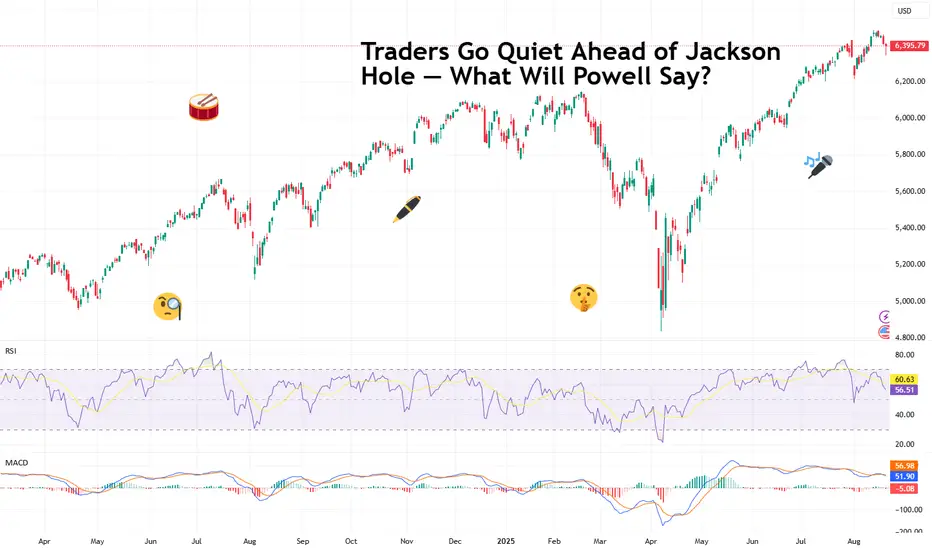
Traders Go Quiet Ahead of Jackson Hole — What Will Powell Say?Markets have been eerily quiet this week. Not because traders suddenly discovered meditation, but because everyone is waiting for one man in Wyoming to make things move.
Federal Reserve Chair Jerome Powell, the man who moves markets with a simple “Good afternoon,” is about to step onto the stage at the annual Jackson Hole Economic Symposium. And when he does, markets will hang on every word — because it’s his final speech as Fed boss at the premium event.
⛰️ Jackson Hole: Where Hiking Boots Meet Basis Points
The Jackson Hole conference isn’t your average PowerPoint snoozefest. Each year, central bankers from around the world swap suits for Patagonia fleeces and gather in Wyoming’s Grand Teton National Park. Think Davos, but with more elk.
This year’s theme? “Labor Markets in Transition.” Translation: the Fed wants to talk demographics, productivity, and immigration — the forces shaping how Americans work and how the economy grows. But make no mistake: nobody’s tuning in for a TED Talk on labor force participation rates. They want Powell’s take on interest rates.
🎯 Powell’s Big Moment
Powell’s speech may only run about 15 minutes (he’s not known for monologues), but the stakes couldn’t be higher. His term as Fed chair ends in May, and President Donald Trump has spent most of this year taking swings at him — calling him a “major LOSER” and grumbling that the Fed is moving “Too Late” on rate cuts.
Trump has even floated the idea of firing Powell early, which, technically speaking, isn’t supposed to happen. But this is 2025, and “not supposed to happen” has lost most of its meaning.
So, Jackson Hole could be Powell’s last best chance to lock in a legacy: defending the Fed’s independence while signaling where rates are headed next.
⛅️ Markets Already Have a Guess
Wall Street isn’t exactly sitting in suspense. Interest-rate swaps are pricing in an 80% chance of a 25-basis-point cut in September, with two full cuts baked in before the year is out.
Why? Because the data leaves Powell little wiggle room:
Jobs market: Recent revisions show weaker-than-thought employment growth . Maximum employment? Not quite.
Inflation: July’s consumer price index came in at 2.7% year-on-year — stable, but not scary enough to justify keeping rates where they are forever.
Tariffs: Trump’s sweeping duties could pressure inflation further, but they’re also weighing on growth. Powell’s challenge is threading the needle between those forces.
Translation: the Fed looks ready to flip from “higher for longer” to “cutting season.”
🧘♂️ Traders on Mute
If you think markets look a little sleepy, you’re not wrong. On Monday, the S&P 500 basically took a nap , slipping 0.01% as traders sat on their hands. Tuesday was even worse with big tech nosediving all day long.
It’s not just Powell they’re waiting for. Roughly 95% of S&P 500 companies have now reported earnings, (mandatory note: catch all earnings dates in the Earnings Calendar ) with more than 80% beating expectations.
Companies have been surprisingly nimble, offsetting tariffs and riding the weaker dollar . Yet despite the blowout earnings season, nobody wants to make big moves until Powell clears the air.
Call it the pre-Jackson Hole silence — the calm before the potential volatility storm.
🥊 Powell vs. Trump
There’s also political theater baked into this. Trump has made no secret of his desire for lower rates to juice growth and pump markets. Powell, however, has tried to keep the Fed above the political fray.
But that balancing act has been messy. Lower too quickly, and Powell risks stoking more inflation. Hold too high, and he risks slowing the labor market just as it’s showing cracks. Either way, he’ll be accused of playing politics.
This isn’t just about economics. It’s about central bank independence — a fancy way of asking: Can Powell make decisions without getting steamrolled by the White House?
🔮 What to Watch For
Here’s what traders will parse in his speech:
Tone: Does Powell sound more dovish (hinting at cuts) or still hawkish (concerned about tariffs fueling inflation)?
Framework: Will he unveil a new policy strategy for inflation and jobs?
Forward guidance: Any nods to September’s meeting or beyond will be amplified a thousand times on trading desks worldwide.
In other words, the market doesn’t just want Powell’s words. It wants the subtext and the context.
🚀 Why It Matters for Traders
For traders (yes, you), Powell’s Jackson Hole moment has real portfolio consequences:
Equities: A dovish Powell could extend the market’s record run — the S&P 500 and Nasdaq already logged new all-time highs this summer.
Bonds: Rate cuts could mean yields falling, bond prices rising. Treasuries might not be the snooze trade they’ve been.
Dollar: Lower rates could push the greenback down, offering a boost to commodities and emerging markets. Lower rates = lower deposit yields = less appeal to hold greenback.
Crypto: Yes, even Bitcoin BITSTAMP:BTCUSD cares. A dovish Fed means more liquidity sloshing around — which historically finds its way into risk assets.
🏁 The Takeaway
Markets are quiet now, but don’t expect them to stay that way. Powell’s Jackson Hole speech is shaping up as one of the most important of his career — maybe his swan song as Fed chair.
Off to you : Here’s a question (or two). Will he go dovish, handing traders the rate cuts they crave? Or will he stand firm, reminding everyone that the Fed won’t be bullied by politics? Share your thoughts in the comments!
Fed’s Powell to Address Rate Cuts at Jackson Hole: What to KnowThe annual Jackson Hole Monetary Policy Symposium takes place this week. Jay Powell, head of the Federal Reserve, will step up to the podium on August 23 and shed light into the central bank’s interest rate-cut timeline. His words will echo around global markets and either propel stocks higher on rate-cut optimism or knock them down if the outlook turns gloomy in the lead-up to the Fed's rate-setting meeting on September 18. No in-between.
The most exclusive retreat in central banking — the Jackson Hole Monetary Policy Symposium — is gathering top bankers, economists, financiers and other financial heavyweights for three days of idea swapping, hint dropping and market popping (hopefully.)
What’s Jackson Hole?
Every August, the top dogs in global finance trade their suits for some Wyoming flannel and gather at Jackson Hole. Hosted by the Kansas City Fed since 1978, this is the forum to brainstorm the future of monetary policy and send it out to traders ready to absorb every word. It’s like summer camp for the financial elite, except the campfire stories can crash markets or send them soaring.
When the Fed Chair speaks here, the world listens. Major policy shifts have been telegraphed at Jackson Hole, from hints of rate hikes to the next round of quantitative easing. If you’re trading, you can’t afford to ignore what’s said — or not said — in these mountain-side discussions.
Highlights from Past Forums
2010: Ben Bernanke, then Fed Chair, hinted at QE2, a measure to spur growth and keep prices steady through bond purchases, and the markets took off like a rocket. Were you long? Because it was a good time to be long.
2020: Jerome Powell unveiled a major shift in Fed policy towards average inflation targeting. The central bank was more inclined to tolerate inflation above the ideal 2% target before it started pumping interest rates.
Expectations for This Week’s Gathering
This week’s Fed event will be especially meaningful and consequential. The Fed boss is slated to present his keynote address on August 23. Jay Powell, the man who moves markets with a simple “Good afternoon,” has a lot to break down.
Inflation has been going down recently. The latest figures show the consumer price index for July slipped under the 3% mark for the first time since 2021.
Consumer spending remains resilient. The retail sales report, again for July, showed that the mighty American shopper upped spending by 1% , topping expectations.
The labor market, however, got way off the beaten path. Just 114,000 new jobs were created in July. This is also what caused the global market shake-up that sent ripples through every asset class — from stocks to crypto and beyond.
Against this economic backdrop, Jay Powell will be moving markets and making headlines as he delivers his remarks. Front and center is some sort of further confirmation of an expected interest rate cut — already communicated and most likely already priced in.
The question now is not if, but by how much interest rates are getting trimmed. Analysts expect borrowing costs to go down either by 25 basis points or a bigger, juicier 50-basis-point cut. And here’s what each one of these means and what’s at stake.
If the Fed chooses to cut rates down by 25bps, it risks not doing enough to prevent the economy from tipping into a recession. Higher rates for longer make it more difficult for businesses to borrow and drive growth.
But if the Fed chooses to cut rates by too much — a jumbo 50bps cut — it runs the risk of reigniting inflation and, what’s even more, fueling another speculative bull run in the markets. Low rates make money less expensive as loans cost less.
The expansive monetary policy measure of cutting interest rates aims to boost economic growth both on the business level and the consumer level. Companies take out loans to expand their operations, build new stuff and hire more workers. And the average consumer finds it easier to get a mortgage or buy a new car (or some Bitcoin ?).
Overall, more money is spinning around, creating opportunity and offering liquidity for deals across markets.
Brace yourselves as Jay Powell gets ready to drop some hints and prepare the audience for the Fed’s next meeting coming September 17-18. The markets may very well be heading into a rollercoaster few weeks as they try to predict the scale of interest rate cuts. Are you getting ready to pop a trade open this week? Share your thoughts and expectations below!