MARKETS week ahead: December 7 – 13Last week in the news
September's PCE data was in line with market expectations, which supported investors expectations that the Fed might cut interest rates at December meeting. US equities continued to gain, where the S&P 500 managed to close the week at 6.870. This week gold was not in the spotlight of investors, who are waiting for a correction in gold price in order to continue purchases. Gold closed the week at $4.197. The US Treasury yields reacted to inflation data on Friday, pushing the 10Y yields toward 4,14%. The crypto market continues to lag behind, with BTC struggling to sustain levels around the $90K, but dropping again on Saturday below this level.
The key U.S. economic release of the week arrived Friday with the publication of the September PCE data, a particularly important indicator given its timing just ahead of next week’s FOMC meeting. The PCE Price Index rose 0.3% m/m and 2.8% y/y, while core PCE increased 0.2% in September. Personal income climbed 0.4%, and personal spending advanced 0.3%, both broadly in line with expectations. Friday also delivered the University of Michigan’s preliminary December Consumer Sentiment reading of 53.3, slightly above the anticipated 52, while five-year inflation expectations eased to 3.2% from 3.4% previously. Eased inflation figures supported market expectations that the Fed might cut interest rates at December's meeting. Current odds as per CME FedWatch Tool stands at 87%.
Netflix has agreed to acquire Warner Bros. Discovery’s film and TV studios plus the streaming service HBO Max in a deal valuing the business at about $72 billion equity, giving Netflix control over a massive content library including hits and legacy franchises. The deal faces sharp opposition from unions, theatre-owners, and lawmakers, who argue it could reduce competition, hurt jobs, raise prices for consumers, and damage diversity of content. At the same time, according to reports, the White House officials view the merger with “heavy scepticism,” meaning that the administration may not be enthusiastic about its approval
Kraken and Deutsche Börse announced a strategic partnership aimed at bridging traditional finance and the digital-asset space by combining Deutsche Börse’s regulated infrastructure with Kraken’s crypto-native platform. In the first phase, Kraken will integrate with Deutsche Börse’s FX platform 360T, giving its clients access to bank-grade foreign-exchange liquidity and improving fiat on/off-ramp capability. Future plans (subject to regulation) include offering regulated crypto trading, tokenized assets, and derivatives (from Eurex) and potentially letting institutions trade spot crypto, tokenized stocks (via xStocks), and crypto derivatives under one roof.
News is reporting that OpenAI has declared a “code red,” refocusing the company’s resources solely on improving ChatGPT while pausing development of other projects like advertising, AI agents for health and shopping, and its planned assistant “Pulse.”. This comes as competition intensifies: rival models such as Gemini 3 from Google and offerings from Anthropic have closed the performance gap, threatening OpenAI’s dominance. Analysts warn the company faces three “code red” structural risks: slowing subscription growth despite growing user numbers, rising substitute products, and the burden of huge planned infrastructure investments.
CRYPTO MARKET
In a CNBC analysis of the BTC recent price moves, the analysts are noting that Bitcoin has dropped nearly 30 % from its record high of about $126,000 in early October, a decline that some analysts see as normal volatility given its historical patterns of large drawdown after big rallies. The sell-off is being driven by weak liquidity, massive liquidations of leveraged positions, and a broader risk-off mood among investors; this has been exacerbated by outflows from spot Bitcoin ETFs and concerns over macroeconomic factors like interest rates and tightening liquidity. As a result, price action has become choppy, with technical support around the mid-$80,000s being closely watched. A break below could open the door to further downside, while renewed institutional demand or improved liquidity could stabilize or push prices higher.
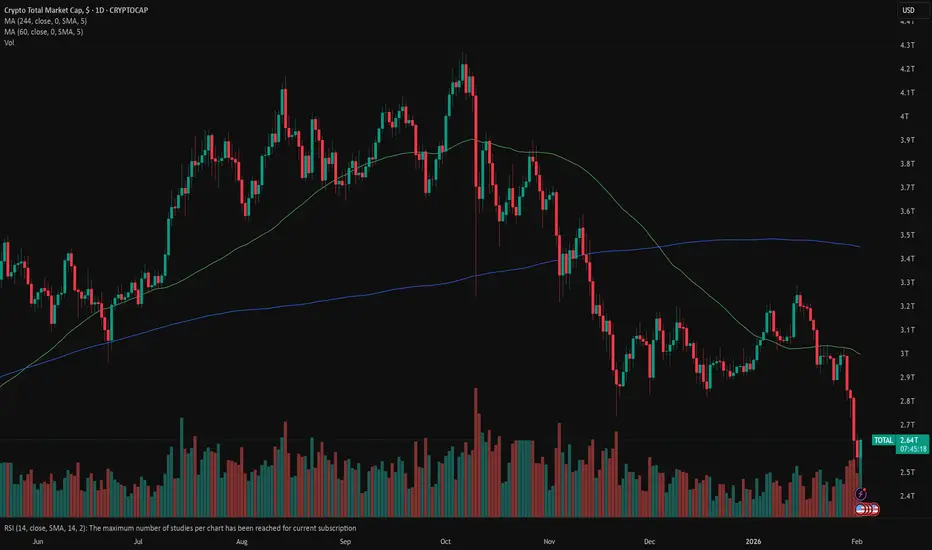
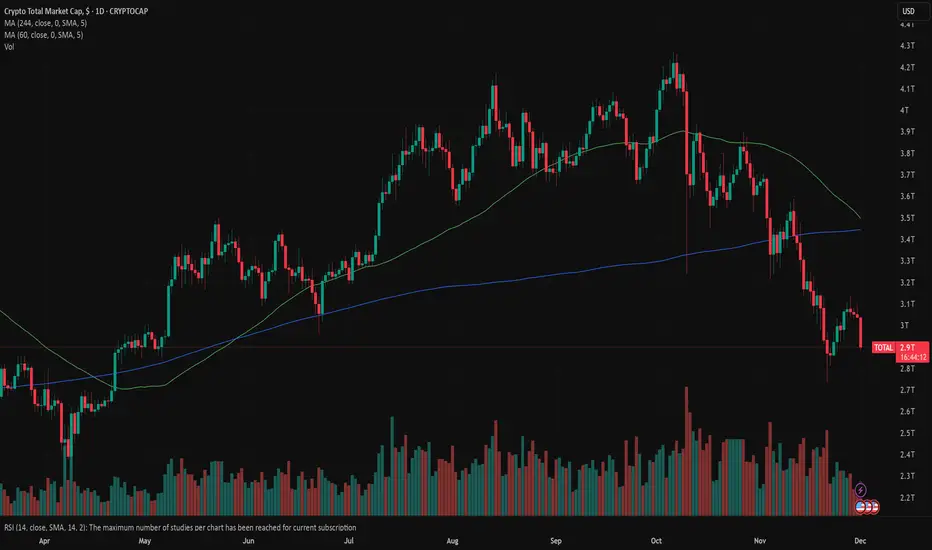
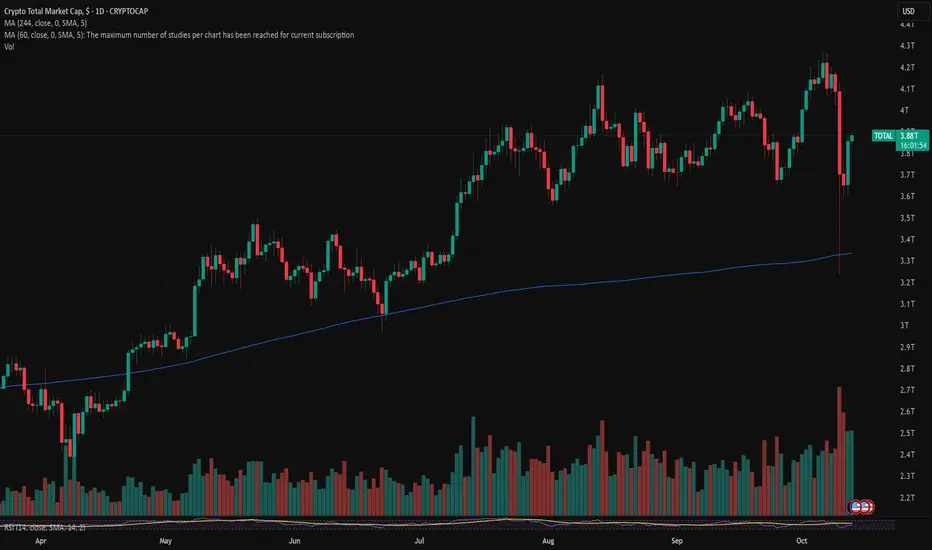
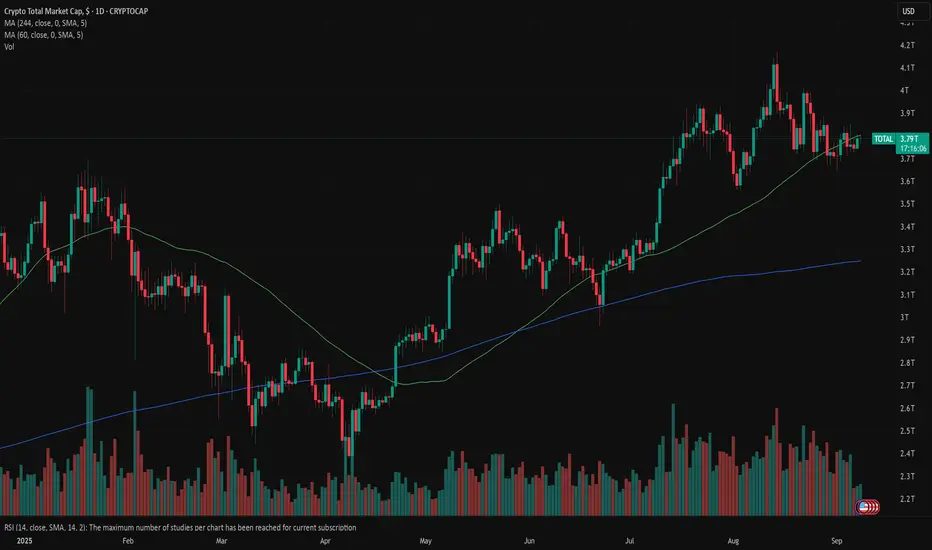
The crypto market is evidently lagging behind the optimism exposed on US equity markets. Total crypto market capitalization decreased by 1% during the previous week, with an outflow of $23B. Daily trading volumes remained relatively flat w/w, trading around $219B on a daily basis. Total crypto market capitalization increase from the beginning of this year currently stands in a negative territory of -6%, with a total funds outflow of $206B.
Although the total crypto market lost around 1% during the previous week, not all coins were traded in a negative territory. While BTC lost 1% in value with an outflow of $18,6B, ETH managed to close the week positively, with an increase of 2%, gaining $7,4B in its market cap. Some of the higher weekly losers were ZCash, with a drop in value of 26,6%, DASH was traded down by 15,8%. AVAX lost 6,7%, XRP was traded down by 7,5%, SOL lost around 2% w/w. Few coins which were traded in green were LINK, gaining almost 8% w/w, SUI was traded higher by 5,7%, BNB closed the week by 2,2% higher.
Increased activity with circulating coins continues. This week SUI gained 1,3% new coins on the market, Filecoin added 0,3% of coins, while DOGE made an incredible increase of circulating coins by 6,3%. Such a course of action is not frequently seen by DOGE. The majority of other altcoins had an increase of 0,1% of circulating coins.
Crypto futures market
Crypto futures markets softened this week, reflecting a period of consolidation following recent volatility. Both Bitcoin and Ether futures traded lower across the curve, though the magnitude of the pullback remained moderate compared to prior weeks.
Bitcoin futures declined between 1.6% and 2.1% across maturities. The front-end (Dec 2025–Apr 2026) posted slightly smaller weekly losses, ranging from –1.61% to –1.78%, while the mid- to long-dated maturities (June 2026–Mar 2027) saw steeper declines of around - 2.14%. Prices remain in a relatively tight structure, indicating that despite short-term weakness, the curve is not pricing significant long-term deterioration in sentiment.
Ether futures were more resilient this week, with changes clustering around the flat to slightly negative range. Front maturities declined modestly by –0.62% to –0.81%, while the mid-curve stabilized, and the longer maturities (Sep 2026–Mar 2027) remained flat on a weekly basis. The Ether curve’s relative stability suggests buyers are stepping in at lower levels, reflecting firmer structural support compared to Bitcoin.
Marketoverview
MARKETS week ahead: November 30 – December 6Last week in the news
As US macro data started to be released on a regular basis, investors turned their sentiment to a positive side in expectations that the Fed might cut interest rates by another 25 bps in December. The S&P 500 had its five-days positive streak, closing the week at 6.849. The same sentiment also pushed the price of gold toward the higher grounds, where the metal closed the week at $4.230. The 10Y US Treasury benchmark yields were holding around the 4,0% level. The crypto market is lagging behind the risk-off mode on traditional markets. BTC tried to move higher, reaching levels above the $92K, however, closed the week around the $90K.
Based on posted US data, the U.S. Producer Price Index (PPI) rose 0.3% in September, lifting the annual rate to 2.7%. Core PPI increased 0.1% m/m and 2.6% on a yearly basis. Retail sales edged up 0.1% in September, resulting in a 4.3% yearly increase, though the monthly figure came in slightly below the 0.3% forecast. Relatively weaker data increased investors' sentiment that the Fed might cut interest rates by another 25 basis points in December. Current odds, based on CME FedWatch Tool stands at 83%.
The price of gold continued to rise this week. A recent survey by Goldman Sachs of over 900 institutional investors found that more than 70% of them are expecting gold prices to rise over the next year. The expectations of 35% participants is that the gold price could surpass $5.000 per ounce by the end of 2026, while 33% expect a range between $4.500 and $5.000. The bullish outlook reflects strong demand from central banks and exchange-traded funds (ETFs), and growing investor interest amid macroeconomic uncertainty.
Although tech companies in the US were supported by the risk-off mode of investors, still Nvidia was lagging this run. As news is reporting, the Chinese company Baidu is emerging as a major competitor of the American company, after implementing export restrictions. Through its semiconductor unit in Kunlunxin, Baidu unveiled a multi-year roadmap that includes next-gen ships, designed for large scale AI training and inference. Baidu already sells chips to third-party data centre builders and powers its own AI services, which is perceived as a sign that it is positioning itself as a full-stack AI hardware and cloud provider in China.
News is reporting that the Peoples Bank of China (PBOC) reiterated its strict stance on cryptocurrencies, announcing a renewed crackdown on virtual currency activity, including stablecoins. The PBOC stated that virtual currencies “do not hold the same legal status as fiat currency” and banned their use as legal tender, calling any crypto-related business activity “illegal financial activity”.
The rating agency S&P Global downgraded Tethers stablecoin USDT from “constrained” to the lowest possible stability rating, “weak”. The downgrade stems from S&P’s concerns that USDT’s reserves now include a higher share of risky assets, including Bitcoin (about 5.6% of reserves), exceeding the over-collateralization buffer once considered sufficient. In addition, S&P flagged persistent “gaps in disclosure” around reserve valuation, custodians, and counterparty creditworthiness, raising doubts about the reliability of USDT’s backing.
CRYPTO MARKET
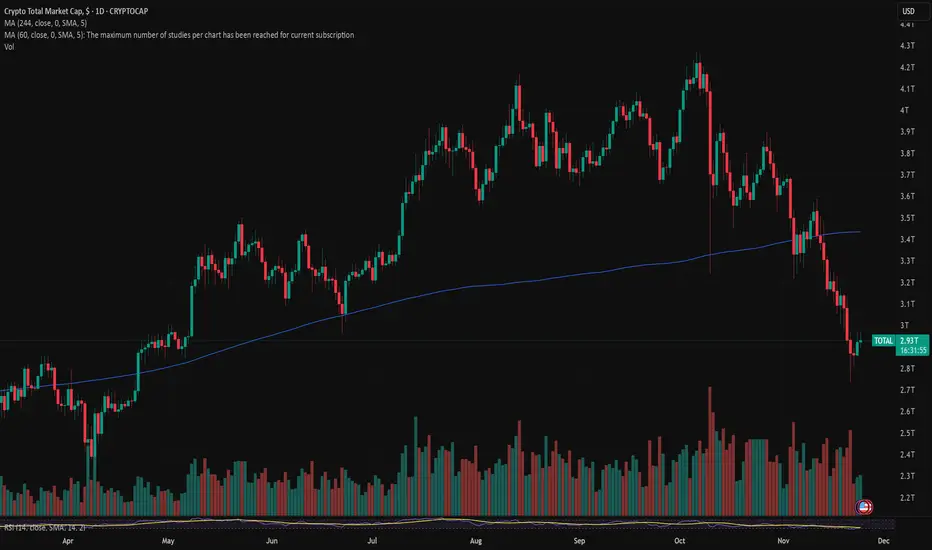
The US stocks reacted positively on an increased sentiment that the Fed might cut interest rates by 25 bps at December FOMC meeting. However, the crypto market is lagging behind the risk-off sentiment, while having only a modest upside correction. Investors are still in the wait-and-see mood, which might be changed in case that the Fed indeed cuts rates two weeks from now. Total crypto market capitalization was increased by 7% w/w, adding $196B to its total cap. The market was mostly driven by a surge in BTC value, but also other altcoins contributed. Daily trading volumes decreased this week to $203B on a daily basis, from $313B traded a week before. Total crypto market capitalization increase from the beginning of this year currently stands in a negative territory of -6%, with a total funds outflow of $183B.
BTC was the leading coin of the week, with a surge of more than 7% adding $122B to total market cap. ETH was following the lead, with an weekly increase of 8,7%, attracting $29B to its cap. XRP also had a good week, with a surge of 13,4%, and an increase in cap of $15,7B. From other leading coins, BNB increased its value by 5,4%, while Solana gained more than 6% w/w. Altcoin with a significant move was Maker, with a surge of 36% w/w, while Monero was traded by 14% higher from the end of the previous week. Stellar also had a good performance with a surge of 11%. On the opposite side was ZCash, with a drop in value of 11,3%, and only a few other altcoins which finished the week in red.
Increased activity with circulating coins continues. This week ZCash and Polkadot had a surge in the number of coins on the market by 0,6% each. IOTA increased the number of coins by 0,5% w/w. Filecoin and Stellar had an increase of 0,2%, while the majority of other altcoins increased the number of circulating coins by 0,1% w/w.
Crypto futures market
After several weeks of persistent declines, the crypto market staged a strong rebound, with both Bitcoin and Ether futures posting broadly higher prices across the entire curve. Bitcoin futures advanced between 7.1%–7.9% w/w, marking a robust recovery following the previous sharp drawdown. The front end of the curve, December 2025 through May 2026, led the move higher, gaining 7.6%–7.9%, indicating renewed demand for short- to medium-term exposure.
Long-term maturities also firmed, with Mar 2027 finishing the week at $99,005, up 7.11%.
The upward shift in the curve suggests improving expectations for market stabilization and a potential return of directional positioning after recent deleveraging.
Ether futures outperformed Bitcoin on a relative basis, rising 10.1%–11.6% across maturities. The strongest gains appeared at the front end, with January 2026 futures climbing 11.60%, followed closely by February 2026 at 11.52%. Although gains moderated slightly beyond mid-2026, the entire curve moved solidly higher, with March 2027 settling at $3,334, up 10.18% w/w. This suggests a sustained recovery in ETH sentiment despite ongoing volatility.
Overall, the futures market shows early signs of restoring confidence, with both assets retracing a significant portion of recent losses.
MARKETS week ahead: November 24 – 30Last week in the news
The US Government started to work and some macro data were posted during this week. Still, jobs and unemployment data were mixed, not providing much guidance to investors whether the Fed will cut or not in December. At this moment higher concerns are raising a question: are we in the AI-bubble or not? The US equity markets continued with a correction, where the S&P 500 dropped by more than 5% since its ATH, closing the week at 6.602. The price of gold is holding strongly its grounds below the $4.100 level, while the 10Y yields are sticking between 4% and 4,1%. The crypto market continues to suffer high sell-off for the second week in a row. BTC dropped to $80K, but managed to close the week at $84K. The hurting question is whether the correction is over or maybe $75K is waiting to be tested?
The first set of U.S. macroeconomic data was released last week following the end of the longest government shutdown in history. Non-farm payrolls for September came in at 119K, well above the market expectation of 50K. The unemployment rate for the month rose to 4.4%, up from the previously reported 4.3%. Average hourly earnings increased by 0.2% month-over-month and 3.8% year-over-year, aligning with market forecasts. Existing home sales rose by 1.2% in October. On Friday, the University of Michigan’s final Consumer Sentiment reading for November registered at 51.0, while five-year inflation expectations declined to 3.4% from the previously reported 3.9%.
The week opened with markets highly focused on Nvidia’s quarterly results, which were posted on Wednesday. Nvidia's CEO, Jensen Huang highlighted that demand for the company’s chips, particularly its Blackwell GPUs, remains exceptionally strong. Nvidia reported Q3 revenue of $57 billion, a 62% y/y increase. The company also expects strong performance to continue through year-end, projecting $65 billion in revenue for Q4, which exceeds current Wall Street forecasts. Regarding market concerns that tech companies are currently strongly overvalued and that there is an “AI bubble” Huang commented that from Nvidia’s perspective, “something very different” is happening, a strong compute demand is compounding across training and inference.
JPMorgan warns that MicroStrategy could be removed from major equity indexes, including MSCI, once the index provider delivers its decision on January 15th, potentially triggering $2.8B in passive fund outflows, and up to $8.8B if other index providers follow suit. The bank argues this index risk, not just Bitcoin volatility, is driving the recent sharp drop in the stock.
Eli Lilly has become the first pharmaceutical company to reach a $1 trillion market capitalization, marking a milestone outside the tech sector. The surge is largely fuelled by strong sales of its weight-loss drugs. Investors have responded positively, pushing the stock to record highs and cementing Lilly’s place among the world’s most valuable companies. This achievement highlights the growing influence of innovative healthcare products on market valuations.
CRYPTO MARKET
Another challenging week for the crypto market. The sell-off continued, where all gains from this year were erased, making November one of the most difficult months in the history of the crypto market. There is no clear reason why this actually happened, but some analysts are pointing to the possibility for MicroStrategy to be excluded from the MSCI index, while others are noting just fear from over-valuation of tech companies. All the major US equity indices are in the correction for the last two weeks, reflecting this fear in investors. Anyway, this is not the first such correction on the crypto market, in which sense, many crypto investors are just sitting aside and waiting for the bottom-buy. Total crypto market capitalization decreased by 11% w/w, with a weekly outflow of $342B. Daily trading volumes remained flat on a weekly basis, moving around $313B. Total crypto market capitalization increase from the beginning of this year currently stands in a negative territory of -12%, with a total funds outflow of $379B.
BTC was leading another market sell-off season. Last week, the coin erased $215B from crypto market cap, and with a drop in value of 11,2%. ETH followed the flow, with a decrease in value of 13,3% or $51B. Almost all coins finished the week in red. Majors were leading in total volume. XRP lost 13.5% w/w with $18B outflow. BNB dropped by 11% or down $14B in market cap. Solana had a relatively smaller drop, compared to other majors, so it was down by $7,7% with an outflow of $6B. Although DASH was a gainer previous week, this week it dropped by 30% in value. ZCash also significantly dropped by 25% w/w. All other coins lost somewhere between 10% and 30% w/w.
In line with the general correction on the crypto market, increased activity in circulating coins continues. This week, Solana added 0,9% new coins to the market, Stellar had a surge in the number of coins by 0,4%, while Filecoin added 0,3% of new coins. This week was especially important as the number of BTC coins also increased by 0,1% w/w, which is not frequently seen on the market.
Crypto futures market
This week brought another wave of broad-based weakness across the cryptocurrency futures market, with both BTC and ETH futures experiencing notable declines. The sell-off was consistent across all maturities, reflecting a continuation of the risk-off sentiment that has dominated the digital asset space and broader financial markets.
BTC futures posted declines ranging from -10.03% to -10.49%, with the sharpest weekly losses seen in the mid-2026 maturities. Across the curve, prices moved lower in a nearly parallel fashion, indicating systematic selling pressure rather than maturity-specific positioning.
Ether futures saw an even more pronounced decline this week, with losses ranging from -12.72% to -12.90%. Front-end maturities dropped sharply, and longer-dated contracts out to March 2027 followed a similar trajectory. ETH futures are now priced in the $2,700–$3,000 range, marking a significant reset from levels seen earlier this month.
The synchronized move across all tenors for both BTC and ETH indicates that the market is undergoing a broad repricing rather than a structural shift. Curve shape remains intact, maintaining its usual upward slope, but the entire structure has shifted meaningfully lower.
MARKETS week ahead: November 10 – 16Last week in the news
The U.S. Government shutdown and high AI valuations were at the core of investors interest during the previous week. A lack of U.S. macro data turned investors to revalue historically highest levels of U.S. tech companies. The S&P 500 closed its second corrective week at 6.713. Amid high uncertainties, the price of gold is still strongly holding the $4K level. Although US 10Y yields had a move toward the 4,1%, they still ended the week at 4,0%. The crypto market also had another corrective week, with BTC dropping to $100K.
The biannual Financial Stability Report released on Friday highlights policy uncertainty, including issues like central bank independence, trade policy and lack of economic data, as the top financial stability concern (61% of respondents flagged it in a survey). Geopolitical risk is also escalating as a major worry, alongside emerging risks from artificial intelligence, cited by about 30% of contacts as a potential shock in the next 12-18 months. The report noted some stabilization in the commercial real estate market and Treasury market liquidity, but flagged high leverage in hedge funds and other sectors as “notable” risks. The mention of the absence of reliable economic data appears for the first time in a survey, driven by the ongoing U.S. government shutdown, underscoring how data gaps themselves are a source of instability.
Elon Musk announced that Tesla, Inc. may need to build a “gigantic” chip fabrication facility, a “terafab”, to meet its future AI and robotics demands. Tesla is developing its 5th-generation AI chip (AI5), with limited production slated for 2026 and full scale output in 2027, and a follow-on AI6 expected by mid-2028. Musk revealed that even with the best forecasts from its current suppliers, including TSMC and Samsung Electronics, Tesla’s chip volume needs won’t be fulfilled.
Stephen Miran, a Governor at the Federal Reserve, warned that the growing adoption of dollar pegged stablecoins could lead to an increased supply of loanable funds, thereby putting downward pressure on the economy’s neutral interest rate. Miran made the link between stablecoins, increased global demand for U.S. dollar assets (especially Treasury bills), and lower U.S. government borrowing costs. Although he didn’t provide a precise timing for rate changes, he suggested that wide stablecoin use could lead to a prolonged environment of lower policy rates, similar to past periods of high global savings suppressing interest rates.
News is reporting that XRP outperformed Bitcoin this week, driven by momentum around spot ETF filings and increasing institutional interest. The filings by entities such as Canary Capital Group for the U.S. listed XRP based ETF and a parallel filing by 21Shares are cited as major catalysts, with new wallet creation and network activity supporting the bullish view. On the other hand, analysts are noting that large BTC holders, referred to as “whales” are increasingly dominating market activity, with on chain data showing their accumulation and influence rising relative to smaller investors. While retail and smaller wallets are reducing exposure, whales are either hoarding or strategically positioning, which has impacted power dynamics in the market.
CRYPTO MARKET
The crypto market passed through another corrective week. Its further decline was largely driven by a broader retreat in risk assets and growing worries over tighter monetary policy. A hawkish stance from the Federal Reserve, coupled with weak macroeconomic data, dampened investor sentiment and curtailed short-term upside momentum. Meanwhile, analysts point out that large Bitcoin holders, or “whales,” are increasingly shaping market activity, with on-chain data showing rising accumulation and influence compared to smaller investors. As retail participants scale back exposure, whales continue to hoard or reposition strategically, shifting the overall balance of market power. Total crypto market capitalization decreased by 8% during the previous week, with an outflow of $285B of funds. Daily trading volumes were also modestly increased to the level of $363B, from last week's $229B. Total crypto market capitalization increase from the beginning of this year currently stands at +5%, with a total funds inflow of $157B.
Altcoins played a major role on the crypto market during the previous week. Majors were dragging the market to the downside, while several altcoins performed in a quite positive manner. BTC dropped by 7,6% w/w dragging $168B from the crypto market. ETH had a weekly drop of 13% w/w and funds outflow of $61B. XRP was also traded lower by 9,7% for the week, while BNB lost 9,1% in value. Solana had a significant drop in value of more than 15% w/w. On the opposite side was DASH, who continued its winning streak. This week DASH gained 14%, in addition to previous weeks 72%. ZCash continues with a strong surge, gaining this week another 37%. Filecoin also outperformed other altcoins on the market with a weekly gain of 68%.
Increased activity continues also with circulating coins. This week Polkadot increased the number of coins on the market by 0,6% while Filecoin coins surged by 0,3%. Stellar, IOTA and Solana increased their circulating coins by 0,2% w/w, while DOGE, Avalanche and DASH number of coins were up by 0,1% w/w each.
Crypto futures market
The crypto futures market experienced a sharp downturn over the week, as both BTC and ETH futures declined significantly across maturities. The sell-off reflected a renewed wave of risk aversion in the broader crypto space, driven by weaker spot market sentiment and increased volatility toward the end of the week.
BTC futures fell around -5.6% w/w, marking the steepest weekly decline since early October. The November 2025 futures closed at $104,030, while the March 2027 maturity settled at $113,065. Despite the notable correction, the curve maintained its upward slope, suggesting that investors continue to anticipate price stabilization and potential recovery over the medium term. The persistence of a positive curve structure, even amid broad declines, points to ongoing confidence in the long-term BTC outlook.
ETH futures registered heavier losses, sliding between -10.99% and -11.24% w/w across maturities. The November 2025 futures closed at $3,475, while March 2027 ended the week at $3,846. The sharp retreat erased much of the prior month’s gains and underscored ETH’s higher sensitivity to short-term shifts in sentiment.
Overall, the week’s movement highlighted a broad but sentiment-driven correction, rather than a structural change in the longer-term trend. The pronounced weakness in ETH relative to BTC suggests that traders remain cautious, but the enduring upward slope of both futures curves signals that the market still prices in gradual recovery potential once near-term pressures subside.
MARKETS week ahead: November 2 – 8Last week in the news
The most important news during the previous week was not that the Fed cut interest rates by 25 basis points, but that the Fed is not sure whether rates will be cut in December. The US equity markets were positive during the first half of the week, when the S & P 500 reached another all time highest level for this year. Still, comments on potential no-cut in December made investors pull back, closing the index at 6.840 on Friday. The US 10Y yields also reacted strongly by bringing 10Y yields back toward the 4,1%. The US Dollar is holding relatively steady, while the price of gold retreated a bit, in a quest for a new equilibrium level around the $4K. Amid macro uncertainty, investors are still reluctant to return to the crypto market. BTC was testing the $106K support during the week, but closing it around the $110K.
The Fed cut its benchmark interest rate by 25 basis points to a range of 3.75%–4.0%, its second cut of the year, citing signs of a cooling labour market and economic uncertainty. Despite the cut, Fed Chair Jerome Powell emphasised that a further cut in December is “far from a foregone conclusion,” signalling internal dissent and caution about the outlook. The Fed also announced it will halt its balance‐sheet “run-off” (quantitative tightening) starting December 1. Chair Powell also emphasised that inflation could remain at higher levels, while at the same time the labour market is showing signs of softening.
During the same week the ECB meeting was held, where interest rates on euro were left unchanged, with emphasis on potential risks regarding supply chain disruptions or bottlenecks that could arise from the latest tensions between the EU and China over microchips and rare earth minerals. ECB President Lagarde also mentioned risks of increased inflation coming from the services sector in the EU.
“Its in the best interest of America to serve that China market. It's in the best interest of China to have American technology” concluded Nvidia CEO Jensen Huang in an address to reporters at the APEC CEO summit in Gyeongju, South Korea. He dismissed the notion that U.S. export controls on its AI chips sold to China are justified by national security risks, arguing the real issue is lost business for Nvidia.
Reported Q3 earnings of Berkshire Hathaway showed an increase in net income of 17% y/y to $30,8B, while operating profit climbed 34%. The company’s cash pile reached a record $381.7 billion, signalling a very cautious capital deployment stance amid market uncertainty.
News is reporting that tech firms are ramping up their AI investments, with projected capital expenditures reaching around $600 billion next year at this moment. Analysts are commenting that investors will be closely monitoring this, particularly to see how these CAPEX commitments translate into increased AI-driven revenue for each company.
CoinDesk is reporting that ARK Invest has boosted its exposure to crypto related assets to over $2.15 billion across its three ETFs. The firm added roughly $5.3 million in shares of Bullish, bringing its holding in the company to about $114 million. Meanwhile, ARK trimmed stakes in traditional tech names like Palantir Technologies and Shopify to make room for its growing crypto infrastructure weighting.
CRYPTO MARKET
The Fed lowered interest rates by 25 basis points, but the likelihood of another cut in December remains uncertain. The U.S. government is still in a “shutdown” state, and considering all other uncertainties regarding the economy and Government moves, investors are hesitant to commit to riskier assets. Price action of major crypto coins reflects this caution, as investors prefer to wait for clearer macroeconomic signals and regulatory developments before re-entering the crypto market, suggesting continued volatility with limited near-term upside. Total crypto market capitalization dropped by -1% during the week, decreasing its value by $51B. Almost half of this outflow comes from BTC. Daily trading volumes returned to the “regular” levels of around $229B on a daily basis, from $431B traded a week before. Total crypto market capitalization increase from the beginning of this year currently stands at +14%, with a total funds inflow of $446B.
Major crypto coins performed in a negative manner during the week. BTC dropped by 1% w/w, decreasing its market cap by $24B. ETH lost $8,4B or 1,8% in value, while XRP dropped by 4,6% w/w losing $7,4B in market cap. Solana was also down by 3,3%, DOGE by 5,1%, while BNB was traded down by 2,7%. The vast majority of other altcoins were traded either with a small gain or with a small loss on a weekly basis. However, two coins outperformed significantly. ZCash continued with a strong gain in value, surging by an incredible 55,6% for the week. Another coin was DASH with an incredible 72% increase in value for the week, showing that investors are rotating into digital assets emphasizing anonymity and alternative payment infrastructure.
There has been an increased activity with circulating coins. The number of BTC coins on the market increased by 0,1%, which is relatively rarely seen. XRP also increased the number of its coins on the market by 0,1%, the same as Stellar, DOGE, IOTA and ZCash. This week Filecoin managed to add 0,7% new coins to the market, while LINK added 2,8%. On the opposite side was Algorand with a drop in circulating coins by 0,2%, while BNB decreased its coins in circulation by 1,0%.
Crypto futures market
The crypto futures market traded slightly lower over the past week, marking a pause after the prior period’s moderate rebound. Both BTC and ETH futures saw marginal declines across maturities, reflecting a more cautious stance among traders as the broader market consolidated recent gains.
BTC futures eased around -0.85% w/w, maintaining a stable curve structure. The November 2025 futures closed at $110,320, while the March 2027 maturity ended at $119,750. The small correction suggests limited follow-through selling pressure, as prices continue to hold well within the medium-term range established over the past month. The curve’s gentle upward slope indicates that investors still expect higher BTC valuations over the longer horizon.
ETH futures declined between -1.15% and -1.29% w/w, showing slightly weaker performance than BTC. The November 2025 futures closed at $3,909, and the March 2027 maturity settled at $4,321. Despite the week’s mild retreat, ETH futures remained firmly above the $3,900 mark, demonstrating continued stability in investor expectations for the asset’s medium-term outlook.
Overall, the week was characterized by low volatility and limited directional conviction, suggesting that both BTC and ETH futures are consolidating after recent fluctuations. The absence of strong downside momentum reinforces the view that current price action represents a temporary pause rather than the start of a broader correction, with the futures curve still pointing to gradual long-term optimism across both coins.
MARKETS week ahead: October 26 – November 1Last week in the news
The US September inflation data lifted market expectations on Fed rate cuts at the next FOMC meeting. This also shaped market sentiment, bringing the S&P 500 to its newest all time highest level for this year, at 6.807. At the same time, decreased investors' fears moved the price of gold to short term correction, where gold is closing the week at $4.112. The US Treasuries are gearing up for the forthcoming FOMC meeting, where 10Y benchmark is holding grounds around 4%. This week the crypto market was again left behind, with BTC closing the week modestly above the $111K.
U.S. inflation data were in the spotlight last week. Figures released on Friday showed a 0.3% increase in consumer prices for September, bringing the annual inflation rate to 3.0%. The monthly figure came in slightly below the 0.4% forecast. Core inflation also showed signs of cooling, rising 0.2% in September and 3.0% year-on-year. Friday’s data release also included the University of Michigan’s final Consumer Sentiment Index for October, which came in at 53.6, below the expected 55.0. Meanwhile, five-year inflation expectations edged up to 3.9%, from 3.7% posted previously. This week, both the ECB and the Federal Reserve will hold policy meetings to discuss potential changes in interest rates. The FOMC meeting is scheduled for Wednesday, October 29th, followed by the ECB meeting on October 30th. Given the easing U.S. inflation and some signs of a softer labour market, investors have increased their expectations for another 25-basis-point rate cut by the Fed. According to the CME FedWatch Tool, markets are pricing in a 96% probability of a cut. In contrast, a Reuters survey indicates that market participants do not expect any policy change from the ECB at its upcoming meeting.
Amazon’s cloud division, Amazon Web Services (AWS), suffered a major global outage on October 20th, affecting thousands of apps, websites, and services worldwide, including e-commerce. The root cause was traced to internal monitoring/load-balancer issues in the US-EAST-1 data centre region, causing extensive service disruptions. Despite the outage, Amazon’s shares rose around 1.6% on the day, suggesting the market viewed the event as manageable rather than catastrophic.
High economic officials from the US and China met in Kuala Lumpur on the sidelines of the ASEAN summit, aiming at paving the way for the upcoming summit between Presidents of both countries, and avoiding a re-escalation of the trade war.
Kyrgyzstan has launched a new national stablecoin, KGST, pegged 1:1 to its currency, and has legally recognised its central-bank digital currency (CBDC) ahead of pilot public-sector payments. The country is also building a broader crypto infrastructure, including setting up a national cryptocurrency reserve (which holds assets like BNB), partnering with Binance Academy for university programmes, and collaborating on smart-contract development.
CRYPTO MARKET
Investors' fear is slowly fading on financial markets, but the crypto market was a bit left behind the traditional ones. As investors weighed US September inflation, it increased their prospectus that the Fed might cut interest rates next week. The US equity markets gained, while the crypto market is still holding with only modest weekly gains, still waiting to regain their previous valuations. Total crypto market capitalization was increased by 4% during the week, adding $157B to its market cap. Daily trading volumes were again increased, to the level of $431B on a daily basis, from previous weeks $295B. Total crypto market capitalization increase from the beginning of this year currently stands at +15%, with a total funds inflow of $497B.
Major crypto coins participated with 70% in the total crypto market capitalization increase during the previous week. BTC managed to regain some of its strength, adding $95B to its market cap, increasing it by almost 4,5%. ETH had a smaller gain of 2,3% w/w, adding $10B to the market cap. However, this week the shining coin was XRP, with a significant increase in value of 12,6% and a gain of $17,7B in market cap. Solana was also traded higher by 5,7%, while BNB gained 2,7% w/w. ZCash continues to be in the spotlight of the crypto market. This week ZEC closed the week by 30% higher from the end of the previous week.
There has been a modest activity with coins in circulation. This week Solana added 0,5% new coins to the market. IOTA had an increase of circulating coins by 0,7%, while DASH, Stellar, XRP and ZEC increased the number of coins in circulation by 0,1% w/w.
Crypto futures market
The crypto futures market rebounded modestly over the past week, as both BTC and ETH futures advanced across maturities. The recovery followed two consecutive weeks of declines, indicating that sentiment has stabilized and buyers have cautiously re-entered the market. Gains were broad-based but measured, suggesting that traders remain selective amid a still-fragile macro backdrop.
BTC futures rose between 3.60% and 3.81% w/w, marking the first positive week since late September. The October 2025 futures closed at $110,740, while the March 2027 maturity ended at $120,815. The curve retained its characteristic upward slope, signalling that investors continue to anticipate firmer prices over the medium term. The moderate rebound, following a steep decline in prior weeks, suggests that confidence is gradually returning, although momentum remains contained.
ETH futures posted a smaller but steady recovery, gaining between 2.43% and 2.59% w/w. The October 2025 futures closed at $3,934, while March 2027 settled at $4,375. The move kept ETH comfortably above the $3,900 threshold.
Overall, the week’s performance points to a short-term recovery phase in crypto futures, supported by the market’s resilience in holding key technical levels. While caution still prevails, the consistent upward slope of both BTC and ETH futures curves continues to indicate longer-term optimism among market participants.
MARKETS week ahead: October 20 - 26Last week in the news
Fear was a predominant sentiment on financial markets during the previous week. The price of gold is clearly pointing to this for the last nine weeks. Gold reached another all time highest level on Friday at $4.380, but swiftly reverted back toward the $4.250K. The US equity markets were traded in a mixed manner. The S&P 500 managed to add 0,53% on Friday, but generally closed another red week. The crypto market was marked by another sell-off during the week, with BTC managing to close the week around the $107K level. US Treasuries were holding relatively steady, with a 10Y testing the 4,0% level.
The US Government continues to be in the status of “shutdown” in which sense, there is still lacking major economic data on the US economy. The US President posted on social media on Friday that the 100% tariffs on imports from China is not sustainable, improving a bit of market sentiment. The Fed Chair Powell was a speaker at the National Association of Business Economists (NABE), noting that the weakening job market is pointing to a need for another rate cut. This news was also positively perceived by markets.
Financial markets are sounding alarm bells over the increasing exposure of U.S. banks to risky borrowers, particularly through loans extended to non-depository financial institutions (NDFIs) such as sub-prime lenders, private credit firms and other “shadow” financial vehicles. The fear is that what is currently viewed as isolated defaults could evolve into a broader spill-over effect, where losses at NDFIs ripple back to banks, triggering funding stress, tighter credit conditions, and perhaps wider systemic instability. This alarm was raised after Zions bank announced that it has press allegations to one of its NDFI customers due to false documentation. JPMorgan CEO Jamie Dimon added fuel with a simple comment “When you see one cockroach, there are probably more”.
Apple has concluded a five-year exclusive U.S. media rights agreement with Formula 1, starting in 2026, under which Apple TV will become the sole U.S. broadcaster of all F1 races, including practice sessions, qualifying, sprint events and Grand Prix. The deal is reportedly worth around US$140 million per year which is significantly higher than the previous deal held by ESPN.
S&P Global delivered a surprise downgrade of France’s long-term credit rating on Friday, cutting it from AA⁻ / A-1+ to A⁺ / A-1. The move reflects growing skepticism over the French government’s ability to maintain fiscal discipline amid political turbulence. The agency underscored that recent instability, including a suspended pension reform and two no-confidence votes against Prime Minister Lécuronu, deepens uncertainty around France’s budget trajectory. S&P warned that this uncertainty could weigh on investment, consumer spending, and economic growth.
CRYPTO MARKET
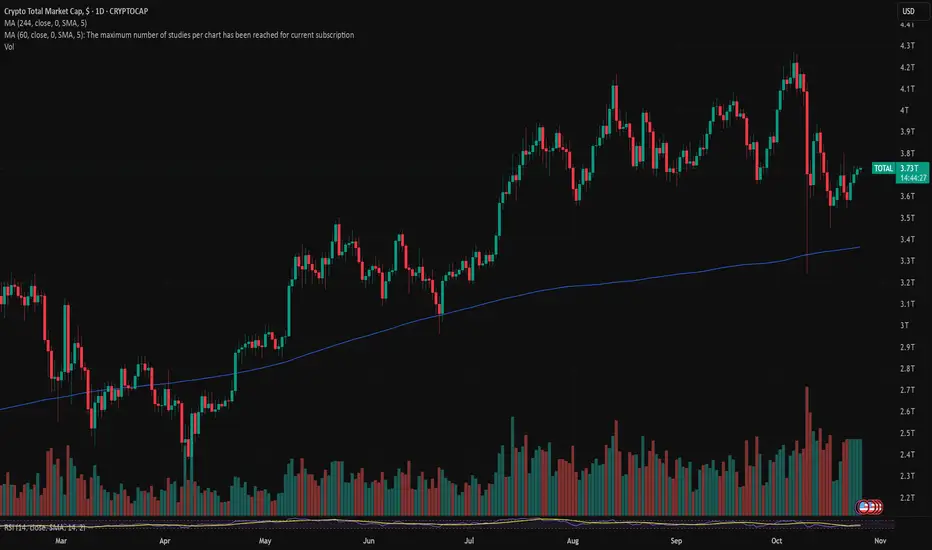
Another week on the crypto market ended in red. Fear is the dominant feeling among investors, which is shaping their appetite for risk assets. There are a lot of uncertainties which were additionally heated by the news over a new potential banking crisis due to lending to NDFIs. Total crypto market capitalization decreased by 4% as of the end of the week, decreasing its value level by $132B. This week daily trading volumes returned to relatively usual ones, around $295B, which was a significant decrease from $986B traded a week before. Total crypto market capitalization increase from the beginning of this year currently stands at +11%, with a total funds inflow of $340B.
BTC was the coin which led to a total crypto market cap decrease. As of the end of the week BTC lost $103B in value or 4,65% w/w. On the other hand, ETH was holding relatively stable, constantly trying to hold to the $4K level. Still, ETH is ending the week at a modest plus of 1,3%. During the previous period ZCash had a strong growth, however, during the previous week the value of this coin dropped by 26,3% w/w. Avalanche was traded down by 11,5%, BNB lost 7,8%, Filecoin dropped by 10%. There were a few coins which managed to end the week in green. Among them are Maker, who gained 12,6% w/w, OMG Network was traded higher by 11,7%, Theta was up by 7,6%.
Increased activity continues with coins in circulation. Filecoin traditionally is increasing its number of coins on the market, however, this week FILs number of coins dropped by 0,3%. On the opposite side was Avalanche, which increased its number of coins on the market by 1,0%. ADA, DOGE, BNB, SOL and ZCash increased their number of circulating coins by 0,1% each.
Crypto futures market
The crypto futures market extended its decline over the past week, as both BTC and ETH futures posted broad-based losses across maturities. The correction followed continued risk aversion in the spot market, though the pace of decline moderated compared to the previous week’s sharp sell-off.
BTC futures retreated between -8.64% and -8.82% w/w, reflecting another week of downside pressure across the curve. The October 2025 futures closed at $106,675, while the March 2027 maturity ended at $116,430. The curve remained upward-sloping, suggesting that despite current weakness, investors continue to price in a gradual recovery in the medium to longer term. However, the consistent losses across maturities indicate that near-term sentiment remains cautious.
ETH futures also moved lower, though with smaller declines compared to BTC, falling between -4.24% and -4.34% w/w. The October 2025 futures closed at $3,837, while March 2027 settled at $4,270. The fact that ETH futures continue to hold above the $3,800–$4,000 range reflects a measure of resilience, as traders maintain confidence in ETH’s relative strength despite the broader market softness.
While the overall tone remains defensive, the more moderate losses in ETH and the persistent upward slope of both BTC and ETH curves suggest that futures markets still view the recent downturn as a corrective phase rather than a fundamental shift in trend direction.
MARKETS week ahead: October 13 - 19Last week in the news
Tariffs 2.0 are again moving markets to the negative territory. Investors weighed how much negative impact they could impose on the U.S. economy and on Friday's trading session closed the S&P 500 2,71% lower. A massive selloff was also triggered on the crypto market, where the majority of altcoins lost even 70%-90% in value within only a few hours. BTC shortly dropped to the level of $105K, but ended the week above the $112K. The U.S. Treasury benchmark yields dropped to the level of 4,0%. The only asset which continues to benefit from market uncertainty is the price of gold, which for one more time reached the all-time highest level at $4.050.
The U.S. Government continues to be in the state of “shutdown” for more than 10 days now, so there are still no releases of important U.S. macro data. However, the announcements on social networks from the U.S. President continue to shake markets. In Tariffs 2.0, started on Friday, he announced a potential 100% tariffs on imports from China. This was the moment when the significant sell off started of the US equities, while investors were weighing how much impact a 100% tariffs could have on the US economy. Tech companies were the ones hit the most negatively.
The story regarding Berkshire Hathaway selling US stocks and stockpiling cash was catching market attention during this year. Its founder Warren Buffet recently noted that he is ready to invest and is investing into Japanese stock. During the previous week, CNBC posted news that Berkshire Hathaway's investments in Japan's five major trading houses—Itochu, Marubeni, Mitsubishi, Mitsui, and Sumitomo—have surpassed $30 billion, reflecting Warren Buffett's long-term commitment to these diversified conglomerates. These holdings have become Berkshire's largest non-U.S. equity positions, with a combined market value of $23.5 billion at the end of 2024.Buffett has praised the trading houses for their shareholder-friendly policies and capital deployment strategies. He has also implemented a currency-neutral strategy by issuing yen-denominated bonds to hedge against exchange rate fluctuations. Berkshire's annual dividend income from these investments is projected to be around $812 million. Despite some fluctuations in share prices, these investments align with Buffett's preference for long-term, value-oriented opportunities in stable, diversified businesses.
Apple is reportedly nearing an agreement to acquire Prompt AI, an artificial intelligence start-up specializing in talent management technology. This move aligns with Apple's broader strategy to bolster its AI capabilities, as CEO Tim Cook has expressed openness to acquisitions that accelerate the company's AI roadmap. The acquisition would enhance Apple's AI infrastructure, complementing its previous integrations such as the partnership with Alibaba to introduce AI features in iPhones sold in China.
CRYPTO MARKET
Tough week for the crypto market. The third largest selloff occurred on Friday. News are reporting that in the largest crypto liquidation event to date, over 1,000 wallets on Hyperliquid were completely wiped out, and 6,300 others are now in the red, with 205 losing more than $1 million each. Triggered by President Trump's announcement of additional tariffs on Chinese imports, the sell-off erased over $1.23 billion in trader capital on Hyperliquid and $19 billion across the broader crypto market within 24 hours. The majority of liquidations were long positions, highlighting the market's bullish sentiment prior to the downturn. Similar situation is also with other crypto exchanges. It was a massive, completely unexpected event.
Total crypto market capitalization is closing the week 10% lower from the end of the previous week, with an outflow of $398B. Daily trading volumes were more than doubled as of the end of the week, trading around $986B on Friday, while the week before was closed with total turnover of $386B. Total crypto market capitalization increase from the beginning of this year currently stands at +15%, with a total funds inflow of $472B.
The week of extremes led to a significant drop in value of the majority of coins. BTC lost almost 8% w/w, with total funds outflow of $194B. ETH lost more, with a drop in value of 14,3% and funds outflow of 77%. All major altcoins were also on a losing side. Just to mention some like Solana, with a drop of 19%, XRP was down by 16%, ADA dropped by 22%, DOGE decreased its value by more than 22%. Interestingly, ZCash continued to significantly gain in strength, second week in a row, adding additional 73% to its value. DASH was another rare coin, which managed to gain 34% on a weekly basis. For some reason, BNB managed to stay intact during this selloff, actually increasing its value by 2,6% on a weekly basis.
There has also been significantly increased activity with coins in circulation. BTC increased its numbers of coins on the market by 0,1% w/w or 10.000 coins. Solana also added 0,2% new coins to the market, while Filecoin increased its circulating coins by 1,2% this week. DASH, Stellar and ZCash added 0,1% new coins to the market.
Crypto futures market
The crypto futures market softened over the week, though the correction remained relatively moderate compared to the sharp sell-off that struck the spot market on Friday. Both BTC and ETH futures declined along the curve but retained levels that continue to signal underlying confidence in longer-term valuations.
BTC futures fell between -5,08% and -5,4% w/w, with the largest losses observed in futures maturing through late 2025. The October futures closed at $116.990, while March 2027 at $127.635. Despite the pullback, prices remained comfortably above recent support levels, and the curve preserved its gradual upward slope. The relative stability in longer-dated maturities suggests that traders continue to anticipate higher BTC valuations over the medium term one.
ETH futures experienced a steeper adjustment, declining between -11,7% and -12% w/w across maturities. The October 2025 futures ended the week at $4.007, while March 2027 closed at $4.460. Even with the broader market weakness, ETH futures continued to trade above the psychologically important $4K mark, underscoring resilience in expectations for the coin's longer-term trajectory.
As a conclusion to recent developments on the crypto spot market, it should be noted that while the Friday spot market sell-off was both sudden and stronger than anticipated, futures prices did not fully mirror the decline. This divergence indicates that market participants may view the move as temporary rather than structural, maintaining confidence that current weakness could prove to be a short-lived phase within the broader recovery trend.
MARKETS week ahead: October 6 - 12Last week in the news
Despite the federal government “shutdown” delaying key economic data, equity investors pushed markets higher, seemingly focusing more on earnings and tech optimism than macro news. The S&P 500 reached the new all-time highest level at 6.750, despite some pullback on week-end. The government shutdown increased demand for both real and alternative safe-haven assets, in which sense gold reached new highest levels at $3.894, while the price of BTC was also pushed toward levels above the $123K. The US Treasury yields are waging a potential Fed rate cut in October, closing the week at 4,11%.
The most important macro indicators, NFP and Unemployment data for September have not been posted during the week, due to the US government “shutdown”. The event was triggered by Congress’s failure to pass a funding bill. Over 800,000 workers were left unpaid, and many agencies scaled back operations. With no agreement so far, the shutdown continues and there’s currently no announced date for when Congress will pass the funding bill.
The value of Palantir fell around 7,5% during the previous week after an internal U.S. Army memo flagged “fundamental security” flaws in a battlefield communications system. The memo states the system lacks proper access controls, logging, and verification of software integrity, and that third-party applications integrated into it carry severe vulnerabilities. Palantir disputed the claims, saying the issues were addressed and that no vulnerabilities were found in its core platform; they argued the memo reflected an outdated snapshot of the project.
Goldman Sachs CEO David Solomon, speaking at Italian Tech Week in Turin, Italy, warned that a market pullback is likely ahead, probably within the period of next two years. He noted that current valuations appear stretched and urged investors to prepare for increased volatility. Despite the recent rally in equities, Solomon expressed doubts about its long-term sustainability. His comments reflect broader concerns about overheated markets and rising downside risks.
Quantum computing is becoming a key focus for investors as companies like Rigetti Computing and D-Wave gain attention for their advances in quantum hardware and algorithms. The technology promises transformative potential across sectors—from finance to materials science—and is seen as a frontier for long-term growth. Investors are closely watching which firms will emerge as leaders in the race to build scalable, fault-tolerant quantum systems. As the hype evolves into practical breakthroughs, market sentiment could shift rapidly around these quantum names.
Robinhood has begun listing Strategy’s Bitcoin-backed preferred shares, including STRC, opening up new structured yield products for retail investors. These instruments aim to offer monthly dividends with varying risk profiles, bridging traditional finance and crypto investment.
Walmart-backed fintech OnePay plans to let users buy, hold, and convert Bitcoin and Ether in its finance app by year-end. The crypto features will be powered by infrastructure from Zerohash, aligning OnePay with platforms like Venmo, Cash App, and PayPal.
CRYPTO MARKET
The crypto market saw strong momentum last week, shaped by weaker private-sector jobs data and ongoing political uncertainty from the U.S. government shutdown, both of which fueled appetite for risk assets. Analysts noted that recent gains across digital assets appear to be driven by genuine institutional inflows and long-term holder accumulation, rather than speculative leverage. Overall, crypto markets reflected increased confidence in the sector's resilience during uncertain macroeconomic conditions. Total crypto market capitalization was increased by 10% for the week, adding total $373B to its market cap. Daily trading volumes increased during the week to the level of $350B on a daily basis, from $320B traded a week before. Total crypto market capitalization increase from the beginning of this year currently stands at +27%, with a total funds inflow of $870B.
Major coins surged strongly during the week, however, the absolute winner of the week was ZCash. This coin surged by an incredible 200% in one moment, however, ending the week with an increased price of 156% w/w. Such a strong demand for this coin was impacted by a launch of a ZCash Trust for accredited investors by Grayscale fund, framing ZEC as a privacy-focused Bitcoin analog. The rising demand for privacy in the face of surveillance and CBDC discussions pushed renewed attention to ZCash's zero-knowledge proof technology. Back to majors - BTC and ETH performed extremely well during the week, where both had a surge of more than 11%. BTC attracted $246B of fresh funds flow, while ETH gained $54B. Solana managed to add 12% to its value, while BNB gained 17.8% w/w. DASH was another coin with great performance of +43% during the week. Almost all altcoins mark a green week.
Considering circulating coins, Solana, Stellar and Filecoins increased the number of their coins on the market by 0,3% each, during the week. Algorand, XRP, DASH and DOGE increased their coins by 0,1% w/w.
Crypto futures market
The crypto futures market advanced strongly over the week, as both BTC and ETH futures posted consistent gains across the curve. Sentiment among traders turned more constructive, supported by renewed demand for longer-dated contracts.
BTC futures rose between 11,6% and 12,63% w/w, with the sharpest gains concentrated in the near-term maturities. Contracts maturing in October 2025 led the advance, closing at $123.635. Prices followed a steadily upward trajectory along the curve, reaching $134.470 for March 2027. This marked the highest level ever recorded for BTC futures, underscoring the growing confidence in longer-term instruments.
ETH futures also posted broad-based increases, rising between 11,95% and 12,26% across maturities. October 2025 closed the week at $4.553, while March 2027 settled at $5.054. Despite the solid performance, ETH futures did not reach new highs, with the peak of $5.347 still standing from August this year. The curve nonetheless retained its upward slope, pointing to sustained expectations of gradual recovery.
MARKETS week ahead: September 29 – October 7Last week in the news
U.S. PCE data for August were in the spotlight of investors interest during the previous week, which shaped investors sentiment and trading decisions. The US equity markets modestly corrected, where S&P 500 touched the lowest level at 6.565, however ended the week at 6.643. The price of gold reached another all time highest level at $3.790, but eased till the end of the week to $3.760. The US yields also reacted to PCE data, with a move toward the 4,18% level. The crypto market had a corrective week, where BTC dipped down toward levels below the $110K.
The key U.S. economic release of the week was the August PCE Price Index, which rose 0.3% month-over-month, bringing the annual rate to 2.7%, in line with market expectations. Core PCE, excluding food and energy, slowed to 0.2% for the month and 2.9% y/y. Personal income rose by 0.4%, while personal spending increased by 0.6% in August. In addition, the final Q2 GDP growth rate came in at 3.8%, beating expectations of 3.3% and reflecting strong economic momentum. As per CME Fed WatchTool investors are continuing to perceive two more rate cuts till the end of this year.
The US President Trump proposed a 100% tariff on imported pharmaceuticals effective October 1, but allowed exemptions for companies that had begun building U.S. manufacturing plants. The tariff does not apply to companies that are actively building US drug manufacturing plants. The rationale is to incentivize onshoring of pharmaceutical production and reduce reliance on foreign supply chains. Several European pharma firms, like Novo Nordisk, Roche, and Novartis, saw stock declines, as investors weighed how exposed they would be to the tariff.
News is reporting that Chinese stocks have posted strong gains this year, fueled largely by renewed foreign and domestic investor interest in tech, AI, and innovation sectors. Analysts highlight the market’s momentum being driven by policies supporting chip development, optimism over regulation, and favorable valuations that are attracting capital. Foreign investment flows into Chinese equities have increased, while domestic investors are reallocating toward secular growth themes over property or stimulus plays. Still, concerns remain over narrow market breadth, lofty valuations, and whether the rally can sustain itself amid global uncertainty.
The U.S. government is reportedly considering a mandate that would force semiconductor companies to produce as many chips domestically as they import, a 1:1 production-to-import ratio, to reduce reliance on foreign supply. Under this plan, firms that fail to meet the ratio over time could face tariffs (possibly up to 100 %). To ease the transition, companies that pledge to build domestic capacity would receive credits, allowing them to import while new plants are constructed. The proposal is part of a broader push to reshore chip manufacturing, though critics note the complexity and cost involved in aligning global supply chains under such a rule.
CRYPTO MARKET
As per news reports, it seems that large investors decided to offload part of their crypto holdings during the previous week. The offload was followed with higher level of liquidations of leveraged position, which added to total crypto market capitalization decreased during the previous week of 6%, or $251B. However, analysts are noting that this drop should not be perceived as negative development, but a necessary catalyst for future move toward the upside. Daily trading volumes increased during the week to the level of $326B on a daily basis, from $241B traded a week before. Total crypto market capitalization increase from the beginning of this year currently stands at +23%, with a total funds inflow of $748B.
It was a correction week for the majority of crypto coins. The largest coin, BTC lost 5,5% in value or $128B in funds outflow. ETH also went through a correction of 10,2% on a weekly basis, signalling investors caution in the altcoin market. From other major coins, XRP finished the week 6,7% lower from the week before, while market favorite Solana, was traded lower by around 15% from the end of the previous week. BNB went through a week relatively solid with a minor drop in value of 2,7% w/w. Most other leading coins such as Cardano, DOGE, Polkadot or Uniswap suffered double-digit losses, underscoring a broadly bearish week across the crypto sector. On the opposite side, ZCash should be especially mentioned, as this coin managed to increase its value by 10%, which was indeed a rarity during the previous week.
When it comes to circulating coins, increased activity was also evident in this field. Polkadot managed to increase the number of coins on the market by 0,6%, while Filecoins added by 0,3% new coins to the market. The majority of other altcoins added around 0,1% of new coins to circulation.
Crypto futures market
The crypto futures market experienced a turbulent week, reflecting the broader correction that swept across the spot market. Both BTC and ETH futures posted consistent declines across all maturities, underscoring cautious sentiment among traders and institutional investors.
BTC futures fell between 4,78% and 5,5% w/w, with contracts maturing in January 2026 leading the decline. Prices still followed an upward trajectory along the curve, beginning with $109.195 for September 2025, climbing to $119.875 for March 2027. This week marked the first time March 2027 futures were traded, signalling growing demand for longer-term instruments despite short-term weakness.
ETH futures registered steeper losses of 9,2% to 11,2%. Regardless of negative developments on the spot market, ETH futures managed to hold above the $4K mark. December 2026 closed the week at $4.428, while first time trading March 2027 closed the week at $5.502. Despite the consistent declines, ETH futures exhibited an upward-sloping curve, highlighting expectations of gradual recovery over the long run.
MARKETS week ahead: September 21 – 27Last week in the news
The first Fed rate cut this year occurred during the previous week. The FOMC meeting was the most important event which was closely watched by investors and also with high sentiment. The Fed fulfilled market expectations, and cut interest rates by 25 basis points. This move was highly welcomed by markets. The S&P 500 reached a new all time highest level at 6.665 points. The price of spot gold also had its move toward fresh new historically highest levels at $3.705, following the weakening of the US Dollar. Although the 10Y US benchmark yields reached their lowest level at 4.0%, still they bounced back after the Fed`s decision, toward 4.14% driven by stronger GDP forecasts, slightly higher inflation, and concerns over growing government debt issuance. The crypto market was relatively steady during the week, with BTC holding strongly above the $116K.
The U.S. Federal Reserve announced a 0.25 percentage point cut to its key interest rate, the first reduction this year. In a press conference after the meeting, Fed Chair Jerome Powell addressed the decision and its broader implications. He acknowledged that President Trump's tariffs are starting to raise some prices, though their full impact on inflation and economic activity remains uncertain. Powell also noted that the tight U.S. labour market is more affected by slowing immigration than by trade policies. Regarding housing, he suggested the rate cut is unlikely to significantly shift the market. While he described the move as modest, saying it likely won’t make a huge difference to the economy, Powell emphasized that the Fed is “not on a pre-set path”, leaving future cuts dependent on evolving data.
Nvidia announced a $5 billion investment in Intel, acquiring about 4% of the company and triggering a strategic partnership to jointly develop custom chips for data centers and PCs. Intel’s shares jumped around 30% on the news, marking their biggest single day gain since 1987. Under the deal, Intel will build Nvidia-custom x86 CPUs and integrate Nvidia’s GPU chiplets into system-on-chips for PCs, while also employing Nvidia’s NVLink technology to better connect their architectures. Analysts say this could be a turning point for Intel, boosting investor confidence and helping strengthen its competitive position in the AI and high-performance computing sectors.
Once a leader in e-commerce, Alibaba is now leaning heavily into artificial intelligence, rolling out a multibillion dollar AI transformation with investments of more than $3,3 billion in AI technology. The company believes that its future growth will depend more on data, automation, and algorithmic efficiency than on its traditional online retail business. This overhaul reflects shifting strategy under pressure from slowing sales growth and intensified competition. Alibaba hopes that embracing AI will help it streamline operations, find new revenue streams, and stay relevant in China’s hypercompetitive tech landscape.
CRYPTO MARKET
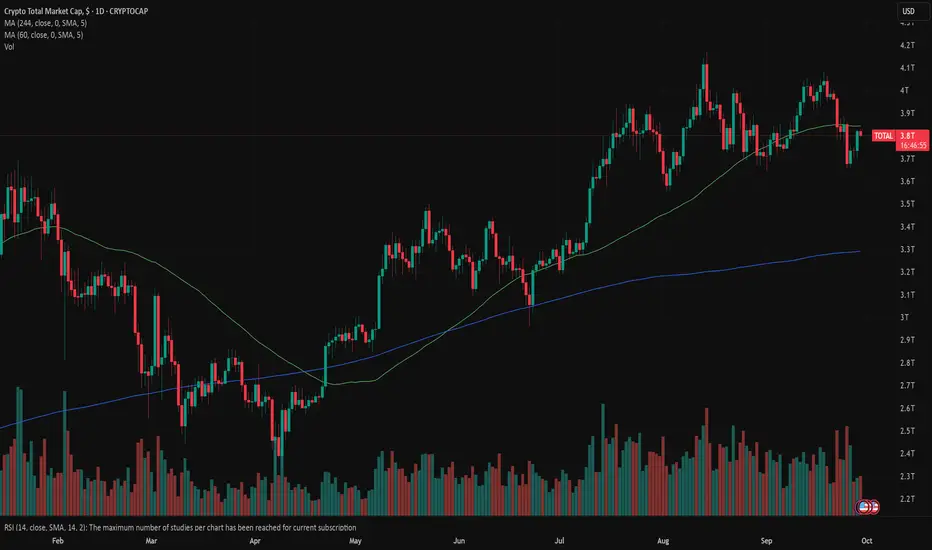
As investors switched their focus to the FOMC meeting and Feds rate cut during the previous week, the crypto market was a bit left behind investors focus. The total crypto market capitalization decreased by a modest 1%, with an outflow of $55B. It could be concluded that the crypto market remained flat during the week. Daily trading volumes were also modestly decreased to the level of $241B, from $298B previously traded. Total crypto market capitalization increase from the beginning of this year currently stands at +23%, with a total funds inflow of $748B.
BTC closed the week flat compared to the week before, still moving around the $116K level. The majority of altcoins went into a short price correction. ETH had a weekly drop of 5,3%, with funds outflow of $30,6B. Among higher weekly losers were Uniswap, with a drop in value of 11%, Algorand was traded down by 9% and Filecoin dropped by 7,2%. Among market favorites, Solana had a modest drop in value of 1,9%, while DOGE surprisingly lost 12,5% in value. XRP and Litecoin had a modest drop of 5%. On the opposite side was BNB who managed to increase its value by 6,4% w/w, while Monero was traded higher by 3,9%. Avalanche should be mentioned as the coin surged by 9,1% during the week.
There has been modestly increased activity with coins in circulation. This is the second week in a row that IOTA is increasing the number of circulating coins by 0,7%, this week. Filecoin traditionally surging is circulating coins, this week by 0,4%. XRP was also one of the coins which increased its number of coins on the market by 0,3%.
Crypto futures market
Despite the increasing interest of investors for ETH and its futures, during the previous week ETH futures entered into a short correction of around 5% for all maturities. Contracts maturing in December this year closed the week at $4.541 and December 2026 at $4.895, falling short of the previously reported levels above the $5K mark.
BTC futures also experienced a decline of around 1,5% w/w. Futures maturing in December this year ended the week at $117.495, and those maturing a year later were last traded at $124.630.
The latest future data points to a cooling off in short term momentum for both BTC and ETH futures, despite sustained institutional interest, as markets react to macroeconomic shifts and Fed policy signals.
MARKETS week ahead: September 15 – 21Markets are gearing up for the forthcoming FOMC meeting and surging expectations over a 25 basis points rate cut. These expectations have been priced during the week, where the S&P 500 reached a fresh, new all time highest level, ending the week at 6.584. On the same expectations the price of gold surged to another all time highest level, closing the week at $3.643. The 10Y US Treasury benchmark dropped below the 4,0% at one moment, however, returned a bit back as of the end of the week at 4,068%. This time the crypto market was also in the eye of the investors, where BTC managed to break the $115K resistance, ending the week modestly below the $116K.
The previous week started with the annual revision of non-farm payrolls, revealing a decline of 911,000 jobs, adding to concerns about a cooling U.S. labour market. In August, the Producer Price Index (PPI) fell by 0.1% month-over-month, bringing the annual rate to 2.6%, while core PPI also dropped 0.1%. Both figures came in below market expectations of a 0.3% increase. Meanwhile, inflation rose 0.4% for the month and 2.9% year-over-year, with core inflation slightly elevated at 0.3% monthly and 3.1% annually. Preliminary data from the University of Michigan showed September’s consumer sentiment at 51.8, slightly below the forecast of 54.9, while inflation expectations held steady at 4.8%. Declining jobs market increased market expectations to almost certain that the Fed will cut interest rates by 25 basis points on September 17th.
Nvidia and OpenAI are reportedly in talks to fund a multibillion dollar AI infrastructure project in the U.K., centred on building new data centres, in partnership with cloud firm Nscale. The agreement is expected to be unveiled during President Trump’s state visit to Britain next week. Governments globally are increasingly trying to attract the tech giants to bolster their domestic “sovereign AI” capabilities.
Gemini Space Station shares surged over 40% on Friday during their debut on the Nasdaq, opening at $37.01 under the ticker GEMI after being priced at $28, and reaching a high of $40.71. Founded by Tyler and Cameron Winklevoss, the company was valued at $4.4 billion and joins a growing wave of crypto firms going public amid a loosening regulatory environment under current US Administration.
News are reporting that investors have poured over $7 trillion into cash-like assets such as money market funds and high-yield savings, benefiting from recent Fed rate hikes. However, with the Federal Reserve expected to cut interest rates soon, these safe assets may lose appeal, prompting a shift toward riskier investments like stocks and bonds. Experts warn that a massive market rally fuelled by this "wall of cash" is unlikely unless rates drop close to zero. Historical data shows significant outflows from money funds only occur during major economic crises when rates are very low.
CRYPTO MARKET
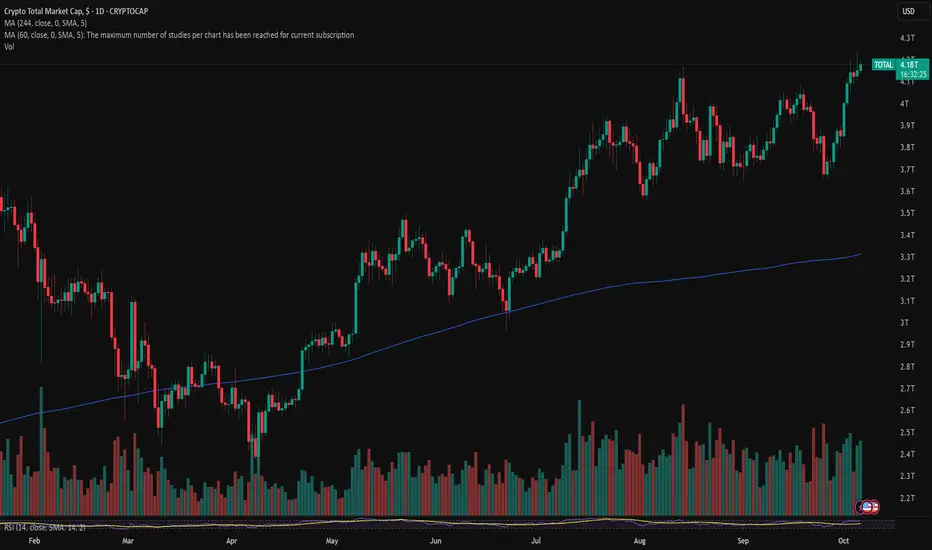
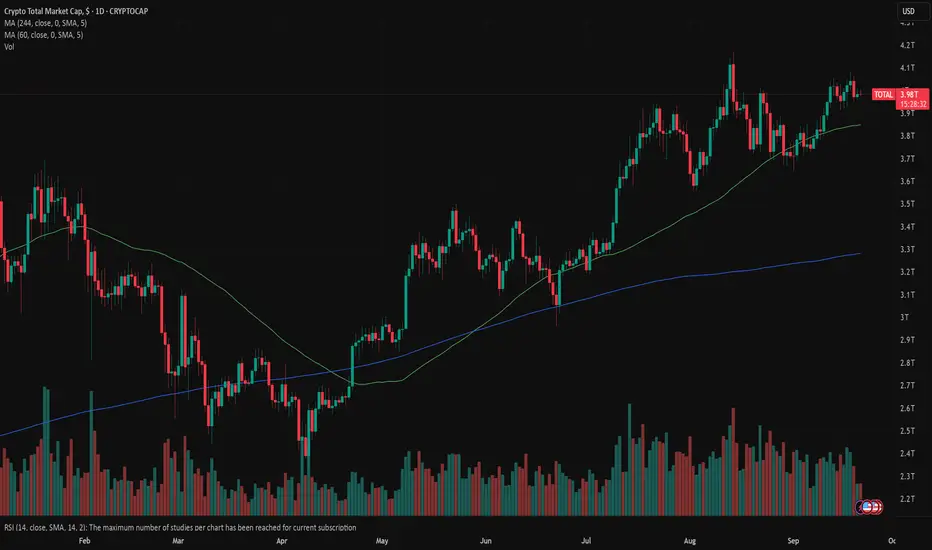
A green week on the crypto market, supported by investors' expectation that the Fed will cut interest rates at their FOMC meeting, on September 17th. Almost all coins gained on this expectation surging the value of crypto coins mostly between 10% to 20%. At the same time total crypto capitalization passed the $4B mark, which represents another significant milestone for the crypto market. On a weekly level, total crypto market capitalization was increased by 8%, adding total $290B to its market cap. Daily trading volumes remained at higher levels, with turnovers of around $298B on a daily level. Total crypto market capitalization increase from the beginning of this year currently stands at +25%, with a total funds inflow of $803B.
BTC was the coin to lead the market, however, other altcoins also performed well during the week. BTC gained $115B of funds, increasing its value by 5,2% for the week. ETH had a good week with a gain of 10,3%, adding $53B to its market cap. XRP gained almost 13% w/w, adding $21,5B to its value. Solana and Polkadot are worth mentioning, as both coins gained above 20% for the week. Certainly, the star of the week was DOGE, with an incredible weekly gain of 41%. Ospreys Dogecoin ETF started trading during the previous week, attracting investors' funds and letting the coin surge by 41%.
Increased activity was also reflected in circulating coins. During the previous week, EOS increased the number of its coins on the market by 0,6%, while Algorand gained 0,5% of coins. Stellar managed to add 0,3% new coins to the market, same as Uniswap.
Crypto futures market
Investors' increased interest in ETH was recently exposed both on the spot and the crypto futures market. As per CME, the ETH futures open interest on this market has hit records of over $10B, as a reflection of institutional investors demand. ETH futures gained more than 7% during the previous week for all maturities. Futures expiring in December this year closed the week at $4.792, and those with the expiration date a year later were last traded at $5.143. This is a huge milestone as the long term futures returned once again to levels above the $5K mark.
BTC futures also gained more than 4,5% for all maturities. Futures maturing in December this year were last traded at $119.565, and those maturing a year later closed the week at $126.490.
MARKETS week ahead: September 8 – 14Last week in the news
The previous week was marked with surprisingly low August Non-farm payrolls of only 22K new jobs in the U.S. Figures increased market expectations that the Fed will cut rates at the FOMC meeting in September. Market reaction at Friday's trading session was strong. The S&P 500 reached another all time highest level and then tumbled back toward the 6.481, within the same day. The 10Y US Treasury benchmark dropped down from 4,2% to 4,0%. Although the US Dollar remained relatively flat during the week, the price of gold reached a new all time highest level, ending the week at $3.586. This week the crypto market was left aside, with BTC closing the week by testing the $110K.
U.S. labour market data took centre stage in the markets last week. On Wednesday, the JOLTs Job Openings report showed 7.181 million positions for July, falling short of the expected 7.3 million. Friday delivered another surprise, with August Non-Farm Payrolls revealing just 22K new jobs, which was well below the 75K anticipated by the market. Meanwhile, the unemployment rate edged up by 0.1 percentage points to 4.3%. Average hourly earnings rose by 0.3% in August, marking a 3.7% y/y increase. A significant drop in the US jobs data increased market expectations that the Fed will now certainly have a good grounds to cut interest rates by 25 basis points at September FOMC meeting.
Nobel laureate Joseph Stiglitz cautions that bond markets haven’t fully accounted for the weakening U.S. fiscal outlook, particularly the temporary boost from tariff revenues that won't last as businesses readjust supply chains. He suggests that the current projections are overly optimistic and that the true financial position of the U.S. may be significantly worse. Stiglitz’s remarks signal that investors should brace for deeper fiscal and inflationary risks than markets currently anticipate
There has been a lot of media coverage related to the announced split of shares of Kraft Hainz, aimed to unlock brand value. Shares of the company were losing value during the year, with a stock loss of around 21% over the period of the past year. Famous investor Warren Buffett commented on the split, expressing disappointment, noting that breaking up will not resolve the deeper challenges the company is facing. The proposed spin-off will create two distinct, independently traded entities, one centered on sauces and spreads, the other on grocery staples, a strategy aimed at unlocking shareholder value after years of sluggish performance.
The European Commission has levied a €2.95 B (US $3.45 B) antitrust fine against Google for abusing its dominance in the adtech market by favouring its own services, marking the company’s fourth major EU penalty. Regulators have given Google 60 days to propose remedies to end these self-preferencing practices, warning that failure to comply could lead to divestitures. Google has announced plans to appeal the decision, calling it unjustified and warning it could harm numerous European businesses. Meanwhile, the U.S. President has criticized the penalty and threatened retaliatory trade measures, escalating tensions between the U.S. and the EU.
CRYPTO MARKET
The crypto market remained relatively calm during the previous week. Investors were more concerned with surprisingly weak US jobs data, increasing expectations that the Fed might make a move in rate cuts at their September FOMC meeting. They were positioning accordingly, in which sense US equities, bond and gold markets were affected. Total crypto market capitalization was increased by modest 1% during the week, adding $28B to its total market cap. Daily trading volumes dropped to the level of $222B on a daily basis, from last week's $311B. Total crypto market capitalization increase from the beginning of this year currently stands at +16%, with a total funds inflow of $513B.
For the week, crypto coins showed mixed performance, with a blend of gains and losses across major and altcoins. BTC had steady movements, with a weekly gain of 1,4% and an inflow of $30,5B. This week, ETH was a modest losing side of -1,4% (-7,5B). Major altcoins on the market finished the week relatively flat. Market favorites Solana, ADA, XRP, BNB all finished the week almost without a change from the end of the previous week. Avalanche managed to add 3,3% to its market value. At the same time, Maker had an excellent week with a gain of 13,1%. Monero was traded higher by 4,4% and Filecoin was up by 2,7%. Another coin with a significant weekly gain was ZCash, with a surge of 11,3%.
Although the value of coins remained relatively flat, there has been increased activity with circulating coins. This week Stellar managed to add 1,1% new coins to the market. Miota`s number of coins closed the week higher by 0,8%. This week Filecoins added 0,2% to its total circulating coins. XRP should be also mentioned, as this coin continues to increase its number on the market, this week by 0,2%.
Crypto futures market
The crypto futures market showed some divergence from BTC and ETH price movements, following developments on the spot market. Bitcoin futures experienced consistent gains across all maturities, with w/w increases ranging around 2,7%. Futures with maturity in December this year closed the week at $114.205, and those maturing a year later were last traded at $121.000.
In contrast, ETH futures saw moderate declines across the board, with w/w changes around 0,4%. For the moment, the market is showing subdued expectations for ETH in the near to mid-term. However, ETH futures continue to hold strongly above the $4K mark. December 2025 finished the week at $4.435, while December 2026 was last traded at $4.780.
MARKETS week ahead: August 31 – September 4Last week in the news
The market sentiment during the previous week was driven by PCE data. As the inflation was in line with expectations, the sentiment about Fed rate cut was further supported. The US equity markets continued to surge, with the S&P 500 reaching the new all-time highest level at 6.500 and closing the week at 6.460. In expectation of rate cuts, the price of gold surged, closing the week at $3.446. The US 10Y continued to test the 4,2% supporting level, ending the week at 4,23. The sentiment around the BTC and the crypto market was not in a positive territory, where BTC slipped down to the levels below the $109K.
July’s PCE inflation report came in right on target to market forecast, with headline PCE up 0.2% month-over-month and core PCE up 0.3%, reinforcing expectations for a Federal Reserve rate cut in September. The revised second estimate for Q2 U.S. GDP showed stronger-than-expected growth at 3.3% annualized, up from the initial 3.0%, fuelled largely by increased consumer spending and business investment. According to the CME Group’s FedWatch tool, there's now an approximately 87% chance of a 25-basis-point cut at next month’s FOMC meeting, all of which supports market optimism ahead of upcoming labour data. The week ahead is bringing the release of non-farm payrolls and JOLTs.
The Federal Reserve’s ongoing quantitative tightening has entered a more uncertain phase as usage of its overnight reverse repo facility, once a $2.6 trillion liquidity buffer,has plunged to just $32 billion, signaling that this tool is nearly exhausted. With the reverse repo effectively drained, further balance sheet reductions will increasingly come directly from bank reserves, currently around $3.3 trillion, raising the risk of strains in short-term funding markets. To mitigate this risk and maintain control over interest rate policy, the Fed is relying on its Standing Repo Facility (SRF) as a contingency for future liquidity support. However, analysts remain cautious, warning that the Fed must tread carefully to avoid a repeat of the 2019 episodic funding stress.
A federal appeals court ruled 7–4 that most of former President Trump’s sweeping global tariffs, imposed under the International Emergency Economic Powers Act (IEEPA), are unlawful, finding that the law does not explicitly authorize tariffs, a power reserved for Congress. Nonetheless, the court has allowed the tariffs to remain in effect until mid-October to permit time for appeal, likely setting the stage for a potential U.S. Supreme Court review. The US President responded by denouncing the court’s decision and signalling his intent to pursue the case further.
El Salvador will redistribute its entire national Bitcoin reserve—valued at approximately $682 million from a single address into multiple new wallet addresses to enhance security and reduce exposure. Each address will hold no more than 500 BTC (around $54 million), a strategic limit designed to minimize risk in the event of a security breach. To maintain transparency, the country’s National Bitcoin Office will launch a public dashboard displaying the total holdings across all addresses.
CRYPTO MARKET
Bitcoin dropped to around $108K last week due to a combination of technical sell signals, large “whale” liquidations, and ETF outflows, which also triggered margin call liquidations. This decline reflected a broader pullback across the cryptocurrency market, despite ongoing institutional interest. Notably, a major investor reportedly sold about 24,000 BTC, sparking forced liquidations that accelerated the price drop. Due to general crypto market correction, the total crypto market capitalization dropped by 6% for the week, with an outflow of $217B. Daily trading volumes were modestly decreased to the level of $311B on a daily basis, from $468B traded the week before. Total crypto market capitalization increase from the beginning of this year currently stands at +15%, with a total funds inflow of $485B.
Over the past week, major crypto coins experienced mostly negative performance. Bitcoin fell sharply to the levels below $109K, with total value decrease of 5,5% and funds outflow of $127,5B. ETH continues to trade above the $4K, still, with a weekly decrease in value of 8,5% and funds outflow of $48B. Other prominent coins such as XRP (-7,1%), Litecoin (-8,2%) and BNB (-2,6%) also posted losses. Market favorite Solana managed to sustain the $200 level, with a relatively small weekly loss of 1,5%. The majority of altcoins finished the week with a single-digit loss. Among rare coins which finished the week in positive territory were POL (previous Matic) with a weekly gain of 2%, and DASH with a plus of 1%.
With respect to coins in circulation, the week was surprisingly calm, with only a few changes. BNB decreased the number of its coins on the market by -0,1%. On the other side were coins like Stellar, DASH, Solana or Filecoin which increased their circulating coins by 0,1%.
Crypto futures market
Crypto futures expressed broader weakness, similar to the spot market. BTC futures experienced a week-on-week decline of around 7,5% for all maturities. Futures maturing in December this year ended the week at $110.985, and those maturing a year later were last traded at $117.505. Despite the price drop, the BTC futures curve remains upward sloping, suggesting that while near-term sentiment is bearish, traders still expect higher prices in the long term.
A similar situation is with ETH futures, which were traded lower by more than 10% on a weekly basis. The steepest drop occurred for maturities in August 2025 which were traded down by 11,3%. December 2025 closed the week at $4.458, and December 2026 was last traded at $4.800. The structure of the futures curve indicates that there is still long-term bullish positioning priced into the market.
MARKETS week ahead: August 24 – 29Last week in the news
Fed Chair Powell's speech at Jackson Hole Symposium brought a significant shift in market sentiment on Friday. Markets welcomed the information regarding a potential rate cut in the coming period. The US equity markets were the major weekly gainers, where S&P 500 added 1,52% on Friday, closing the week in a plus of 0,3% at the level of 6.466. The US Dollar lost in value on the news, pushing the price of gold 0,98% higher, and close $3.371. The 10Y US benchmark yields also strongly reacted, easing to the level of 4,25%. Among weekly gainers was also BTC, which tested the resistance at $117K.
In his speech at the Jackson Hole Symposium on Friday, Fed Chair Jerome Powell took a balanced tone, acknowledging progress in bringing inflation down while emphasizing the need for continued vigilance. He noted that inflation has eased from its peak but remains above the Fed's 2% target. Powell indicated that the Fed is prepared to adjust monetary policy as needed, suggesting that if inflation continues to decline sustainably, a rate cut could be considered in the near future. However, he also stressed that the Fed will act cautiously, monitoring economic data closely to avoid reigniting inflation. Overall, his remarks signaled a potential shift toward monetary easing, but with a clear message that the path forward depends on continued improvement in inflation dynamics.
The U.S. government will acquire a 9.9% equity stake in Intel for $8.9 billion by converting previously awarded CHIPS Act grants and Secure Enclave program funds into non-voting common stock. This passive investment does not grant the government any board or governance rights, though it includes a five-year warrant to potentially purchase an additional 5% if Intel’s foundry ownership drops below 51%. The agreement follows tensions between President Trump and Intel CEO Lip-Bu Tan, but industry observers suggest this move aims to bolster U.S. semiconductor manufacturing and national technological leadership.
The U.S. and EU have introduced more specifics on their updated trade framework, with clear 15 percent tariffs set for pharmaceuticals, semiconductors, lumber, and automobiles, offering some clarity to already imposed tariffs. However, many businesses remain wary—uncertainties around customs rules, enforcement, and the deal’s long-term reliability continue to create unease.
Apple is reportedly in early talks with Google to use Google's Gemini AI model to power a revamped version of Siri, sparking investor optimism. Following the news, Alphabet’s stock climbed approximately 4%, while Apple’s stock also gained around 2%.
According to UBS Weekly Intelligence, the biggest tech spenders (based on combined capex and R&D intensity relative to sales) are Meta, Intel, and Oracle, while the lightest spenders include Mastercard, Uber, and Accenture. Other notable names include Microsoft (36 %), Amazon (31 %), Alphabet (35 %), and Apple (11 %) — a useful gauge of how tech firms are prioritizing investment amid the AI-driven market environment.
CRYPTO MARKET
Crypto assets surged after Fed Chair Powell's Jackson Hole remarks hinted at an interest rate cut as soon as next month, fuelling renewed risk-on sentiment. Bitcoin rallied back above $117K from below $112K, while crypto-linked stocks like MicroStrategy and Coinbase gained around 5–7%. Altcoins such as Ether and Solana also climbed sharply. Ether gained 15% on Friday, surpassing the $4,8K level. Regardless of Friday's higher push toward the higher grounds, the total crypto market capitalization remained relatively flat on a weekly level. By managing to cover weekly losses, the crypto market cap gained quite modest $9B in total cap during the week. At the same time, daily trading volumes were significantly increased to the level of $468B on a daily basis, from $312B traded the week before. Total crypto market capitalization increase from the beginning of this year currently stands at +22%, with a total funds inflow of $702B.
The previous week was significant for ETH, since this coin attracted the majority of investors attention and also funds. ETH ended the week by 7% higher from the week before, adding more than $37B to its market cap. ETH also managed to reach ATH at the level of $4.877. BTC is closing this week by 2,13% lower from the week before, after dropping during Saturday trading to the level of $115K. Other altcoins were traded in a mixed manner, with either small gains, or small weekly losses. Among higher gainers were LINK, with an increase in market cap of 14.5%, ZCash had a very good week, with a gain of 16%, while market favorite Solana was last traded higher by 7,5% w/w. This week Maker closed with a higher drop in value of 7,3%.
Regarding circulating coins, the situation was also a bit mixed. On one side was Polkadot, with a weekly increase of circulating coins by 0,6%. On the opposite side was Filecoin, with a decrease in the number of coins on the market by 0,6%. This sort of action is indeed rarely seen, when Filecoins is in question. ADA was another coin with an increase in circulating coins by 0,3%. BTC should be especially mentioned, as its circulating supply was increased by 0,1% w/w.
Crypto futures market
While BTC futures saw a week of softening prices, ETH futures rallied significantly, reflecting diverging market sentiment between the two leading crypto currencies. BTC futures experienced moderate decline across all maturities, with the largest weekly drop in March 2026 of -2,08% and June 2026 of 1,93%. The weekly price changes indicate a slightly firmer long-term sentiment, as December 2026 closed the week at $126.795 and December this year dropped by 0,9% at the level of $119.845.
In contrast, ETH futures showed strong bullish momentum, with weekly gains of around 10% across all maturities. The highest rise was in October 2025 of 10,3%, suggesting a robust market outlook for ETH in both the short and long term. At the same time ETH futures maturing in December 2026 reached their all time highest level at $5.347, while December 2025 was closed at $4.994.
MARKETS week ahead: August 18 – 24Last week in the news
The U.S. July inflation showed that the U.S. economy is for the moment ready to absorb implemented trade tariffs without their significant impact on inflation. The relieving conclusion pushed the market sentiment to higher grounds, where the S&P 500 managed to reach a new all time highest level, still, ending the week at 6.449. Based on the same grounds, but also on easing geopolitical tension, the price of gold passed through a price correction, closing the week at $3.335. On the other hand, a mixed data related to increased US retail sales in combination with Michigan consumer sentiment, pushed the 10Y US benchmark yields back to 4,3% level. BTC had its new, shiny moment at $123,5K, but without buying of the US government for its strategic reserves, the price retraced back to $117K.
Posted US macro data showed some results which might be treated as a bit contradictory, as per analysts. The July inflation was holding at 0,2% m/m, and was in line with market expectations. It also showed that the US economy at this moment is ready to absorb the effects of implemented tariffs. However, on the other hand, retail sales in July increased by 0,5% m/m, implying a possibility of future increased inflation level coming from domestic demand. This sentiment was reflected in University of Michigan inflation expectations which were increased to 4,9% from previous 4,5% for a year and to 3,9% from previous 3,4% for the five year period.
US Treasury Secretary Scott Bessent said in an interview for Fox Business that the U.S. government will not purchase new BTCs for its Strategic Bitcoin Reserve. Instead, the plan is to keep existing Bitcoin holdings and to build the reserve only through seized assets and cease selling any of the Bitcoin currently held. It is estimated that existing BTC holdings are currently valued between $15 and $20 billion, and were acquired through criminal forfeitures. This stance marks a shift from earlier speculation that the government might expand its crypto holdings via market purchases, suggesting instead a more passive, forfeiture-driven reserve strategy.
News reported that Warren Buffett's Berkshire Hathaway has sold another portion of Bank of America shares of 26,3 million, decreasing its stake in shareholding structure to 8,1%. Analysts commented that this move will not have any significant impact on the value of BoA shares. The fund also sold 20 million shares of Apple in the Q2, continuing a multi-quarter trend of trimming its Apple position, though Apple remains its biggest equity holding. On the other hand, news reported that these sales followed broader strategic rebalancing, considering that the fund initiated or increased its stakes in companies like UnitedHealth, Chevron, Dominos Pizza and others.
China’s industrial production and retail sales growth both slowed significantly in July, with factory output rising only 5.7%—its weakest pace since November 2024—and retail sales climbing just 3.7%, the slowest gain since December 2024. Weakness also extended to fixed-asset and property investment, which lagged expectations, alongside a rise in unemployment—painting a subdued picture of domestic demand despite some policy support. Analysts warn this slowdown could drag GDP growth below the official 5% target in the coming quarters, likely prompting Beijing to consider further stimulus measures.
CRYPTO MARKET
Quite a mixed trading week on the crypto market. The minute BTC managed to reach a fresh, new all time highest level, the comment from the US Treasury Secretary Scott Bessent spoiled another BTC victory. In his interview, Bessent noted that the US government will not buy new Bitcoin for its Strategic Bitcoin Reserve but will rely solely on seized assets to grow it. Existing holdings, valued at $15–$20 billion, will be retained, signaling a shift to a passive, forfeiture-based strategy. The crypto market corrected its valuation, however, managed to end the week with a small gain of 1%, adding modest $35B to its cap. Daily trading volumes remained elevated, trading around $321B on a daily basis. Total crypto market capitalization increase from the beginning of this year currently stands at +21%, with a total funds inflow of $693B.
Although BTC managed to achieve a new ATH, still, the coin is ending the week with an weekly increase of 0,6% and inflow of $13B to its market cap. For the second week in a row ETH managed to outperform BTC, as the coin closed the week with a gain of 3,5% and inflow of almost $19B to its market cap. This week ADA should be specially mentioned, as this coin gained a significant 13,5% w/w. Positive weekly closing also had LINK, with an increase in value of 6,2%, BNB was traded higher by 3,8%, while Tron surged by 3,8%. Solana also had a relatively solid trading week, with a positive close of 3,6%, increasing its market cap by $3,5B. Other major coins closed the week in negative territory, like XRP, with a drop in value of 4,7% and outflow of $9B. It should be noted that a vast number of altcoins finished the week in negative territory.
Increased activity was also reflected in circulating coins. XRP managed to add 0,2% of new coins to the market. ADA had one of rare moments, where its number of circulating coins surged by even 0,5% w/w. This week Filecoin was also the one with a significant increase in coins in circulation by 0,8%.
Crypto futures market
Mixed trading from the spot market was also reflected in the value of crypto futures contracts. BTC short term futures were last traded with a small weekly change of around 0,9%, while longer term futures managed to gain between 1,7% and 2,18% on a weekly basis. Futures maturing in December this year were last traded at $120.905, and those maturing a year later closed the week at $127.330.
ETH futures closed the week by around 7,9% higher from the previous week's closing prices. This increase refers to all maturities. Futures maturing in December 2025 were last traded at $4.533 and those maturing in December 2026 closed the week at $4.863.
MARKETS week ahead: August 11 – 17Last week in the news
Although there is a positive sentiment on financial markets, still, a level of precaution among investors could be also observed. Markets used the previous week to both digest the latest US macro data and to prepare for the July inflation report coming in the week ahead. The US equity markets finished the week in a positive territory, with S&P 500 reaching the level of 6.389. On the same ground, the 10Y US benchmark yields corrected a bit last week's push toward the 4,20%, by ending this week at 4,28%. The price of gold was under the impact of “misinformation” of Swiss officials that the 39% imposed tariffs on Swiss goods also refer to gold imported from this country. Gold reached the level of $3.398. The US Presidential order that 401 (k) pension plans could include cryptocurrencies, pushed the BTC to higher grounds, ending the week above the $116K.
During the previous week there has not been much of currently significant US macro data scheduled for a release, in which sense, investors have used it to set the trading for the week ahead, when US July inflation data are set to be released. At the same time, news that occupied US equity markets came from Apple, whose shares rose by 13% within a week. Namely, its CEO, Tim Cook, met last week with the U.S. President in the Oval Office, to discuss the plans of Apple to invest $600B over the next four years in the U.S. Analysts have interpreted the move as an effort to appease the U.S. President, who has repeatedly called for IPhones to be manufactured domestically. Tim Cook commented that IPhone will not be assembled in the US for a while.
Another news that attracted market attention was that the U.S. President Donald Trump has signed an executive order permitting cryptocurrency investments in 401(k) retirement plans, potentially unlocking billions of dollars for the asset class. The order also extends to private equity investments, significantly expanding the range of assets retirement plan providers can allocate funds to. Analysts are noting that this move could not only boost crypto prices but also deepen the integration of digital assets into the mainstream financial system.
The US Federal Appeals Court currently reviews challenges to implemented tariff policy, by the U.S. Administration. As per former House Speaker Paul Ryan, the Supreme Court might invalidate duties imposed under the International Emergency Economic Powers Act of 1977. Commenting on this news, the US President warned U.S. courts against blocking his tariff policy, highlighting its “positive impact” on the stock market and cautioning that such interference could trigger a severe economic downturn, comparing it with the one that occurred in 1929. In the U.S.
As Reuters is reporting, global equity funds faced significant selling pressure last week, with investors pulling out a net $7.82 billion amid U.S. tariff announcements and signs of economic weakness fuelling risk aversion. Meanwhile, money market funds saw their largest weekly inflows since January, attracting $135.37 billion as investors sought safer assets. Despite heavy outflows from U.S. equity funds, European and Asian equities, along with sector funds in communication services, industrials, and tech, saw notable inflows. Additionally, global bond funds attracted nearly $21 billion, led by strong demand for short-term, euro-denominated, and high-yield bonds.
CRYPTO MARKET
Another positive news hit the crypto market, when the U.S. President signed an executive order, which permits crypto investments for the U.S. pension 401(k) plan. Analysts are noting its significance, considering the high amount of funds which are held in these funds, part of which could be distributed also in the crypto currencies. Such a move would certainly increase the prices of BTC and some altcoins, through increased demand for these coins. This news mostly pushed altcoins to higher grounds during the previous week. Total market capitalization was increased by 8% on a weekly basis, adding total $274B to its market cap. Daily trading volumes were modestly increased to the level of $314B on a daily basis. Total crypto market capitalization increase from the beginning of this year currently stands at +20%, with a total funds inflow of $658B.
Although BTC gained during the previous week, still the coin was left in the shadow of altcoins. The star of the week certainly was ETH, with an increase in value of 23%, certainly not recently seen for this coin. ETH attracted $97B of new funds, surpassing BTC, which attracted $73B and an increase in value of 3,2% w/w. XRP is also a coin with a significant weekly gain of 14,2% and a cap increase of $24B. Market favorite Solana had a surge in value of 13% or $11,5B. DOGE also had a strong shift in value of 24%, while Stellar, Uniswap, Theta also had a surge of more than 20%. ADA, Monero, Filecoin surged by around 15% each, while the majority of other altcoins gained around 10% on a weekly basis. Overall, an extremely good week for altcoins.
As for coins in circulation, there has not been much change compared to the previous week. Stellar had a surge in value, but it also increased the number of coins on the market by 0,2%. This week was another week with IOTAs coin surge by 0,8%. Solana increased its number of coins by 0,2%.
Crypto futures market
Following spot market developments, crypto futures significantly gained in value during the previous week. As ETH managed to pass the $4K mark, so the crypto futures followed, surging by almost 16% on a weekly basis. ETH futures maturing in December this year closed the week at $4.197, and those maturing in December 2026 were last traded at $4.509.
BTC futures gained almost 3% for all maturities. Futures with maturity in December this year closed the week at $119.875, and those maturing in December next year reached the last price at $126.940. Just as a reminder, the historically highest price reached for this maturity was $129.355.
MARKETS week ahead: August 4 – 10Last week in the news
US macroeconomic data took center stage during the previous week, with major correction occurring on Friday, after the NFP July data were released. Investors fear of economic consequences of implementing trade tariffs pushed US equity markets to downside. The S&P 500 lost 1,5% on Friday, closing the week at the level of 6.238. On the same grounds the price of gold strongly gained 2,2% on Friday, reaching the last price at $3.362. Strong reaction also came from US Treasury yields, where the 10Y US benchmark dropped to the level of 4,22%. This time the crypto market was also affected, where BTCs price dropped sharply, closing the week around the $113K level.
The FOMC meeting was held during the previous week, without changes in the level of interest rates. As per Fed's view, the economy is growing at a solid pace, while they acknowledged increasing risks originating from implemented trade tariffs on inflation and potential slowdown in the future economic growth. There were no comments regarding potential rate cuts in September, except that the Fed will continue further to balance interest rates based on “the incoming data, the evolving outlook and the balance of risks”, as noted by Fed Chair Powell.
A macro data heavy week in the US included data on JOLTs in June of 7,437M, modestly below market forecast of 7,55M. The PCE Price Index in June was relatively steady with 0,3% for the month and 2,6% for the year, which was in line with market expectation. However, what shocked the market on Friday were posted non-farm payrolls data for July of only 73K, although the market estimate was standing at 110K. During Saturday, news was published that the US president Trump requested immediate release of a duty of a Commissioner of labor statistics, due to posts of inaccurate labor data and its frequent revisions. The US President also questioned the accuracy of the July NFP figure of 73K.
During the previous weekend the U.S. finalized the trade-tariffs deal with the European Union. Details of the deal are officially published at the website of the European Commission, and include, among other, tariffs of 15% on imports from the EU, establishment of tariff-rate quotas for imports of steel, aluminium and copper from the EU, cutting the current 50% current tariffs. EU companies will also invest at least $600B in different sectors in the US by 2029.
Interesting news for crypto enthusiasts was posted by Cointelegraph, noting that on July 4, 2025, eight dormant Bitcoin wallets from the Satoshi era collectively moved 80.000 BTC, with each wallet transferring 10.000 BTC. The Satoshi era, generally defined as the period from 2009 to 2011, was when Bitcoin could still be mined or transacted using standard computer processors. The sudden activation of these long-inactive wallets has sparked intense speculation, with some suggesting that emerging quantum computing threats may have prompted the transfers. Still, analysts with a knowledge of blockchain technology commented that coins were not transferred directly to cryptocurrency exchanges but instead moved to newly created SegWit addresses — a move that likely indicates a security upgrade.
CRYPTO MARKET
As the crypto market became part of mainstream markets, it needed to manage both ups and downs of the investors' sentiment, which was usually related to traditional markets. This occurred during the Friday trading session, when investors' fear of future consequences of implemented trade tariffs turned to the negative side. Total crypto market capitalization decreased by 6% on a weekly basis, losing a total $216B. Daily trading volumes were relatively flat on a weekly basis, moving around $304B on a daily basis. Total crypto market capitalization increase from the beginning of this year currently stands at +12%, with a total funds inflow of $384B.
This week BTC was leading the market cap drop, with an decrease in value of 4% w/w and outflow of almost $96B in funds. ETH also had a drop in value of 7,2%, with total funds outflow of $32B. The third coin by total market cap, XRP, was traded around 10% lower, closing the week with total fund outflow of $18,6B. Another coin with a significant drop in the market cap was Solana, of almost 13% w/w, and funds outflow of $13B. Both DOGE and ADA were on a losing side, where DOGE was traded 17,1% lower, losing $6,13B in the market cap, while ADA dropped by 14,6% with an outflow of $4,3B. The majority of other altcoins finished the week with a loss in value between 14% and 18%.
This week there has not been too much activity when circulating coins are in question. Algorand had an increase of coins on the market by 0,2% w/w, while Stellar's number of coins surged by 0,3%. This week Filecoin had a modest increase of 0,1% on a weekly basis, same as ZCash and DOGE.
Crypto futures market
The general drop in the value of crypto coins on the spot market was also reflected to some extent also in the futures market. BTC futures were traded lower by more than 3% for all maturities, while ETH futures had a weekly drop in value of more than 4%. However, it is important that the general levels of the value of futures remain at higher grounds.
BTC futures maturing in December this year closed the week at $116.390, and those maturing in December next year were last traded at $123.490. A similar situation is with ETH futures, which managed to hold grounds above the $3K. Futures maturing in December 2025 closed the week at $3.631, and those maturing a year later were last traded at $3.894.
MARKETS week ahead: July 27 – August 2Last week in the news
Trade tariff (un)certainties shaped market sentiment during the previous week. The US-Japan trade deal was settled which brought some relaxation among investors. The US equities continued with a positive trend, with the S & P 500 reaching fresh all time highest level, ending the week at 6.388. On the same ground the price of gold turned a bit toward the downside, closing the week at $3.336. The relaxation was evident also in 10Y US Treasury yields, which closed Friday trading session at 4,38%. BTC had a short liquidation session on Friday, shortly reaching the $115K level, however, swiftly returned back toward the $118K.
The European Central Bank (ECB) held its July meeting during the previous week, where it held interest rates steady after seven consecutive cuts, signalling a more cautious approach going forward. While its macroeconomic outlook remains unchanged, the ECB sees downside risks to growth, including global trade tensions and weak market sentiment. President Lagarde downplayed concerns about the stronger euro and minor inflation undershooting, emphasizing a data-dependent, meeting-by-meeting policy stance. Although the ECB appears comfortable with its current position, a final rate cut in September is still possible if inflation or macro data disappoint.
President Trump announced a major trade deal with Japan this week, featuring a 15% reciprocal tariff, marking a shift in bilateral trade relations. The U.S. also reached a framework agreement with Indonesia, reinforcing efforts to strengthen trade ties across Asia. Trump signalled that more deals may be finalized before the August 1 tariff deadline, including potential progress with the EU, as a meeting with Commission President von der Leyen is set for Sunday in Scotland. These developments have been well received by investors, easing concerns over trade uncertainty and potential supply chain disruptions.
China unveiled a global AI action plan at the World Artificial Intelligence conference in Shanghai, calling for international cooperation on technology development and governance. Premier Li Qiang proposed establishing a global AI cooperation organization to coordinate regulation and infrastructure, emphasizing equitable access. The plan positions China in contrast to the U.S., favoring multilateralism over America's more block-oriented approach to AI strategy. Featuring participation from over 800 companies including domestic giants Huawei and Alibaba, the conference showcased thousands of AI innovations and signals China's ambition to challenge U.S. dominance in the field.
Palantir's stock achieved a new record high last Friday, rising over 2% and lifting its market cap to around $375B. With the latest move, the company is now holding 20th place as the most valuable U.S. company. The company's shares have more than doubled this year as investors' enthusiasm grows around its AI capabilities and government contract momentum. Analysts attribute the rally to Palantir's strengthened role in AI analytics and expansion in defence-related software and data contracts.
CRYPTO MARKET
The crypto market was traded in a mixed mode during the previous week. Some liquidations were made in BTC, followed by altcoins, however, there were also coins with relatively solid weekly performance. Total crypto market capitalization was increased by 1% on a weekly basis, adding total $39B to its market cap. Daily trading volumes were modestly decreased to the level of $275B on a daily basis, from $333B traded a week before. Total crypto market capitalization increase from the beginning of this year currently stands at +19%, with a total funds inflow of $600B.
BTC had a relatively flat week, with only $3B of funds inflow. On the other hand ETH continues to perform strongly, with another week in a positive territory of 5,3%, increasing its cap by $23B. XRP did not perform well on a weekly basis, as the coin had a drop in value of 7,4% and outflow of $15B. Some of the significant weekly gainers include Litecoin, with a surge of 13% on a weekly basis, Maker was traded higher by 14%, BNB gained 7%, while Solana was higher by 5% same as Uniswap. Other altcoins were traded either with a modest drop in value or with a modest increase in value.
There has been increased activity with circulating coins. Another week in a row, IOTA is increasing the number of coins on the market by 0,8% w/w. EOS had an increase of 0,6%, same as Polkadot. The majority of other altcoins had a modest increase of circulating coins of 0,1%, including XRP.
Crypto futures market
This week the crypto futures market reflected perfectly developments on the spot market, with ETH long term futures managed to pass the $4K level.
BTC futures were traded mostly flat compared to the previous week. Futures maturing in December this year closed the week at $120.810, and those maturing in December 2026 were last traded at $127.500. At the same time, ETH futures were traded around 2,5% higher for all maturities. Futures ending in December 2025 reached the last price at $3.779, while those maturing in December 2026 for the first time ended the trading week at $4.058.
MARKETS week ahead: July 20 – 26Last week in the news
Resilient inflation and the jobs market in the US supported further investors sentiment, bringing equities to higher grounds. The new all time highest level was reached by the S&P 500, which is closing the week at 6.296. The US Dollar gained in value during the week, however, the price of gold remained relatively flat, closing it at $3.349. Strong macro data decreased expectations among market participants over the Fed's rate cut, bringing 10Y US yields down to 4,42%. The new Genius Act was passed in the U.S. House, supporting the price of BTC to hold at higher grounds, above the $118K.
The U.S. economic data in focus last week was led by June inflation figures. Headline inflation remained relatively stable, rising 0.3% for the month and 2.7% on a yearly basis, both matching market expectations. Core inflation came in at 0.2% for the month and 2.9% annually, slightly below forecasts by 0.1 percentage points, though still elevated. The Producer Price Index (PPI) was flat in June (0.0%), with core PPI also unchanged. On an annual basis, PPI rose by 2.3%, and core PPI by 2.6%. Meanwhile, retail sales in June outperformed, climbing 0.6%, well above the expected 0.1%. Another positive news came from the University of Michigan preliminary Consumer Sentiment Index for June, where five-year inflation expectations eased to 3,6% (down from 4% posted previously), while one-year expectations declined to 4,4% from the previous 5%. Resilient macro data decreased market expectations over the potential Feds rate cut in September to 50% from previous 70%, as per data shown in CME FedWatch Tool.
The Genius Act was passed by the U.S. House on July 17th, after its approval from the Senate in June. The bill represents an important milestone for the crypto market, as it sets a comprehensive federal standard for stablecoins, clearing the way for banks and fintechs to issue them under clear reserve and audit rules. Among others, it allows permitted institutions to issue U.S. Dollar-pegged stablecoins, backed 1:1 by liquid reserves such as cash or Treasuries. It also mandates strict rules for reserves, custody and consumer protection in terms of full reserves, monthly disclosures, segregation of assets and priority in bankruptcy, aimed to boost consumer confidence and financial stability.
Weekly news on trade tariffs include a report by the Financial Times indicating that the US President had intensified his trade demands on the European Union after weeks of negotiations. According to the report, Trump is now pushing for a minimum tariff of 15% to 20% on imports from the EU, escalating further trade tensions.
Effective July 23, the composition of the S&P 500 index will be adjusted. A tech company Block will be added to the index, replacing energy company Hess, which will be removed. Following the announcement, Block’s shares jumped 10% on Friday.
Denmark is the first country in the world which passed the legislation by which citizens of their country own the copyright to their own face, voice and body. With this move Denmark Government is trying to protect its citizens from AI deepfakes, and similar misuse of data, pictures and voices of its citizens, without an explicit consent.
CRYPTO MARKET
While the previous week was the one dedicated to BTC, this week belongs to altcoins, who drove total market capitalization to higher grounds. The adoption of the Genius Act by the U.S. House was the main trigger behind the strong demand for altcoins. The crypto market gained a total $181B in market cap, increasing it by 5% on a weekly basis. Out of $181B, BTC participated with “only” $11B. Daily trading volumes were also increased to the level of $333B, from around $300B traded a week before. Total crypto market capitalization from the beginning of this year currently stands at 17%, with a total funds inflow of $561B.
This week belongs to ETH and other altcoins, which were major weekly gainers. ETH managed to add $74B to its market cap, increasing it by an incredible 20,8%, reaching levels of $3,5K. XRP was also one of coins with a gain above 25%, adding total $41B to its market cap. This week, market favourite Solana added $9,4B to its capitalization, increasing its total value by 11%. BNB managed to collect new $6,3B, surging by 6,6%, while DOGE added $6,7B to its market cap, which was increased by 23%. Among significant gainers ADA should also be mentioned, with an weekly increase in its cap by $4,2B or 17%.
A relatively calmer week when coins in circulation are in question. The main weekly difference relates to ZCash which withdraws 3,8% of its coins from the market free float. At the same time, Solana was the one to increase its number of circulating coins by 0,4% this week. Algorand also had an increase of coins on the market by 0,3%.
Crypto futures market
BTC and ETH futures were moving in opposite directions during the previous week. While BTC futures had a modest drop in value for all maturities, ETH futures gained significantly. BTC futures were traded by around 0,8% lower from the week before. Futures maturing in December this year closed the week at $121.215, and those maturing a year later were last traded at $128.345.
At the same time, ETH futures marked a surge in value of around 18% for all maturities. The coin passed the $3,5K levels. December 2025 futures were closed at $3.678, while those maturing in December 2026 were last traded at $3.958.
MARKETS week ahead: July 13 – 19 | XBTFXLast week in the news
Previous week was short in US macro news, however, news regarding trade tariffs were the ones that shaped market sentiment at Friday's trading session. The optimism on the US equity markets still holds, regardless of a short correction on Friday. The S&P 500 reached another all time highest level, ending the week at 6.259. Gold was once again a refuge from tariffs for investors, gaining during the week, ending it at $3.354. Tariffs tensions rattled US Treasury yields, with the 10Y benchmark closing at 4,41%. Certainly, the winning asset of the week was BTC, which broke the $108K resistance and moved all the way up to $118K, bringing another all-time highest level.
This week was relatively quiet in terms of key U.S. macroeconomic data. The main highlight was the release of the FOMC meeting minutes from June. The minutes didn’t reveal any new information beyond what has already been communicated publicly. The Federal Reserve continues to emphasize the need for flexibility regarding future rate cuts and is likely to remain on hold until economic indicators more clearly signal a slowdown. Most analysts still expect the next rate cut to come in late 2025 and early 2026. This outlook is shaped by persistent risks of both rising inflation and increasing unemployment, driven by recently imposed trade tariffs, which present ongoing challenges for Fed policymakers.
When it comes to trade tariffs, the previous week brought news regarding imposition of a 35% tariff on imports from Canada and a 50% tariff on goods coming from Brazil into the U.S. There have also been discussions about the possible introduction of a broader 10% universal tariff on most other countries, with some mentions of rates as high as 15% or 20%, as well as 50% on all copper imports. News posted on Saturday noted the introduction of a 30% tariff on all imports from the European Union and Mexico. The European stocks closed the Friday's trading session lower, waiting for a tariffs-letter from the US Administration, which was released on Saturday.
News is reporting that the US Government managed to end June with a budget surplus of $27B, for the first time since 2017. The reason behind the increased funds analysts are noting a surge in income from tariffs, which reached $113B this year. Still, the broader fiscal picture remains challenging, as analysts are concluding.
Speaking at an event, Fed Governor Christopher Waller stated that the growing use of stablecoins could lead to faster and more affordable payments. "As a free-market capitalist economist, my goal is to see competition in the payments space lower costs for households, consumers, and businesses—plain and simple," he said. Waller also noted that while stablecoins might reduce the demand for physical U.S. currency, they could simultaneously strengthen overall demand for the U.S. dollar.
CRYPTO MARKET
This was a week for celebration for crypto enthusiasts. BTC not only reached the all time highest level, but this coin is on the road to $120K as it managed to reach level above the $118K. This was indeed another significant milestone for BTC to reach, while crypto enthusiasts are noting that the price could easily reach even higher values till the end of this year. What will be the case, is to be seen in the future. Total crypto market capitalization significantly gained during the week, ending the week total 10% higher from the week before, adding $330B of new funds. Daily trading volumes were more than doubled, with an average daily trading volume of around $300B. Total crypto market capitalization from the beginning of this year currently stands at 12%, with a total funds inflow of $380B.
The vast majority of crypto coins gained during the previous week, and managed to significantly increase their market capitalization. The most important coin which drove the market to the upside was BTC, with a surge in value of 8,6% on a weekly basis, adding a total amount of $185B to total crypto market capitalization. ETH also had an incredible week, surging, after a longer period of time, to levels above the $3K, adding 17,5% to its market cap with an inflow of $53B of funds. All major coins had a positive week. Solana was traded higher by 9,3%, adding $7B to its market cap. ADA ended the week higher by 22,6%, with an inflow of $4,6B. One of the unexpected significant gainers of the week was Stellar, with an incredible surge in value of 63,7%. DOGE gained 21%, Uniswap surged by 21%, Algorand was traded higher by 26%. Indeed one incredible week for all crypto coins with strong gains.
As on the spot market, there has also been higher activity when it comes to coins in circulation. It is not frequently seen that BTC has a weekly increase of circulating coins, as it was during the previous week, when the number of coins was increased by 0,1%. Stellar increased its value by an incredible 63,7%, but at the same time, it increased the number of coins on the market by 0,4% w/w. IOTA had a surge in coins on the market by 0,8%, while Filecoin added 0,4% of new coins on the market. Interestingly, this week, BNB decreased the number of circulating coins by 1,1%.
Crypto futures market
In line with the surge of the value of coins on the spot market, crypto futures also skyrocketed in value, reaching some of the all time highest values for long term maturities. BTC short term futures ended the week by more than 9% higher, while the longer term futures were up by more than 7%. Futures maturing in December this year reached the last price at $122.135. At the same time futures maturing in December 2026 reached the new all time highest level at $129.355. As per values of futures, the price of BTC has more space to reach higher grounds.
ETH futures also had an excellent week, surging by more than 20% for shorter maturities and above 16% for longer maturities. What is most important is that futures finally ended the week above the $3K levels. Futures maturing in December 2025 closed the week at $3.121 and those maturing a year later were last traded at $3.359.
MARKETS week ahead: July 6 – 12Last week in the news
The US jobs data posted during the previous week shaped investors sentiment. The jobs market seems resilient, making market participants diminish any expectations that the Fed might cut interest rates at July's FOMC meeting. In this sense, the 10Y Treasury yields adjusted from level of 4,2% to close the week at 4,33%. On the opposite side, strong jobs figures pushed the S&P 500 to reach all time highest levels for the last five days, closing the week at the level of 6.279. Weakening of the US Dollar supported the price of gold to end the week higher, at the level of $3.333. The crypto market had a volatile week, with BTC reaching the level of $110K, still, ending it at levels above the $108K.
This week was marked with US jobs data, exposing its further resilience. The JOLTs job openings ended May at 7.769M, which was higher from market anticipation of 7,3M. The posted unemployment rate for June was standing at 4,1%, slightly lower from 4,2% posted for the previous month. The data which mostly impacted market sentiment were related to the Non-farm Payrolls for June, with 147K new jobs. It was higher from the market estimate of 110K for the same period. A strong jobs market made an impact on investors to rethink the potential Fed's rate cut at July's FOMC meeting. Current expectations for September's rate cut were increased.
Trump's “big, beautiful bill”, proposing significant tax cuts, passed the U.S. Senate during the previous week, and is now back in the House for final approval. Analysts are still concerned regarding its effects on the US level of debt in the next 10 years period, currently estimating further broadening of the US debt by $3,7 trillion.
Although the last two weeks passed with increased optimism on US equity markets, still both analysts and investors are closely watching developments with trade tariffs deals by the US Administration. Last week, the US made a deal with Vietnam of 20% tariffs for imports from Vietnam, while the US goods will be tariff-free. However, the next week will be important from the perspective of the end of a 90-days delayed tariffs period, which the US Administration left for the majority of countries around the world, leaving them the space for negotiations. Talks with major US trade partners are still ongoing, including China, European Union, Japan and India.
News is reporting that the ECB will most likely wait for the September meeting to further cut interest rates on Euro. The reason for such expectations are mentioned uncertainties regarding the trade agreement with the US Administration. Economists are also noting this year`s surge of Euro against US Dollar of 14%, which might add an additional burden on the EU economy in addition to trade tariffs.
CRYPTO MARKET
Another volatile week on the crypto market passed. The positive market sentiment was under influence of better than expected US jobs data posted for June. The BTC reached the level of $110K on Wednesday, but still, ending the week lower. Majority of other cons peaked during the week, but are still ending the week lower. On a weekly basis, there has been almost an equal number of gainers and losers among crypto coins. Total market capitalization gained 1% for the week, adding $24B to its total cap. Daily trading volumes remained relatively flat during the week, moving around $153B on a daily basis. Total crypto market capitalization from the beginning of this year currently stands at 2%, with a total funds inflow of $50B.
The largest coin was moving the market during the previous week. BTC closed the week by 0,7% higher on a weekly basis, adding $15B to its total cap. This week ETH also managed to close it 2,7% higher, increasing its market cap by $7,9B. Market favourite Solana had a significant surge during the week, till the level of $159, however, it is ending the week above the $146, marking the weekly loss of 2,9%, or $2,3B outflow of funds. DOGE had a similar movement, but ending the week with a modest loss of 0,5%. ADA managed to sustain its weekly gains, ending it at 1,8% higher. Uniswap had a drop in value of 2,7% while Maker lost almost 5% in value.
Although market prices of crypto coins had a relatively volatile week, still when it comes to circulating coins, the situation was much calmer. Stellar had the highest weekly decrease of the number of coins on the market , of 1%. Such withdrawals are not frequent with this coin. Filecoin traditionally is increasing the number of coins on the market, with this week's increase of 0,3%.
Crypto futures market
Crypto futures also reacted to a positive investor sentiment, where both BTC and ETH futures ended the week higher. BTC short term futures had a modest increase of some 0,7%, while the longer term ones closed the week higher by 2,6%. Futures maturing in December this year ended the week at the level of $113.750, and those maturing a year later were last traded at $120.395.
Similar development was also with ETH futures, where short term ones closed the week by 2,9% higher, and longer term ones surged by more than 7% on a weekly basis. ETH futures maturing in December 2025 were last traded at $2.689. Futures maturing in December 2026 closed the week at $2.894.
MARKETS week ahead: June 30 – July 7 Last week in the news
The news regarding a deal settlement on trade tariffs between the U.S. and China, brought some relief on financial markets during the previous week. The most significant weekly gainer was the US equity market, where the S&P 500 reached a fresh, new all time highest level at 6.185. On the same grounds, the price of gold turned into a correction, with a weekly drop of 2%, reaching the level of $3.273. A further easing of inflation in the U.S. impacted 10Y Treasury yields to ease down to the level of 4,27%. The crypto market managed to sustain upper grounds during the week, with BTC holding above the $107K.
The information which occupied the market's attention during the previous week, was that the US Administration and China managed to settle a trade tariffs deal. Although the details of a deal have not been publicly disclosed, still, the market reacted in a positive manner, bringing the US equity market to higher grounds. The posted macro data showed further ease in the US inflation. Fed's favourite inflation gauge, the PCE index reached 0,1% in May, bringing it to the level of 2,3% on a yearly basis. The core PCE remains elevated, with 0,2% in May and 2,7% for the year. Still, all figures were in the line with market expectations, increasing odds that the Fed might cut interest rates in September.
Weekly tariffs news include the discontinuation of trade negotiations with Canada. As the U.S. President posted on social media, the termination of negotiation is immediate, and the US will decide on the level of tariffs within the next five days. Such a decision came after Canada decided to impose a digital services tax on US tech companies.
CNBC is reporting that Coinbase is the best performing stock in June, with a surge of 43% only during this month. As the reason for such a strong price movement analysts are noting several combined reasons, like its inclusion into S&P 500 index, the GENIUS Act which was passed in the Senate and a strong performance of Circle.
Fed Chair Powell was for one more time a topic of the US President answering the journalists questions. The US President commented that he will put as the head of the Fed anyone who will support the rate cuts. He also noted that there are several candidates for this place, not explicitly mentioning names.
There has been a discussion among analysts whether stablecoins represent a threat to payment card business, concretely to Visa and Mastercard. The one alternative for these companies to sustain the market game is to issue their own stable coins which could function on a prepaid basis. However, a few services which are currently not provided by stablecoins, like buy now - pay later are still advantageous to card issuers.
CRYPTO MARKET
It was a week of ups and downs on the crypto market, however, the week ended in a positive territory. The US-China deal on trade tariffs brought some relaxation among investors, which was also reflected in a crypto market. Total crypto market capitalization gained 4% during the week, where major crypto coins are participating with 70% in total funds inflow of $130B. Daily trading volumes were slightly decreased to the level of $146B on a daily basis from $187B traded a week before. Total crypto market capitalization from the beginning of this year currently stands at 1%, with a total funds inflow of $26B.
The major coins on the market were the ones which mostly supported an increase in a weekly capitalization of the crypto market. BTC managed to add $87B to its market cap, increasing it by more than 4% on a weekly basis. Second place took Solana this week, with an inflow of $7,2B, where its market cap surged by almost 10%. XRP had a strong funds inflow of $5,8B, or 4,7%, while ETH collected $5B which was an increase of 1,8% for this coin. BNB was moving within a modest territory, with a weekly surge of 2% adding almost $2B to its market cap.
It was an active week also when it comes to coins in circulation. This week both Solana and Polkadot had an increase of the number of coins on the market of 0,6%. At the same time IOTA increased its number of coins by 0,8%. Although it is a stablecoin, it is worth mentioning that Tether is continuously increasing the number of its coins, which surged by 1% last week. This could be treated as an indicator of increasing popularity of stablecoins during the recent period.
Crypto futures market
The crypto futures market ended the week in alignment with the spot market developments. BTC futures were closed above 3% higher from the end of the previous week. Futures maturing in December this year were closed at $110.680, and those maturing a year later were last traded at $117.270. On a positive side is that the long term futures are slowly nearing the historically highest level of $124K reached in January this year.
ETH futures were traded relatively flat compared to the week before. Futures maturing in December 2025 closed the week at $2.514, and those maturing in December 2026 achieved the last price at $2.703.