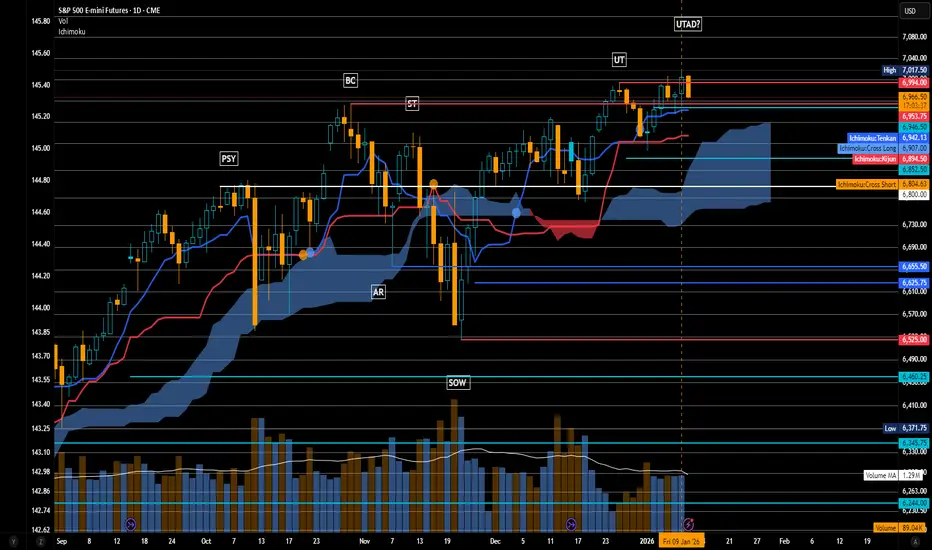
SPX/ES - Bayesian Market thesis 📊 SPX / ES — Bayesian Market Thesis (Academic Summary)
🎯 Objective
Frame current market conditions using a probabilistic research process, not directional prediction, with emphasis on regime identification and invalidation logic.
🧠 Research Methodology (High-Level Transparency)
Our process integrates multiple, independent analytical domains into a single probabilistic view:
Probabilistic inference
We evaluate competing market regimes and assign likelihoods that update as new information emerges.
Market structure analysis (Modern Wyckoff)
Focus on acceptance vs rejection, testing behavior, and transitions between accumulation, markup, distribution, and markdown.
Flow & derivatives context
Options-related positioning and transaction flow are used to understand how positioning may shape price behavior, not to forecast direction.
Classical technical structure
Trend quality, range behavior, and relative location within recent value are used as structural constraints.
These inputs are cross-validated. No single signal determines the thesis.
🧱 Current Structural Context (Wyckoff Lens)
Price is operating near upper range boundaries
Multiple high-area tests with reduced follow-through
Structure consistent with late markup transitioning into distribution risk
➡️ Upside continuation is conditional, not assumed.
📐 Bayesian Scenario Assessment
Probability-weighted view (dynamic):
Regime Probability Characteristics
🔴 Distribution / Downside Rotation ~60–65% Failed acceptance, rotational volatility
🟢 Bullish Continuation ~35–40% Requires sustained acceptance above highs
Probabilities adjust as price resolves uncertainty.
🚦 Invalidation Criteria (Bullish Reassessment)
The current thesis is invalidated only by structural confirmation, not isolated price excursions.
Required conditions:
Sustained acceptance above range highs
Higher high followed by a higher low holding above prior resistance
Expansion in range and follow-through consistent with demand-led control
Absent these, upside moves are treated as tests, not confirmations.
🧭 Interpretation Guidance
This is a location- and regime-based assessment
Elevated prices increase sensitivity to invalidation signals
Risk management outweighs conviction in late-cycle structure
🧩 Closing Note
This framework is designed to continuously update expectations, not predict outcomes.
Markets resolve uncertainty first — direction follows.
Optionsflows
Despite some wiggles and shakes, SPX may disappoint this weekPrimary Chart: SP:SPX chart on a daily time frame with a key options-OI level (relating to JPM's quarterly collar) as well as a couple crucial VWAPs to monitor for this week. Support and resistance for the week are shown in blue horizontal lines.
SPX may trade within a modest range this week unless spooked by aggressive Fed officials' commentary, or encouraged by Fed officials watering down their hawkish views from the FOMC statement and SEP dot plot given on June 14, 2023.
Since the mid-June 2023 high in SPX, price has largely trended modestly lower into the 4300s again. It has remained below the anchored VWAP from this mid-June peak. This is a helpful level to watch for resistance for not only this week (which this post addresses) but also next week and into July.
For now, support lies directly at the large options level of 4320 (which has significant call gamma) which is JPM's short-call strike of its quarterly collar. That collar will be rolled on Friday according to options and vol experts who carefully track this information.
The weekly expected move from a leading brokerage is given at 57 points approximately. This equates to a range of 4291 to about 4405. The 16-delta calculation for the weekly expected move is a little wider, showing an expected move range of $4278–$4410. One other calculation using IV for the June 30 expiration is somewhat wider than the other two ranges at 4260-4428.
Even the volume profile seems to coincide with the expected-move range.
Supplementary Chart A:
Why use these expected move figures this week? They're not perfect, but neither is TA, and sometimes they may help especially at a time when options hedging flows may dominate the action—unless the Fed really does something inconsistent (which could push prices a bit farther than expected) or the Prigozhin / Putin saga isn't as resolved as it appears (completely unknown). This is no different from any other week where unknown black-swans often lurk, especially on social media, but almost never materialize.
So directional traders may be largely disappointed if price remains neutral. However, directional traders with efficiency and nimble precision may find opportunities at the edges of intraday or weekly ranges provided they can be patient for the setups with confirmation and risk management. This is not a recommendation to do so, however, as rangebound markets sometimes are best left alone. Remember the famous trading line about a time to go long, a time to go short, and a time to go fishing (or some other diversion). In any event, the best hope for an edge in trading such markets short term is to trade from the edge (major support and resistance for any range) once price stalls and appears to confirm a reversal. In short, though, the money makers will be the premium sellers in all likelihood for this week.