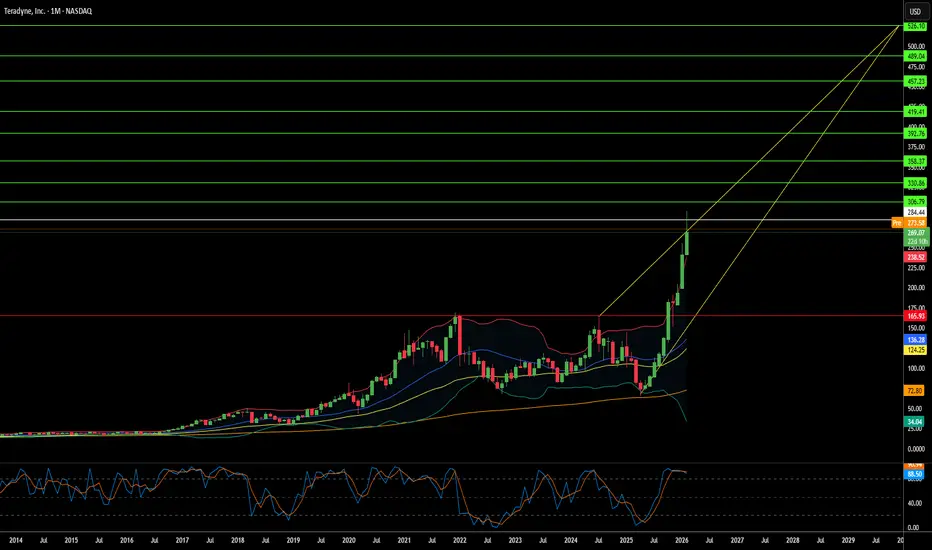
Can a Testing Company Become AI's Hidden Infrastructure?Teradyne has executed one of the semiconductor industry's most dramatic strategic pivots, transforming from a mobile-centric testing company into a dominant force in AI infrastructure validation. With artificial intelligence now driving over 60% of total revenue as of late 2025, the company has positioned itself at the critical junction where cutting-edge chips meet real-world deployment. Management's newly introduced "evergreen" earnings model targets $6 billion in annual revenue and non-GAAP earnings per share between $9.50 and $11.00, reflecting not just incremental growth but a fundamental business model transformation. The Q4 2025 results underscore this shift: record-breaking revenue of $1.083 billion, 41% sequential growth, and 44% year-over-year expansion driven almost entirely by AI tester demand.
The company's technical moat extends far beyond traditional automated test equipment. Teradyne's UltraPHY 224G solution addresses emerging 224 Gb/s data rates critical for next-generation AI clusters, while the Magnum 7H tester targets the upcoming HBM4 memory cycle—a market where testing intensity is 10x that of standard DRAM. The newly formed joint venture with MultiLane positions Teradyne to capture the high-speed interconnect testing market from wafer to data center, moving the company closer to hyperscale infrastructure budgets. Meanwhile, the robotics division is pivoting toward "Physical AI," integrating deep learning models into collaborative robots that adapt to dynamic environments rather than following rigid pre-programmed paths. A strategic Detroit manufacturing hub will support threefold expansion with major e-commerce customers in 2026.
Geopolitical headwinds remain manageable but require vigilant navigation. While China historically represented 25-30% of revenue, the Trump administration's shift from "presumption of denial" to "case-by-case" reviews for advanced computing exports provides regulatory flexibility. However, 25% tariffs on advanced semiconductor components passing through U.S. facilities complicate global supply chains. Teradyne's formidable patent portfolio, comprising over 5,000 patents across 30 jurisdictions, serves as both legal armor and a technological deterrent. The strategic use of Track One rapid examination and Non-Publication Requests helps maintain a competitive advantage. The partnership with TSMC, recognized through the 2025 OIP Partner of the Year award, reinforces leadership in chiplet and 3D stacking methodologies essential for HBM4 and UCIe architectures.
The investment thesis centers on structural market positioning rather than cyclical momentum. Teradyne commands 50% market share in "XPU" testing and targets 30% in GPU testing as merchant GPU customers scale production. While customer concentration (particularly Apple ecosystem exposure), institutional selling pressure, and the inherent "lumpiness" of AI infrastructure spending present near-term risks, management's Q1 2026 guidance of $1.15-$1.25 billion revenue signals a sustained trajectory. The convergence of silicon photonics, HBM4 memory walls, and Physical AI robotics creates multiple expansion vectors. For investors willing to accept premium valuation multiples, Teradyne represents not merely a beneficiary of AI spending but an essential architectural layer enabling the transition from research to production-scale deployment.