Is SanDisk Building the Foundation for the AI Economy?SanDisk Corporation (NASDAQ: SNDK) has emerged from its February 2025 spin-off from Western Digital as a pure-play flash memory powerhouse perfectly positioned for the AI infrastructure boom. The company's stock has surged toward $230 per share, with Morgan Stanley projecting targets as high as $273, driven by a rare convergence of technological innovation, geopolitical maneuvering, and macroeconomic tailwinds. The separation unlocked significant shareholder value by eliminating the conglomerate discount, allowing SanDisk to pursue an aggressive strategy focused exclusively on flash memory. At the same time, the hard disk drive business operates independently.
The company's BiCS8 technology represents a breakthrough in 3D NAND architecture, utilizing CMOS Bonded to Array (CBA) design that achieves 50% higher bit density and I/O speeds reaching 4.8Gb/s—critical capabilities for AI training and inference workloads. This technological leap, combined with strategic manufacturing partnerships with Kioxia in Japan and a calculated divestiture of Chinese assets to JCET, positions SanDisk to navigate the US-China semiconductor conflict while maintaining access to critical markets. The NAND flash market is experiencing a structural supply shortage following years of underinvestment, with contract prices surging by more than 60% in some categories and manufacturers unable to bring new capacity online until late 2026 due to the 18-24-month construction timeline for advanced fabs.
SanDisk's financial performance validates this strategic positioning, with Q4 2025 revenue reaching $1.901 billion (up 8% year-over-year) and cloud segment revenue growing 25% annually to $213 million. The company achieved a net cash position of $91 million ahead of schedule while expanding non-GAAP gross margins to 26.4%. Enterprise SSDs like the 122.88TB SN670 UltraQLC and the PCIe Gen5 DC SN861 are displacing traditional hard drives in data center architectures, as AI workloads demand the density of HDDs combined with flash speed. The company is also pioneering High Bandwidth Flash (HBF) technology, which could offer petabyte-scale capacity at significantly lower costs than traditional High Bandwidth Memory (HBM), potentially revolutionizing AI inference economics and solidifying SanDisk's role as a critical infrastructure provider for the AI economy.
Sandisk
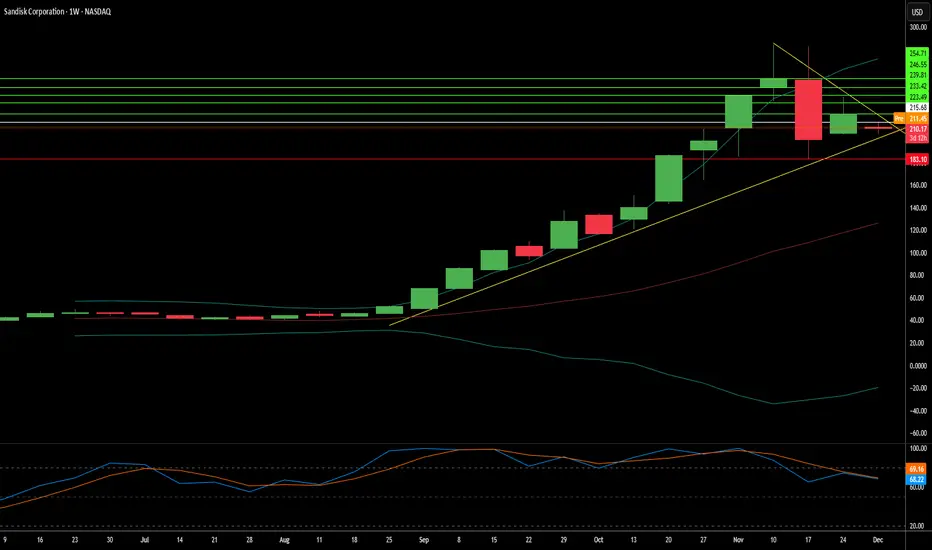
Sandisk Corporation ($SNDK) Jumps as Company Joins the S&P 500 Sandisk Corporation (NASDAQ: NASDAQ:SNDK ) delivered a strong performance as the stock closed at $223.28, gaining 3.83% on November 28. After-hours trading settled slightly lower at $222.99, yet the overall structure remains bullish. The momentum came as Sandisk officially entered the S&P 500, a major milestone only months after separating from Western Digital.
Fundamentals: S&P 500 Inclusion Sparks Heavy Interest
Sandisk’s addition to the S&P 500 triggered immediate enthusiasm. Shares spiked almost 11% during the morning session, driven by institutional positioning. Many funds tracking the index must now include SNDK, creating short-term buying pressure that typically follows S&P 500 entry.
The slot opened after Omnicom Group completed its acquisition of Interpublic Group. Sandisk now joins other recent index entrants born from corporate spinoffs, signaling a trend of newly independent tech companies gaining index-level recognition.
The excitement aligns with Sandisk’s explosive growth in 2025. Since its February spinoff, the stock has surged more than 500%, supported by soaring demand across the AI and cloud ecosystem. Companies building advanced AI models require high-speed, high-capacity storage, and Sandisk sits directly in that supply chain. With a market cap of $32.72 billion, the company is becoming a core player in data-intensive infrastructure.
Why This Matters for Investors
Index inclusion provides more than short-term flows. It lifts long-term visibility, attracts passive and active fund exposure, and reinforces confidence in Sandisk’s role in next-generation data architecture. With AI adoption accelerating, the company’s broader exposure to institutional capital arrives at a strategically perfect moment.
Technicals: Bullish Structure Intact
Price action shows SNDK holding firmly above the key $205–$210 support zone, confirmed on strong volume. Buyers defended the area during the recent pullback, keeping structure bullish.
Resistance: $284.52
As long as price stays above support with sustained volume, SNDK remains positioned for continuation.
$SNDK – “Last Man Standing” Short Setup After a 500% RunNASDAQ:SNDK – Last Strong Memory Stock Now Showing Cracks
NASDAQ:SNDK has been an absolute monster — up nearly 500% in just a few months — and it’s the last man standing in the memory-stock mania. But today, we finally have the first real sign of exhaustion.
🔹 The Setup:
This name has not closed below the 9 EMA for more than a day in months — pure trend monster behavior.
Today we’re printing a reversal candle with a long upper wick — the kind of signature you look for when a parabolic trend loses steam.
After such a massive run, even a normal retracement could be 20–30% down.
🔹 Sector Context:
Other memory names have already cooled off.
NASDAQ:SNDK is the last stronghold, and that’s usually the one that gets hit hardest when the tide finally turns.
When the leader cracks, the rest of the sector often unwinds together.
🔹 My Trade Plan:
1️⃣ Entry: Initiated a short in the mid-$260s.
2️⃣ Stop: Using today’s high of day — clean and tight.
3️⃣ Target: Looking for a sustained break below the 9 EMA, something we haven’t seen in months. First downswing could be brutal.
Why I Like This Short:
Reversal wick at peak extension.
Parabolic trend with no real pullback in months.
Sector softening while NASDAQ:SNDK is overstretched.
Clean stop, massive potential reward.
This is exactly the type of high-reward mean reversion trade I take after extreme exhaustion runs.
SNDK Bullish Continuation: Breakout Toward 285–305On the 1D chart, SNDK has shifted from months of range-bound trade into a powerful uptrend, with price riding well above the 20/60/120-day MAs in a classic bullish stack. Momentum is hot and volatility has expanded, but the market now faces near-term resistance at $270.91 (the latest swing high). The nearest structural demand sits around $185.00—the October “ledge” that launched the current leg.
Primary path: a decisive daily close above $271 confirms a breakout and resumes price discovery. If buyers hold that break, upside extension toward $285 is the first objective, with a continuation push into the $303–$305 area aligning with the recent measured move and psychological magnet. In this scenario, shallow retests of $270.91 turning into support would reinforce the trend.
If $270.91 rejects, expect digestion or a deeper fade before another attempt. A cooling phase could trap price between roughly $265–$270; a heavier unwind risks a drive toward $245 and even $225 if profit-taking accelerates. The bullish idea is invalidated on a daily close back below $185.00, which would mark a clear character change and open room for a broader correction toward the rising 20-day MA ($181.91).
This is a study, not financial advice. Manage risk and invalidations