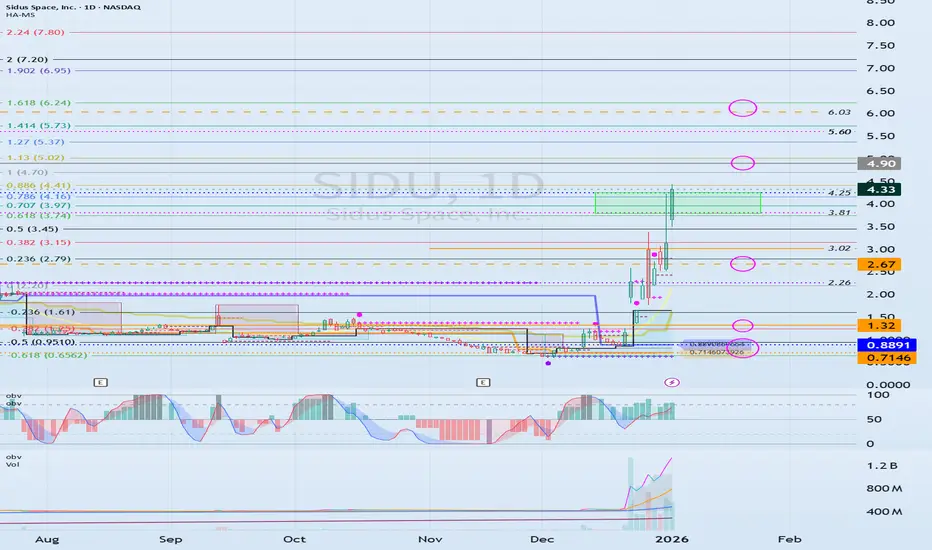
Can a $89M Company Execute on a $151B Defense Contract?Sidus Space (NASDAQ: SIDU) experienced a dramatic 97% stock surge following its selection for the Missile Defense Agency's SHIELD program, an Indefinite-Delivery/Indefinite-Quantity (IDIQ) contract with a staggering $151 billion ceiling. This represents an extraordinary valuation asymmetry—the contract ceiling is 1,696 times the company's current market capitalization of approximately $89 million. The SHIELD award validates Sidus's AI-enabled satellite technology as critical to America's "Golden Dome" missile defense strategy, positioning the micro-cap company alongside defense giants like Parsons Corporation to compete for task orders over the next decade.
The company's LizzieSat platform and FeatherEdge AI system address urgent national security needs, particularly the hypersonic missile threat from near-peer adversaries. By processing data at the edge in orbit rather than relaying it to ground stations, Sidus reduces the "kill chain" latency from minutes to milliseconds—a capability essential for tracking maneuvering hypersonic glide vehicles. The company's 3D-printed satellite manufacturing approach enables rapid 45-day production cycles, supporting the Pentagon's "Tactically Responsive Space" doctrine for quickly reconstituting destroyed assets in contested environments.
However, significant execution risks remain. Sidus currently generates under $5 million in annual revenue while burning approximately $6 million per quarter, with only $12.7 million in cash reserves as of Q3 2025. The company operates at negative gross margins and survives through dilutive equity raises. The SHIELD contract is not guaranteed revenue but rather a "hunting license" requiring successful competitive bidding on individual task orders. The path to profitability depends on winning sufficient task orders to achieve the scale needed to cover high fixed costs and transition to the high-margin Data-as-a-Service model. For investors, this represents a high-risk, asymmetric bet on whether a micro-cap can successfully navigate the "Valley of Death" to become a defense prime contractor.
SIDU
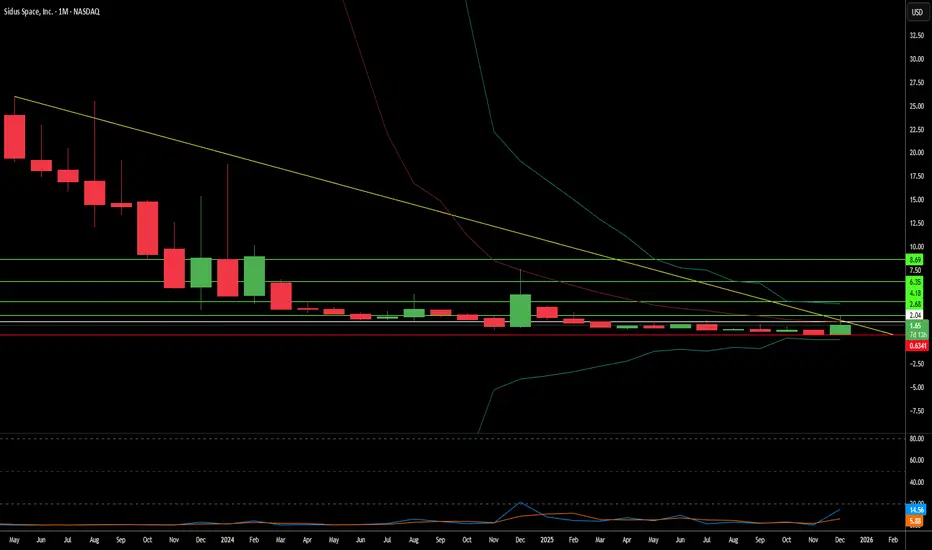
Sidus Space (NASDAQ: SIDU) – At a Critical CrossroadsSidus Space is currently trading at $1.71, placing it in a dangerous zone where it risks falling below NASDAQ's $1.00 minimum bid price requirement. The stock is now ranging between $1.10 and $2.00, with $1.10 as the last strong support level. If this level breaks, the company may face delisting risks, forcing management to take further action, possibly another reverse stock split to maintain compliance.
Previous Reverse Stock Split & Current Risks
On December 19, 2023, Sidus Space conducted a 1-for-100 reverse stock split to push its share price above the minimum threshold. While this action temporarily prevented delisting, the stock has since struggled to attract strong investor confidence. Without new contracts or institutional interest, the company may be forced to consider another reverse split.
Key Levels to Watch
Support Zone: $1.10 (last low) – Falling below this could trigger a downward move toward $1.00, raising the risk of non-compliance with NASDAQ rules.
Resistance Zone: $2.00 – If broken, this could allow Sidus to establish a more stable trading range and regain investor confidence.
Will Sidus Space Need Another Reverse Split?
The company’s future heavily depends on its ability to secure new contracts, attract investors, and demonstrate financial growth. Without positive catalysts, the risk of further stock price deterioration remains high. Investors should closely monitor upcoming earnings reports, strategic partnerships, and any signs of institutional support.
For now, Sidus Space is at a critical inflection point—either it strengthens its position through growth and investment, or it risks another drastic stock adjustment to maintain its NASDAQ listing.
Sidus Space Soaring with Tier 1 License and Satellite Launch
In a major leap forward, Sidus Space (NASDAQ: NASDAQ:SIDU ) has secured a crucial Tier 1 remote sensing license from the National Oceanic and Atmospheric Administration (NOAA). This significant milestone propels the space tech company into a pivotal position, allowing its LizzieSat satellites to capture and distribute Panchromatic (PAN) and Shortwave Infrared (SWIR) imaging data to both government and commercial clients. As the company gears up for the launch of these satellites in the first quarter of 2024 through the SpaceX Transporter-10 mission, NASDAQ:SIDU stock has witnessed an extraordinary surge, gaining almost 80% in a single day.
Positive Catalysts Driving SIDU's Momentum:
The recent surge in NASDAQ:SIDU stock is not solely attributed to the acquisition of the Tier 1 license; additional positive catalysts have played a crucial role in boosting investor confidence. The company's strategic positioning and impending satellite launch have fueled optimism, contributing to a staggering 200% surge since the beginning of the week. With NASDAQ:SIDU currently priced at $11 per share, there appears to be ample room for further growth.
Understanding the Tier 1 License:
The Tier 1 license bestowed upon Sidus Space marks a groundbreaking development for the company. This regulatory approval provides the green light for LizzieSat satellites to undertake PAN and SWIR imaging, enabling the collection and distribution of high-quality images and data. The implications are far-reaching, as the satellites are poised to support a diverse range of applications for both public and private sector clients.
LizzieSat Satellite Launch and SpaceX Partnership:
As part of the SpaceX Transporter-10 mission scheduled for the first quarter of 2024, Sidus Space is set to deploy its LizzieSat satellites into orbit. This strategic partnership with SpaceX positions Sidus as a key player in the rapidly evolving space industry. The four-year lifespan of the satellites presents a significant window of opportunity for Sidus to amass valuable data, aligning with the burgeoning global demand for satellite data services.
Market Potential and Growth Prospects:
The timing of Sidus Space's ascent couldn't be more opportune, considering the explosive growth projected for the satellite data services market. Industry analysts forecast a staggering $45.85 billion valuation by 2030, with a compound annual growth rate of 22.5%. NASDAQ:SIDU stock, trading at a fraction of its potential, appears poised to capitalize on this lucrative market and secure a substantial share of the data-as-a-service sector.
Conclusion
As Sidus Space rides the wave of positive developments, including the coveted Tier 1 license and the upcoming satellite launch, investors are increasingly drawn to the company's potential for explosive growth in 2024. With a strategic focus on meeting the demands of both government and commercial clients, NASDAQ:SIDU stock may well establish itself as a frontrunner among the nation's leading space stocks. As the space tech industry continues to evolve, Sidus Space appears to be positioned for a breakout year that could redefine its role in the dynamic landscape of satellite data services.